Montfort Castle in Dordogne: A Medieval Stronghold in Vitrac
Site at a Glance
- Popularity
- High
- Country
- France
- Primary era
- Medieval
- Eras represented
- Medieval, Early Modern, Modern
- Civilizations
- French
- Site type
- Military
- Remains
- Castle
On this page11 sections
History
Montfort Castle is a medieval stronghold in Vitrac, Dordogne, France, first recorded in 866 under the Latin name Castrum de Monte Forti, roughly meaning “fortress of the strong mountain.” Its history is marked by successive sieges, shifts in lordship, and repeated rebuilding.
Early records and the Albigensian Crusade
In the early thirteenth century, Bernard de Casnac held Montfort along with Aillac and Castelnaud. A Cathar, he was a forceful leader during the Albigensian Crusade, a campaign against Catharism in southern France. Cathars belonged to a Christian religious movement condemned as heretical by the Catholic Church. Bernard was married to Alix de Turenne.
Simon de Montfort captured the castle in 1214, but Bernard took it back the following year. In 1216, an army led by the Archbishop of Bordeaux besieged and captured Montfort, then destroyed it.
Rebuilding and the Pons inheritance
After its destruction, Montfort and Aillac passed to Raymond IV, Viscount of Turenne, who rebuilt the castle. In 1251, part of the Turenne inheritance went to his daughter Hélis and her husband, Hélie de Rudel. Their daughter Marguerite inherited their lands, married Renaud III de Pons, and divided the inheritance among their three children.
In her 1289 will, Marguerite named her son Geoffroy V de Pons as heir to Montfort and other properties, as well as to her rights in the Viscounty of Turenne. As lord of Montfort and Aillac, Geoffroy exercised high justice, jurisdiction over serious crimes including capital cases, in six parishes. In 1309, the French king took away this authority because Geoffroy had supported the castle official at Carlux, who had sheltered people banished from France. A court ruling ordered Montfort burned and destroyed.
War, confiscation, and the return of Pons lordship
During the Hundred Years’ War, a series of conflicts between the English and French crowns, Montfort resisted sieges in 1404 and 1409. Its garrison abandoned the castle in 1441. Jacques I de Pons, a lord of the Pons family and a senior officer in the household of the future Louis XI, was convicted of high treason in 1449. He lost Montfort, Aillac, and Carlux to Pierre de Brézé and fled to Spain. In 1461, the accusations against Jacques were declared false and Louis XI pardoned him, but Jacques died in 1472 or 1473 without recovering all his lands.
Pierre de Brézé died at the Battle of Montlhéry in 1465, and his eldest son, Jacques de Brézé, inherited his titles. After Jacques murdered his wife, Charlotte de Valois, in 1477, he was arrested and imprisoned. On Louis XI’s orders, he was moved from the Conciergerie to guarded confinement at Vernon Castle. A 1481 sentence required him to pay 100,000 gold écus, and he was then imprisoned at Roche-Corbon. In October that year, he surrendered his lands to the king, including Montfort, Carlux, and Aillac. The king transferred them to Louis de Brézé, Pierre’s son. Charles VIII pardoned Jacques for the murder in 1486.
Also in 1486, Guy de Pons, son of Jacques I, regained Montfort, Carlux, and Aillac. The lordship later passed to Guy’s grandson, François II de Pons.
Sixteenth-century conflict and later ownership
On 22 February 1574, three days after Sarlat fell, French Protestants known as Huguenots, led by Geoffroy de Vivans, seized Montfort. The castle’s lord, Antoine de Pons, fought for the king. In 1586, residents of Sarlat asked the Duke of Mayenne’s army to attack and demolish the castle. François de Cazillac, Baron of Cessac, was sent to assess it, but no attack followed. The chronicler Tarde attributed the decision to the castle’s limited importance.
From 1214 to 1606, Montfort was destroyed and rebuilt five times. In 1606, the king ordered its demolition, but the order was not carried out. Gaston-Jean-Baptiste, Duke of Roquelaure, bought the castle in 1664.
Restoration and twentieth-century use
Jean Galmot owned Montfort from 1919 and continued its restoration. Jean Mercier bought it in 1921 and made it his family home in 1927. During wartime, Spanish guerrilla resistance fighters looted the castle and killed Mercier. His wife sold it in 1962.
Remains
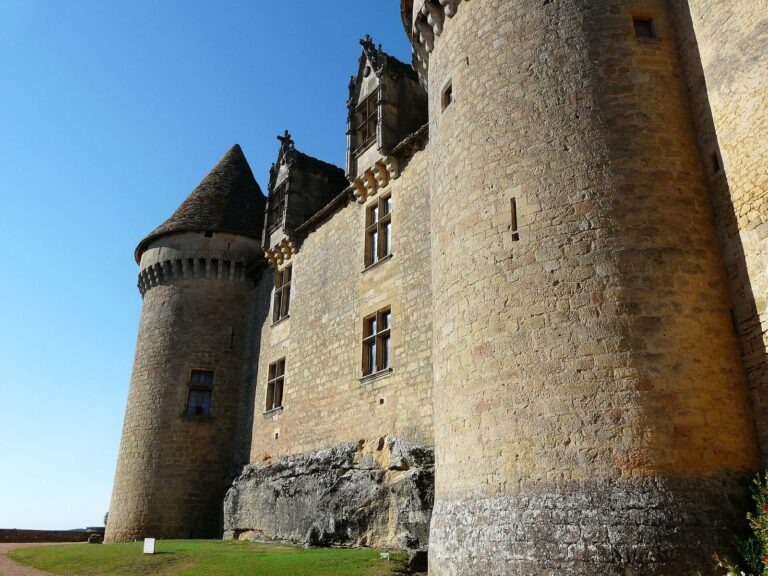
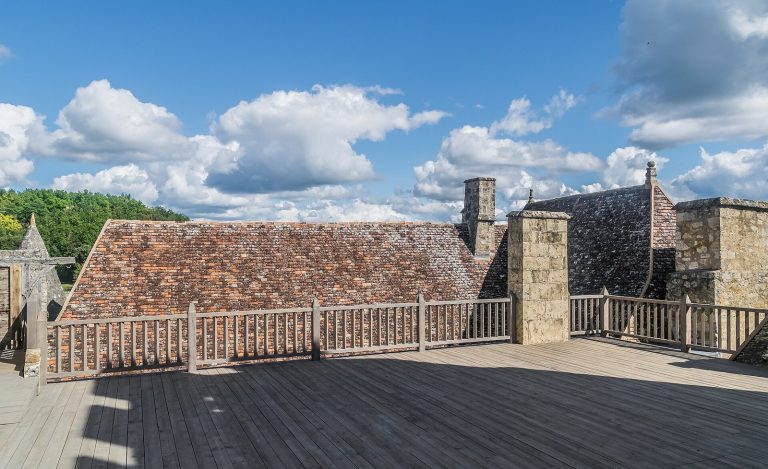
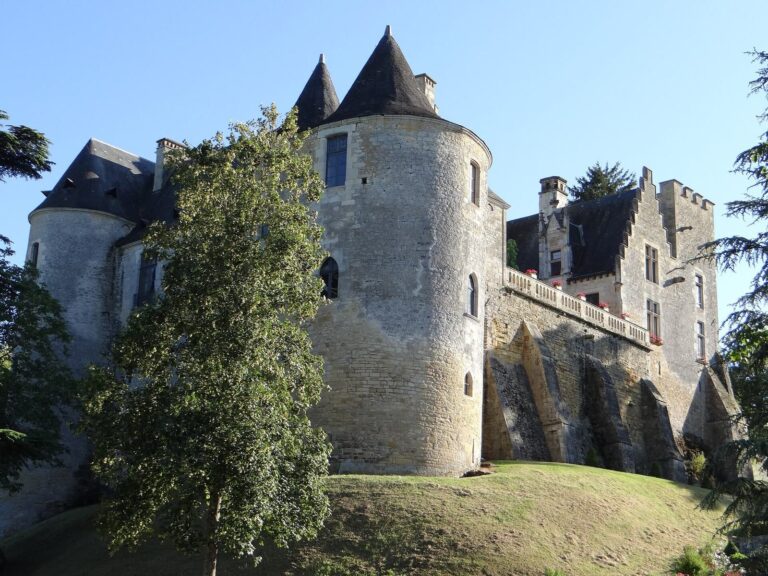
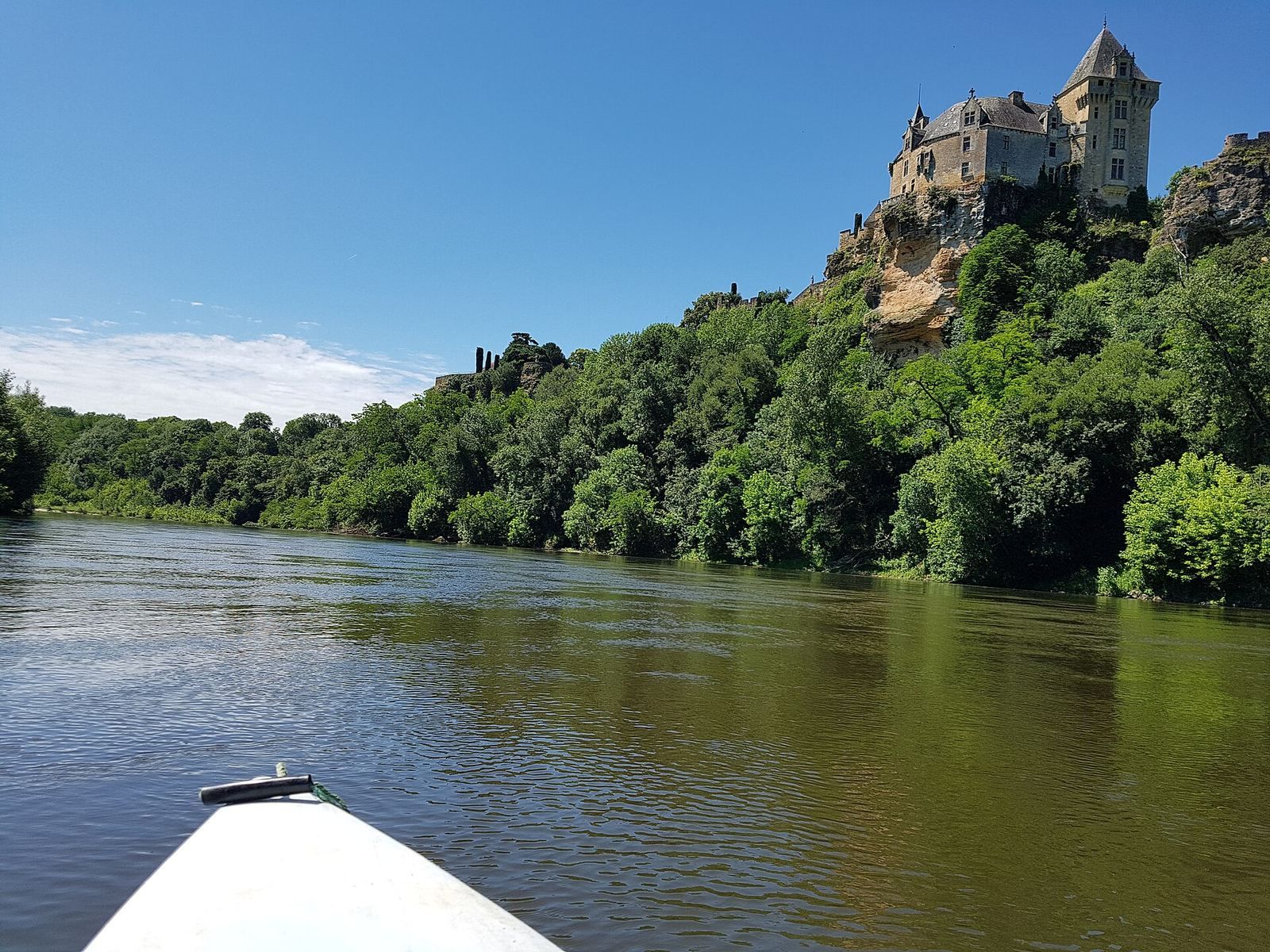
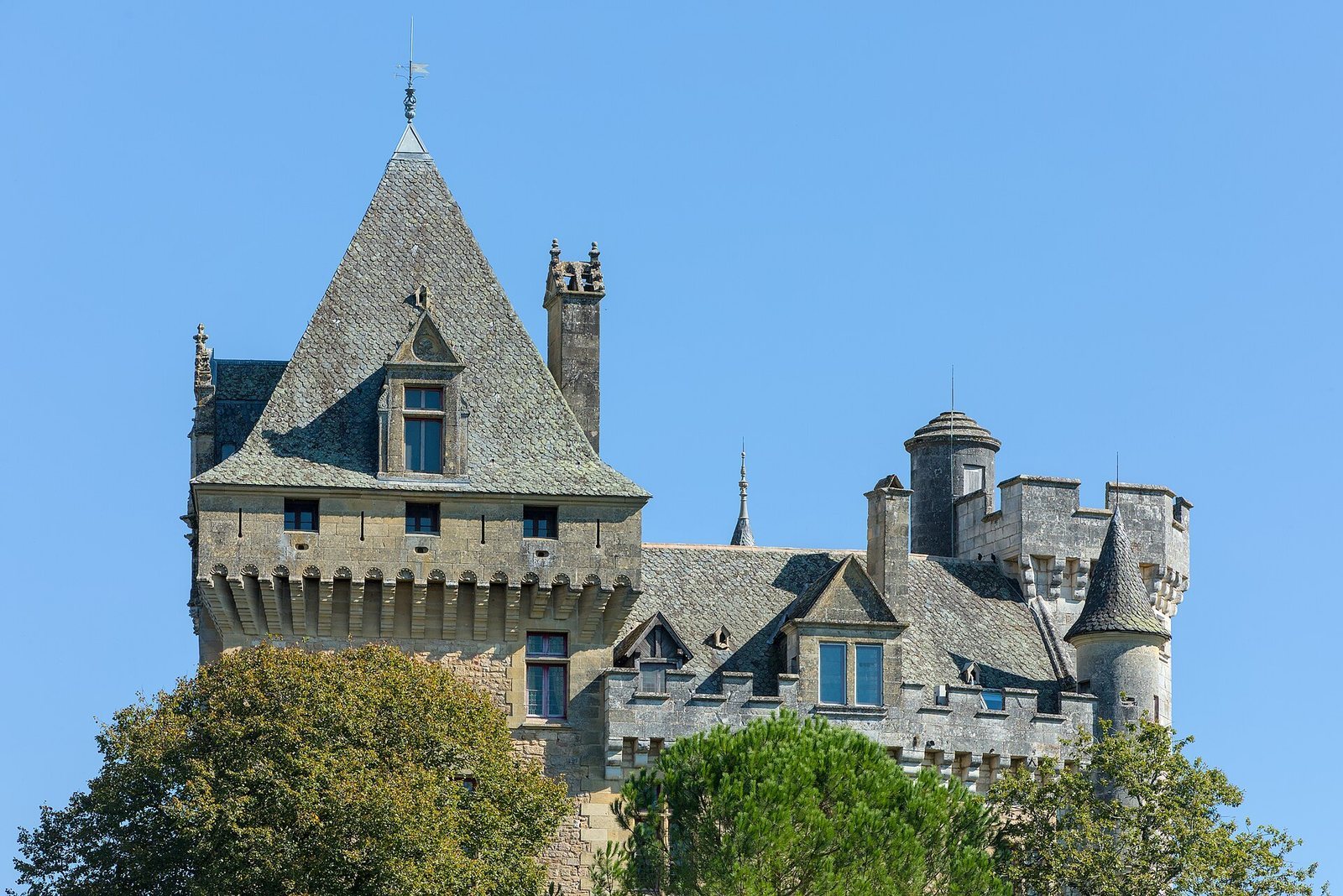
Montfort stands on a rocky escarpment above the Dordogne River. Its standing buildings date from the fourteenth and sixteenth centuries, and the castle is in good condition.
Architectural features
Fortified gate
A fortified gate forms part of the castle’s defenses.
Relocated tower
In the early twentieth century, the owner of Château des Chabannes at Sorges ordered two of its towers dismantled. One was re-erected at Montfort against the main residential building.
Saint-Vaast cloister elements
Columns and capitals, the shaped tops of columns, from the cloister of Saint-Vaast in Béthune were brought to Montfort in 1919. The cloister had been destroyed by German bombardment in 1918. The pieces were intended for a planned pergola, an open framework supported by columns.