Clegyr Boia: A Neolithic Settlement and Iron Age Enclosure in Wales
Site at a Glance
- Popularity
- Low
- Country
- United Kingdom
- Primary era
- Iron Age
- Eras represented
- Stone Age, Iron Age
- Civilizations
- Celtic
- Site type
- Domestic
- Remains
- House
On this page9 sections
History
Clegyr Boia is a prehistoric site with Neolithic settlement remains and an Iron Age enclosure on the St David’s peninsula in Wales, United Kingdom. Its Neolithic remains provide important evidence for a period of Welsh prehistory represented by few surviving structures.
Neolithic occupation
Cattle-farming people occupied the site during the Neolithic. Pottery from Clegyr Boia has been interpreted as evidence of connections with Ireland in the third millennium BC.
Radiocarbon tests conducted in 1973 on samples from the Neolithic occupation area produced a date of about 2,370 years before present, near the beginning of the La Tène period, an Iron Age cultural period in Europe. The National Museum of Wales considered these results unacceptable.
Iron Age enclosure
The enclosure is understood as a defended family farm rather than a hilltop fort. Radiocarbon samples collected near its entrance date to about 1 BC, in the late Iron Age.
Excavation and tradition
The English clergyman and antiquarian Sabine Baring-Gould excavated Clegyr Boia in the early twentieth century. Archaeologist Audrey Williams carried out further work in 1943 for the Ancient Monuments Inspectorate, the government body responsible for overseeing ancient monuments.
The Welsh word clegyr means “rock,” and the name is traditionally linked to Boia, a sixth-century leader of Irish descent. In the medieval Life of David, Boia is an opponent of Saint David, the patron saint of Wales. A historical connection between Boia and the site has not been established. Clegyr Boia is a scheduled monument in Wales.
Remains
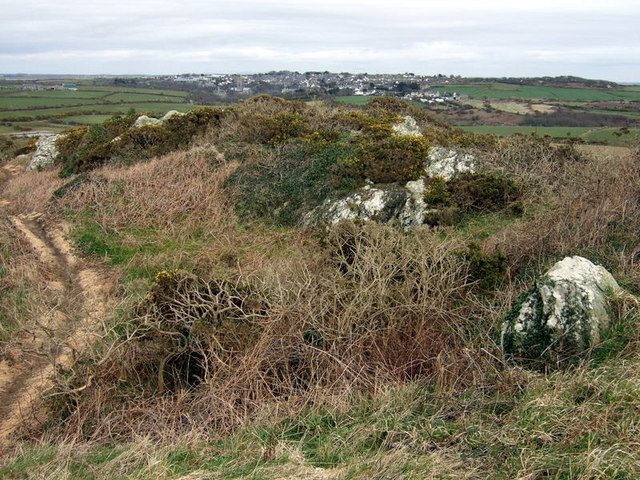
The remains occupy a rocky outcrop that rises about 10–20 m above the surrounding land. The site is roughly a mile west of St Davids and three-quarters of a mile east of the Pembrokeshire coast. Ffynnon Lygaid, a spring-fed pool in a hollow near the outcrop’s southern base, is about 30 cm deep and measures roughly 30 by 20 cm. The outcrop’s steep sides were reinforced by a single earthen rampart, with a rectangular enclosure on its southern part.
Neolithic settlement
Dwellings
Excavations revealed traces of both circular and rectangular dwellings, including a substantial rectangular house. Deposits of charcoal indicate that fires were used and carefully managed.
Midden and finds
A midden, or refuse deposit, dates to about 5,500 years before present, using 1950 as the reference point for “present.” Finds from the site include fragments of round-bottomed Neolithic pottery, polished stone axes and animal bones. The axes may have originated in the Preseli Hills to the north. Baring-Gould considered that the pottery might have been wheel-turned.
Iron Age enclosure
The roughly rectangular enclosure measures about 85 by 30 m. Its walls combined rubble and earth, with large slabs set upright along the outer faces and stone blocks reinforcing the walls. The walls were about 2.7–4.6 m wide and stood roughly 1 m above the enclosure floor. The entrance may have been approached through a tunnel. Baring-Gould recorded that the original enclosure surface lay about 1 m below the level measured in 1903.