Lepreon: Ancient City and Regional Capital of Triphylia
Site at a Glance
- Popularity
- Medium
- Country
- Greece
- Primary era
- Classical
- Eras represented
- Bronze Age, Classical
- Civilizations
- Ancient Greek, Mycenaean
- Site type
- City
On this page15 sections
History
Lepreon was an ancient Greek city-state in Triphylia, southern Elis, Greece. It became the district’s leading city and effective regional capital, prospering during the Classical and Hellenistic periods. Its origins are uncertain, and traditions offer different accounts of its founders and name.
Early settlement and traditional origins
The area was inhabited from the Neolithic period, with settlements in the Early and Middle Helladic phases of Bronze Age Greek prehistory and in the later Mycenaean period. Lepreon has also been proposed as the Homeric city of Aepy, though the identification remains uncertain.
Stories about the city’s foundation name Lepreus, son of Pyrgeus, or Leprea, Pyrgeus’s daughter; another tradition makes Lepreus a nephew of Augeas, the legendary king of Elis. Explanations for the name include a supposed outbreak of leprosy among the first inhabitants and an association with a temple of Zeus Leukaios, a title translated as “of the white poplar.” Lepreon may have taken shape through synoecism, the political joining of separate settlements into one community. Proposed dates for this consolidation range from the late sixth or early fifth century BC to about 460 BC.
Greek tradition held that the Caucones lived in Triphylia before the Minyans displaced them and founded Lepreon. The city was one of six in the region attributed to the Minyans. After the Messenian Wars, Lepreon and other Triphylian cities came under Elean rule. The Triphylians also claimed an Arcadian identity and repeatedly resisted Elis. Lepreon was the only Triphylian city to take part in the Greco-Persian Wars, sending 200 heavily armed infantrymen, known as hoplites, to the Battle of Plataea in 479 BC.
Disputes with Elis and Sparta
During a conflict with Arcadian communities, Lepreon offered half its territory to Elis in exchange for help. After the fighting, the Eleians let the Lepreans remain on their land in return for an annual payment of one talent to Zeus at Olympia. Lepreon continued paying until the Peloponnesian War, when it refused to make further payments.
In 421 BC, Sparta arbitrated a dispute between Elis and Lepreon and judged that the Eleians had acted aggressively. Elis rejected the decision, so Sparta placed a military garrison in Lepreon. That year, Sparta also settled helots, an unfree population, and neodamodes, freed helots with military service, in the city. They had served under the Spartan commander Brasidas, and their settlement lay on the frontier between Laconia and Elis. It has been suggested that some Lepreans opposed the independence imposed with Spartan backing and left for Elis, allowing the settlers to occupy their land.
The quarrel continued during the 90th Olympiad. Elis barred Sparta from the Olympic Games and sacrifices after the Spartans failed to pay a fine of 200,000 drachmas. The fine followed a Spartan attack on the fortress of Phyrcus in Leprean territory and the dispatch of 1,000 hoplites to Lepreon during the Olympic truce, an agreement meant to protect travel to and participation in the games. Elis offered to cancel the fine if Sparta returned Lepreon. When Sparta refused, the Eleians proposed that it swear at Zeus’s altar at Olympia to pay later. Sparta rejected this offer too, and the exclusion remained in force.
After a four-month truce between Athens and Sparta ended in 418–417 BC, the Eleians planned to seize Lepreon. The Mantineans, meanwhile, proposed attacking Tegea. Athens and Argos supported the Mantinean plan, and the Eleians withdrew. In 401 BC, the Spartan king Agis II invaded Elis, and Lepreon broke from Elean rule to join him. Around 400 BC, Elis gave up its claim to Triphylia under an agreement with Sparta.
Leagues and changing rule
After Sparta’s defeat at Leuctra in 371 BC, the Spartans tried to regain control of Triphylia. The Triphylians instead joined the Arcadian League, a federation of Greek communities, and Lepreon became a member. It was probably Triphylia’s principal city at this time, although its precise position in the region’s united political organization is uncertain.
After the time of Alexander the Great, Elis again brought the Triphylian cities under its control, and Lepreon joined the Aetolian League alongside Elis. During Philip V of Macedon’s war against the Aetolians, Lepreon rebelled against its Elean garrison and sided with Macedon. It later joined the Achaean League. Rome defeated that federation in 146 BC, after which Lepreon was incorporated into Elis.
Late antiquity and the medieval period
When the Greek travel writer Pausanias visited around AD 170, Lepreon had declined but was still inhabited and regarded as Triphylia’s capital. The city was abandoned sometime between the eighth and tenth centuries, following raids by pirates and other raiders. The surrounding area remained inhabited into the Byzantine period and was later resettled. The modern village of Lepreo was called Strovitzi until 1916, and the ancient site was excavated in 1982.
Remains
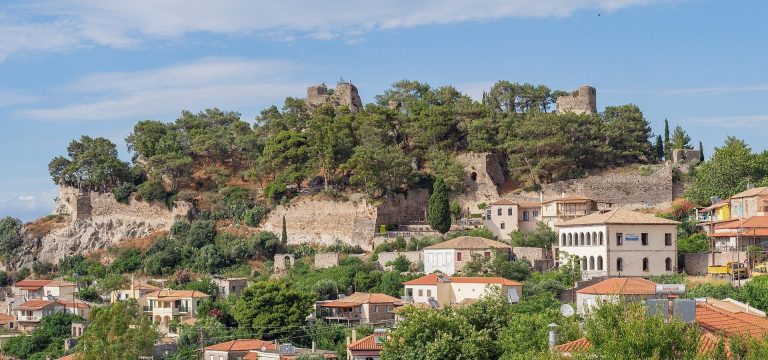
The ancient city occupied the hills and ground around the modern village of Lepreo, at the western end of Mount Minthi and about seven kilometres from the coast. Its acropolis, the fortified high point of a Greek city, stood on the hill north of the village. A prehistoric settlement occupied Agios Dimitrios, a nearby hill to the southeast, while the lower city extended between the two hills in the area of the present village. The principal remains include fortifications, temples, and traces of settlement from several periods.
Acropolis and fortifications
Walls and entrance complex
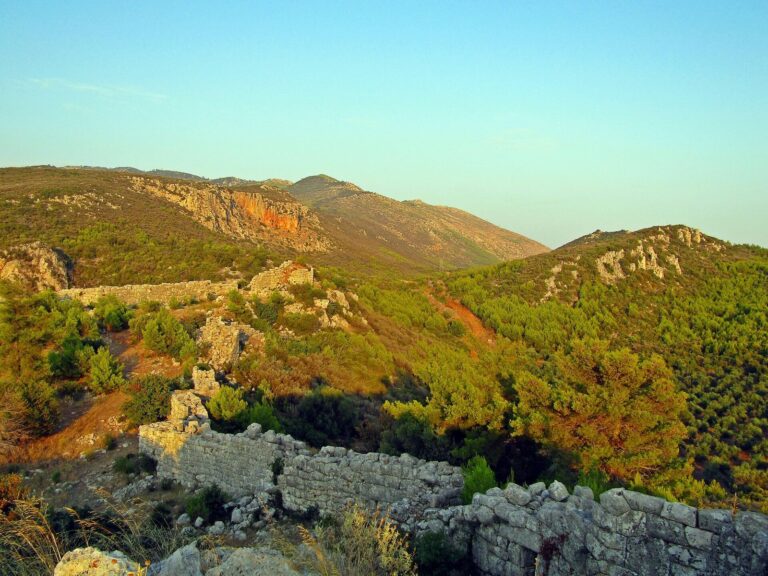
The acropolis was enclosed by city walls and had several towers. The oldest surviving wall sections date to the fourth century BC, while most of the visible fortification remains are Hellenistic. A substantial entrance-and-tower complex survives at the northeastern approach. The lower city was fortified as well, though its wall has not been dated.
Temple of Demeter
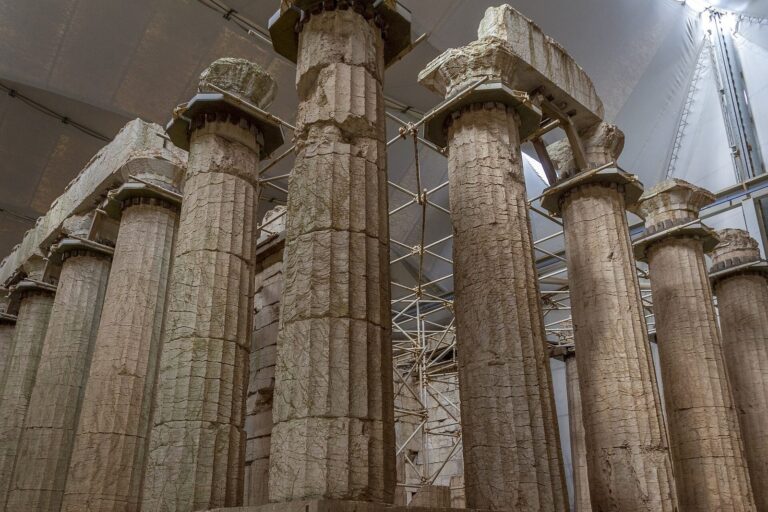
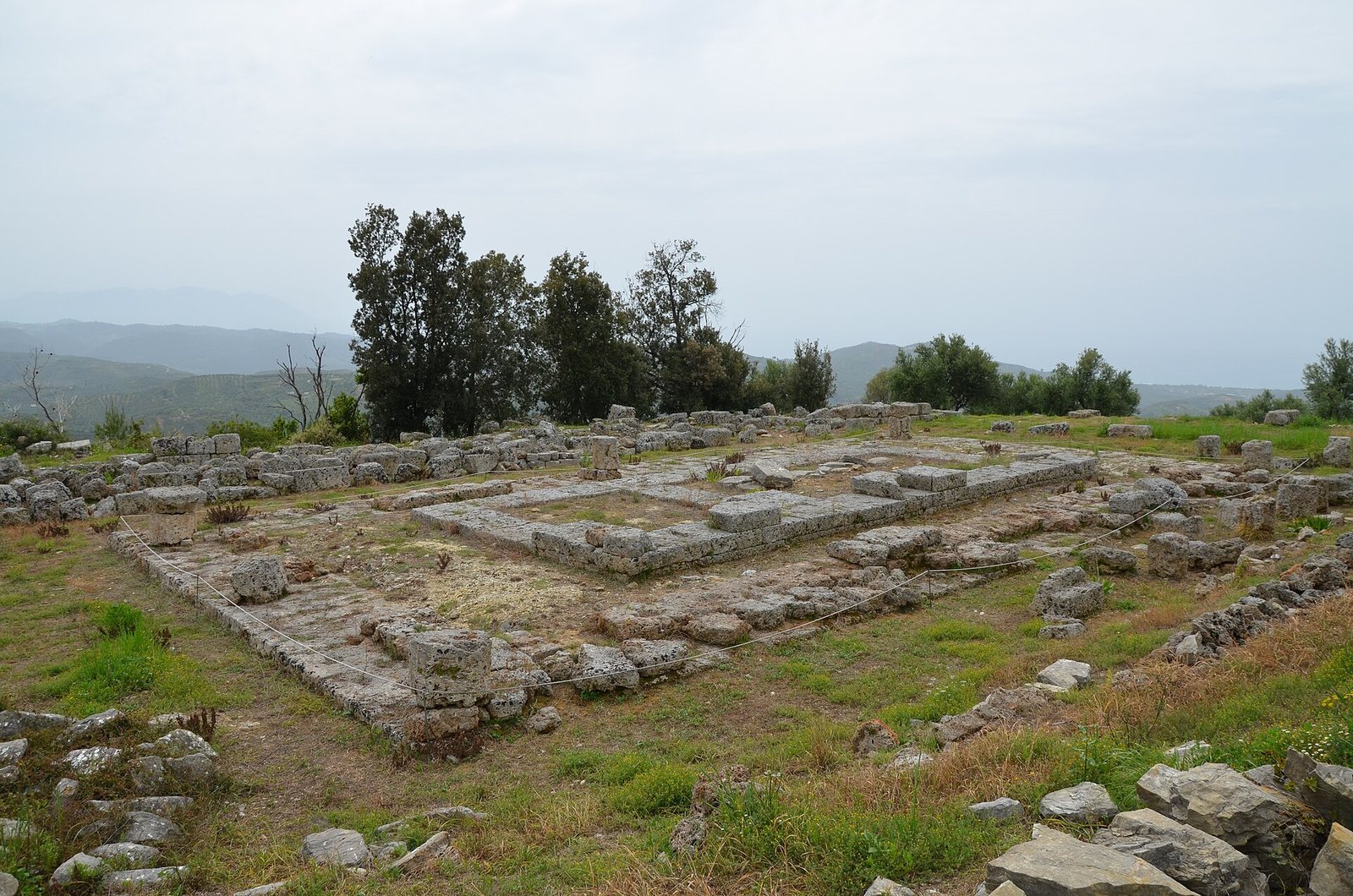
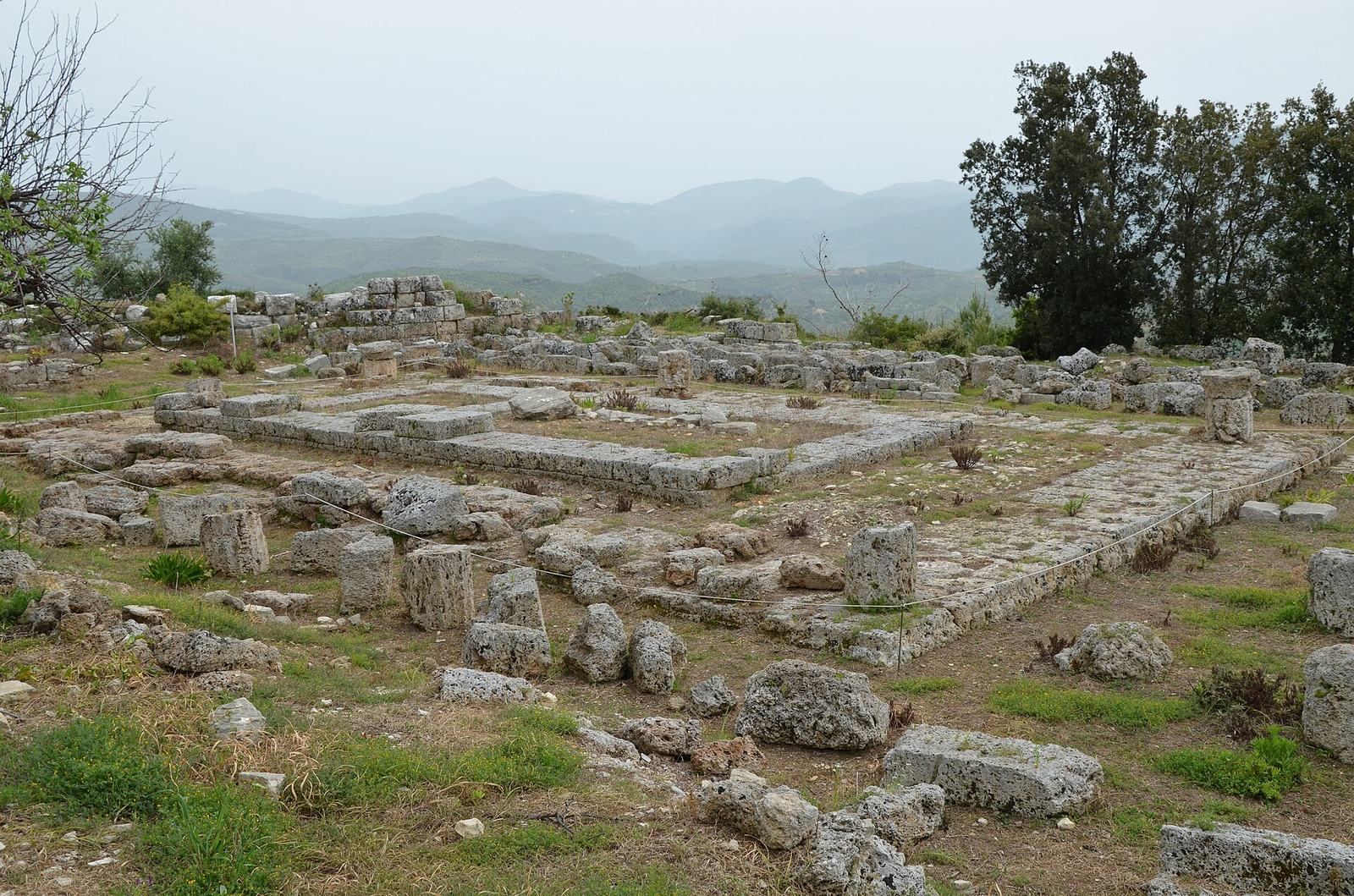
At the southern end of the acropolis are the remains of a Doric temple, one of the principal architectural styles of ancient Greece, dedicated to Demeter, the goddess associated with agriculture. The building dates to about 375–350 BC and appears to have replaced an earlier temple on the same site. It had six columns across its front and eleven along each side, as well as a pronaos, or entrance porch, and a naos, or inner sanctuary. Pausanias described the temple as built of mud brick and said it had no cult statue. Its altar stood in front and measured about 4.9 by 1.5 metres.
Other sacred and funerary remains
A second temple is identified as belonging to Zeus Leukaios, also called Lykaios, though it is uncertain whether it existed when Pausanias visited. Tombs attributed to Lycurgus and Caucon are also associated with the city.
Settlement beyond the acropolis
Prehistoric settlement on Agios Dimitrios
The settlement on Agios Dimitrios covered about 5,000 square metres. Houses had limestone foundations and mud-brick walls, with doors on their north sides, sheltered from strong southerly winds. Paved streets and pottery fragments from the Classical through Byzantine periods have also been found on the hill.
Lower city and surrounding landscape
The lower city lay between the acropolis and Agios Dimitrios, beneath the area occupied by the modern village. Remains have also been found on the acropolis slopes, and several graves have been discovered nearby. The spring of Arene and the Neda River are associated with Lepreon.
Temple at the Neda River
A limestone temple at the Neda River, in present-day Prasidaki, is believed to have belonged to Lepreon. Dedicated to Athena Agorea, a title linking the goddess with the public marketplace and civic gathering place, it was built in the late Classical period over an earlier Archaic temple.
Inscriptions
Lepreon’s name was inscribed on the statue of Zeus at Olympia and on a tripod at Delphi.