Colophon: An Ancient Greek City-State in Ionia
Site at a Glance
- Popularity
- High
- Country
- Turkey
- Primary era
- Classical
- Eras represented
- Iron Age, Classical
- Civilizations
- Ancient Greek, Roman
- Site type
- City
On this page15 sections
History
Colophon was an ancient Greek city-state near present-day Değirmendere in Turkey. It stood in Ionia, the Greek-speaking region of western Asia Minor, and was one of the twelve members of the Ionian League, a confederation of Greek cities. It was probably among the league’s oldest members. Its founding date is uncertain, but the city existed by about 700 BCE. Its name came from a Greek word for “summit,” associated with its position on a ridgeline.
Origins and early power
Several traditions offer different accounts of Colophon’s beginnings. One names Andraemon as founder, while another credits Mopsus. In a longer story, the Cretan leader Rhacius reached Claros, where Carians lived, married the prophetess Manto, and had a son, Mopsus. Mopsus drove the Carians from the area, and Ionians later joined the Greeks already living there. Another account names Damasichthon and Promethus, sons of the legendary Athenian king Codrus, as founders or rulers. Promethus killed his brother and fled to Naxos. Colophon may also have been founded from Pylos. One proposed foundation date lies near the end of the second millennium BCE, but the city’s origins remain uncertain.
Colophon was wealthy and influential, famed for its horses and compared in prosperity with Sybaris. A tradition tells that political exiles from Colophon took control of Smyrna, then an Aeolian settlement, around 700 BCE while its residents celebrated a festival outside the city. An agreement allowed the original inhabitants to leave with their possessions. The story explains Smyrna’s change from Aeolian to Ionian control, although it may instead describe events at Notion, Colophon’s port.
In the seventh century BCE, the Lydian king Gyges brought Colophon under Lydian control. The conquest may have destroyed the city, and Colophonian emigrants probably founded Siris in Magna Graecia, the Greek-settled regions of southern Italy. From about the 540s BCE, Colophon was ruled by Persia and later joined the Ionian Revolt, an uprising of Ionian Greeks against Persian rule.
Persian and Athenian periods
In the fifth century BCE, Colophon belonged to the Delian League, an alliance led by Athens. It appears in the league’s tribute records from 454/453 to 416/415 BCE. During the Peloponnesian War, the late fifth-century BCE conflict among Greek states, Persian forces gained control of Colophon around 430 BCE amid divisions between pro- and anti-Persian factions.
Anti-Persian Colophonians took refuge at Notion, where a pro-Persian faction also formed. In 427 BCE, the Athenian commander Paches intervened at the request of the anti-Persian group, expelled its opponents, and handed Notion to anti-Persian Colophonians. Athens later sent settlers there and gathered other displaced citizens, creating a community known as “New Colophon.” Its location is uncertain: it may have been at Notion or elsewhere on the nearby coast. Colophon remained allied with Athens until the Ionian cities revolted in the war’s final years. Around 408 BCE, an Athenian army led by Thrasyllus captured the city.
Government and cultural reputation
Colophon’s government changed over time. It was oligarchic during at least part of the fifth century BCE, though wealth requirements still allowed most citizens political rights. The city had a popular assembly and a council, and it was democratic in 420 BCE. Democracy returned from about 334 BCE onward. Colophon’s constitution was included in a collection of the constitutions of 158 cities associated with Aristotle’s school.
The city was celebrated for its navy and especially its cavalry. The geographer and historian Strabo linked the cavalry’s reputation, said to secure victory for whichever side it served, with the expression “to put the finishing touch on something.” Another explanation connected the expression to Colophon’s supposedly decisive vote when the Ionian League was tied, a power said to derive from the city’s reception of Smyrna’s inhabitants. Colophon also claimed to be one of the possible birthplaces of Homer.
Colophon was the birthplace of the elegiac poets Mimnermus and Hermesianax, the musician Polymnestus, the poet Phoenix, the epic poet Antimachus, the philosopher Xenophanes, the painter Apelles, and the poet Nicander. At least three ancient Olympic victories were credited to athletes from the city. The wrestler Hermesianax, probably not the poet of the same name, received a statue from the community; his grandson Icasius also won an Olympic wrestling event.
Epicurus lived at Colophon for about ten years, from 321 to 311 BCE. His family had been expelled from Samos and sent there by Perdiccas, one of Alexander the Great’s leading commanders and successors, after Alexander’s death. Epicurus joined them after completing military service in Athens.
Local traditions also connected Colophon with prophecy and religious practice. The seer Calchas was said to have died after losing a divination contest to Mopsus, son of Apollo and Manto; accounts placed the event either at Colophon or at Claros. Herodotus said that Colophonians and Ephesians did not celebrate the Apaturia, an ancient Greek festival, because of an accusation of murder. Colophonians also sacrificed puppies at night to Enodius, a deity associated with roads. The Spartans performed a similar sacrifice to Enyalius, a war deity.
Macedonian rule and the shift to Notion
Colophon regained its freedom from Persia during Alexander the Great’s conquests. In the third century BCE, Lysimachus, another of Alexander’s successors, destroyed Colophon and nearby Lebedos and transferred their inhabitants to Ephesus. Colophonians continued to resist him there. A re-establishment of Colophon after Lysimachus’s death in 281 BCE is recorded, followed by Seleucid rule, but the city did not recover its former importance.
Notion, the port south of Colophon, increasingly became the main settlement associated with the Colophonians. The name Colophon came to be used for Notion, while the older inland city lost prominence. In 190 BCE, the Seleucid king Antiochus III unsuccessfully besieged Notion. Colophonians who remained there received exemption from taxes for their alliance with Rome. A later reference by the Roman writer Cicero to pirates plundering Colophon concerned Notion, then the principal city of the territory. The name Colophon briefly appeared on coinage again under the Roman emperor Trajan.
Christian and modern history
A Christian bishopric at Colophon is traditionally associated with Sosthenes and Tychicus. The bishop Eulalius, also known as Euthalius, attended the Council of Ephesus in 431 CE. Alexander was represented at the Council of Chalcedon in 451 CE but did not attend in person. Colophon continued to appear as a bishopric subordinate to Ephesus in lists into the twelfth or thirteenth century. It is now a Catholic titular see, an episcopal title without an active residential diocese.
Archaeological investigations began in 1911 and continued through 1925. American, Austrian, and Turkish archaeologists, including the American School of Classical Studies at Athens, undertook further work in the 2010s.
Remains
The city lay on a ridgeline about 15 kilometres inland from the Aegean coast and roughly 40 kilometres south of Smyrna. The Halesos River, also called Hales or Ales, flowed beside it and was known for its cool water. The city’s port, Notion, lay to the south, on a route linking Smyrna with Ephesus. Colophonia, the fertile territory controlled by Colophon, is estimated to have covered roughly 200 to 500 square kilometres; its western boundary met the territories of Teos and Clazomenae. The nearby Gallesos Mountain had extensive pine woods.
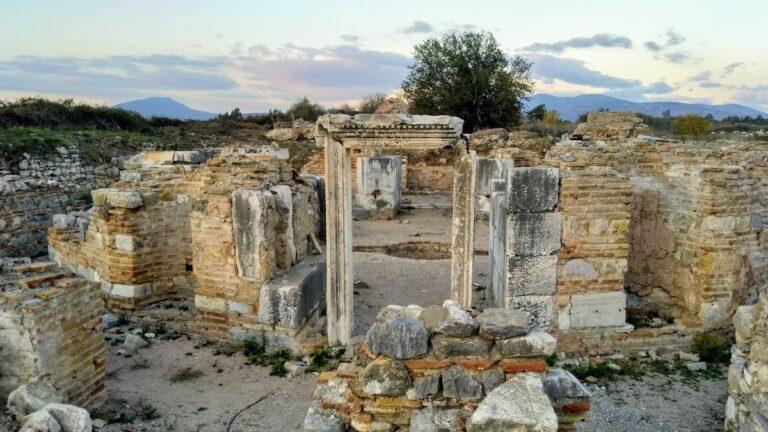
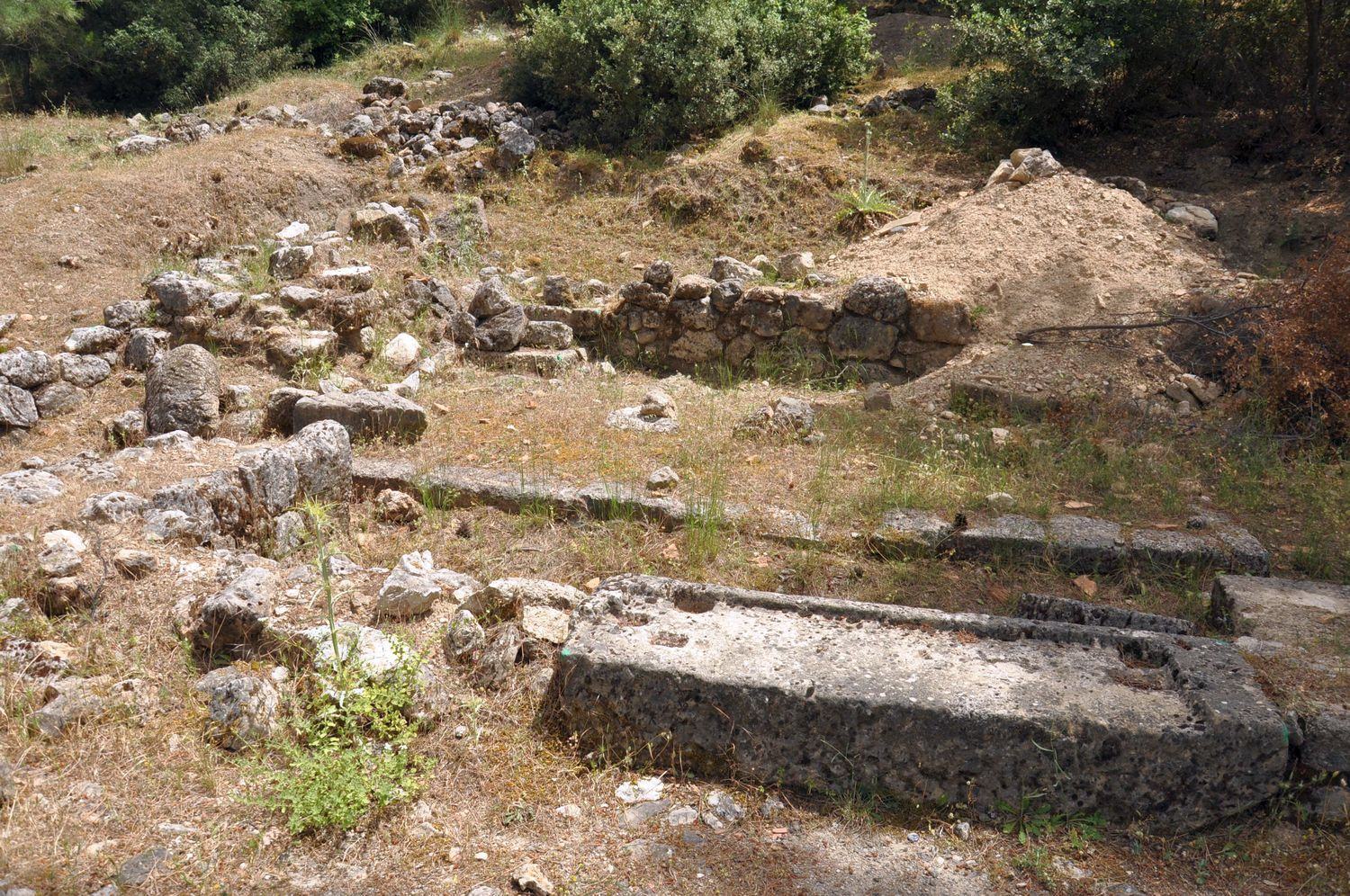
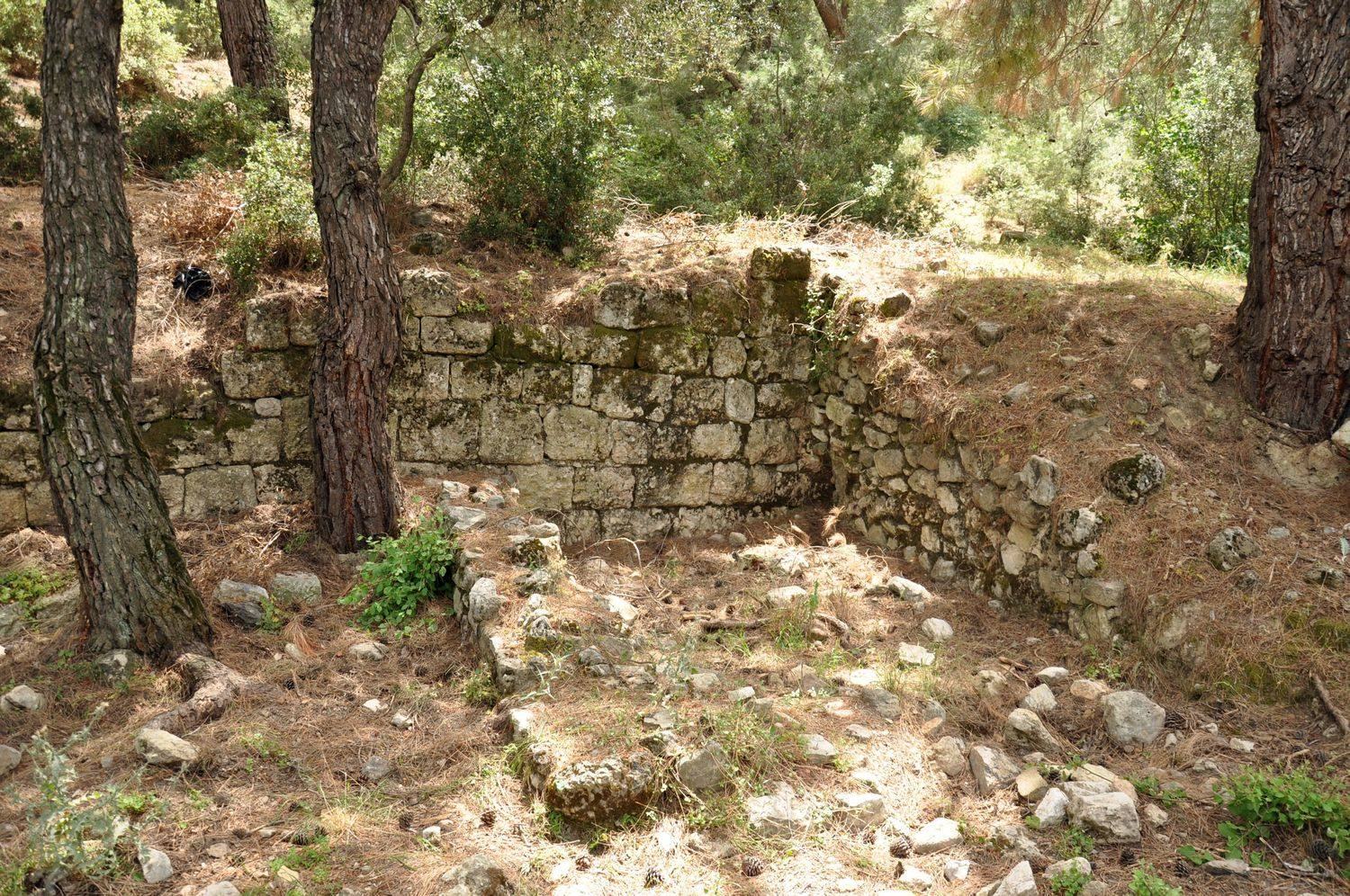
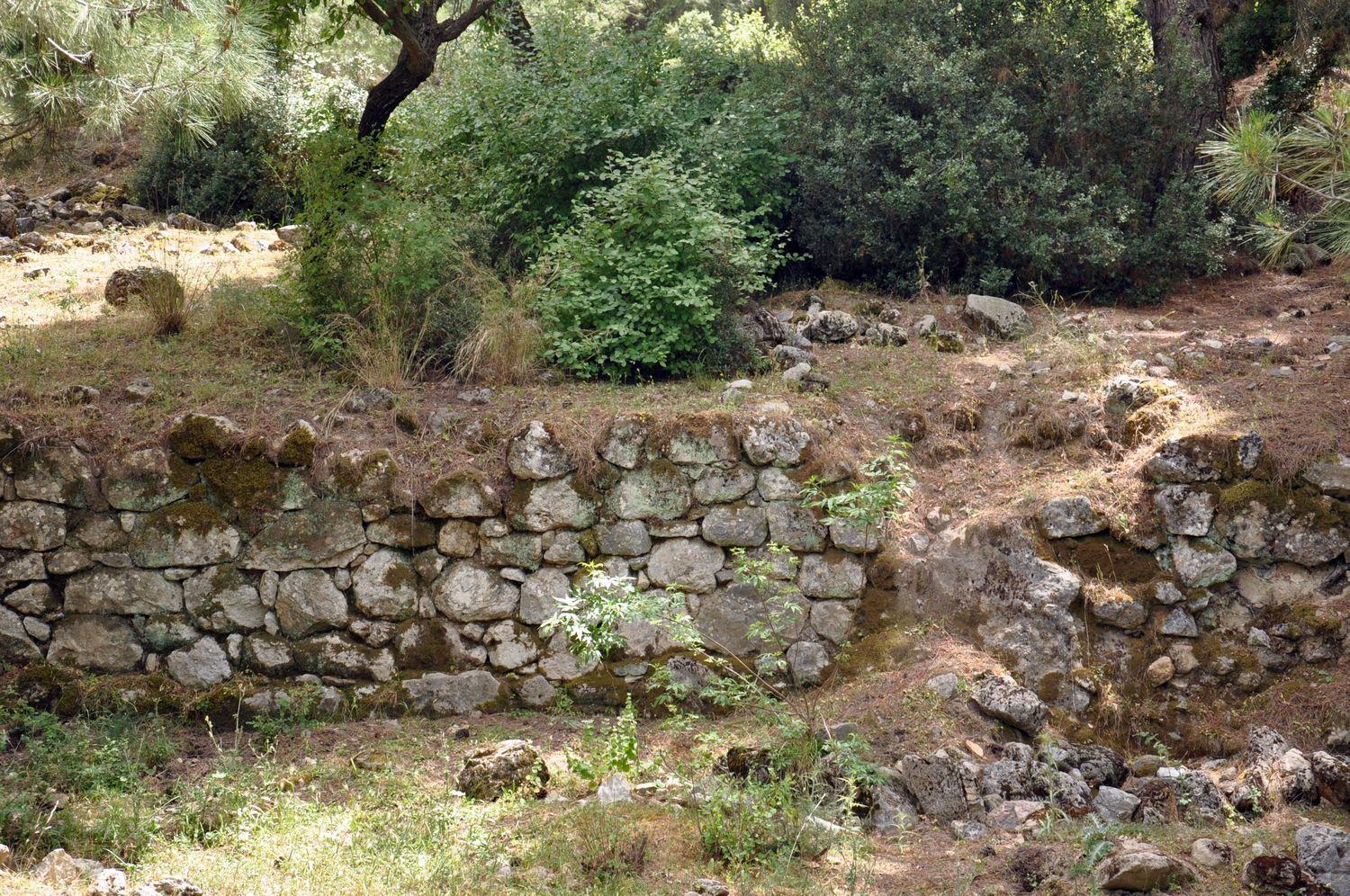
The surviving city reflects several periods of occupation. Its earliest known settlement remains date to the seventh century BCE and lie on the acropolis slopes. Most surviving remains belong to the fourth century BCE, when the city appears to have been rebuilt. The walled area covered as much as 80 hectares, and at least twelve towers are known.
Walls and street remains
The city walls were built in the fourth century BCE and enclosed the settlement. Within the city, excavations have revealed a paved street with buildings alongside it, remains associated with the fourth-century rebuilding.
Acropolis and public buildings
Metroon
The acropolis occupied the southwestern part of the walled city. Remains of a Metroon, a sanctuary associated with a mother goddess, lie in the eastern part of the hill. Dedicated to Demeter Antaia, the sanctuary also served as the city-state’s archive.
Agora, stoa and bathhouse
The northern part of the acropolis contained an agora, a public gathering and commercial space, and an L-shaped stoa, a covered colonnade or hall, with north and west wings. A bathhouse from the Roman period has also been found on the hill.
Burial grounds
Cemeteries and tumuli
Cemeteries have been identified in several parts of the city, with excavations especially to the north, northeast, south, and southwest. Mounds raised over burials, known as tumuli, occur south of the city. One may have served as a grave for people killed while fighting Lysimachus, beside the road from Colophon to Claros.
Andraemon’s reputed grave
Tradition placed the grave of the legendary founder Andraemon beside the road into the city, beyond the crossing of the Kalaon River.
Sanctuaries and the surrounding territory
The sanctuary and oracle at Claros belonged to Colophon’s territory. A sacred grove of Apollo stood nearby, close to the Ales River. The pine resin gathered around Colophon was a valued product, used to increase friction between the hairs of bows and the strings of musical instruments. The name of this resin, colophony, derives from Colophon.