Los Mercados (Duratón): A Roman Urban Settlement in Spain
Site at a Glance
- Popularity
- Very Low
- Country
- Spain
- Primary era
- Classical
- Eras represented
- Classical
- Civilizations
- Roman
- Site type
- City
On this page11 sections
History
Los Mercados (Duratón) is an archaeological site in the municipality of Sepúlveda, Segovia, Spain, centered on a Roman urban settlement that developed from the early first century BCE through the fifth century CE. Its occupied area covered about 50 hectares.
Pre-Roman and Roman occupation
A small quantity of pottery points to limited occupation during the Second Iron Age, a later pre-Roman phase in Iberia, in the third and second centuries BCE.
Los Mercados may be the Roman city of Confluentia, also known as Confluenta, which the Greco-Roman geographer Ptolemy included in his description of places in the known world.
Later occupation and archaeological research
Occupation continued during the Visigothic period, when Visigothic political power followed Roman rule across much of the Iberian Peninsula, from the fifth to the seventh centuries CE. The site was also occupied during the Christian Middle Ages, from the twelfth to the fifteenth centuries.
The earliest excavations took place in 1791 and 1795, when C. Rubio and S. Martín Sedeño sought building material. In 1795, the architect Juan de Villanueva also excavated at Los Mercados, primarily to recover antiquities for the decoration of the Palace of Aranjuez.
The first scientific excavations were carried out at the Visigothic cemetery in 1942–1943 under Antonio Molinero, provincial delegate of the National Service of Archaeological Excavations. In 1949, Molinero and Louis Déroche of the University of Bordeaux excavated the city’s central area. Work then paused for several decades.
Surveys in 1992, undertaken for the Archaeological Inventory of Castile and León, preceded the site’s 1994 designation as an Asset of Cultural Interest, Spain’s formal protected-heritage status. Excavations in 2001–2002 were directed by S. Martínez Caballero, J. Mangas, and G. Prieto through the Complutense University of Madrid. Surveys led by A. Orejas of the Spanish National Research Council examined the site’s scale and condition and investigated settlement in the surrounding territory.
Remains
Setting and urban plan
The site occupies a gently sloping plateau reaching 932 metres in elevation, northeast of the meeting point of the Duratón and Serrano rivers. Its eastern limit follows the road from Duratón to El Olmo and Boceguillas; a path from Duratón to La Serna de Duratón marks its western limit. The Roman urban plan follows a regular grid arranged along ordered axes.
Roman structures
Monumental access ramp
In the southern part of the city, a monumental access ramp has been excavated for 25 metres. It is 4 metres wide and rests against a wall that retains a terrace.
Central building and mosaics
A square space, measuring 7 metres on each side, was uncovered in the central area. It served as an access and distribution area for a large building that may have been a bath complex. A channel beneath the space may have functioned as a sewer or an urban aqueduct. Several mosaics removed from Los Mercados in 1795–1796 were used to decorate the Casa del Ermitaño at the Palace of Aranjuez. Most have since been lost; some surviving pieces are held at the National Archaeological Museum in Madrid.
Southwestern dwellings
Several Roman dwellings are known in the southwestern part of the city.
Las Paredes enclosure
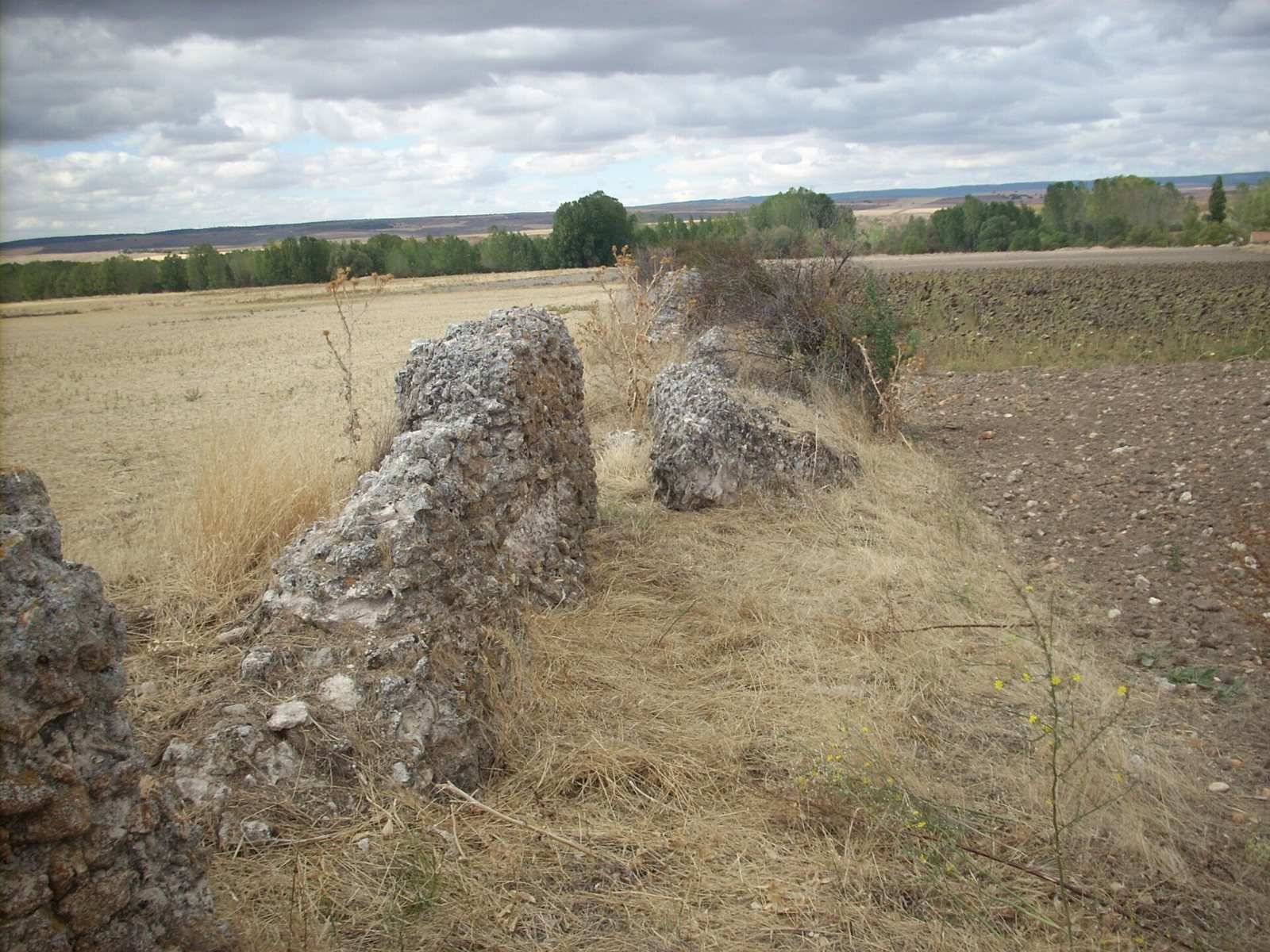
At the eastern edge of the city, Las Paredes is a square compound measuring 150 metres on each side. Its enclosing wall stands 2.1 metres high. Built in the first or second century CE, the compound is interpreted as combining a livestock market with open ground.
Cemetery and material finds
Pottery from the Second Iron Age and the Visigothic period, along with Roman inscriptions, comes from the site. The Visigothic cemetery lies north of the Church of Our Lady of the Assumption. Excavations there identified 666 graves with grave goods; associated finds are held at the Segovia Museum.