Old Jewish Cemetery, Sarajevo: A Jewish Burial Ground Established in 1630
Site at a Glance
- Popularity
- Medium
- Country
- Bosnia and Herzegovina
- Primary era
- Early Modern
- Eras represented
- Early Modern, Modern
- Civilizations
- Austria-Hungary, Habsburg, Ottoman
- Site type
- Burial
- Remains
- Necropolis
On this page12 sections
History
The Old Jewish Cemetery in Sarajevo is a Jewish burial ground in Bosnia and Herzegovina, established by the Sephardic community in 1630 under Ottoman rule. It is the largest Jewish cemetery in Southeast Europe and the second-largest burial complex in Europe, after Prague’s Old Jewish Cemetery.
Jewish community and foundation
Sephardic Jews, whose historical traditions trace to the Iberian Peninsula, were present in Sarajevo by the mid-sixteenth century. Some arrived as traders from Salonica. In 1565, 15 Jewish families were recorded as permanent residents in a Muslim quarter. By 1577, Jews had permission to dig a well and form a courtyard settlement known as El Cortijo.
Sarajevo’s first permanent chief rabbi, Samuel Baruh, was appointed in 1623 and served as the community’s rabbi from 1630 to 1650. In 1630, he obtained permission from the Ottoman governor for Jewish burials at the cemetery. Burial in the area may have begun earlier: a gravestone dated 1551 was identified in the late nineteenth century, but later researchers could not relocate it or confirm the identification. The cemetery’s formal establishment is dated to 1630.
Changing burial practices
Ashkenazi Jews, associated historically with Jewish communities of Central and Eastern Europe, arrived in Sarajevo under Austro-Hungarian rule in the late nineteenth century. They established a separate nearby cemetery. When it closed in 1959, the remains of about 900 people were transferred to the Sephardic cemetery and reburied in a communal grave. Sarajevo’s general cemetery opened in 1966, with sections for different religious communities, and burial use at the Old Jewish Cemetery ended.
The cemetery’s burials include several community leaders and cultural figures. Samuel Baruh’s grave is believed to be the oldest. Rabbi Isak Pardo served from 1781 to 1810, and Grand Rabbi Avraham Abinun from 1856 to 1858. Other burials include the religious and literary scholar Moše Rafael Attias (1845–1916), writer Laura Papo Bohoreta (1891–1942), and writer Isak Samokovlija (1889–1955).
Wartime and heritage
During the Holocaust, about 6,500 Jews from Sarajevo were murdered. In the Bosnian War of 1992–1996, the cemetery lay on the front line. Bosnian Serb forces used it for artillery and sniper positions, and shelling, bullets, and explosions severely damaged the grounds. Mines were placed there before the forces withdrew and were cleared by the late 1990s.
Restoration followed in stages. By 1998, the mines had been removed and the gathering halls restored. Work in 2000 included salvaging and repairing tombstones that could be saved. The cemetery became a National Monument of Bosnia and Herzegovina on 30 August 2004. By 2018, the country had placed it on UNESCO’s Tentative List, an inventory of places that may later be nominated for the World Heritage List.
Remains
The cemetery covers 31,160 square metres on the slopes of Mount Trebević, in Sarajevo’s Kovačići-Debelo Brdo area southwest of the city’s built-up area. More than 3,850 graves occupy the sloping ground. The cemetery adjoins a site of stećak, monumental tombstones associated with medieval Bosnia.
Enclosure and entrance
Boundaries and railway
A stone enclosure wall, built in the late 1920s, surrounds the cemetery. During Austro-Hungarian rule, a railway was constructed through the grounds. The work is estimated to have destroyed about half of the cemetery’s earlier area on the lower part of the slope.
Gates and temple
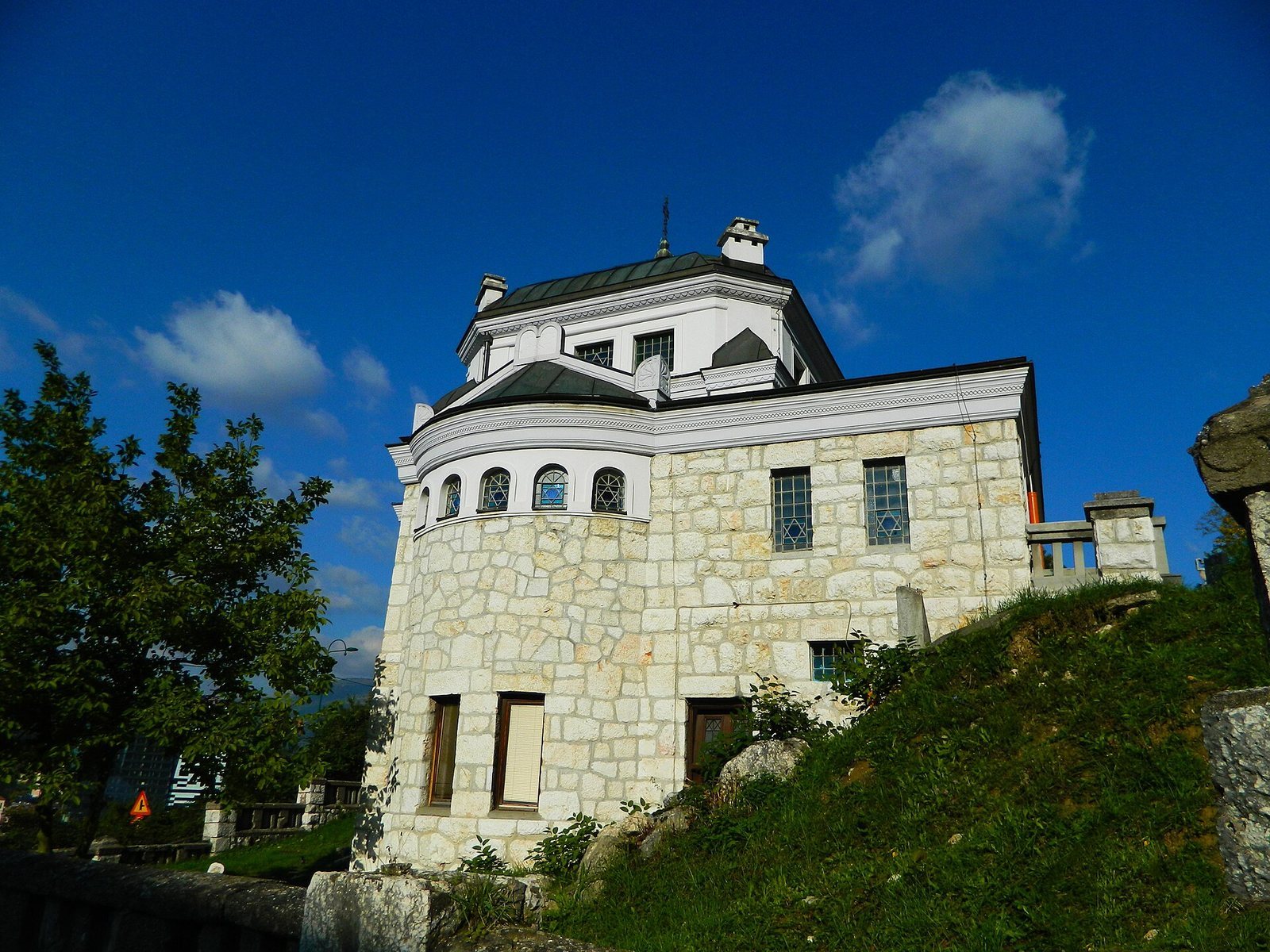
Five iron gates are set in the enclosure. The main entrance has a fountain and an inscription above its gate, with an older wall running along its western edge. A temple stands near the entrance beside the old wall. Another gate is positioned at the highest point of the cemetery’s southern edge.
Burials, memorials, and sacred texts
Burial markers and condition
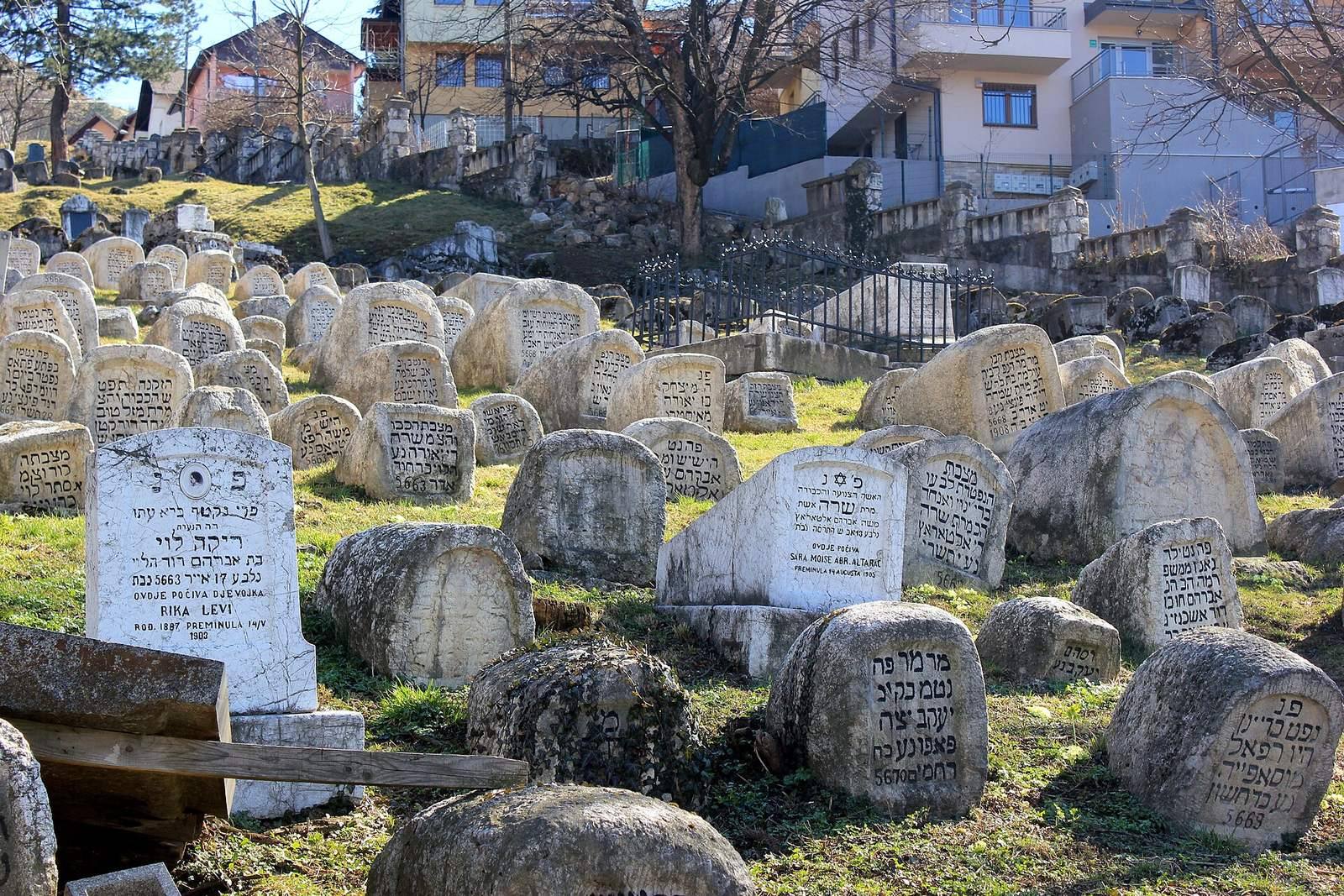
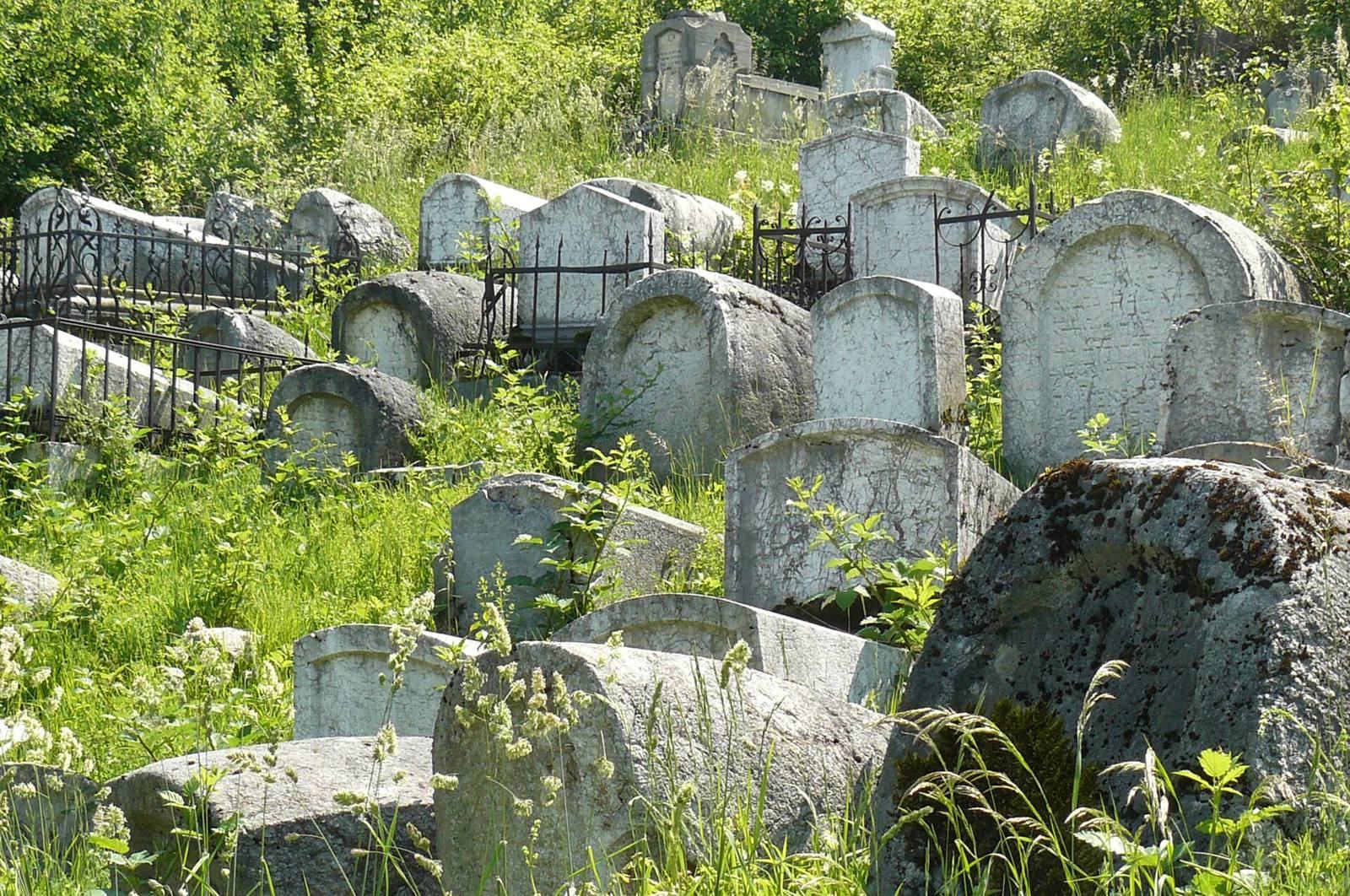
Older gravestones are generally rounded and bear inscriptions in Hebrew and Ladino. The earliest are sarcophagus-shaped and mostly uniform in form and size. Gravestones from before the Yugoslav period generally differ from those installed later. Several cenotaphs, memorial markers for people buried elsewhere or whose burial places are unknown, carry names of the dead. The cemetery retains heavy damage from bullets and explosions, including mortar-shell impacts.
Commemorative monuments
Four monuments commemorate victims of fascism: one Sephardic monument designed by Jahiel Finci and erected in 1952, two Ashkenazi monuments, and one dedicated to victims of the Ustaše, the Croatian fascist movement that ruled the wartime Independent State of Croatia. A memorial to Holocaust victims stands near the main entrance, and another monument commemorates Jewish soldiers killed in the First World War.
Genizah
A genizah, a repository for worn or damaged Jewish sacred texts and objects, lies in the cemetery’s southeastern part. Its first burial took place on 3 July 1916. A second burial is believed to have included about 14 chests of sacred books.