Temple of Eshmun: A Phoenician Healing Sanctuary near Sidon
Site at a Glance
- Rating
- 4.3
- Popularity
- Medium
- Country
- Lebanon
- Primary era
- Classical
- Eras represented
- Iron Age, Classical, Medieval
- Civilizations
- Achaemenid, Babylonian, Byzantine, Phoenician, Roman
- Site type
- Religious
- Remains
- Sanctuary
On this page22 sections
History
The Temple of Eshmun is an ancient Phoenician healing sanctuary at Bqosta, near Sidon in Lebanon. Dedicated to Eshmun, a healing deity and Sidon’s principal male divinity, the site was occupied from the seventh century BC to the eighth century AD. Its earliest monumental phase arose under Babylonian rule, followed by major development during the Achaemenid period, when the Persian Empire governed Phoenicia.
Phoenician origins and Persian development
A place of worship existed before the great buildings were constructed, perhaps focused on a cave or spring. Sidonian king Eshmunazar II and his mother, Queen Amashtart, built temples to Sidonian deities, including a sanctuary for Eshmun beside the YDLL spring and a cistern. The sanctuary’s growth accompanied Sidon’s renewed prosperity and regional standing.
Eshmun appears in written records in 754 BC, when he was invoked as a guarantor of a treaty between Ashur-nirari V of Assyria and Mati’el of Arpad. His name also appears among the divine guarantors of a 675 BC treaty between Baal I of Tyre and Esarhaddon of Assyria. During the wars between Persia and the Greek states, Xerxes I rewarded Eshmunazar II with the Sharon Plain after Sidon placed its fleet at the Persian ruler’s service. The grant enabled the king to support extensive temple building.
Work on the monumental podium began during the reign of King Bodashtart. One group of foundation inscriptions names him alone, while another names him alongside Crown Prince Yatonmilk. About thirty inscriptions were concealed within the podium. A separate Phoenician inscription, found about three kilometres upstream, describes waterworks that carried water from the Awali River to the YDLL spring in the seventh year of Bodashtart’s reign. The water supplied ritual purification at the sanctuary.
Hellenistic and Roman eras
An earthquake in the fourth century BC damaged the sanctuary and demolished the marble temple that stood above the podium. The temple was not rebuilt, but chapels and other places of worship were later added around the podium’s base. The sanctuary remained a pilgrimage destination during the Greek and early Roman periods. From the third century BC, Eshmun was increasingly identified with Asclepius, the Greek god of medicine and healing, while the sanctuary continued its healing role.
Roman additions, including a colonnaded street, point to renewed importance for Sidon in the later Roman period. During the late Roman persecution of pagan worship, the cult of Eshmun was prohibited and a Christian church was built at the site. The sanctuary declined as Christianity replaced the older cult. An earthquake struck the Sidon region around AD 570; the sixth-century Christian pilgrim Antoninus of Piacenza described parts of the city as ruined.
Reuse, rediscovery, and modern history
After Eshmun’s cult disappeared, the sanctuary became a source of building stone. In the seventeenth century, Emir Fakhr-al-Din II used large temple blocks to build a bridge over the Awali River, and the site gradually fell into obscurity. Richard Pococke, travelling between 1737 and 1742, described what he thought were defensive-wall remains near the river. In 1860, Ernest Renan noted finely worked blocks from an earlier structure in the bridge abutments and recorded local reports of a large building nearby.
The site came to wider attention in 1900, when four workers extracting stone for the Druze notable Nassib Jumblatt found blocks bearing inscriptions painted in red. Theodore Makridi cleared the remains between 1901 and 1903. Wilhelm von Landau excavated in 1903–1904, Gaston Contenau led a survey in 1920, and Maurice Dunand conducted the first extensive excavation from 1963 to 1975.
During the Lebanese Civil War and the Israeli occupation of southern Lebanon, the sanctuary was neglected and became overgrown. It was cleared and rehabilitated after the Israeli withdrawal. During the Civil War, Dunand moved more than 2,000 artifacts from Sidon to an underground chamber in Byblos Castle at the request of Maurice Chehab, director general of antiquities. Looters broke into the depot in 1981 and stole about 600 sculptures and architectural elements, which were smuggled abroad. Eight sculptures were later identified and returned to the Lebanese National Museum.
The Temple of Eshmun was placed on UNESCO’s World Heritage Tentative List in 1996 and recorded there again in 2019. In 2024, UNESCO included it among Lebanese cultural properties given enhanced protection during the conflict. Managed by the Lebanese Directorate General of Antiquities, it is regarded as one of Lebanon’s best-preserved Phoenician archaeological sites.
Remains
The sanctuary lies on the southern bank of the modern Awali River, in the area known as Bustan el-Sheikh, about two kilometres northeast of Sidon and 40 kilometres south of Beirut. The river was known in antiquity as the Bostrenos or Asclepius fluvius. Citrus groves now occupy ground associated with the ancient sacred groves of Asclepius. Within the sanctuary, an esplanade and a large court were enclosed by a massive limestone terrace wall. The wall supported a monumental podium that once carried a marble temple.
Early monument and podium
Babylonian-period structure
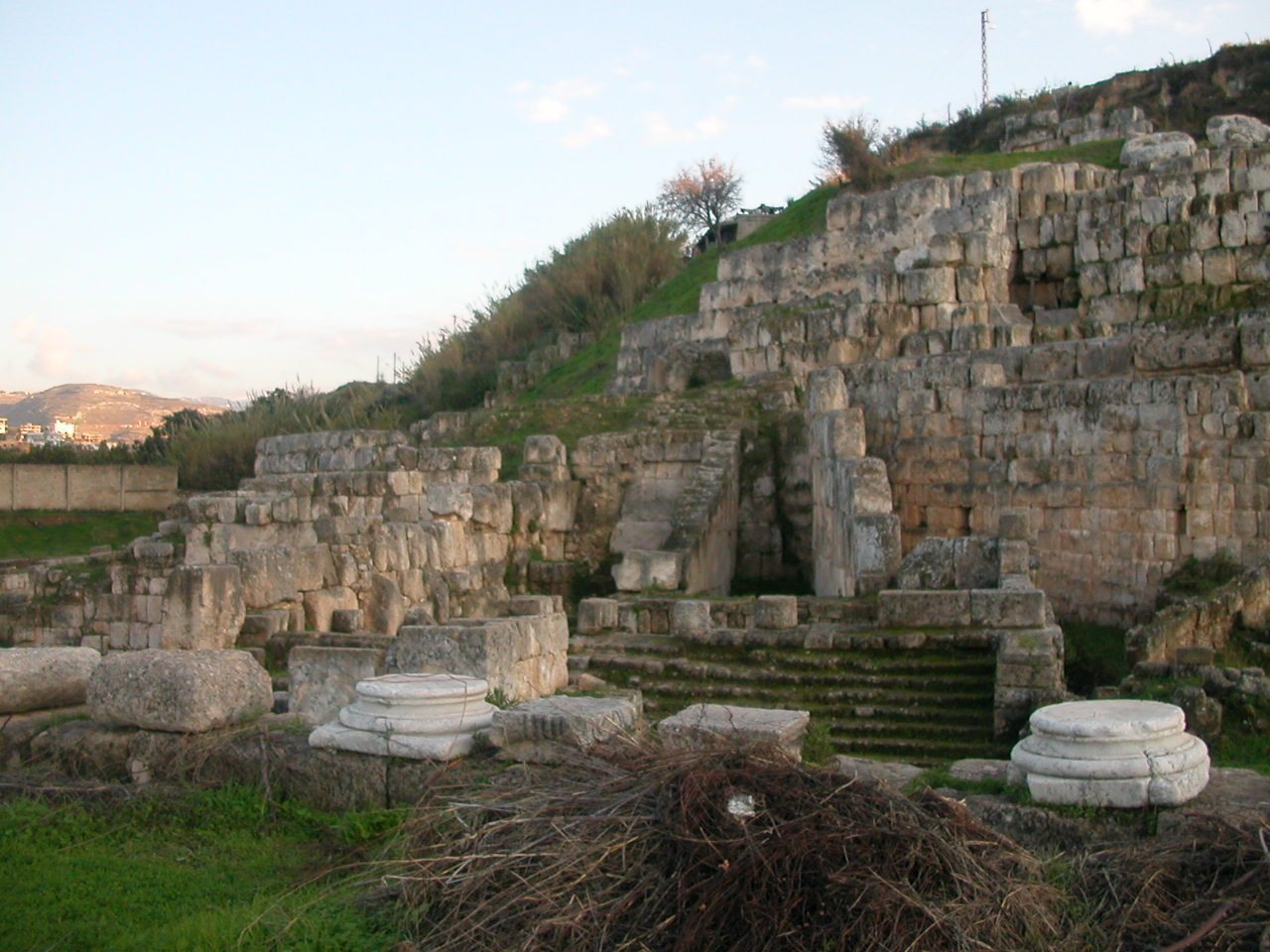
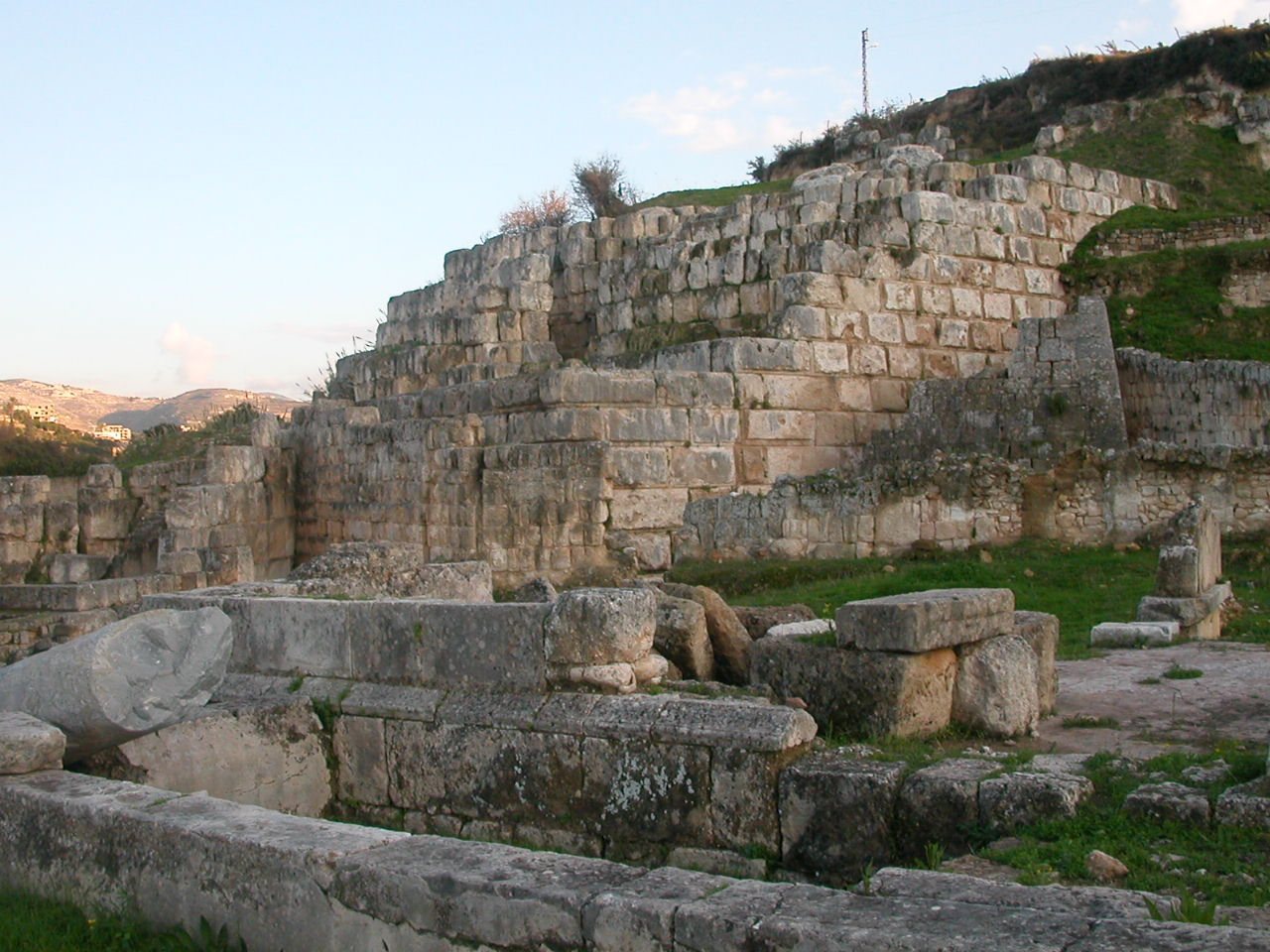
The oldest monument was a stepped, pyramid-like structure with a ramp leading to a water cistern. Its surviving fragments include rounded, ring-shaped marble column bases with moldings, faceted columns, and capitals carved with the foreparts of bulls. The structure was dismantled around the middle of the fourth century BC, and its remains were placed in a favissa, a prepared deposit for removed temple objects and building material. The deposit includes material from the fifth and the first half of the fourth century BC.
Persian-period podium and upper temple
The earlier structure was covered by a large limestone podium built from blocks more than three metres wide and about one metre thick. Their rough, raised faces were laid in courses approximately one metre high. The podium rises about 22 metres, extends roughly 50 metres into the hillside, and has a façade about 70 metres wide.
A marble temple in the Greco-Persian style and Ionic order once stood on the upper terrace, probably built around 500 BC. A small number of stone fragments survive after later removal of its blocks.
Chapels and cult monuments
Eastern chapel
The fourth-century BC chapel at the podium’s eastern base measures approximately 10.5 by 11.5 metres. It contained a paved pool and the large Throne of Astarte, carved from a single block of granite in an Egyptian style. Two sphinxes flank the throne, with two lions around it; hunting scenes appear in relief on the chapel walls. Astarte was a major Phoenician goddess associated at the sanctuary with fertility and healing.
The Astarte basin lost its function during the second century AD and was filled with earth and fragments of statues.
Western chapel
A second chapel of the fourth century BC stood at the western base of the podium. Its focus was a capital topped by a carved bull’s forepart. The capital is now in the National Museum of Beirut.
Northeastern temple
A temple dating to the third century BC stands northeast of the principal sanctuary, beside the Astarte chapel. Its façade, about 22 metres wide, is built from large limestone blocks. Two registers of reliefs depict drunken revelry in honour of Dionysus. One scene shows a man trying to seize a large rooster, an animal commonly sacrificed to Eshmun-Asclepius.
Tribune of Eshmun
The Tribune of Eshmun is a white-marble altar dating to the fourth century BC. It measures approximately 2.15 metres long, 2.26 metres wide, and 2.17 metres high. Set against a retaining wall, it stands on a limestone base faced with marble blocks. Its Hellenistic reliefs are framed by moldings, one of which divides the surface into two symmetrical registers.
The upper register depicts eighteen Greek deities, including two charioteers around Apollo playing a lyre. Below, Dionysus leads his ecstatic retinue, accompanied by flute and lyre players. The Tribune is displayed in the National Museum of Beirut.
Waterworks and later buildings
Hydraulic system
The sanctuary’s water system drew on the Awali River and the sacred YDLL spring. Canals, retaining basins, ritual-washing basins, and paved pools formed part of the network. These installations supported ablution and therapeutic practices; the spring was regarded as sacred and healing.
Roman street and staircase
A Roman colonnaded street lined with shops crossed the sanctuary. Fragments and bases survive from the large marble columns that bordered it. The Romans also built a monumental processional staircase leading to the podium’s summit and decorated it with mosaic patterns. A cubic Roman altar stands beside the staircase. Two columns from a large portico mark the approach toward pools and other cult installations.
Nymphaeum and villa
Near the entrance beside the Roman road stood a nymphaeum, a monumental fountain associated with nymphs. Its niches once held statues of three nymphs, and its mosaic floor depicts Maenads, ecstatic female followers of Dionysus. The floor remains largely intact.
Across the colonnaded road, facing the nymphaeum, are the remains of a Roman villa. Its surviving features are chiefly the courtyard and fragments of a mosaic depicting the four seasons.
Christian church
A Christian church stood across the Roman street from the podium. Parts of its Byzantine mosaic flooring remain at the site.
Inscriptions, sculptures, and other finds
Inscriptions
Inscribed pottery fragments recovered by Dunand provide rare examples of cursive Phoenician writing from the Phoenician mainland. One carries the name grtnt, indicating veneration in Sidon of Tanit, a lunar goddess.
Votive sculptures
Fragmentary, life-size votive sculptures show boys lying on their sides and holding animals or small objects. The best-known, the Baalshillem Temple Boy, depicts a royal child holding a dove. The child has a shaved head and bare torso, with a large cloth wrapped around the lower body. A dedication to Eshmun by Sidonian king Baalshillem II appears on the statue’s base.
The figures appear to have been deliberately broken after dedication and ceremonially deposited in the sacred canal, perhaps as part of a rite representing the sacrifice of a sick child. All the known figures depict boys.
Other objects
A limestone bust of a kouros, an archaic Greek type of youthful male statue traditionally shown standing and nude, measures about 31.5 by 27 centimetres and dates to the sixth century BC. This example is clothed. Other finds include a gold plaque showing a snake coiled around a staff, a Greek-era symbol of Eshmun, and a granite altar bearing the name of Egyptian pharaoh Achoris. The altar is interpreted as a gift reflecting relations between the pharaoh and Sidon’s kings.
Cypriot pilgrims from Paphos left a marble stele dedicated to Astarte and inscribed in Greek and Cypriot syllabic writing. It is held by the Lebanese Directorate General of Antiquities. Large decorative elements, carved friezes, and mosaics remain in place, while other finds are held by the National Museum of Beirut, the Louvre, or the Directorate General of Antiquities.