Khan al-Franj: An Ottoman Caravanserai in Sidon, Lebanon


Site at a Glance
- Rating
- 4.4
- Popularity
- Low
- Country
- Lebanon
- Primary era
- Early Modern
- External website
- Open
- Eras represented
- Early Modern
- Civilizations
- Ottoman
- Site type
- Economic
- Remains
- Caravanserai
On this page6 sections
History
Khan al-Franj is an Ottoman caravanserai in Sidon, Lebanon, built in the mid-sixteenth century as a protected inn for merchants, travelers, and their goods. Construction had probably begun around 1560 on the initiative of Sokollu Mehmed Pasha, the Ottoman grand vizier, although tradition later attributed the building to Fakhr al-Din II, a Druze emir and Ottoman provincial governor associated with Sidon.
Construction and early name
Official documents originally called the complex Khan Ibrahim, after Ibrahim, Sokollu Mehmed Pasha’s eldest son. Its foundation therefore belongs to the Ottoman period before Fakhr al-Din II’s traditional association with the building. The khan formed part of Sidon’s commercial environment, providing accommodation and secure storage within the city.
European merchants and the French consulate
The name Khan al-Franj, meaning “Caravanserai of the Franks,” refers to the European occupants who stayed there, especially French merchants and travelers during the seventeenth century. French merchants benefited from privileges in taxation and pricing, while the French consul held extraterritorial status under the Franco-Ottoman Capitulations of 1535, agreements that granted French merchants and consular representatives special commercial and legal rights within the Ottoman Empire.
The French consul was based at the khan around 1616. During the 1630s, the consulate moved to the neighboring Dar al-Musilmani, a property formerly associated with the Ma’n family of Fakhr al-Din II.
War damage and modern use
Khan al-Franj was damaged during the Lebanese Civil War. The Hariri Foundation restored and rehabilitated the building in the 1990s, and uses it as a cultural center. The French government owns the property and leased it to the foundation. In 2019, the khan was included on the preliminary list of World Heritage sites in the historic city of Sidon, together with the Sea Castle, the Land Castle, and al-Kikhia Mosque.
Remains
Courtyard plan and defensive enclosure
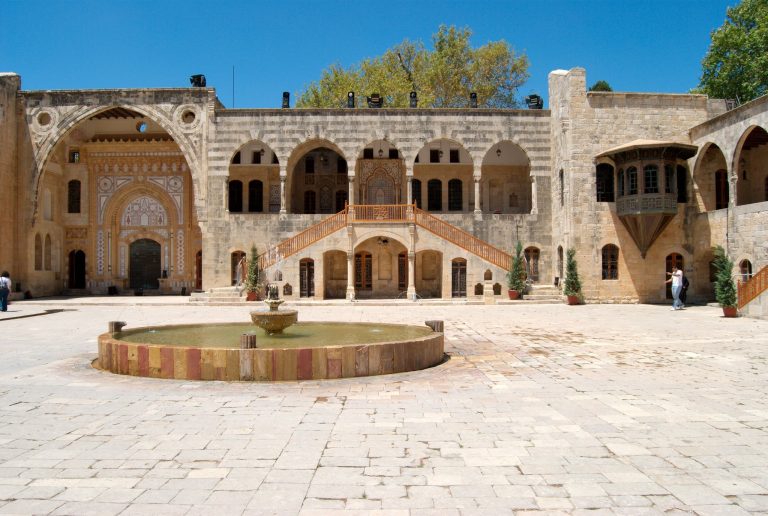
Khan al-Franj is a square, two-storey Ottoman building measuring approximately 58 by 58 metres. Its plan centers on a large courtyard with a central pool and covered galleries. This arrangement follows the established caravanserai pattern, with storage spaces on the ground floor and living quarters above.
The lower outside walls are largely blind, interrupted only by narrow slit openings. This enclosed construction provided security for people and property inside the khan. A single gate faces the harbor, and it could be closed at night or during epidemics to restrict movement into and out of the complex. The building is described as the largest and most complete of Sidon’s historic khans.