Catacombs of Marcellinus and Peter: An Early Christian Cemetery in Rome
Site at a Glance
- Popularity
- High
- Country
- Italy
- Primary era
- Classical
- Eras represented
- Classical
- Civilizations
- Roman
- Site type
- Burial
- Remains
- Catacomb
On this page12 sections
History
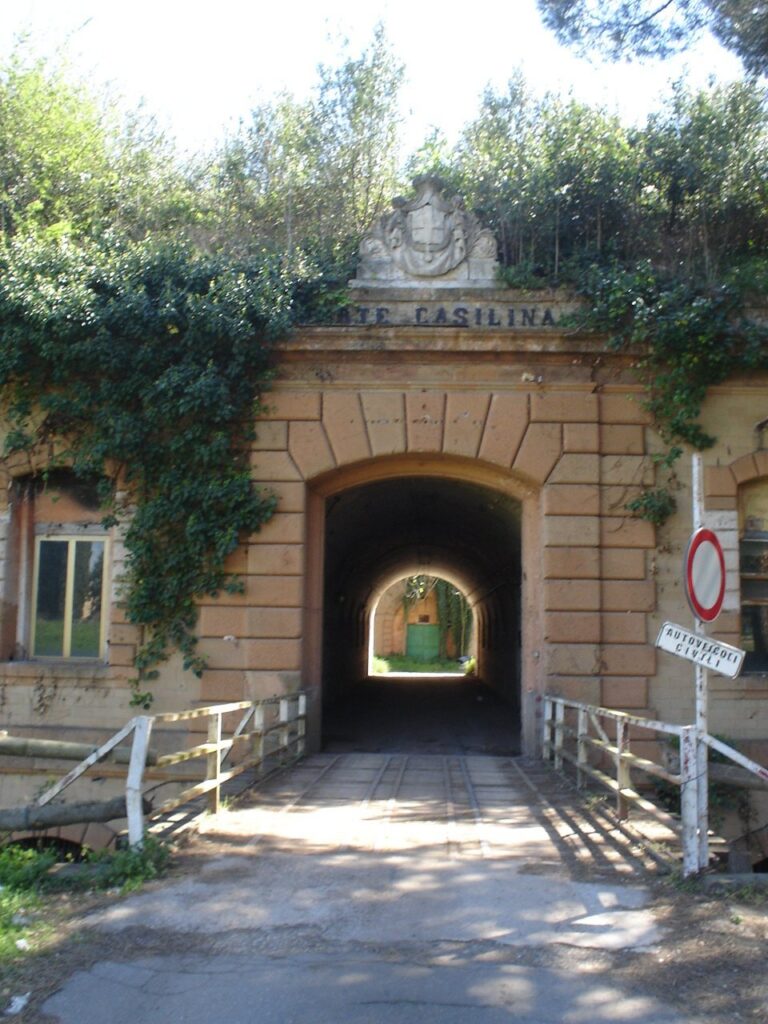
The Catacombs of Marcellinus and Peter are an early Christian cemetery about three kilometres southeast of Rome, Italy, along the ancient Via Labicana, now called the Via Casilina. Burial use began around the middle of the third century, although the catacombs’ precise beginnings are uncertain. Tradition says that the Christian martyrs Marcellinus and Peter were buried here near the body of St. Tiburtius. The cemetery is also known as the Catacombs of St. Helena and the Catacombs of St. Tiburtius.
Third- and fourth-century development
The oldest identified sections date to the second half of the third century, a chronology supported by funerary inscriptions. Further areas were opened in the fourth century. Inscriptions from that century give more information about the deceased and include sales of burial niches, indicating that their purchase was recognized as legitimate. The cemetery held many thousands of underground burials as well as several thousand above ground.
At the beginning of the fourth century, the area belonged to Constantine’s mother, Flavia Julia Helena, who held the imperial title Augusta. The Liber Pontificalis, in its account of Sylvester, bishop of Rome in the early fourth century, records Constantine’s donation of the estate. It describes the estate as extending from the Porta Sessoriana, now Porta Maggiore, to the Via Latina, and south to Monte Cavo. The cemetery formed part of Ad Duas Lauros, meaning “between the two laurels.” Two laurel trees at the site may have given the area its name.
Excavations from 2004 to 2010 revealed previously unknown burial spaces and mass graves dating to the first and third centuries. The work uncovered an estimated 20,000 skeletons. A chance discovery in 2006 brought to light a mass grave containing more than 1,200 people. Their deaths appear to have occurred close together, and the grave dates to the late second or early third century. Many bodies were associated with the same ceremonial incense. An epidemic, possibly the Antonine Plague, a major epidemic in the Roman Empire in the late second century, may explain the deaths. The dead may have included families of the Equites singulares Augusti, the emperor’s mounted guard. The catacomb interiors were also restored.
Remains
Layout and burial forms
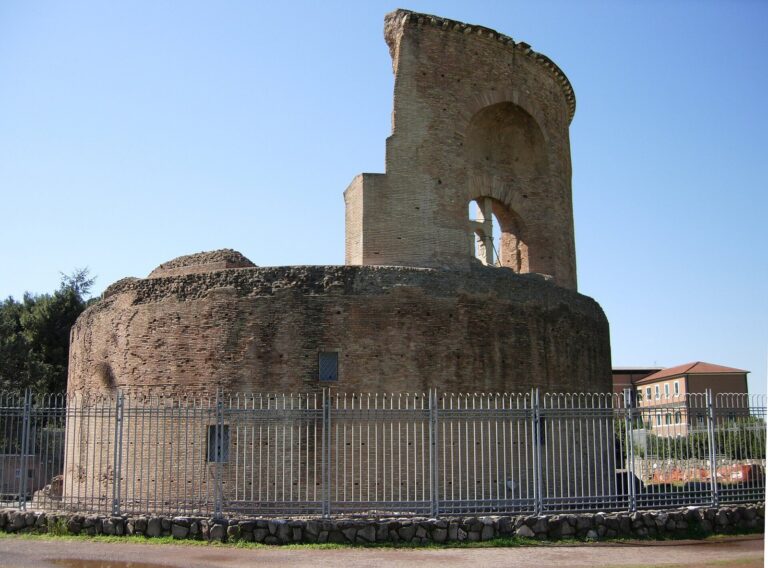
The underground cemetery has three levels of galleries, extending across roughly three hectares and about 4.5 kilometres. Its entrance is beside the church of Marcellinus and Peter. The associated complex also includes Helena’s mausoleum, a basilica now underground, and remains of a cemetery belonging to the Equites singulares Augusti. Within the catacombs, burials occupy individual niches in the walls, spaces beneath arched recesses, and chambers used for one person or for groups. Some of the later chambers have painted walls.
Painted chambers and imagery
Room 79
Paintings in Room 79 combine pagan and Christian subjects. They include Moses bringing water from a rock, a lyre-player identified either as Orpheus, the legendary Greek musician, or as King David, the biblical king; the raising of Lazarus; and Daniel in the lions’ den. The range of subjects offers evidence of a gradual change toward Christian imagery.
Room 66
Paintings in Room 66 depict athletes, presenting a different subject from the biblical scenes in Room 79. These images form part of the varied painted decoration in the catacombs.
Late-fourth-century image of Christ
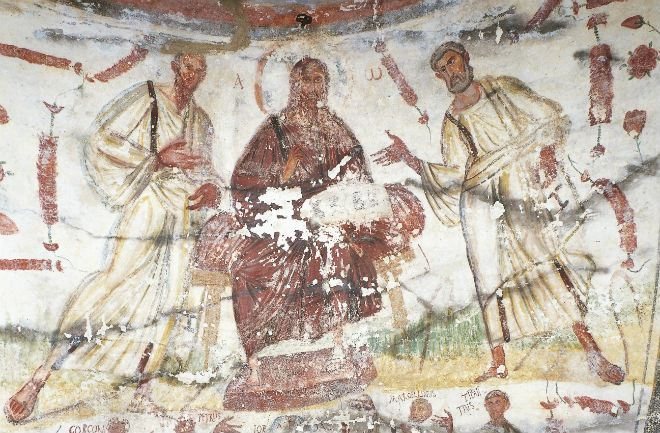
A painting from the late fourth century shows Christ with long hair and a beard, accompanied by two apostles wearing togas. The figures are portrayed more realistically than in earlier paintings, reflecting an approach to depicting Christ and the apostles that became established during this period.
Jonah ceiling painting
A ceiling painting presents episodes from the story of Jonah. He boards a ship at Joppa to avoid his mission to Nineveh, and the sailors lower him into a stormy sea. A great fish swallows him and releases him after three days and nights. Jonah then preaches repentance to the Ninevites before sitting beneath a shelter he has built to watch for the city’s destruction.
The details draw on different visual and interpretive traditions. Jonah appears naked aboard the ship, perhaps recalling the sailors’ effort to keep it afloat by throwing unnecessary cargo overboard; the scene may also reflect Roman marine art. The sailors lower him feet first, in keeping with a Jewish tradition of interpreting the story. The fish is a great sea creature rather than the Leviathan more often shown in traditional depictions. The painting combines Roman visual conventions with Jewish biblical interpretation, and its origins or meaning may have been Jewish rather than Christian.
Mass burials and other finds
Mass-burial chambers
Excavated mass graves contain from tens to hundreds of articulated skeletons, depending on the size of each chamber. Some bodies were covered with plaster or amber and wrapped in textiles. The individuals appear to include both sexes and to range from young adults to adults, although their ages are difficult to establish. Bones are generally better preserved in the catacombs than in open-air settings, and survive especially well near the centres of larger chambers. Runoff and greater humidity may have affected remains near chamber walls, while the confined space in smaller chambers may also have contributed to changes in bones and surrounding materials after burial.
Gold-glass fragment
A fragment of a gold-glass disk from the catacombs bears imagery associated with both Jewish and Christian traditions. It shows a tomb between two freestanding columns, with a menorah, a seven-branched Jewish ritual lamp, in front. The identification and meaning of the image remain controversial.