Königsbrunn Mithraeum: A Roman Sanctuary of Mithras
Site at a Glance
- Popularity
- Very Low
- Country
- Germany
- Primary era
- Classical
- Eras represented
- Classical, Modern
- Civilizations
- German, Roman
- Site type
- Religious
- Remains
- Mithraeum
On this page9 sections
History
Roman sanctuary and settlement
The Königsbrunn Mithraeum is a Roman sanctuary dedicated to Mithras, a deity worshipped in a mystery religion. It lies in Germany and dates to the second or third century AD. It is one of six Mithraea found in Bavaria and the only one preserved within the former Roman province of Raetia, which included parts of what is now southern Germany.
The sanctuary formed part of a wider Roman settlement that may have served as the final road station before Augusta Vindelicum, the Roman settlement at modern Augsburg. The settlement is estimated to have contained about 30 to 40 buildings. The Via Claudia Augusta, a major Roman road connecting the Alpine region with areas to its north, ran roughly parallel to the east, just over a kilometre away. A paved route about 1.3 kilometres long linked the road with Königsbrunn and continued northwest. An aqueduct crossed the area toward Augusta Vindelicum and may have begun at the spring reservoir at Hurlach.
The Roman complex was raided and destroyed around AD 180 and again around AD 375.
Rediscovery and protection
Roman remains came to light in 1976 and 1977 during construction of Königsbrunn’s municipal cemetery. The complex was first understood as a rural Roman estate with about eight associated buildings. By 1999–2000, building 5 had been identified as the Mithras sanctuary and another structure as a Roman bath. The buried foundations were excavated again in 2000 by the Working Group for Prehistory and Early History. A protective building was erected over the poorly preserved sanctuary in 2001–02.
Remains
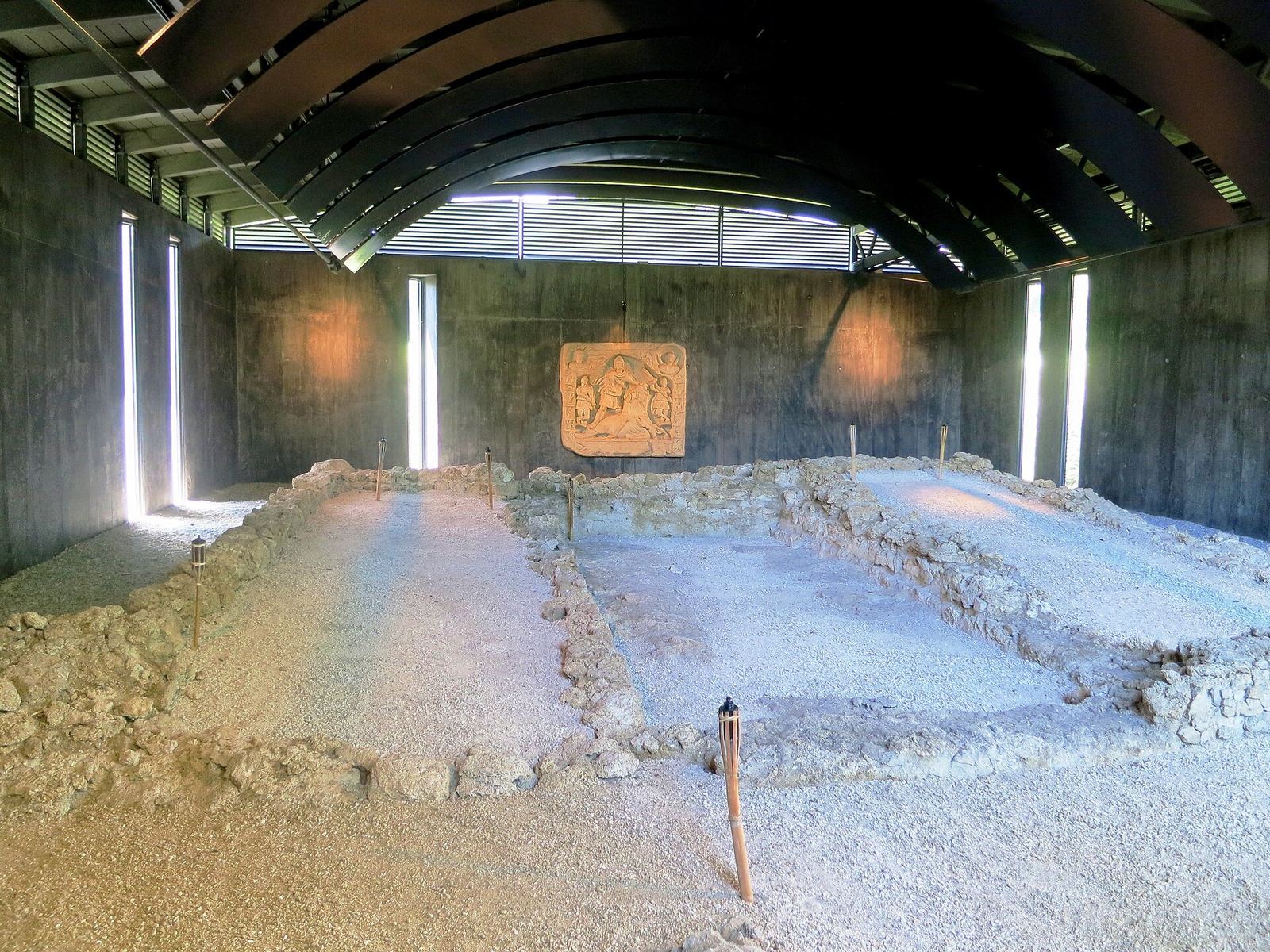
The Mithraeum stands on the slope of the Lechfeld high terrace. Its exterior measures 9.8 by 9.1 metres. Tuff, probably brought from the Untermeitingen area, forms the walls, which now rise only about 30 centimetres. The upper structure was probably timber-framed and covered with shingles.
Mithraeum interior
Entrance and plan
The entrance was on the north side, where a double-leaf door opened inward into a small vestibule. Beyond it, a smaller room lay directly to the south; a turn to the right led into the east-west sanctuary. Two raised platforms flanked its central passage, where participants reclined during ceremonies. At the western end, a lower rectangular room adjoined the sanctuary.
Floor and decoration
The central passage had a lime-mortar floor, later covered with loose, fine-grained tuff. It yielded 98 low-value coins used as offerings, dating from the second to the fourth century AD. Surviving wall plaster carries red, white, and green paint.
Cult image
The shelter’s inner west wall displays a copy of the Mithras stone from Sterzing, showing Mithras killing a bull. The original stone was found in 1589 in a mountain cave at Mauls, in Freienfeld, South Tyrol.
Roman bath
A public Roman bath lies about 70 metres north of the Mithraeum. Its rooms served for changing, washing, and bathing in pools at different temperatures. A hypocaust, which circulated hot air beneath floors and through wall spaces, heated the rooms. Water came from the aqueduct, which ran slightly above the bath; after use, it flowed to the latrines and then downhill for field irrigation. Excavated in 2012, the bath’s buried walls are protected beneath sand, sheeting, gravel, and earth. Above-ground wire cages filled with stone mark their position, while work begun in 2013 made the remains’ layout legible without uncovering them.