Vildštejn: A Medieval Castle Ruin Above Seč in Czechia


Site at a Glance
- Rating
- 4.2
- Popularity
- Low
- Country
- Czechia
- Primary era
- Medieval
- Eras represented
- Medieval
- Civilizations
- Holy Roman Empire, Kingdom of Bohemia
- Site type
- Military
- Remains
- Castle
On this page7 sections
History
Vildštejn is a medieval castle ruin in Czechia, located about one kilometre south of Seč, whose construction is generally dated to the late thirteenth century. Its exact foundation date is uncertain, but Hrabiše of Paběnice was the first known owner and probable founder. A written reference associated with him dates to 1251, while the castle itself is documented by 1289.
Early owners and medieval administration
Hrabiše of Paběnice was involved in a successful property dispute with the Vilémov monastery in 1315, concerning 350 kopy of groschen. A kopa was a medieval Bohemian counting unit equal to 60 groschen. As part of the settlement, Hrabiše received Mount Oheb as a pledge. His sons Petr and Oldřich later returned Oheb to the monastery in 1348; Oldřich was recorded as being of Vildštejn. A castle at Oheb, on the opposite bank, had been built in 1315.
Later holders included Hrabiše of Vildštejn, recorded in 1382, and Beneš, who served as burgrave of Vildštejn in 1383. A burgrave was the governor or commandant responsible for a castle’s administration and defence.
Raiding base and Hussite occupation
Ješík of Popovec held Vildštejn from 1404 to 1411 and used it as a base for raiding expeditions. After his death, the castle reverted to King Wenceslaus IV as escheated property. Wenceslaus IV was king of Bohemia from 1378 to 1419.
During the Hussite Wars, fifteenth-century religious and political conflicts in the Kingdom of Bohemia that followed the execution of the reformer Jan Hus, Jan Hertvík of Rušínov seized Vildštejn. He was a leader of the Orphans, a radical Hussite military faction, and held the castle until 1427.
Decline and later changes
In 1436, King Sigismund transferred Vildštejn to Jiří of Dubá and Vízmburk. Sigismund was Wenceslaus IV’s younger brother and later became king of Bohemia and Holy Roman Emperor. Jiří incorporated the castle into the Žleby estate, after which Vildštejn declined and was later abandoned.
In 1499, King Vladislaus II transferred Vildštejn, together with Seč and other villages, to Mikuláš the Younger Trčka of Lípa. Vladislaus II was a late fifteenth- and early sixteenth-century king of Bohemia and Hungary. Mikuláš incorporated the property into the Lichnice estate. It passed to the Zárub family in 1596 and was sold in 1623 to František de Couriers, who incorporated it into the Nasavrky estate.
Vildštejn is a protected cultural monument of the Czech Republic, a legally protected heritage site recognized for its historical, architectural, or cultural value. The Seč Dam was built below the ruin between 1924 and 1934. During the same period, a road tunnel was driven beneath the castle remains for the road crossing the dam crest. This work removed further parts of the tower and other surviving masonry. Larger remains of the keep had already been removed by about 1840.
Remains
Rocky spur and castle layout
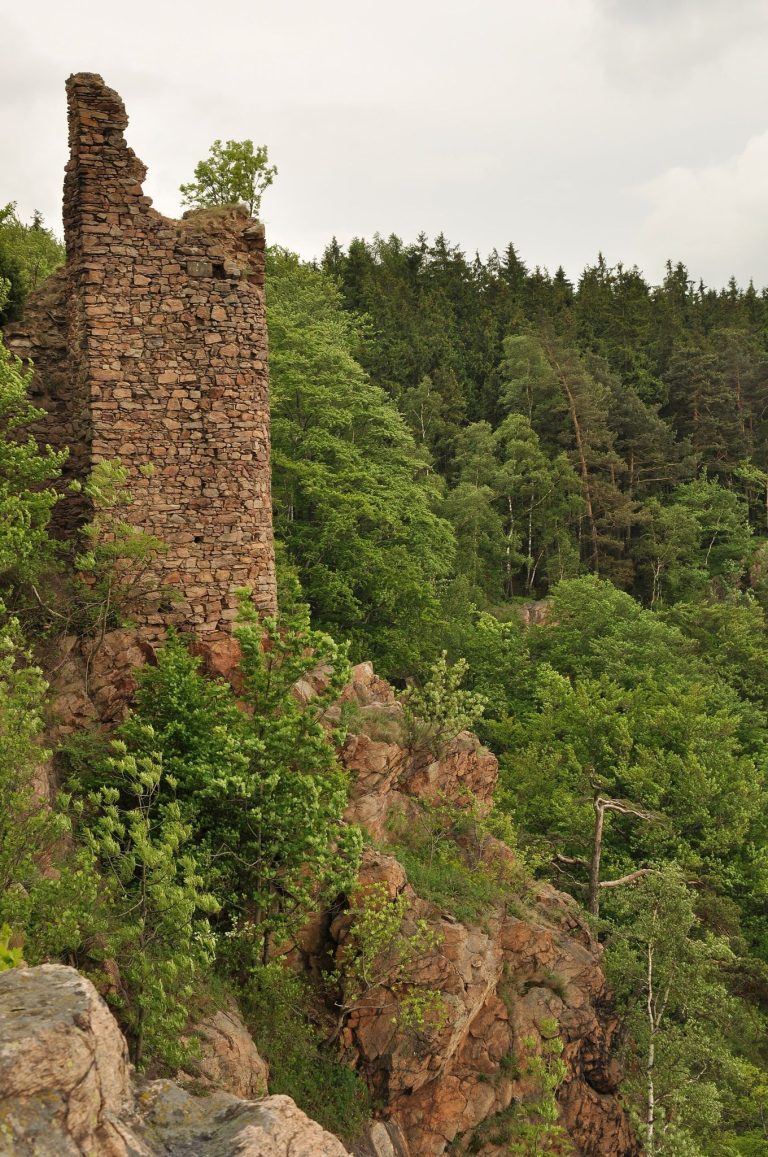
Vildštejn occupies a rocky spur on the left side above the Chrudimka valley, within the Iron Mountains, at approximately 495 metres above sea level. The ruin stands above the dam wall of the Seč Reservoir. As a spur castle, it used a projecting ridge or rocky promontory and its surrounding slopes as part of its defence. Access was possible only from the north, across a steep saddle approached by wooden stairs and ladders.
At the summit stood a tower-like palace with an irregular ground plan. Its ground floor contained storage areas and other economic facilities, while the owner’s residence occupied the upper floor. A second building stood south of the palace, and walls followed the edge of the slope to protect the complex.
Surviving masonry
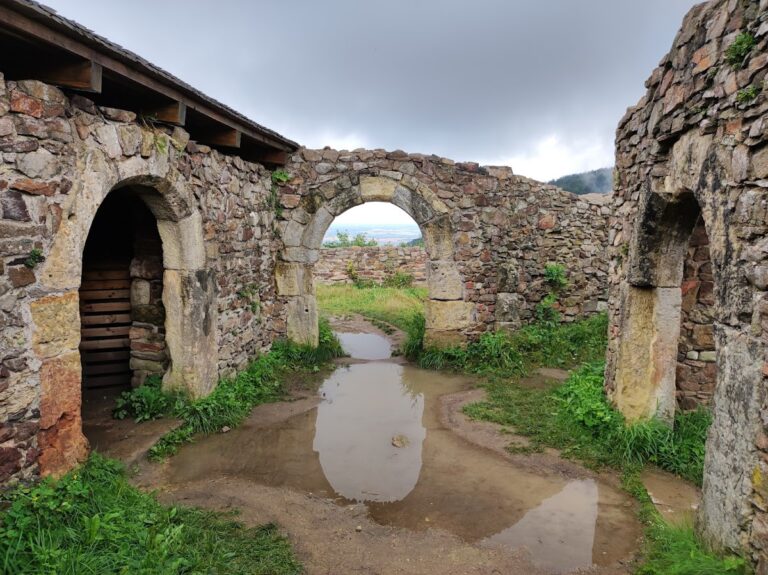
The surviving fabric is a ruin built primarily of stone and wood. It includes part of a bastion and part of a tower with a Gothic window. Further losses occurred during construction of the Seč Dam and the approximately 30-metre road tunnel beneath the ruin in the twentieth century. The heritage remains are registered under number 28637/6-969.