Mellingburg: An Early Medieval Lowland Castle in Hamburg


Site at a Glance
- Rating
- 4.1
- Popularity
- Low
- Country
- Germany
- Primary era
- Medieval
- External website
- Open
- Eras represented
- Medieval
- Civilizations
- Unclassified
- Site type
- Military
- Remains
- Castle
On this page6 sections
History
Early Medieval Origins
Mellingburg is an abandoned lowland castle in Hamburg, Germany, at Sasel, whose construction is placed between the ninth and eleventh centuries. A lowland castle is a fortified site built in relatively level or low-lying terrain rather than on a steep hill. The proposed early medieval date comes from the castle’s location and from archaeological finds at the nearby Treudelberg settlement, which is associated with the complex.
Treudelberg was occupied over a long period, beginning in the Neolithic period with the Funnel Beaker Culture, a northern and central European society named for its characteristic funnel-shaped pottery. The settlement was discovered during gravel-quarry work in 1930. Excavations in 1931 and 1932 produced extensive pottery fragments and flint tools from the Neolithic phase, as well as early medieval material dating to the ninth or tenth century.
The early medieval settlement material included coarse pottery from at least five flat-bottomed pots and a disc-shaped spindle whorl, a weighted tool used to help spin fibers into thread. Later quarry work in 1939 produced pottery associated with Slavic communities and the late Saxon period, together with loom weights and a basalt-lava millstone. Loom weights helped tension the threads of a vertical loom, while basalt lava is a dense volcanic stone suitable for making a millstone. These finds support an early medieval date for the settlement and provide the principal archaeological context for Mellingburg.
Recording and Excavation
Mellingburg first appeared in the surviving written record on the Sasel cadastral map of 1783. Archaeological work at the castle took place in 1932 under the Museum of Ethnology. The excavation was largely unsystematic, and problems with recording and archiving limited the value of the results. A trench ten metres long was cut through the eastern side of the main rampart. Three ceramic sherds recovered there could have helped establish when construction began, but they later became untraceable.
The archaeological record from Treudelberg also suffered from losses after excavation. Some ceramic fragments cannot now be located, including one of two pieces decorated in a characteristic Slavic manner. Further typically Slavic pottery was recovered from a nearby property in 1986 and remains in private ownership. Together, the surviving finds connect the settlement with early medieval Slavic and late Saxon pottery traditions without providing a precise foundation date for the castle.
Remains
Rampart Complex and Earthworks
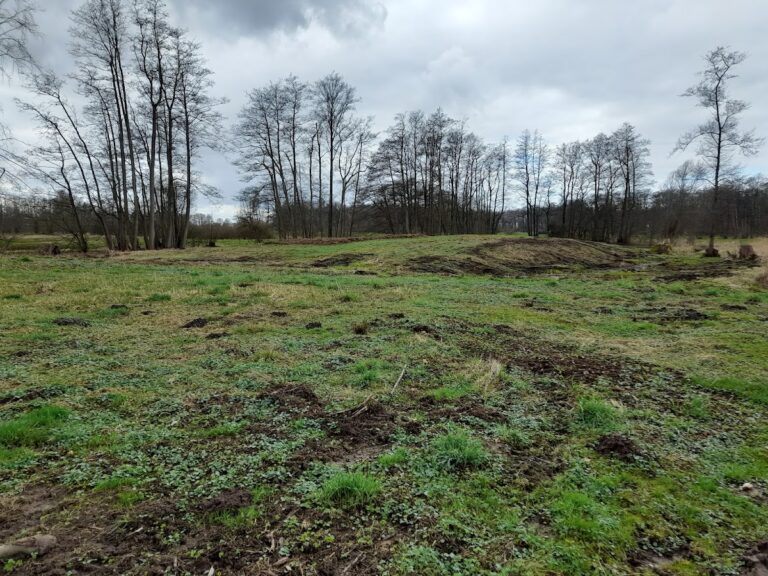
Mellingburg occupied the projecting tip of a sandy terrace at the narrow point of a large loop of the Alster River near Sasel. The terrace sides descend toward a river lowland that now contains a biotope. The castle had a keyhole-like plan formed by a main bailey and an outer bailey. A bailey is an enclosed area within or adjoining a castle’s defensive works. The main bailey covered about 3,000 square metres, while the outer bailey covered about 1,000 square metres.
Two small ramparts divided the outer bailey from the main bailey, whose principal rampart rose about three metres high. The main rampart survives as a mound almost three metres high. The outer-bailey ramparts are represented through terrain traces identified in terrain models, including a model based on a 2021 scan. Residential buildings partly cover both baileys. The Alster walking trail passes the site, which is marked by the castle mound and other surviving ground forms.
Treudelberg Settlement Finds
The nearby Treudelberg settlement provides material evidence for the community associated with the castle. Its finds include flat-bottomed pottery, a disc-shaped spindle whorl, loom weights, a basalt-lava millstone, flint tools, and pottery fragments from several periods. The early medieval ceramics resemble Slavic and late Saxon examples in their forms, manufacture, and decoration. This combination of household, textile, agricultural, and craft-related objects places the settlement within the wider early medieval landscape around Mellingburg.