Rocca di Novellara: A Medieval Fortress and Gonzaga Residence in Italy
Site at a Glance
- Rating
- 4.4
- Popularity
- Low
- Country
- Italy
- Primary era
- Medieval
- Eras represented
- Medieval, Early Modern, Modern
- Civilizations
- Holy Roman Empire
- Site type
- Military
- Remains
- Castle
On this page11 sections
History
Rocca di Novellara is a medieval castle in Novellara, Italy, built to defend the town. Its construction phases extend from the twelfth to the fourteenth century, and its later history is closely tied to the Gonzaga, an Italian ruling dynasty whose branches governed territories and courts in northern Italy.
Early defenses and the Gonzaga fortress
The earliest recorded defensive structure at Novellara was a tower commissioned by Gherardaccio Malapresa, a Lombard lord. A major change followed the defeat of Feltrino Gonzaga, leader of the anti-Visconti League, an alliance formed against the ruling dynasty of Milan. On 17 May 1371, Feltrino was forced to sell Reggio and the surrounding territory to Bernabo Visconti for 50,000 gold florins.
The impoverished Gonzaga family then took refuge in the small fief of Novellara, which they had retained between Reggio and the Mantuan lordship. Feltrino never went to his new domain and died in extreme poverty at Padua in 1374. His son, Guido II Gonzaga, succeeded him and began building the fortress that developed into the Rocca.
Transformation into a seigneurial castle
In the early sixteenth century, the fortress was strengthened and given the character of a seigneurial residence. Costanza da Correggio, widow of Alessandro I Gonzaga, the first Count of Novellara, arranged for another storey to be added. Under Alfonso I Gonzaga, the fourth count, the painter Lelio Orsi was invited to the court and enriched the castle’s rooms with paintings and coffered ceilings, which are ceilings decorated with recessed panels in geometric patterns.
Later history and present institutions
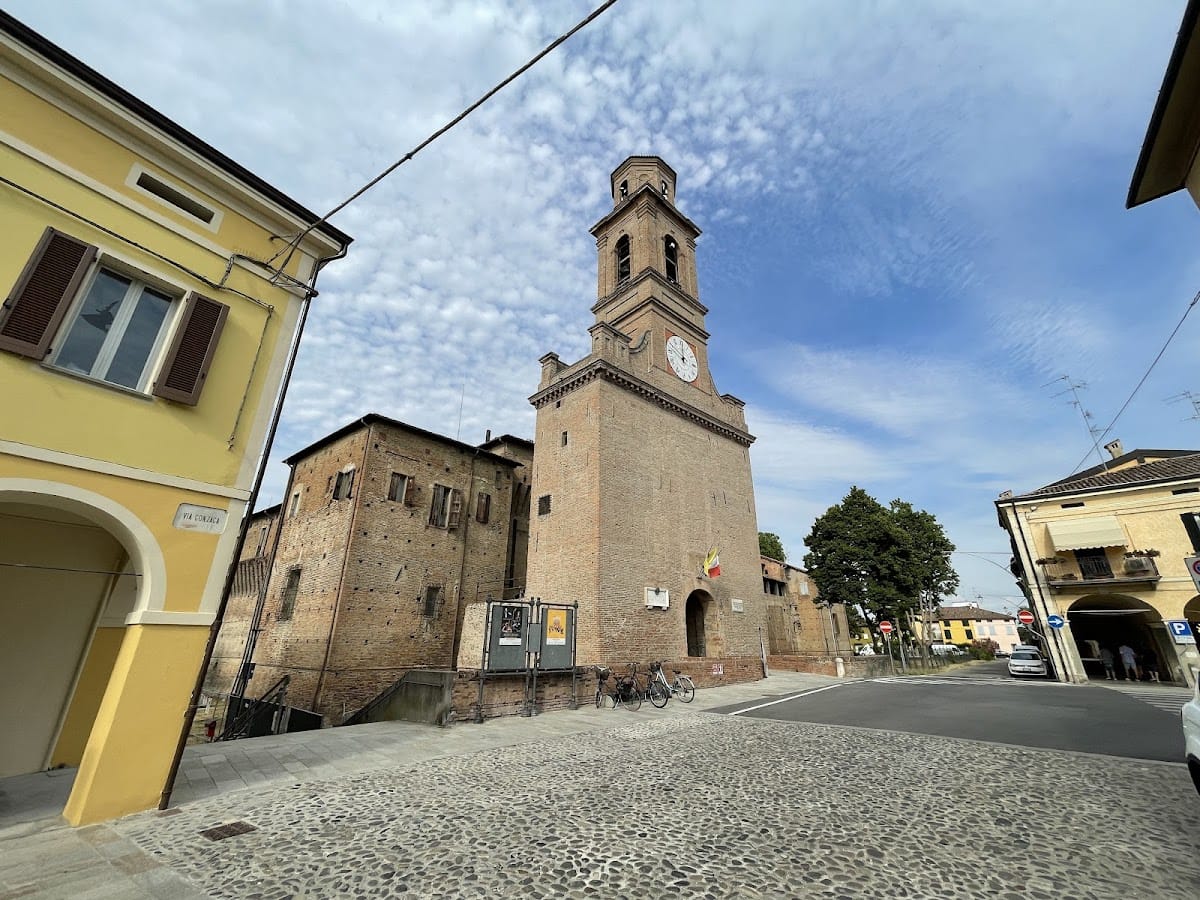
At the end of the seventeenth century, the main tower was raised and fitted with bells and a clock. Known as the Campanone, it became a prominent functional element of the complex. After Filippo Alfonso Gonzaga, the family’s last heir, died in 1728, the County of Novellara and the Rocca passed to Rinaldo d’Este, a member of the House of Este.
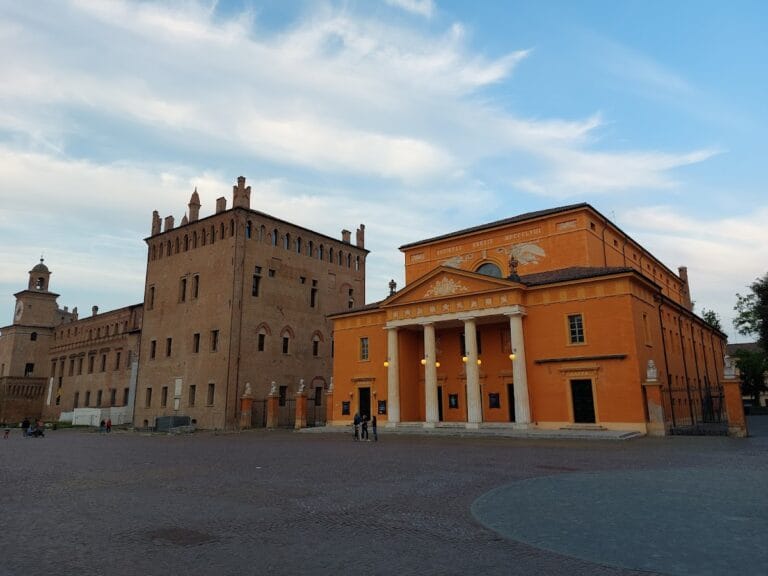
The Rocca now accommodates Novellara’s municipal administration, the Gonzaga Museum, the Museum of Rural Civilization, and a theatre constructed in the mid-nineteenth century. The complex is designated Italian national heritage.
Remains
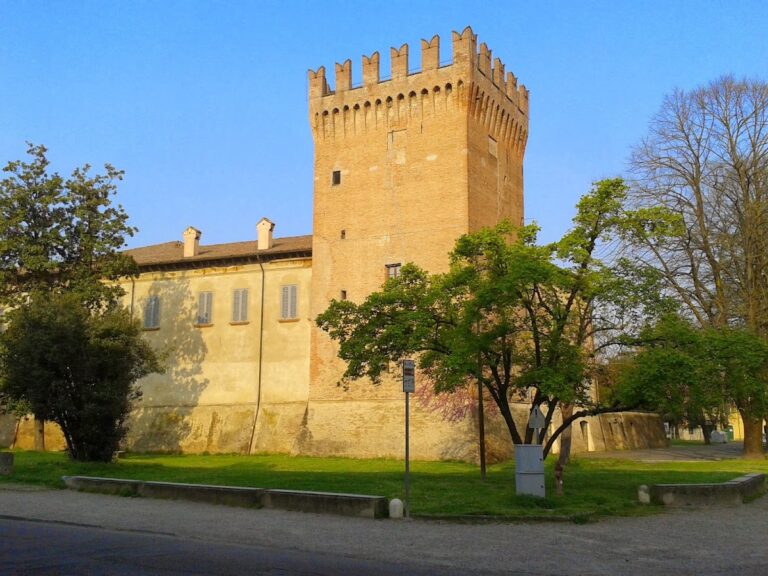
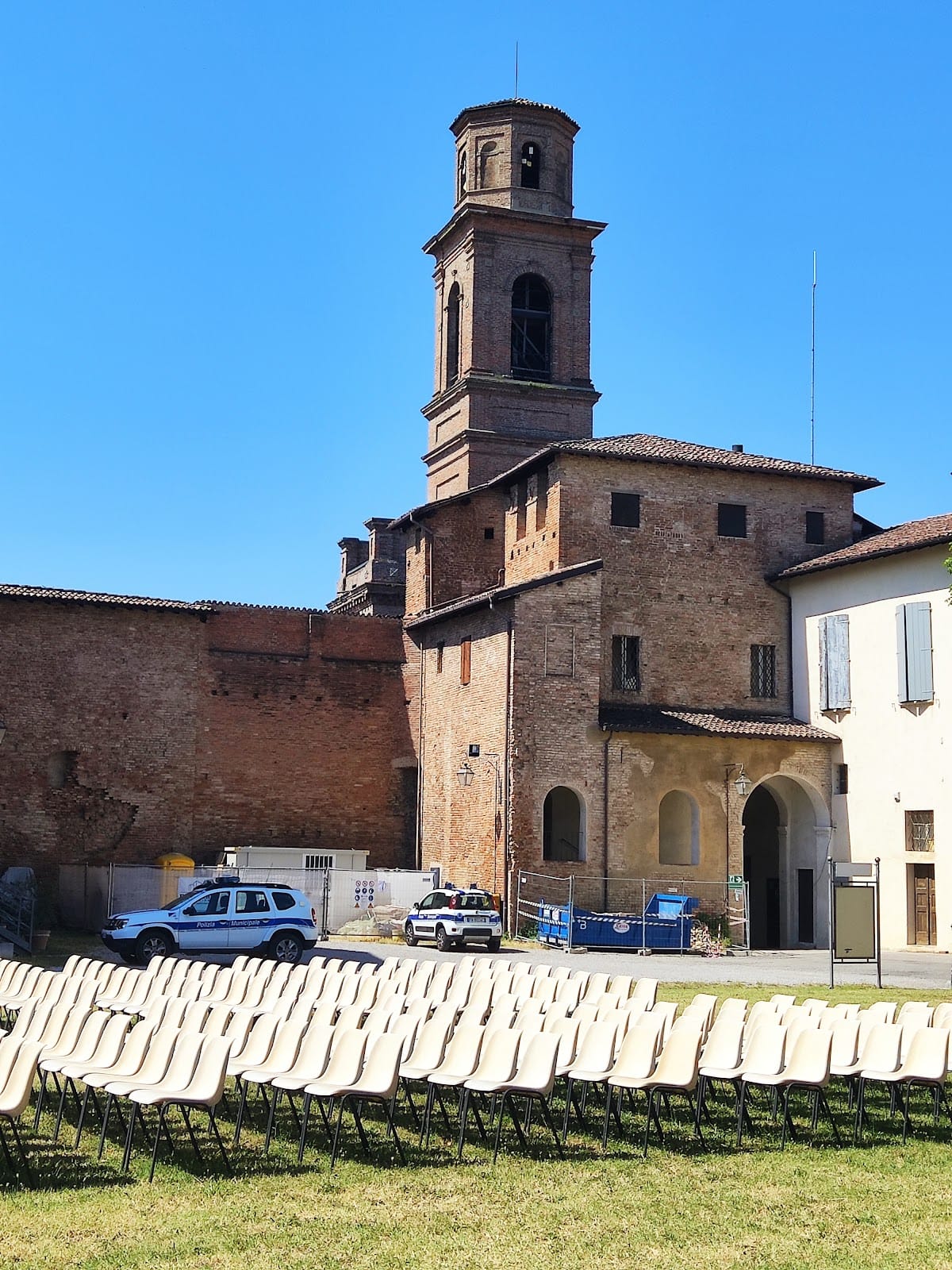
Rocca di Novellara is a lowland medieval fortress built of brick and pebbles. The well-preserved complex retains the defensive arrangement associated with Guido II Gonzaga’s fortress, as well as later additions that adapted it for residential, cultural, and civic use.
Defensive enclosure
Walls and corner towers
The fortress had enclosing walls and four towers positioned at the corners. Together, these elements formed the principal defensive enclosure of the medieval Rocca and remain part of the complex’s physical structure.
Entrances and ravelin
Two drawbridges served the fortress, while a ravelin, a detached fortification placed outside an entrance to shield the gate from attack, protected the approach to the entry. These features express the defensive design of the fortress built under Guido II Gonzaga.
Residential and civic spaces
Campanone
The main tower, called the Campanone, was raised at the end of the seventeenth century. It contains bells and a clock, reflecting the tower’s later role within the evolving complex.
Painted rooms and theatre
The early-sixteenth-century remodelling added a storey and changed the fortress into a seigneurial residence. Lelio Orsi’s work survives in the form of painted rooms and coffered ceilings. The complex also contains a theatre dating from the mid-nineteenth century, alongside the municipal offices, the Gonzaga Museum, and the Museum of Rural Civilization.