Sidon Sea Castle: A Crusader Fortress Defending Lebanon’s Harbor


Site at a Glance
- Rating
- 4.3
- Popularity
- Medium
- Country
- Lebanon
- Primary era
- Medieval
- Eras represented
- Iron Age, Medieval, Early Modern
- Civilizations
- Crusader, Mamluk, Ottoman, Phoenician
- Site type
- Military
- Remains
- Castle
On this page9 sections
History
Sidon Sea Castle is a medieval Crusader fortress in Sidon, Lebanon, built in 1228 to defend the city’s harbor. Sidon was an ancient Phoenician city on the Mediterranean coast, with religious, political, and commercial importance and a history of settlement reaching back to approximately 4000 BC.
Ancient Sidon and the Island
The small island occupied by the castle probably held a temple of Melqart, a major Phoenician god whom Greek and Roman writers identified with Heracles. The temple was damaged and rebuilt several times. The island may also have contained a Phoenician king’s palace and other monuments. These were destroyed by Esarhaddon, a king of the Neo-Assyrian Empire, and by later earthquakes. During attacks on Sidon, the island served as a refuge for people escaping the city.
Accounts of the Assyrian king Sennacherib’s campaigns against Sidon and nearby cities mention Greater Sidon, Lesser Sidon, strong fortresses, pastures, cisterns, towers, and other defenses. Submerged remains around the castle preserve evidence of the earlier Phoenician city.
Crusader and Mamluk Rule
Latin Christian Crusaders established the castle as part of the fortifications of the medieval Holy Land and placed it under the control of the House of Grenier, a noble family connected with the Crusader states. Its position at the harbor gave the fortress a defensive role as well as a direct connection with Sidon’s maritime life.
The Mamluks, a military ruling dynasty that governed Egypt and much of the Levant after the Crusader period, damaged the castle when they captured Sidon from the Crusaders. They later rebuilt it and added a long causeway linking the island with the mainland.
Later Restoration and Modern Memory
After several centuries of disuse, Emir Fakhr al-Din II restored the castle in the seventeenth century and rebuilt its most damaged sections. During the 1941 Syria and Lebanon campaign, Australian troops were photographed among the ruins, providing a record of the fortress in the modern period.
Remains
Island Fortress
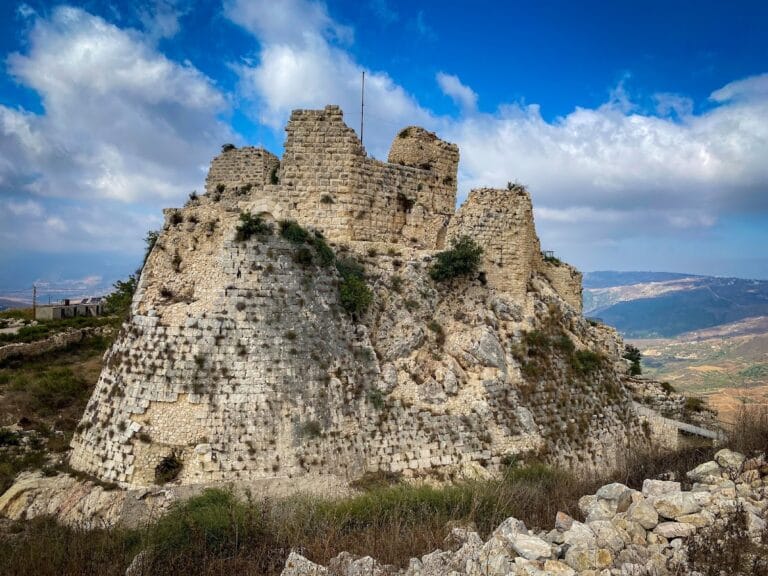
The castle occupies a small island joined to the mainland by a narrow causeway approximately 80 metres long. The surviving fortress is formed mainly by two towers connected by a wall. Roman columns were set horizontally into the outer walls as reinforcement, combining elements from different periods of Sidon’s history.
Western Tower
The rectangular western tower, positioned to the left of the entrance, is better preserved than its eastern counterpart. Inside it is a large vaulted room, meaning a chamber roofed by an arched structural vault. Cannon fire damaged the room, where fragments of carved capitals and rusty cannonballs remain. A spiral staircase rises to the roof, which carries a small domed mosque from the Ottoman period.
Eastern Tower
The eastern tower survives in a more fragmentary condition and was constructed in two stages. Its lower portion belongs to the Crusader period, while the upper portion was added by the Mamluks. Together, the two sections show how the fortress was altered after control of Sidon passed from the Crusaders to their successors.
Submerged Phoenician Remains
The sea around the castle contains remains of the ancient Phoenician city. These include wall structures, columns, paved surfaces, stairs, buildings, statues, towers, and cisterns, which were reservoirs designed to collect and store water. The underwater remains extend the archaeological setting of the fortress beyond the island itself and preserve evidence of Sidon’s earlier urban landscape.