Ashtown Castle: A Medieval Tower House in Phoenix Park


Site at a Glance
- Rating
- 4.5
- Popularity
- Low
- Country
- Ireland
- Primary era
- Medieval
- External website
- Open
- Eras represented
- Medieval, Early Modern
- Civilizations
- English
- Site type
- Military
- Remains
- Castle
On this page7 sections
History
Ashtown Castle is a medieval tower house in Phoenix Park, Dublin, Ireland, commonly thought to have originated in the fifteenth century. A tower house combined domestic accommodation with defensive features in a compact, vertically arranged residence. The castle’s small dimensions have been linked to a policy associated with King Henry VI of England, whose government offered a £10 subsidy for castles meeting minimum defensive requirements. Although its precise construction date remains uncertain, the building certainly existed by the early seventeenth century.
Medieval origins and seventeenth-century changes
The castle may have been built around the 1430s, but this date is not certain. Its roof appears to have been altered during the seventeenth century, when the building formed part of the property of John Connell, also known as John of Ashtown. In 1641, his estate covered approximately 200 acres and was valued at about £200.
Georgian residence and diplomatic use
Construction of the adjoining Ashtown Lodge began in 1751. During the Georgian period, an era associated with classical architecture and the reigns of the Hanoverian kings named George, the lodge was modernized and enlarged from 1774. From 1782, it served as the official residence of the Under Secretary for Ireland, a senior British official who assisted the chief secretary in governing Ireland.
Between 1922 and 1929, the estate housed the United States embassy before the embassy moved to the Deerfield estate. Ashtown Lodge remained a diplomatic residence and was occupied by the Apostolic Nuncio, the Vatican’s diplomatic representative to Ireland, until 1978.
Discovery, demolition, and restoration
By 1978, dry rot had left the lodge structurally beyond repair. When the lodge was demolished, the earlier castle was discovered concealed within its walls. The possible use of the property by the Taoiseach, the head of Ireland’s government, was discussed, but the lodge was removed while the castle core was retained. Ashtown Castle was restored in 1989 after a period of poor structural condition and now forms part of the Phoenix Park Visitor Centre.
Remains
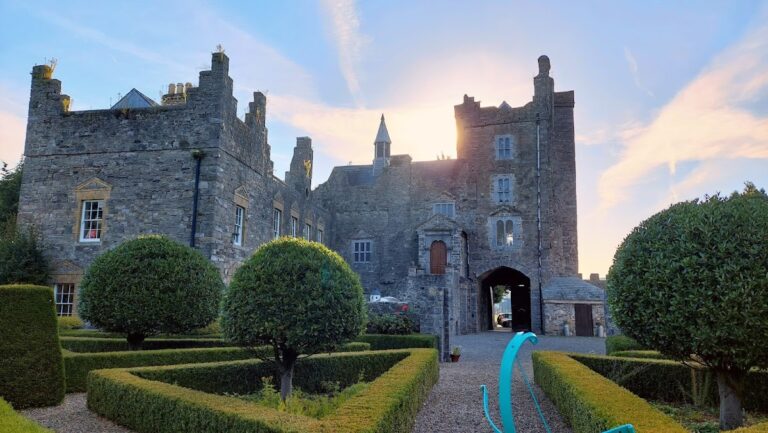
Ashtown Castle survives as a four-storey tower house on a rectangular plan measuring approximately 6 by 9 metres. Its compact form reflects the combination of residential and defensive purposes associated with this type of medieval building. The castle stands beside the Phoenix Park Visitor Centre, while the surrounding gardens mark the footprint of the much larger lodge that once enclosed it.
Tower house
A projecting structure at the southeast corner contains the stairway, including access by a spiral staircase. The original uses of the ground-floor rooms are uncertain, although they are thought to have included a kitchen. The lord’s living quarters occupied the first floor, while the second floor contained the great hall. Defensive arrangements were placed in the roof area.
The building now has a gabled roof, whose form indicates a seventeenth-century alteration. Georgian windows and other later additions connected with the castle’s use as part of a diplomatic residence were removed during the 1989 restoration, bringing the surviving tower more closely to its earlier appearance.
Former Ashtown Lodge
Ashtown Castle was incorporated into the much larger Georgian Ashtown Lodge, which transformed the earlier fortified house into a residence designed to resemble a castle. The lodge has since been demolished. Its former footprint remains legible through the gardens surrounding the tower, while the retained castle core preserves the earlier building within the altered estate.