Castro of Chibanes: A Prehistoric Hilltop Settlement in Portugal
Site at a Glance
- Popularity
- Low
- Country
- Portugal
- Primary era
- Stone Age
- Eras represented
- Stone Age, Iron Age, Classical
- Civilizations
- Roman
- Site type
- Military
- Remains
- Fortified Town
On this page13 sections
History
The Castro of Chibanes is a hilltop settlement on the Serra do Louro in Palmela municipality, Portugal, first occupied around 2900 BCE during the Chalcolithic, or Copper Age. Its history includes an early occupation that continued into the Early Bronze Age, a long interval without settlement, and later Iron Age and Roman use.
Chalcolithic and Early Bronze Age
The earliest community farmed crops and raised livestock, while also hunting, gathering shellfish, and fishing in estuaries with the tides. Nearby farmland, rivers, and the sea shaped the settlement’s resources; the Sado estuary was probably an important source of food. The archaeological record also helps trace long-term exchange and social change linking the territory of present-day Portugal with northern Europe and the Mediterranean.
This first period of occupation extended broadly from around 2900 to around 2000 BCE. Sections of the early fortifications and residential areas collapsed around 2600–2500 BCE, possibly in an earthquake, and settlement activity may have paused for a time. The final defined Chalcolithic subphase is dated to about 2300–1900 BCE. People may have begun to establish themselves in nearby lowland areas during this phase. The community may also have buried its dead in the artificial caves at Quinta do Anjo, also known as the caves of Casal do Pardo.
Iron Age and Roman use
After a hiatus of about 1,700 years, people returned during the later Iron Age, in the third and second centuries BCE. Roman-period use followed. The wider area’s regional importance is also reflected by the nearby remains of Alto da Queimada, associated with Roman, medieval, and Islamic-medieval settlement.
Islamic-era association and archaeological study
In the twelfth century, under the Almohads, a Muslim dynasty that ruled parts of the Iberian Peninsula and North Africa, the hilltop was associated with an Islamic-era rural settlement called an alcaria, a term for a village.
António Inácio Marques da Costa identified and first excavated the site in 1906. Carlos Tavares da Silva and Joaquina Soares, archaeologists at the Museum of Archaeology and Ethnography of the Setúbal District, have carried out further excavation and study since 1996. The site is registered as a Special Protection Zone and has been classified as a Site of Public Interest since 2011.
Remains
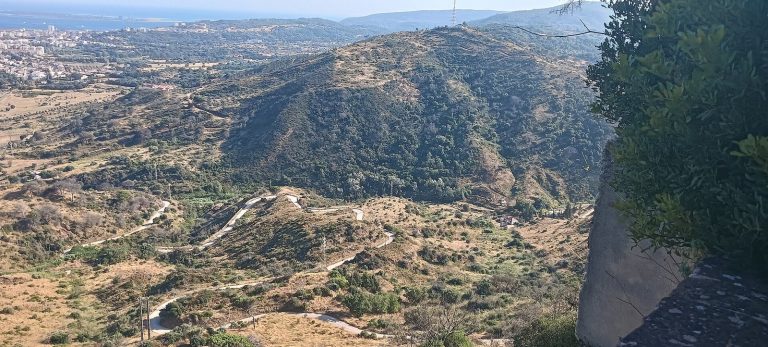
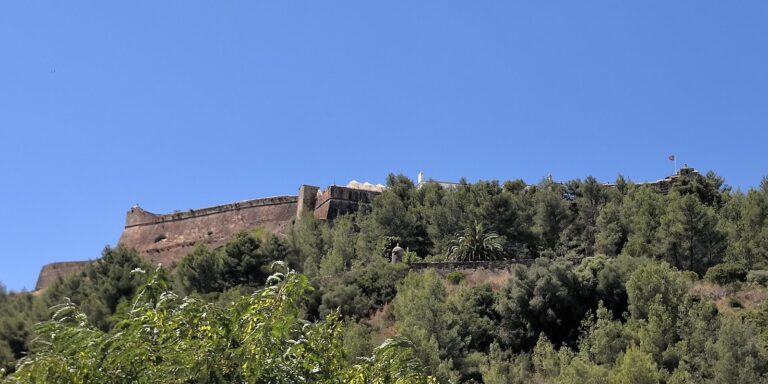
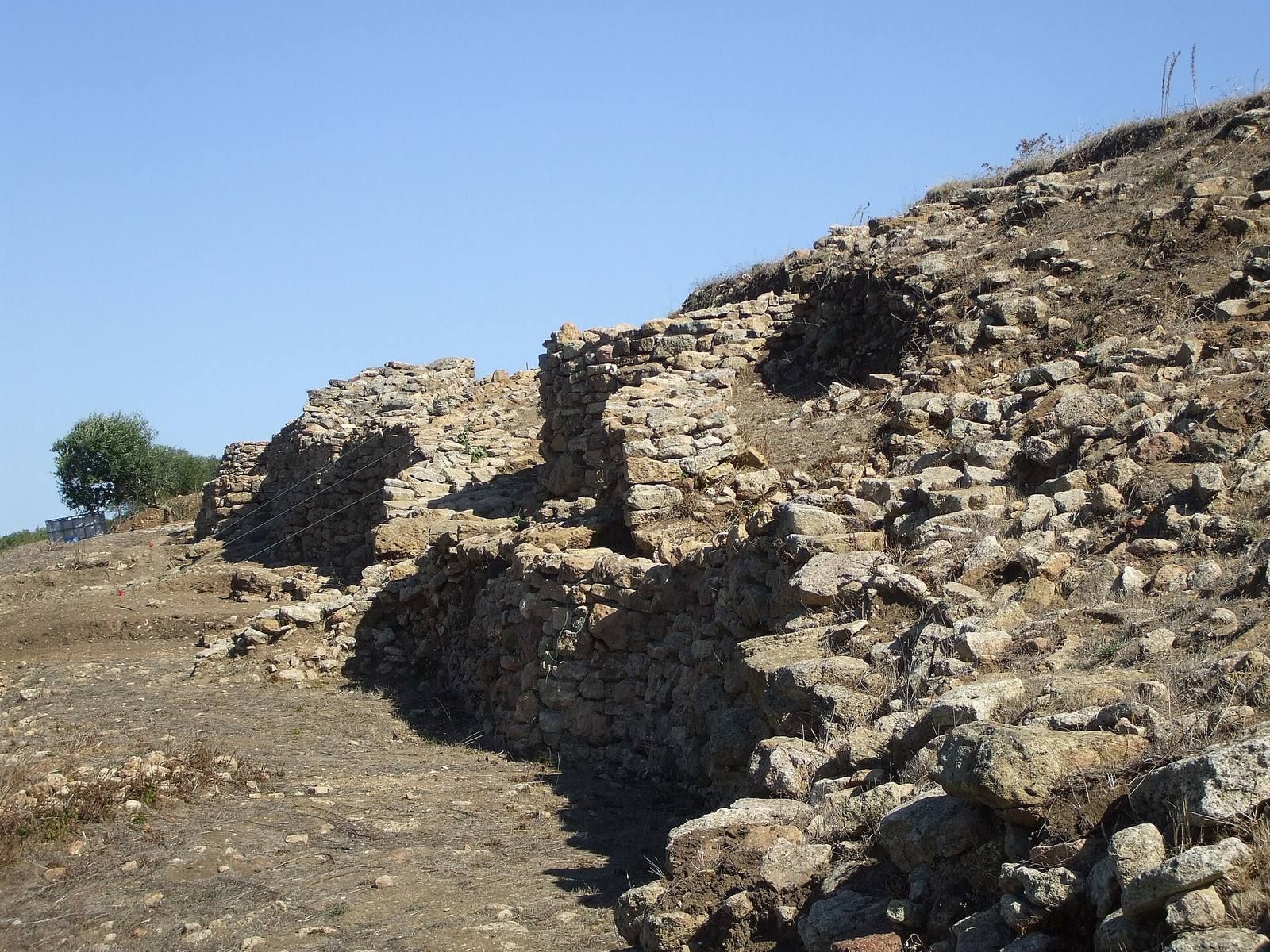
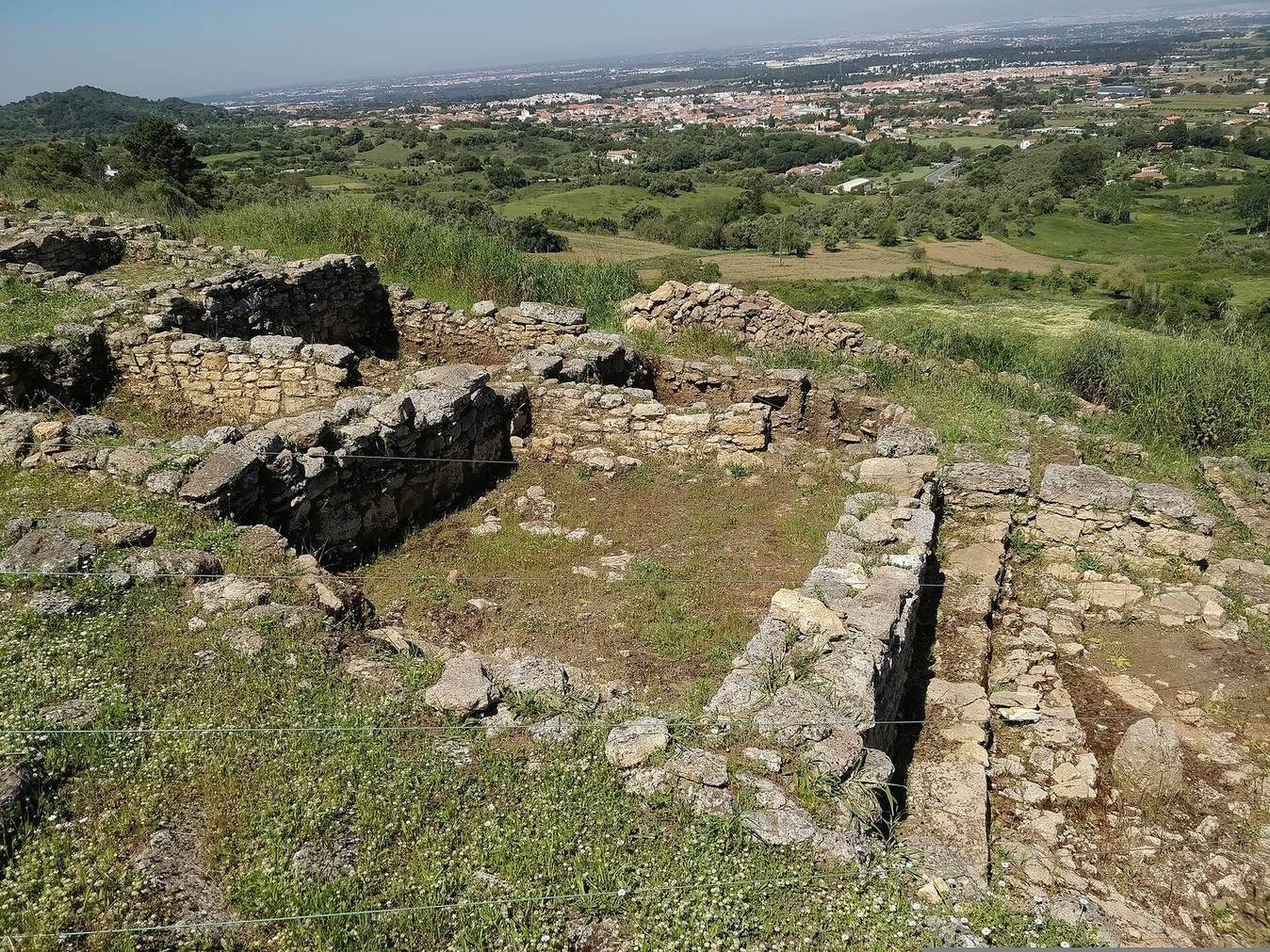
The settlement covers about one hectare on a hilltop. A steep natural slope protects its southern side, while the northern-facing slope carries remains of successive fortifications. The Tagus estuary lies to the north and the Sado estuary to the south; Lisbon is also visible from the summit.
Chalcolithic defenses and material evidence
Early fortifications
During the early and middle Chalcolithic, a defensive wall about 300 metres long followed the north-facing slope. It incorporated semicircular projecting defenses. The settlement’s early residential areas formed part of this defended site.
Pottery and copper working
Pottery from the earliest phase, dated about 2900–2600 BCE, often has fluted decoration, particularly on drinking vessels. Acacia-leaf patterns appear on pottery in the phase dated about 2600–2500 BCE and become more frequent on vessels in the following phase, about 2500–2300 BCE. Copper-smelting furnaces were built during that later phase, and copper production was substantial in the final Chalcolithic subphase.
Bell-Beaker pottery, part of a prehistoric tradition recognized in part by its bell-shaped vessels, appears in two styles in the final Chalcolithic subphase. Local Palmela-style vessels carry dotted and incised geometric patterns; another style bears impressions made by pressing twisted cord into unfired clay.
Animal and food remains
Animal bones include European rabbits with butchery marks, probably hunted rather than domesticated. Pig or boar bones suggest that these animals were likely domesticated and slaughtered at about 12–24 months; they appear to have provided a principal source of meat. The remains also include a small number of red deer bones, 20 cattle-bone fragments, and 73 goat or sheep fragments, which may point to milk production as well as meat use. Bird remains include northern gannet. Fish bones and many mollusc remains were recovered, with grooved carpet shell clam the most common.
Iron Age and Roman structures and finds
Iron Age enclosure
In the third century BCE, a wall about 300 metres long formed a broad circular arc, following approximately the line of the earlier fortification. It included circular towers or rounded projecting defenses. Square and rectangular buildings stood close together within the enclosed area.
Later boundary and Roman-period building
A later wall was built above part of the Iron Age wall between the last quarter of the second century and the first quarter of the first century BCE. It was no more than 0.8 metres thick and appears to have marked the settlement’s boundary along the northern slope more than served as a defensive barrier. At the western end, a straight defensive wall system protected access along the Serra do Louro ridge; a similar arrangement may have existed at the eastern end.
Building work in the Roman Republican period, Rome’s political system before imperial rule, rearranged earlier buildings during the second quarter and around the middle of the first century BCE. The western defensive structure was adapted for residential use, and some existing walls were incorporated into the work.
Archaeological finds
Recovered material includes Chalcolithic pottery and incised Bell-Beaker pottery. Finds associated with the second Iron Age period include amphorae, large vessels used to transport and store goods, and pottery decorated with painted bands. Pottery from the later Iron Age and Roman periods is also present. Most of the recovered artifacts are held at the National Museum of Archaeology in Lisbon.