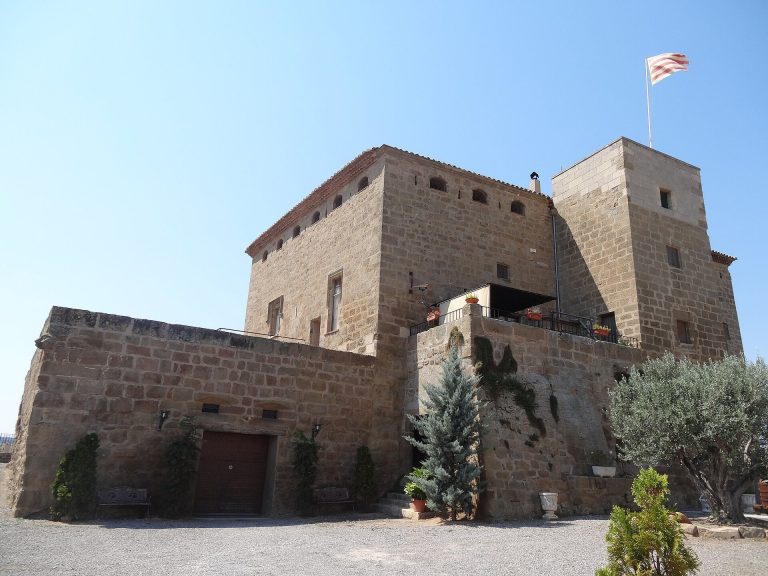
Reguers de Seró: A Pyrenean Dolmen and Statue-Menhir Group
Site at a Glance
- Popularity
- Very Low
- Country
- Spain
- Primary era
- Bronze Age
- Eras represented
- Bronze Age
- Civilizations
- Unclassified
- Site type
- Burial
- Remains
- Tomb
On this page17 sections
History
The Reguers de Seró statue-menhirs and dolmen form a prehistoric burial monument near Artesa de Segre, Spain. Built in the third millennium BC, the tomb is a Pyrenean-type dolmen, a regional form of simple megalithic tomb. Human remains date funerary use to about 2880–2580 BC and again to about 2127–1903 BC, while associated grave goods include objects linked to the Bell Beaker tradition, recognized in part by its distinctive pottery.
Construction and earlier sculptures
The tomb incorporated parts of an earlier monument, probably including at least three statue-menhirs. These carved stones were deliberately broken and reused in the chamber and mound. The original monument and arrangement of the sculptures remain unknown. Statue-menhirs A and B may date to the Late Neolithic, the later phase of a prehistoric period characterized by farming and settled communities. Statue-menhir C may be later, perhaps contemporary with the dolmen, and might have had a role beyond serving as building material.
The tomb was disturbed in antiquity. Its closing slab was taken away and discarded, and some of the burial deposit was scattered beyond the chamber. Stones were then used to fill and deliberately seal the interior.
Discovery and preservation
The monument was discovered in 2007 during construction of the Segarra-Garrigues irrigation system, about seven kilometres from Artesa de Segre. The Prehistoric Research Group at the University of Lleida excavated it between January and April that year. Human remains and associated finds show that the tomb was used for burial in more than one period.
Study of the sculptures has established a distinctive group within Catalan megalithic culture and contributed to research on megalithic statuary in Iberia and Europe. Readings of the zigzag patterns as clothing and the rectangular designs as pieces of hide are interpretations rather than settled identifications. Comparisons with images from Catalonia, the Iberian Peninsula and elsewhere in Europe have also shaped their study. Similar graphic signs in Catalonia have been interpreted as evidence of contact with people in what is now France.
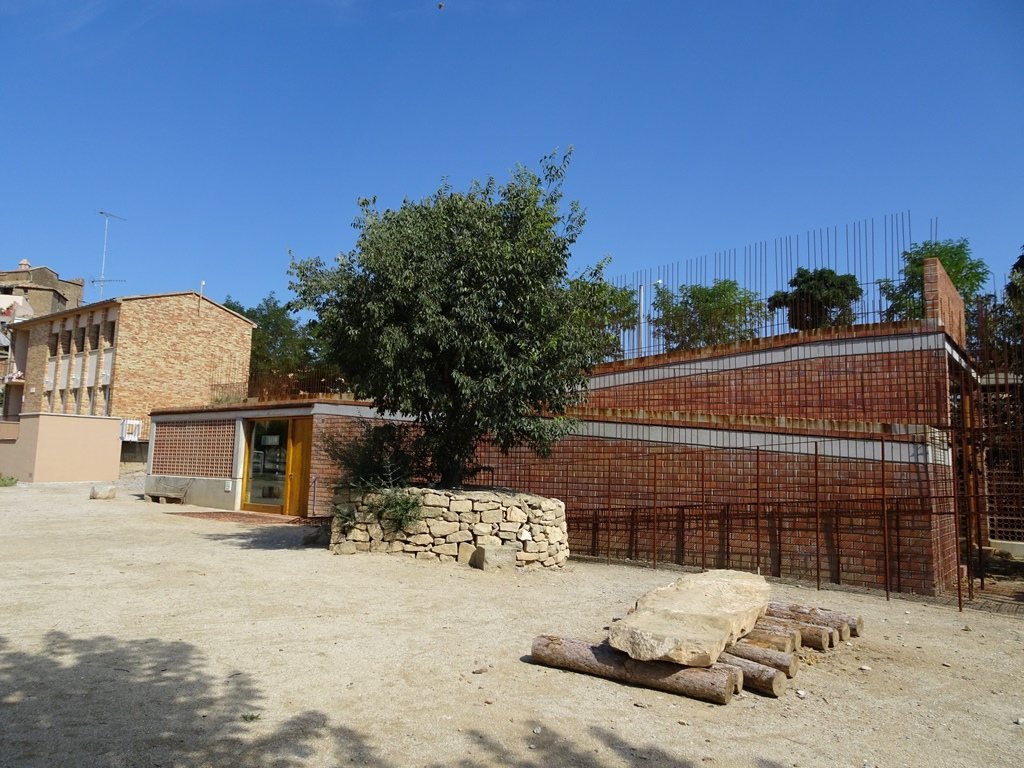
Construction work threatened the remains, so the tomb and statues were dismantled and reinstalled at the Seró Espai Transmissor museum in October 2013. The museum preserves and displays the stones and associated finds. La Noguera Museum oversees conservation, educational work and research.
Remains
The tomb lay about three metres underground in a valley bottom on the right bank of the Senill, a tributary of the Segre, at an elevation of roughly 400 metres. It stood on natural ground over older sediments and was later buried by river deposits and gravel. Flooding eroded the mound’s southern side and contributed to its burial beneath layers of silt, clay and gravel. The structure joined a rectangular chamber to a surrounding mound and stone enclosure.
Tomb and mound
Chamber
The chamber measured about 1.80 metres long by 1.40 metres wide and faced roughly west, at an orientation of about 280 degrees. Four large slabs of local calcarenite, a rock made mainly from sand-sized carbonate grains, formed its sides. They were seated in foundation trenches and secured with smaller blocks, some of them fragments of statues. The chamber’s covering arrangement is unknown. Small holes beside the trenches, each about 0.15 to 0.20 metres across, may have held posts or stakes. Burial underground left a thin layer of calcite on the chamber slabs.
Mound and enclosure
The mound had an original north–south diameter of about nine metres. Flat stones formed a pavement beneath a mass of stone and earth that did not completely cover the chamber. Seven slabs made up an outer enclosure, with smaller fragments of statue-menhir A incorporated into its stonework. Statue-menhir C was found lying on the mound with its decorated face down; it may originally have formed part of the enclosure.
Reused statue-menhirs
Statue-menhir A
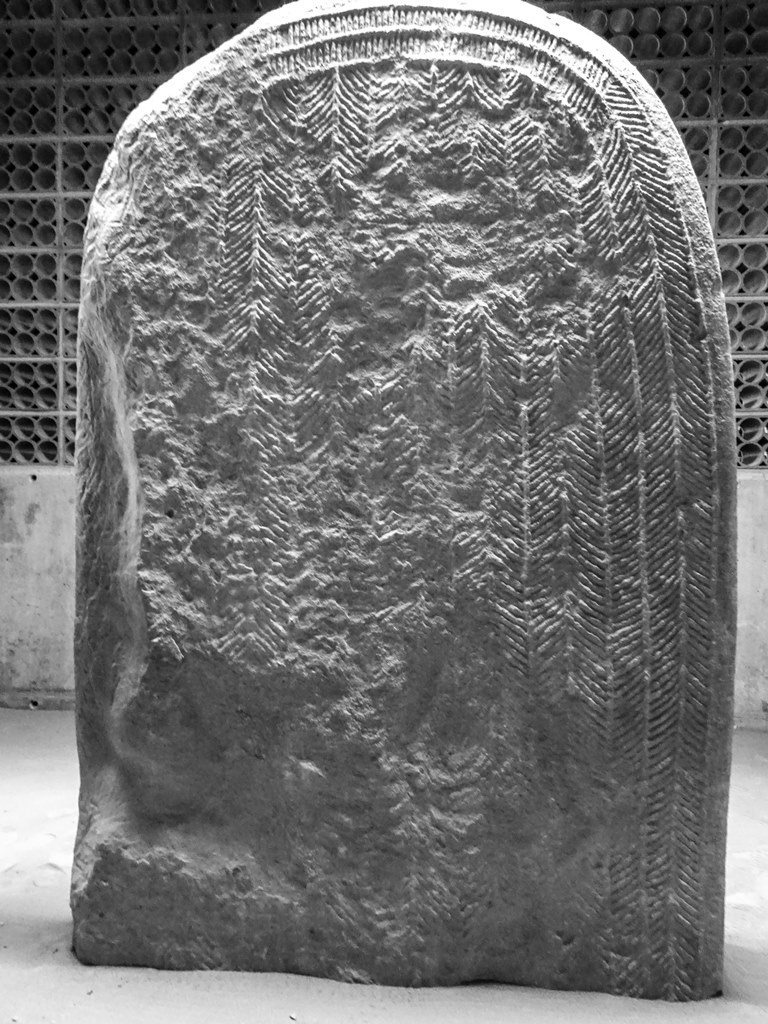
Seró A was broken into two approximately equal-height pieces, formerly catalogued as Seró V and VI. The complete statue is estimated to have stood at least 2.60 metres high, with a central width of about one metre and a thickness of 0.23 metres. Its carved decoration includes vertical chevron bands on the front, sides and top, and offset rectangles on the back. A smooth band with a central buckle has been interpreted as a belt holding a tunic beneath a mantle.
Seró V measures 130 by 100 by 30 centimetres and was found in place at the mound’s southwest edge. Its front has chevrons and a smooth belt-like band with a central rectangular feature, together forming a T-shaped design. Seró VI measures 129 by 92 by 23 centimetres. This trapezoidal slab supported the southwest part of the stone enclosure and carries six vertical chevron bands separated by plain bands.
Statue-menhir B
Seró B was divided into four pieces, once catalogued as Seró I–IV. The statue had a rectangular form with a rounded, semicircular top interpreted as an abstract head. Its estimated original height is at least seven metres; it was about 1.35 metres wide and 0.25 to 0.30 metres thick. Its style has been compared with statues of the Rouergue group, a group associated with a historical region of southern France. Unlike Seró A, it has no belt. A feature near the head has been read as a veil topped by a diadem.
Seró I, measuring 225 by 115 by 20–30 centimetres, is a nearly complete calcarenite slab with an inverted-U outline. It formed the chamber’s south side and has seven or eight vertical chevron bands on its front, with the outer bands following the slab’s shape. Seró II measures 170 by 135 by 20 centimetres and formed the east side; cuts were made to fit it into position. Nine chevron bands sit within a smooth border on its front, which also has an unidentified lower-left motif. A lattice design appears on the back.
Seró III, a 220-by-160-by-30-centimetre trapezoidal slab, formed the chamber’s north side. Despite two fractures and impact marks, it retains eleven chevron bands within a smooth border. Seró IV measures 100 by 140 by 25 centimetres and formed the west side and entrance. Its front bears nine chevron bands within a narrow border; traces of a lattice design remain on the back.
Statue-menhir C
Seró C is a thin, trapezoidal slab about 1.10 metres high, 0.75 by 0.60 metres across and 0.12 metres thick. One face is flat and the other slightly concave, and its edges are rounded. Both ends were recut, though it is unclear whether this happened when the slab was made or when it was reused. Irregular V-shaped incisions decorate only the flat face. The carving includes a belt and buckle, divided panels, a possible object and shoulder strap, and an almost complete right leg with five toes. Two small central cup-shaped depressions may be natural. The decoration may reflect more than one design phase; its technique and motifs differ from those of A and B and have been compared with examples from the Rouergue and Haut-Languedoc regions of southern France.
Other carved stones
Seró VII
This sandstone slab measures 110 by 75 by 12 centimetres. Its fluted patterns were made by abrasion, and it is described as the most carefully worked support in the group.
Seró VIII–XI
These four rectangular sandstone pieces have well-finished surfaces and decoration without recognizable figures. Their measurements are, respectively, 77 by 55 by 17 centimetres, 59 by 51 by 26 centimetres, 81 by 56 by 20 centimetres and 74 by 56 by 21 centimetres.
Burials and grave goods
Human and animal remains
Excavation recovered partial remains from two human burials. Those of a young adult included parts of the rib cage, clavicles and spine. Two incisors belonged to two different individuals. The burial layer was mixed in places with animal bones, stones and earth. The badly deteriorated animal bones were identified as belonging to sheep or goats.
Objects
The grave goods included nearly 400 shell beads and a stone bead, along with four triangular bone buttons pierced with V-shaped openings and a pyramidal shell button. Other finds included flint flakes, a flint arrowhead with barbs and a tang, and pottery. The pottery comprised Bell Beaker fragments, an undecorated bowl with a concave base, half of another vessel and additional sherds.