Schöner Brunnen: A Gothic Fountain on Nuremberg’s Main Market
Site at a Glance
- Popularity
- Very High
- Country
- Germany
- Primary era
- Medieval
- Eras represented
- Medieval, Early Modern, Modern
- Civilizations
- German, Holy Roman Empire, Kingdom of Bavaria
- Site type
- Civic
- Remains
- Fountain
On this page8 sections
History
Construction, water, and legends
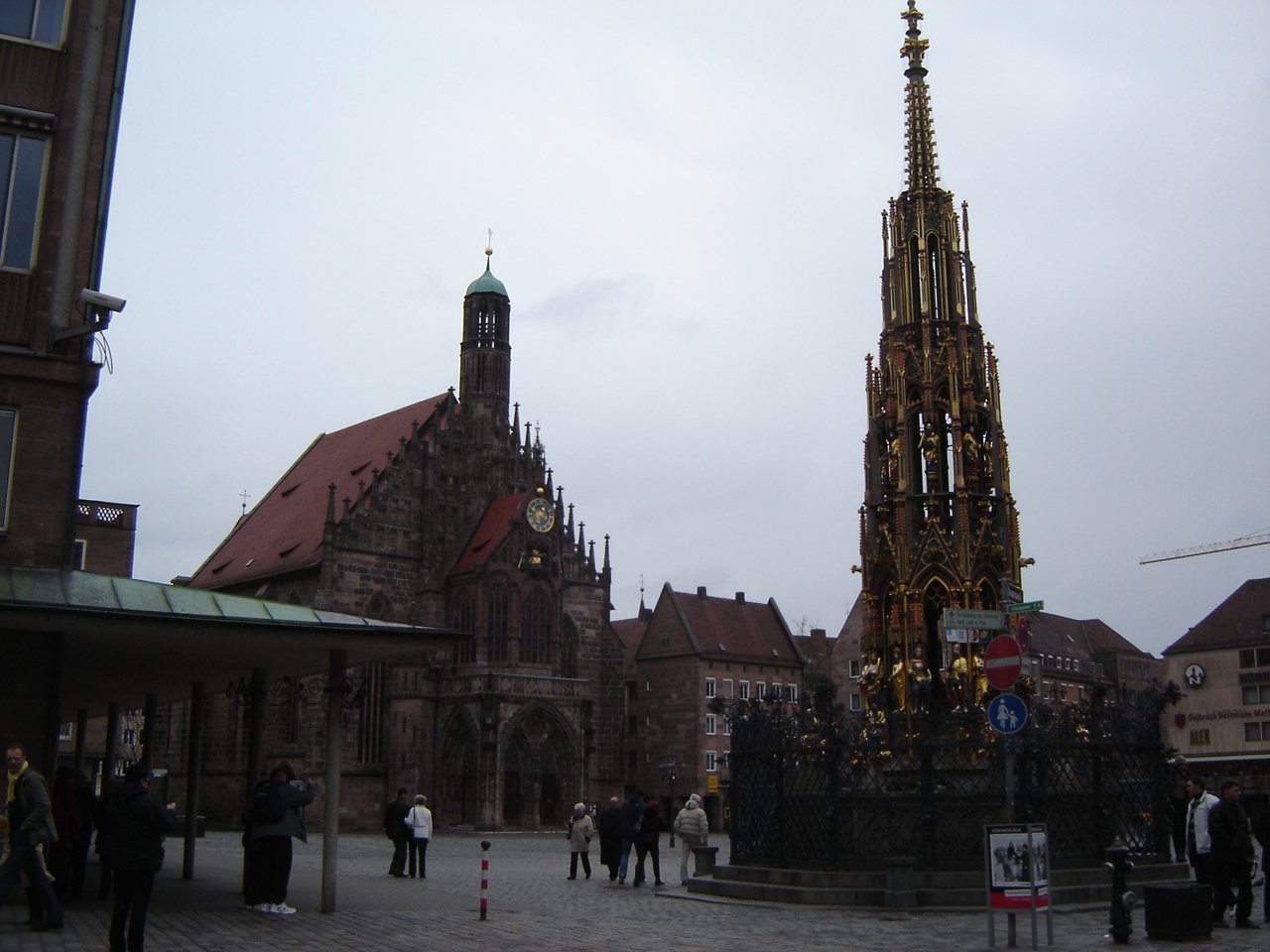
The Schöner Brunnen is a Gothic fountain on the Main Market in Nuremberg, Germany, constructed from 1385 to 1396. The medieval German builder and sculptor Heinrich Beheim is credited with its construction, although another attribution names the brothers Georg and Fritz Rupprecht working with Sebald Schonhofer.
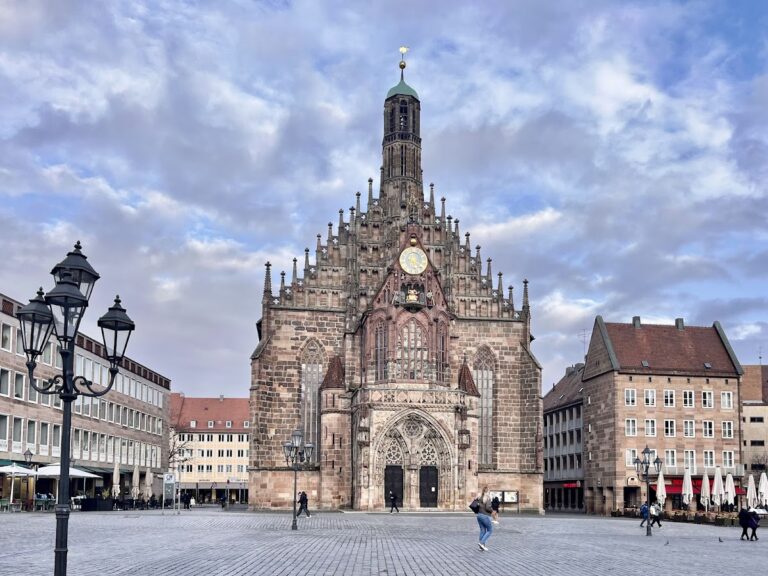
A legend links the fountain’s sculpture to the nearby Church of Our Lady. It says the sculpture was intended to crown the church, consecrated in 1358, but the plan was abandoned because it could not be lifted into place. Beheim’s earlier work on part of the church porch and his drawings for its furnishings may have helped give rise to the story.
The fountain received water through the Schönbrunn conduit, laid around 1388. Nuremberg chronicler Johannes M. Müllner instead dated its construction to 1362. The conduit was among the city’s oldest utility water systems and remained in use into the 20th century.
Another local legend tells of a master metalworker called Kuhn, who opposed his apprentice’s courtship of his daughter Margret because the young man was poor. Kuhn challenged him to make a grille ring that could turn. The apprentice secretly cut a ring, fitted it into the grille, and worked the join until it was concealed. He then left the city and never returned. Kuhn later regretted driving him away and would have accepted the marriage, but Margret was left to grieve. The tale promises good fortune and children to those who turn a ring. The brass ring is often treated as lucky, while many Nuremberg residents regard the black iron ring as the true one.
Restoration and copies
After Nuremberg joined the Kingdom of Bavaria in 1811, citizens and artists protested against a proposal to remove the fountain’s surrounding grille. Their opposition helped save it. Sculptor Jacob Daniel Burgschmiet restored the fountain in 1822–24, and a complete sandstone copy was made in 1835–39.
The stone original was restored under Heinrich Walraff between 1899 and 1903. A copy was installed on the Main Market in 1903, and the fountain was reconstructed in its present form in 1912, using the weathered Gothic original as its model.
Twentieth-century interventions
From 1902 until 1934, the Baroque Neptune Fountain stood as an architectural and urban-design counterpoint to the Schöner Brunnen. Nuremberg’s Nazi administration ordered its removal in 1934.
During the Second World War, a concrete casing shielded the fountain from air raids on Nuremberg, and it survived undamaged. In 2006, for the FIFA World Cup, German artist Olaf Metzel enclosed it in an installation of stacked stadium seats titled Goodbye. The work provoked bitter disputes between supporters and opponents.
Remains
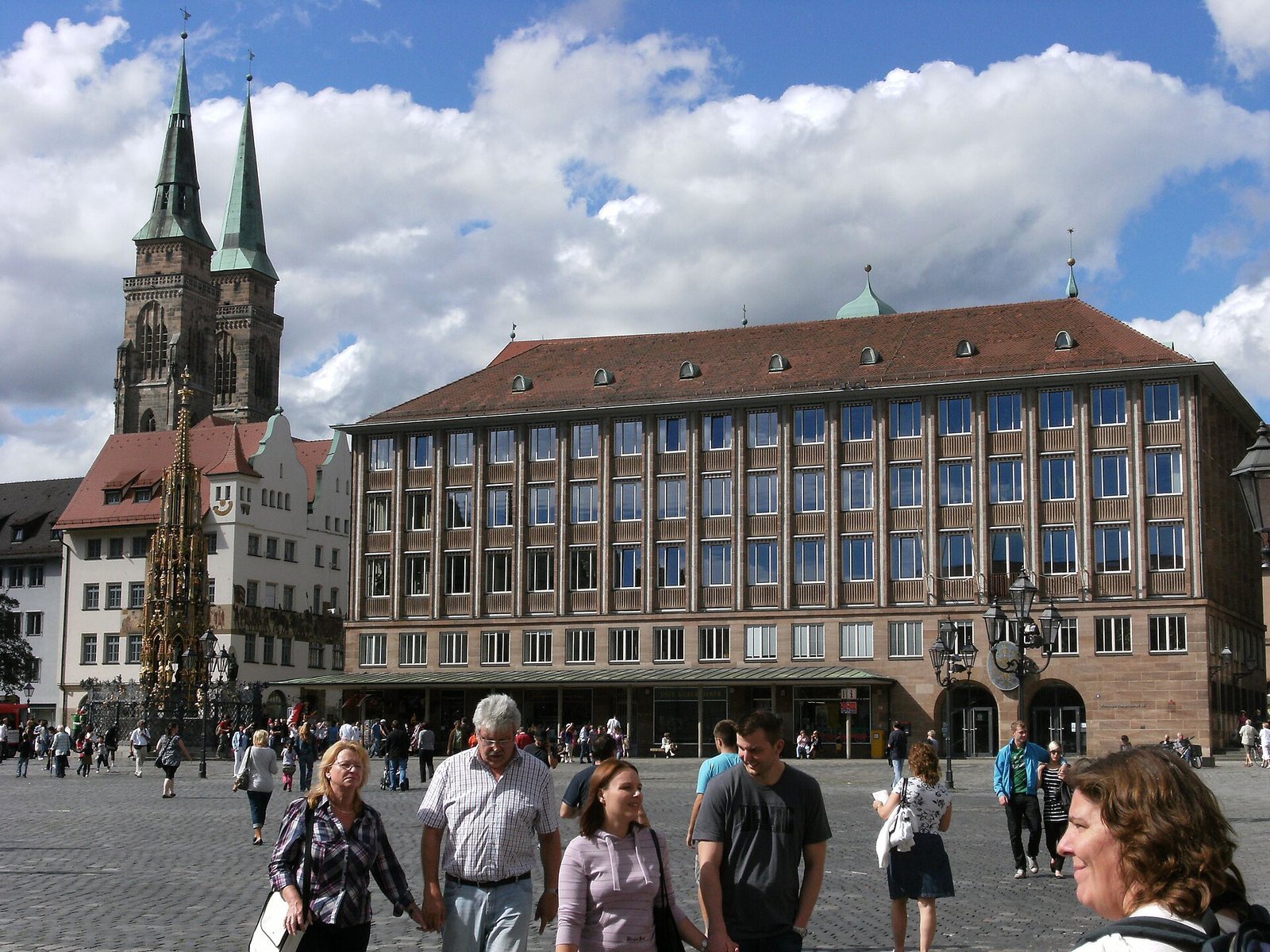
The fountain stands at the edge of the Main Market beside the town hall. About 19 metres high, it takes the form of a Gothic church spire with pinnacles. The brightly painted structure now on the square is a shell-limestone copy, with a ring of steps around its stepped platform. Pieces of the stone original are held by the Germanisches Nationalmuseum in Nuremberg.
Figures and symbols
Forty brightly painted figures occupy four tiers, presenting an image of the Holy Roman Empire, the Central European political order that lasted from the Middle Ages until 1806. The lowest tier represents Philosophy and the Seven Liberal Arts, a traditional curriculum of grammar, rhetoric, logic, arithmetic, geometry, music, and astronomy. Above them are the four Evangelists, traditionally associated with the Gospels, and four Church Fathers, influential early Christian theologians. The next tier shows the seven prince-electors, rulers entitled to choose the emperor, alongside the Nine Worthies, exemplary heroes of medieval tradition. Moses and seven prophets occupy the top tier. The water spouts represent the seven vices, while a stork is associated with good fortune.
Grilles and rings
Eight grilles surround the fountain, two fitted with turning rings. Augsburg ornamental locksmith Paulus Kuhn forged the rotating rings in 1587. The installation date of the original brass ring is unknown; it was renewed at least five times, in 1824, 1903, 1949, 1950, and 1957. The brass ring on the southwest side dates from 1957. An iron ring was installed on the northeast side in 1902 and has remained unchanged, while the other, stationary rings are Kuhn’s original work.
The Schönbrunn water conduit
The conduit began at two springs in Gleißhammer, south of the present railway line, and passed through Tullnau. At St. Peter, it crossed the Schütt, hospital-water, and wash-water conduits. It entered the city by the southern Zwinger Tower, part of Nuremberg’s defenses, near the Pegnitz river entrance. The route crossed the Pegnitz at Insel Schütt and again at Wildbad by Spital Bridge, then continued along Spitalgasse and Plobenhofstraße to the Main Market. The conduit was first made of wood and later partly replaced with lead.