Great Lavra: The First Monastery on Mount Athos
Site at a Glance
- Popularity
- High
- Country
- Greece
- Primary era
- Medieval
- Eras represented
- Medieval, Early Modern, Modern
- Civilizations
- Byzantine, Ottoman
- Site type
- Religious
- Remains
- Fortified Monastery
On this page22 sections
History
Great Lavra is an Eastern Orthodox monastery on Mount Athos in Greece, founded in 963 by the Byzantine monk Athanasius the Athonite. It was the first monastery established on the peninsula, and its foundation began an organized monastic community there. Great Lavra ranked first among Mount Athos’s twenty monasteries and held the largest territory.
Foundation and imperial patronage
Athanasius began the building project with support and funding from his friend, Emperor Nikephoros II Phokas. Work proceeded from a protective wall to the church and then the monks’ living quarters. Nikephoros had promised to become a monk at Great Lavra, but died before he could join the community. One tradition explains his support by his preference for monasteries in remote, rugged places; another says he intended eventually to leave the throne for monastic life. His wife, Theophano, and his nephew John Tzimiskes, who later became emperor, killed him while he slept. Tradition says he was found lying on a monk’s habit.
An imperial grant provided continuing support for the monastery, and John I Tzimiskes doubled it. Imperial gifts included the island of Saint Eustratius and the Monastery of Saint Andrew in Thessaloniki. Great Lavra’s community grew from 80 monks to 120, reached 160 by the end of the tenth century, and numbered 700 in the eleventh century. Smaller monasteries were also transferred to its authority. The monastery was founded on the site of an ancient city, possibly Akrothooi.
Athanasius and six others died in a building accident in 1000 or 1001. The monastery continued to operate after his death, and his feast is observed on July 5.
Medieval growth and changing monastic life
The fourteenth century was a high point in Great Lavra’s history. Among its monks was Gregory Palamas, an Orthodox theologian and leading figure in contemplative prayer. The monastery also faced attacks by forces associated with the Crown of Aragon and by other pirates. Further pirate raids in the fifteenth century damaged the complex and contributed to a shift toward idiorrhythmic life, in which monks had greater independence in their daily arrangements.
Near the end of the fifteenth century, damaged buildings were repaired, and the main church and its chapels were painted again. In the mid-1570s, a patriarchal decree restored cenobitic life, communal monastic life organized under a shared rule and leadership. The monastery prospered again, including by paying taxes on behalf of other monasteries. This period of renewed prosperity continued until the late eighteenth century, when Great Lavra declined and later returned to idiorrhythmic life. In 1655, Patriarch Dionysios III of Constantinople gave his personal fortune in an unsuccessful effort to restore communal life. Further attempts in 1914 also failed.
Early modern period and the Greek War of Independence
In the mid-eighteenth century, Great Lavra established the oldest printing workshop to operate in the Greek lands. At the outbreak of the Greek War of Independence, the monastery had 117 resident monks and 448 affiliated hermits, skete-dwellers, and cell-dwellers. Many of them took an active part in the revolution.
Modern communal life and heritage
Great Lavra returned to cenobitic life in 1980. Elder Athanasios, who lived from 1911 to 1984 and came from Iconium in Asia Minor, became its first abbot in this period and worked to renew communal monastic life. He had served the monastery for 55 years as a priest, steward of its dependencies, secretary, supervisor, and abbot. He also served a term as chief administrator of the Holy Community of Mount Athos, the body representing the peninsula’s monasteries.
The monastery is dedicated to the Annunciation, the Christian celebration of the angel Gabriel announcing to Mary that she would bear Jesus. It is under the Ecumenical Patriarchate of Constantinople and follows the Charter of Mount Athos, the governing framework for the peninsula’s monastic community. Great Lavra is included in the Mount Athos UNESCO World Heritage designation, inscribed in 1988. Its historical archives have been preserved almost intact, leaving an unusually complete record of its history among the monasteries of Mount Athos.
Remains
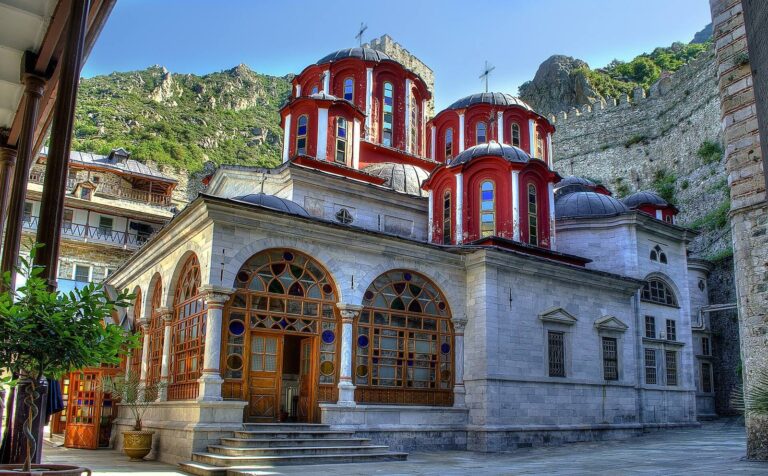
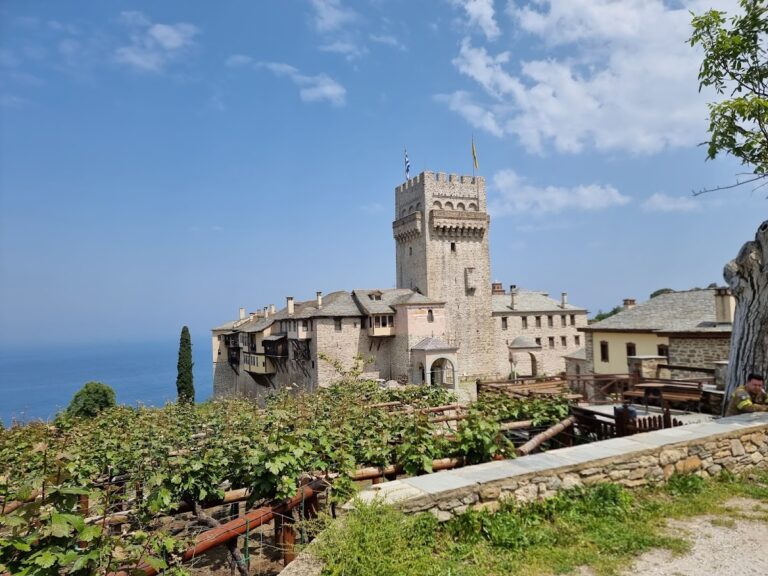
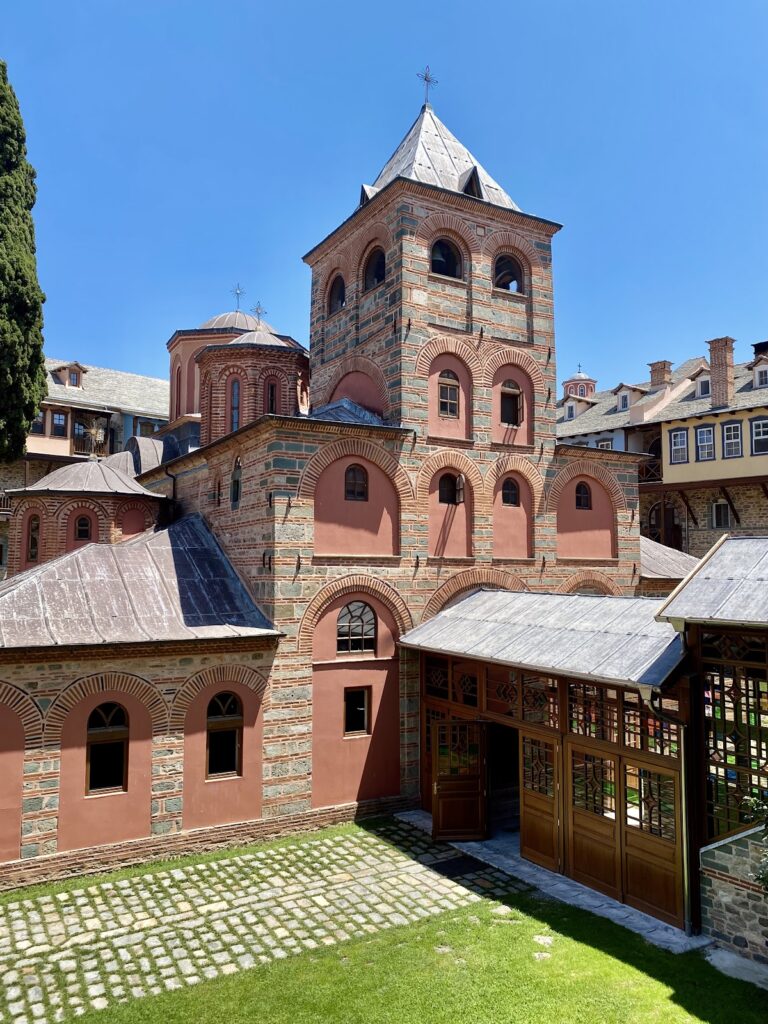
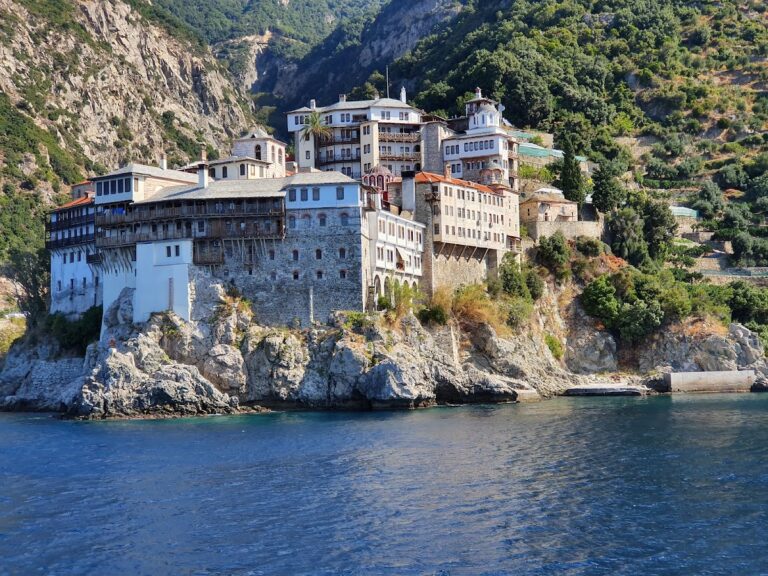
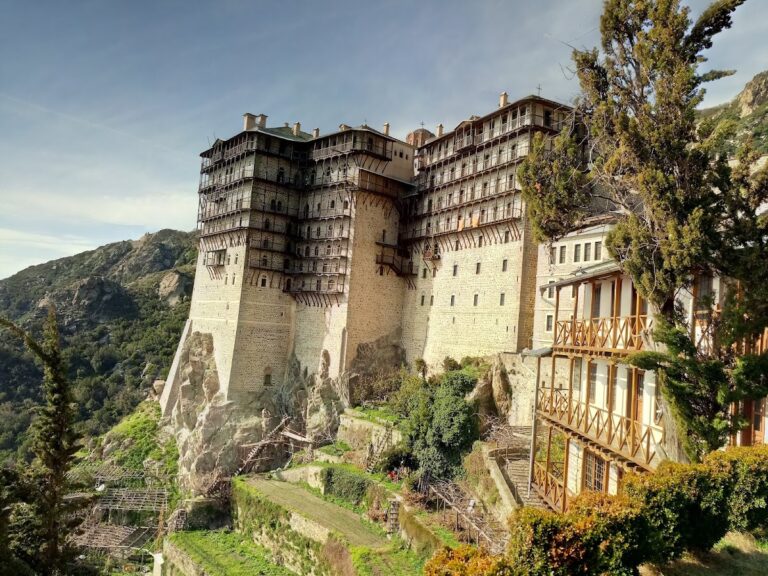
Great Lavra occupies a rocky plateau on the southeastern side of the Athos peninsula, slightly north of its southeastern tip. Its extensive complex is enclosed by a quadrangular protective wall, with church, chapels, refectory, and other monastic buildings within the monastery. Grounds and dependencies extend beyond the enclosure, from the nearby landscape to the coast and higher parts of the mountain.
The enclosure and surrounding grounds
Walls and defenses
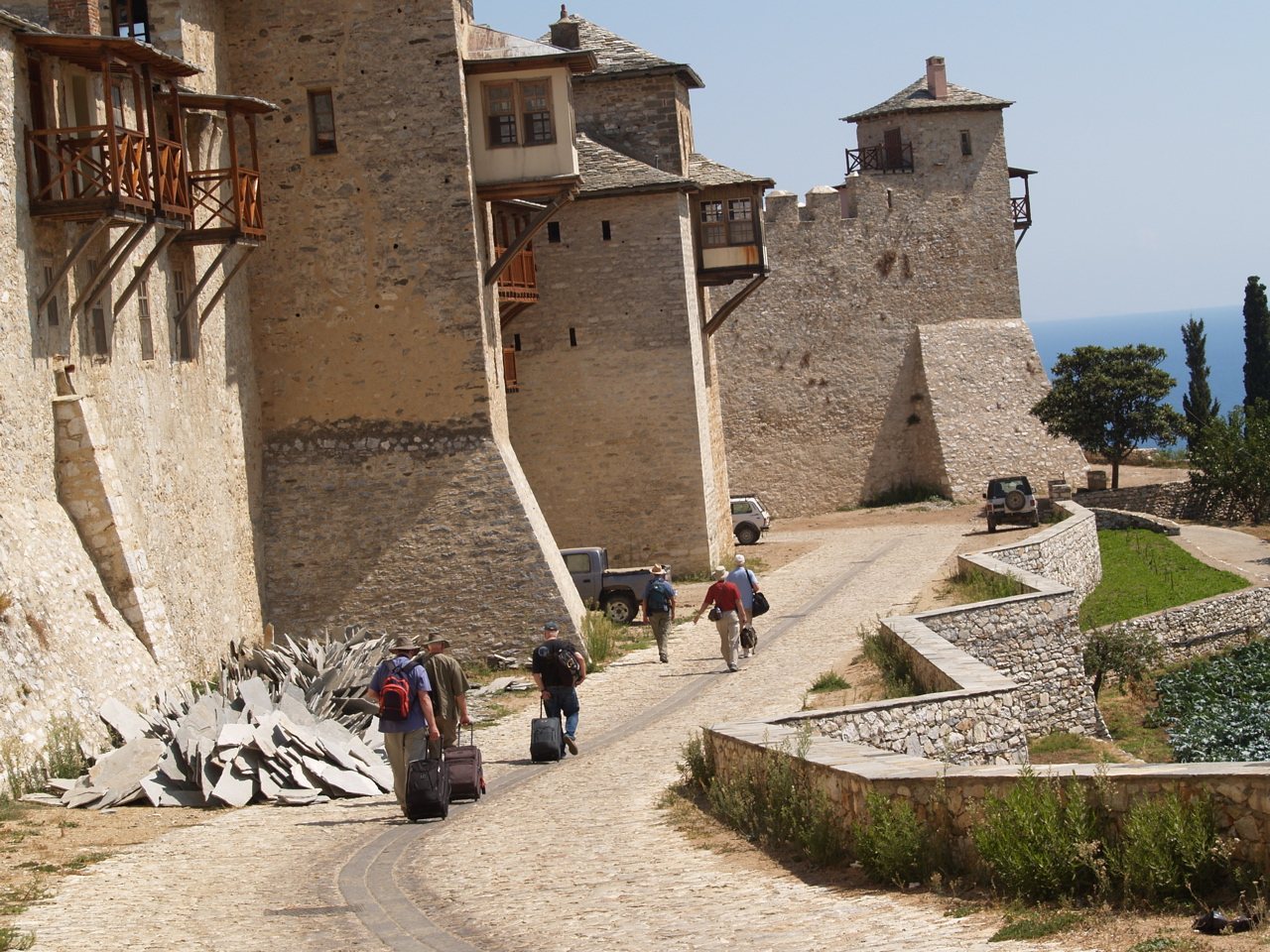
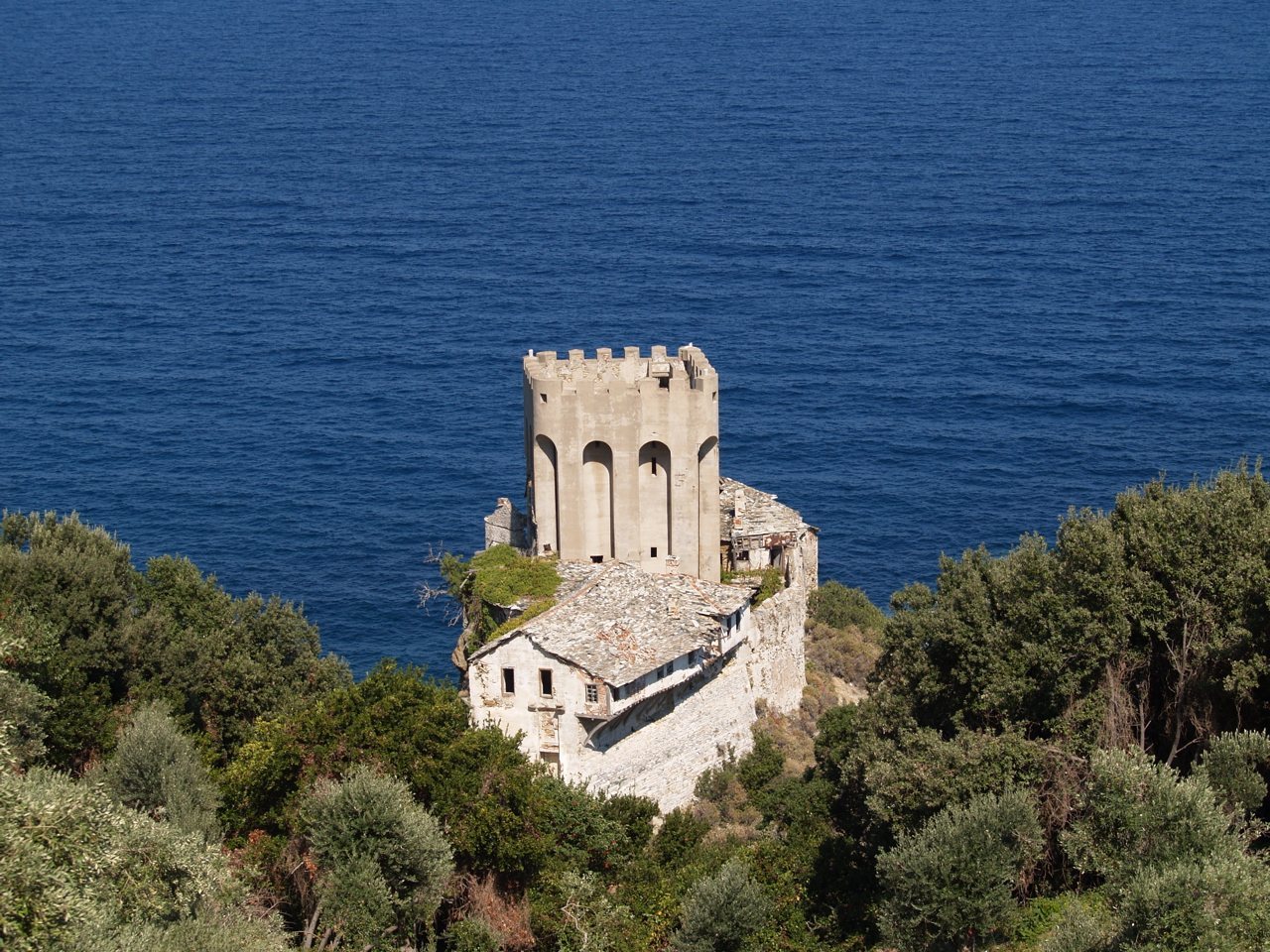
The protective wall, defensive towers, and castle-like arrangements reflect the monastery’s need to guard against pirate attacks. Projecting openings above the entrances were designed to let defenders pour hot oil down on attackers. The fortifications enclose the main monastic complex.
Grounds beyond the wall
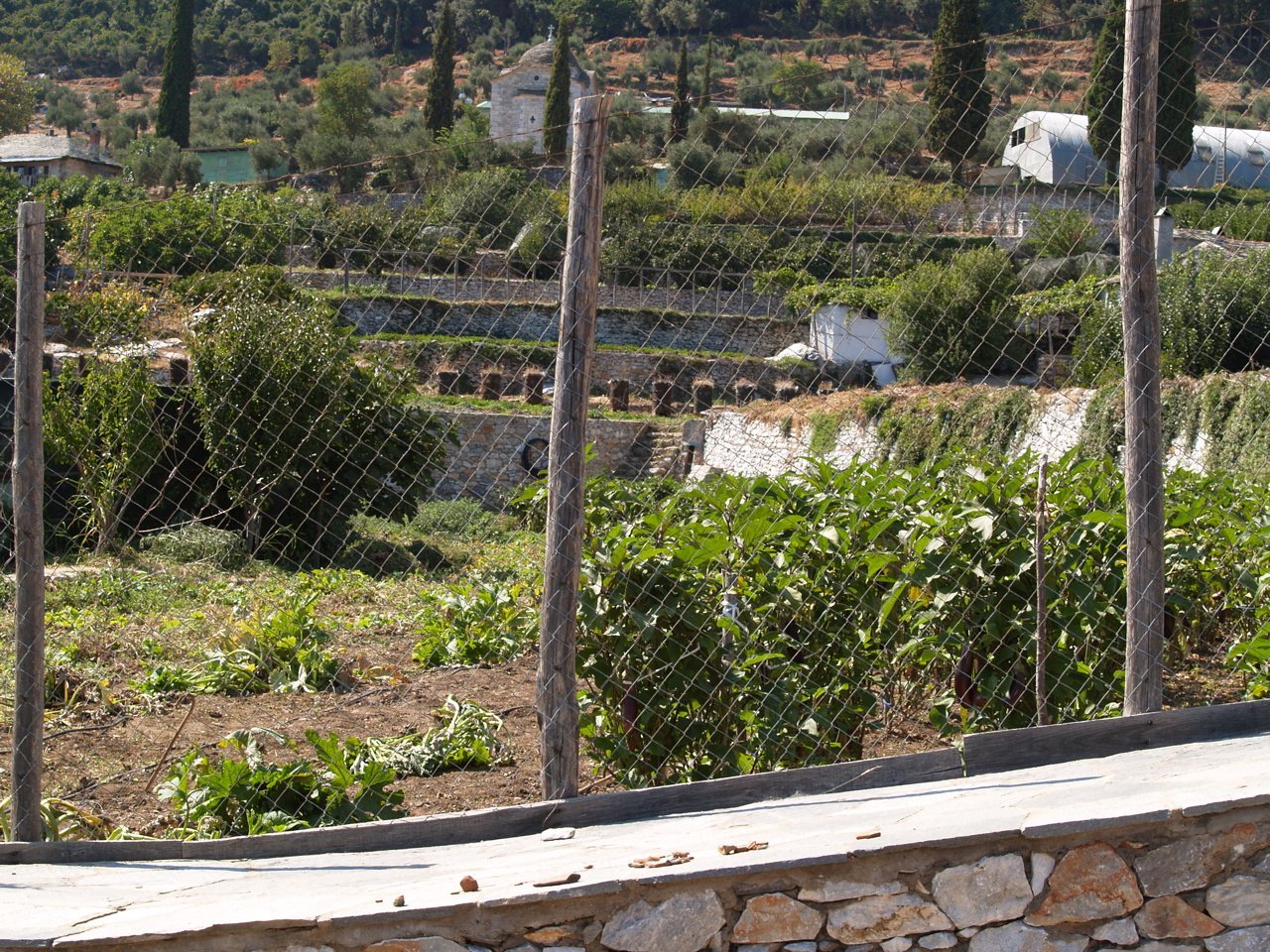
A watermill, vegetable plots, and a cemetery lie outside the monastery. The harbor is on the coast, while Athanasius’s hermitage stands high on the mountain. A cypress grows by the church entrance; tradition says Athanasius planted it and that it is more than 1,000 years old.
Ancient sarcophagi
The monastery’s oil-storage building holds sarcophagi associated with the ancient city on whose site Great Lavra was founded, possibly Akrothooi.
The church and worship spaces
The main church
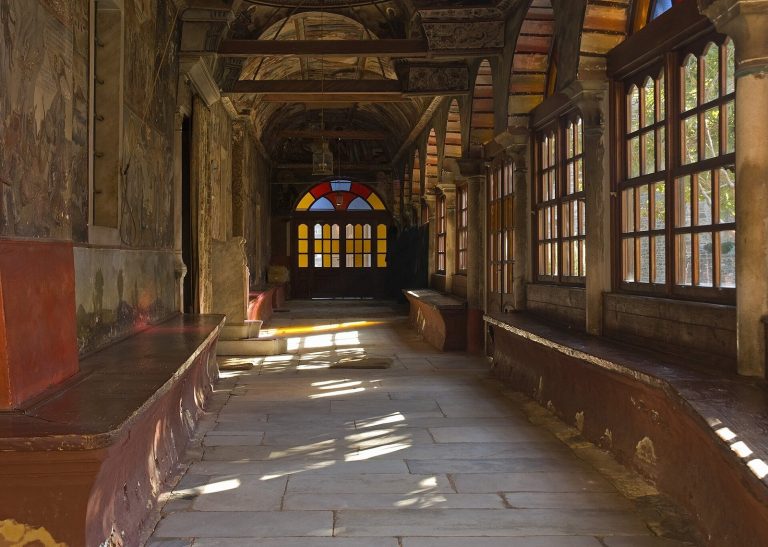
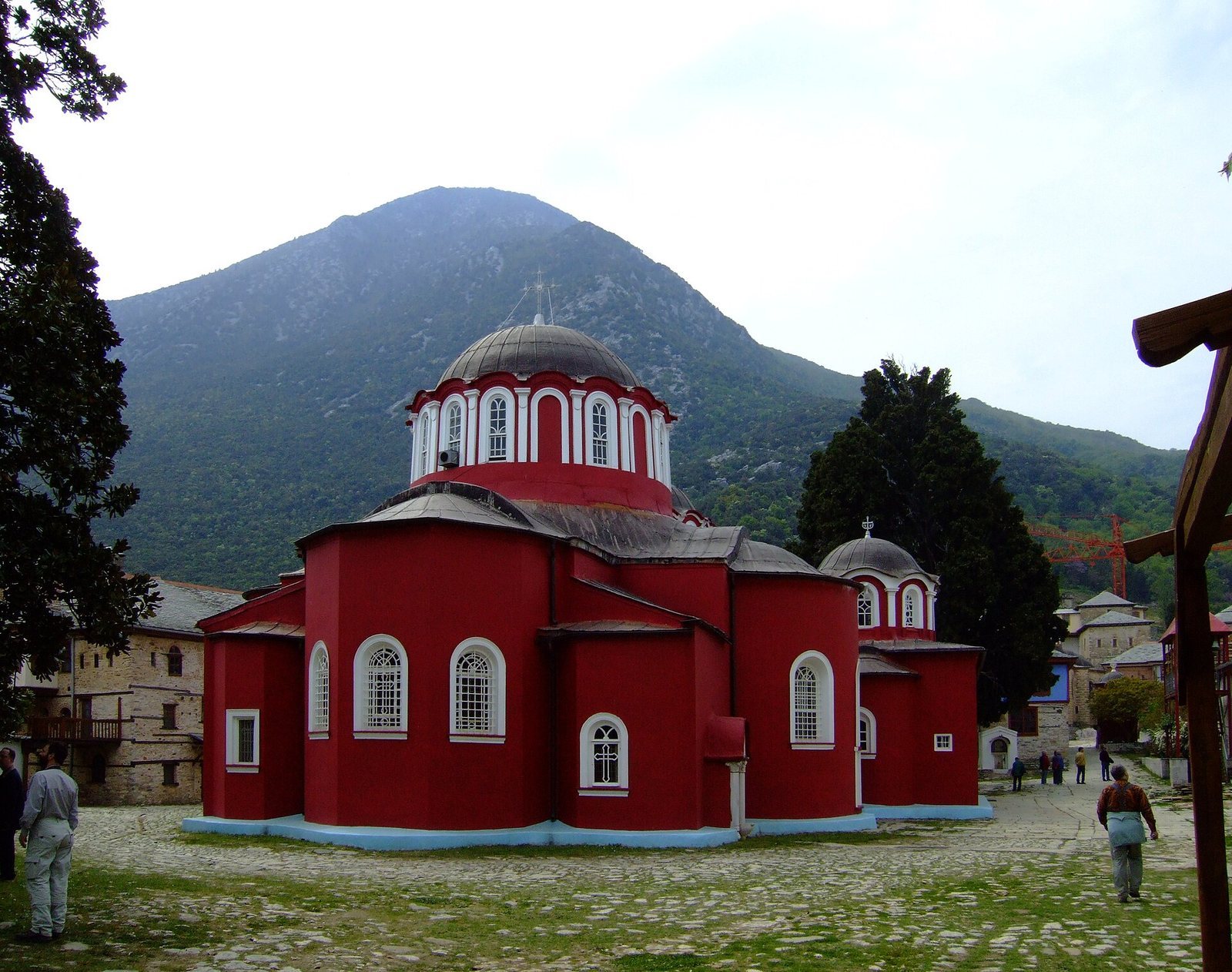
The katholikon (the monastery’s main church) has two large areas for choir and prayer, an arrangement later copied by other monasteries. A heavy, two-leaf wooden door separates its narthex (the church’s entrance vestibule) from the main church. The door was a gift from Nikephoros II Phokas and is associated with war booty. Inside, a tall, elaborate iconostasis (a screen separating areas of an Orthodox church) divides the church’s spaces. Theophanis painted the church’s frescoes in 1535. Zahari Zograf worked in the narthex in 1851 and 1852, and it was painted in 1854.
Chapels and the tomb of Athanasius
The monastery has 37 chapels, 21 within its walls and others outside. North of the narthex, the chapel of the Forty Martyrs of Sebaste contains Athanasius’s tomb. Tradition says the tomb was opened once, when a patriarch of Alexandria tried to take a relic; thunder and lightning were said to issue from it, and it has not been opened since. In 1981, during feast celebrations attended by pilgrims, the tomb was said to emit myrrh.
South of the narthex, the chapel of Saint Nicholas was painted by Franco Cantellano in 1560. The monastery’s other named religious features include chapels dedicated to the Prophet Elijah, Saint Gregory, and Saint Paraskevi, a holy-water site associated with Athanasius, and the cemetery church of the Holy Apostles. Francisco Castellanos carved marble reliefs at the monastery.
Courtyard chapel and the Virgin’s icon
A courtyard chapel contains a venerated icon of the Virgin Mary and is associated with John Koukouzelis, a celebrated medieval Byzantine composer and cantor who had served at the imperial court. Tradition says he left court for monastic life, arrived at Great Lavra in disguise, and became a leading church cantor. It also tells that, when he grew tired while singing before the icon, the Virgin spoke to him and gave him a gold coin.
Refectory
The trapeza (the monastic refectory) stands opposite the main entrance to the church, with a fountain and a cypress between them. The cross-shaped building is the largest refectory on Mount Athos. Frescoes cover its interior and are attributed to Theophanis or his school.
Library and sacristy
Library
Behind the main church, the library holds 2,116 Greek manuscripts, 165 codices, or manuscript books, more than 20,000 printed books, and about 100 manuscripts in other languages. Its New Testament manuscripts include Codex Coislinianus and Codex Athous Lavrensis, as well as manuscripts catalogued as 049, 0167, 1073, 1505, 2524, and 1519.
Sacristy
The sacristy is also behind the main church. Its treasures include a Gospel manuscript with a gold cover given by Nikephoros II Phokas, the Kouvaras, a list of monks beginning with Athanasius, and about 2,500 icons.
Dependencies and outlying monastic sites
Sketes
Great Lavra’s dependencies include three sketes (monastic settlements linked to a larger monastery). The settlement-style Skete of Saint Anne and the Skete of the Holy Trinity, also called Kausokalyvion, lie on the southwestern side of the peninsula. The Romanian Skete of the Forerunner, a title for John the Baptist, is a unified building complex above Akrothooi.
Cells
The monastery’s cells are spread across several districts, including Karyes, Mount Athos’s administrative center. There it has a representative house dedicated to Saint Anne, eight cells housing ten monks in total, three other buildings, and forest land. Until 1930, additional cells stood where the present square outside Karyes’s principal church is located, including cells connected with church administration and printing. Across Mount Athos, Great Lavra’s cells number in the hundreds, most in ruins. Sixty are habitable, and 45 of those are occupied by 65 dependent monks.
Retreats and hermitages
The monastery has ten small monastic retreats, seven near the main complex. The retreat of the Holy Archangels, also called Koukouzelis, is associated with John Koukouzelis, who lived there in the fourteenth century. The retreat of the Akathist Hymn, an Eastern Orthodox hymn of praise, is also known as the Cave of Athanasius. It lies in the Vigla area near the Skete of the Forerunner. The retreat of Saint Eustathius, also called Mylopotamos, is about eight kilometres north of Great Lavra, near Karakallou Monastery.
Great Lavra also has about 60 hermitages in several areas of Athos. Many stand in dry locations, depend on rainwater, and have no cultivable land.