Dolmen du Champ-du-Ruisseau: A Prehistoric Covered Passage Grave in France
Site at a Glance
- Popularity
- Very Low
- Country
- France
- Primary era
- Unclassified
- Eras represented
- Unclassified
- Civilizations
- Unclassified
- Site type
- Burial
- Remains
- Tomb
On this page14 sections
History
Dolmen du Champ-du-Ruisseau is a prehistoric covered passage grave in France, classified as Armorican type, a regional category associated with northwestern France. Its construction date remains uncertain. Charcoal produced dates between 1210 and 475 BC, but these are considered much too recent in relation to the archaeological material and may result from a technical error.
The monument was reused during the Gallo-Roman period, the period and culture of Roman Gaul. Dr. J.-B. Glotin discovered it in 1949. Excavation and restoration took place from June 1961 to December 1962, and it received French state protection as a historic monument in 1961.
Remains
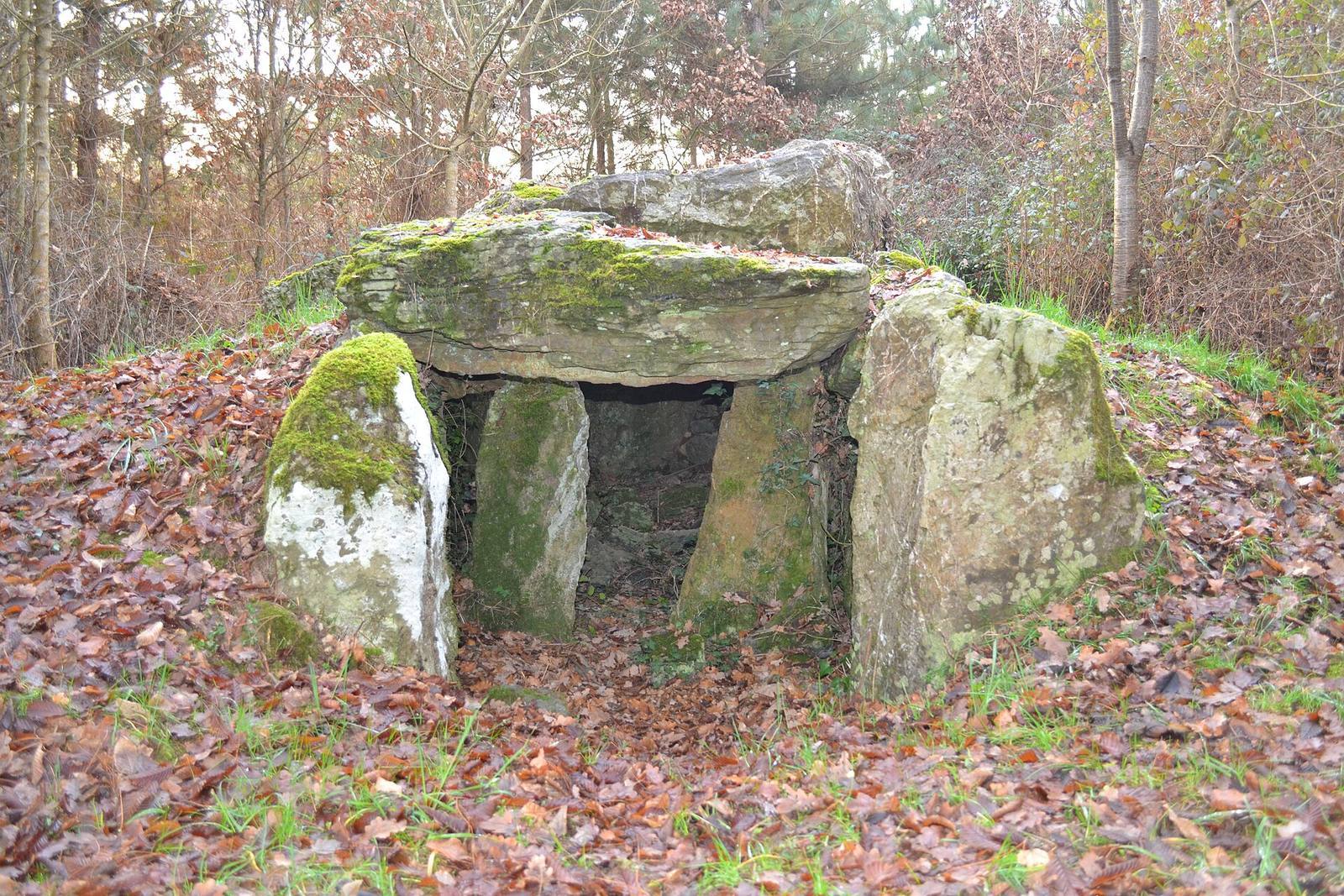
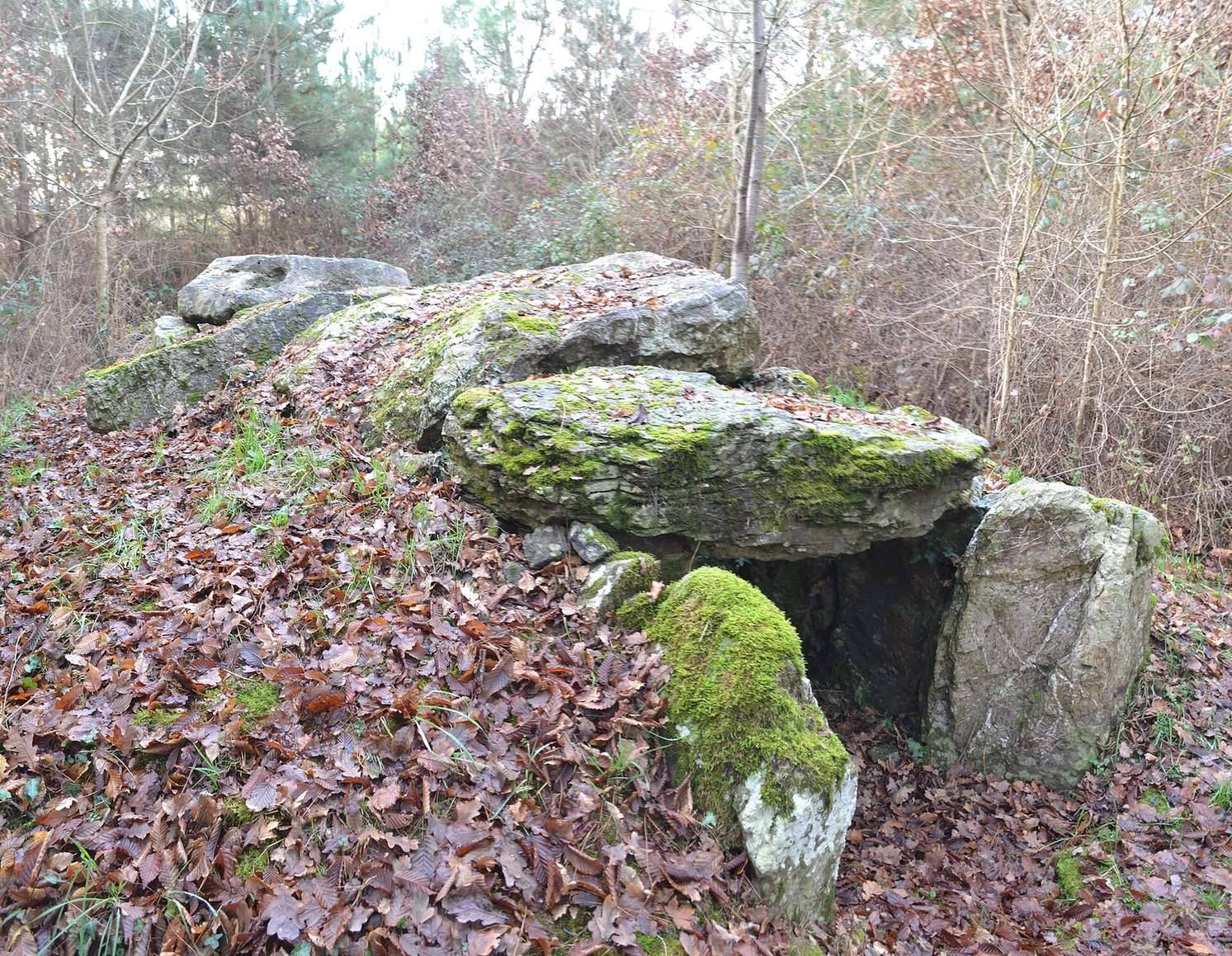
The covered passage is about 7 m long, aligned almost exactly east to west, and opens to the east. It stands near the Auxence River, below a hillside 450 m to the south. The stone-built structure has a burial chamber and entrance passage, with a mound and stone setting around it.
Passage and chamber
Covered passage
Six small upright stones line each side of the passage, which ends in a slab and is covered by four large stones. Its slabs include fourteen of sandstone and three of puddingstone, a type of stone; phtanite, a fine-grained siliceous rock, is also used in the monument. Fourteen sandstone slabs came from outcrops near the top of the southern slope, whose incline eased their transport. The largest puddingstone slab weighs more than two tonnes. The nearest puddingstone deposit, at Ingrandes, lies 5.40 km to the west. The passage’s length, threshold, and division between the antechamber and burial chamber have parallels at the covered passage of Men-ar-Rumpet in Kerbors.
Entrance and partition
A square-section threshold block closes the entrance. Three thin upright slabs once formed a crosswise partition between a small, nearly square antechamber and the burial chamber. They were fragile and broken at their lower ends, so they could not be reset during restoration.
Chamber interior
Part of the floor was paved near the middle of its north side. Two thick slabs rising about 20 cm above the floor formed an inner threshold 1.30 m in front of the end slab. Between this threshold and the end slab, flat-topped, cubical phtanite blocks set in the earth form a U-shaped arrangement of unknown function. An unusual posthole, a hole for a post, was also found.
Capstone surface
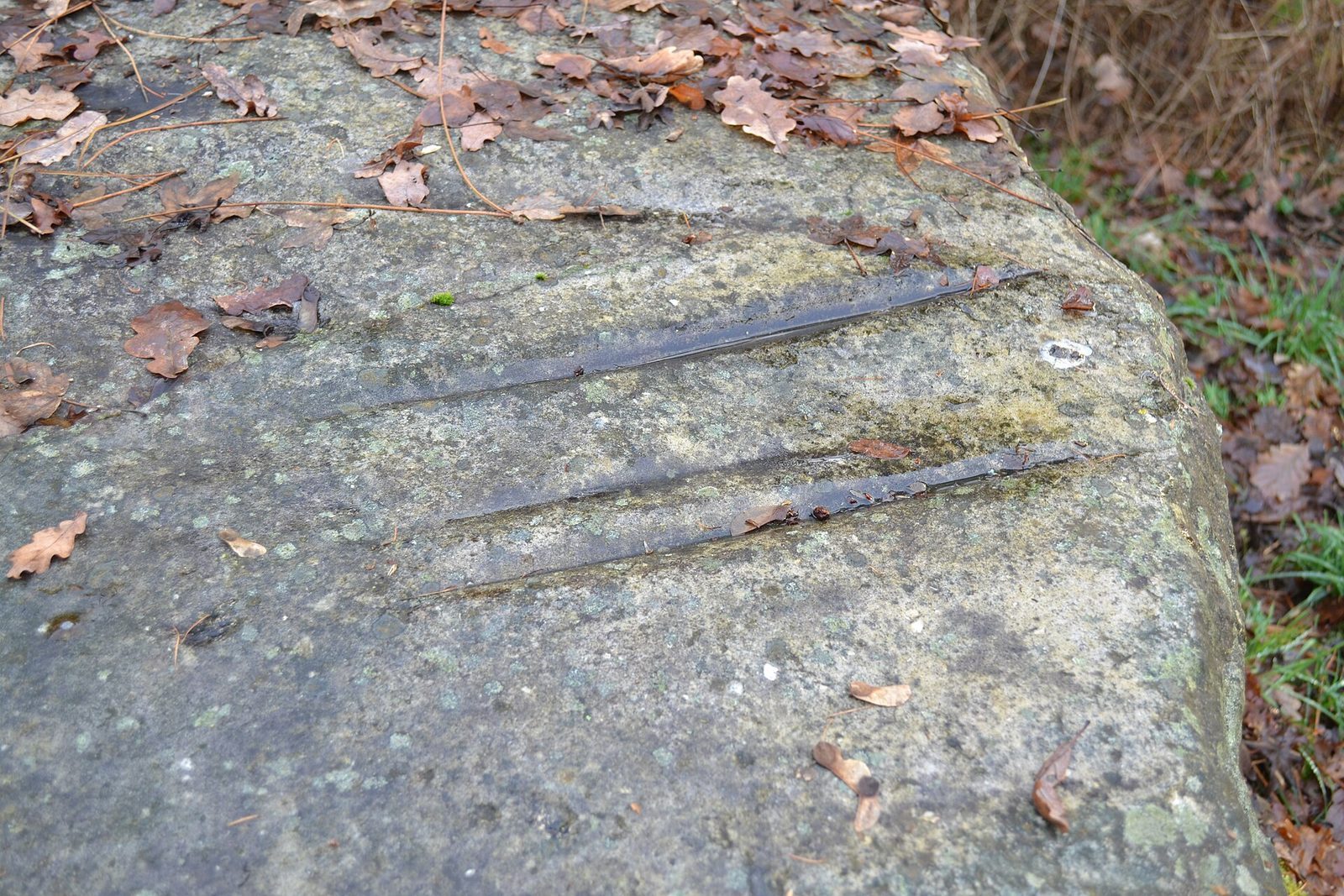
The upper surface of the westernmost capstone has three parallel grooves, each 38–43 cm long and about 2.5 cm deep, as well as two shallow oval depressions. In 1951, the grooves were identified as a surface for polishing stone tools. Their relationship to the construction of the monument is uncertain; they may be earlier or later.
Mound and outer setting
Tumulus
The tumulus, or burial mound, consists of small phtanite blocks and earth and is enclosed by an oval stone setting. The monument was long covered by a mound, and some of its stones were taken for other works in the modern period.
Outer walkway
Beyond the stone setting, a ring of flat-laid slabs forms a walkway 1.75–2 m wide. It contains four cells with concave bottoms, arranged side by side in front of the entrance.
Excavated deposits and finds
Upper layers
The upper deposits included a group of modern objects and medieval pottery sherds. They also contained a Gallo-Roman layer about 30 cm thick, with flint flakes and a flint scraper.
Lower layer
A lighter lower layer yielded 25 worked flints, including scrapers, cores, and bladelets, alongside sherds from two fine-paste vessels associated with the Bell Beaker facies, an archaeological grouping named for its characteristic bell-shaped pottery. One vessel has oblique hatched bands; the other bears parallel horizontal incisions.
Deposits above the original floor
An otherwise sterile earth layer about 20 cm thick lay over the original floor. Charcoal and flint material were found in it, including a fine flint perforator, a pointed tool for piercing, as well as flakes and bladelets. Two fragments had become vitrified, or glass-like.