Maria Magdalena Church: A Lutheran Church in Stockholm
Site at a Glance
- Popularity
- High
- Country
- Sweden
- Primary era
- Early Modern
- Eras represented
- Early Modern, Modern
- Civilizations
- Swedish
- Site type
- Religious
- Remains
- Church
On this page21 sections
History
Maria Magdalena Church is a Lutheran church on Södermalm in Stockholm, Sweden. Dedicated to Mary Magdalene, it serves the Church of Sweden’s Maria Magdalena Parish in the Diocese of Stockholm and is the oldest church on Södermalm. The present building was begun in 1588 under Swedish King John III and later acquired a Baroque character, an artistic and architectural style that shaped many of its features.
The medieval chapel and its destruction
A funeral chapel and cemetery occupied the site by the 1350s. King Magnus Eriksson had the chapel built with permission from Pope Clement VI. Its first known written mention dates to 1352, and a tower was added around 1430.
During Gustav Vasa’s campaign to take Stockholm in the early 1520s, troops under Peder Fredag camped in the chapel. Christian II’s forces attacked from the city, inflicting heavy losses. After Protestantism was introduced in Sweden in 1527, Gustav Vasa ordered religious buildings on the heights around Stockholm to be destroyed, including the chapel. The earlier attack may have contributed to that decision.
The present church and its Baroque development
Construction of the present church began on the chapel site in 1588. Work stopped after John III died in 1592. The church was consecrated in 1634, two years after the death of Gustav II Adolf, and completed in 1635.
Swedish architects Nicodemus Tessin the Elder and his son, Nicodemus Tessin the Younger, directed later additions and changes that established the church’s Baroque character. The Elder’s tower spire, erected in 1676, was destroyed in a fire in 1759. In 1751, the funeral of inventor Christopher Polhem took place at the church, attended by his former assistant, Emanuel Swedenborg.
Fire and later restoration
On 19 July 1759, a major fire swept through the surrounding district, destroying about 300 buildings and severely damaging the church, including part of its tower. Architect Carl Johan Cronstedt supervised repairs from 1760 to 1763. The work gave the interior a Rococo design, a European artistic and architectural style, while preserving much of the earlier scheme.
The interior was restored in 1927 under architect Lars Israel Wahlman, and improvements to the exterior masonry were completed in 1986. The church also has a connection to poet and songwriter Carl Michael Bellman: his grandfather served as a pastor there.
Remains
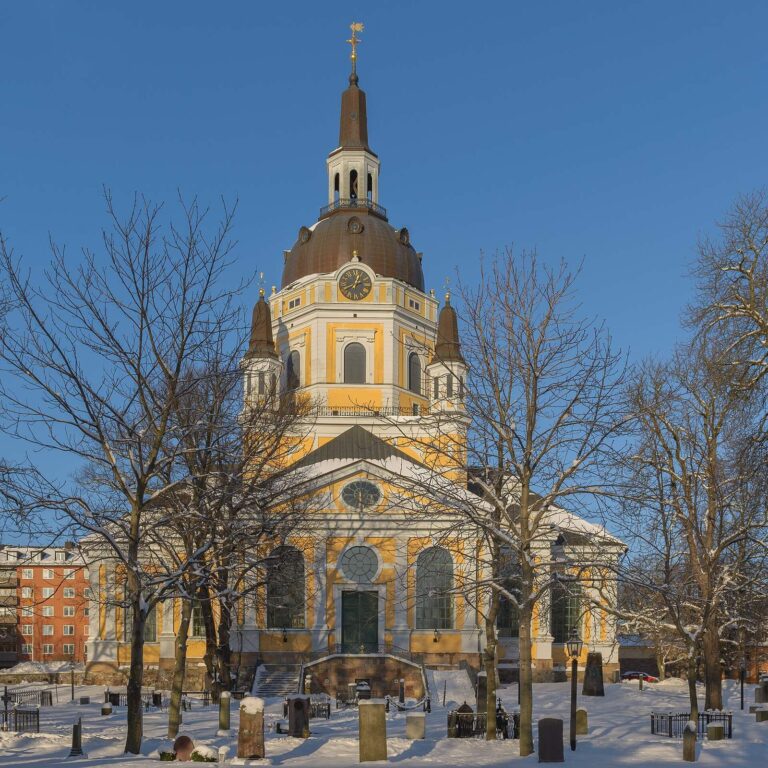
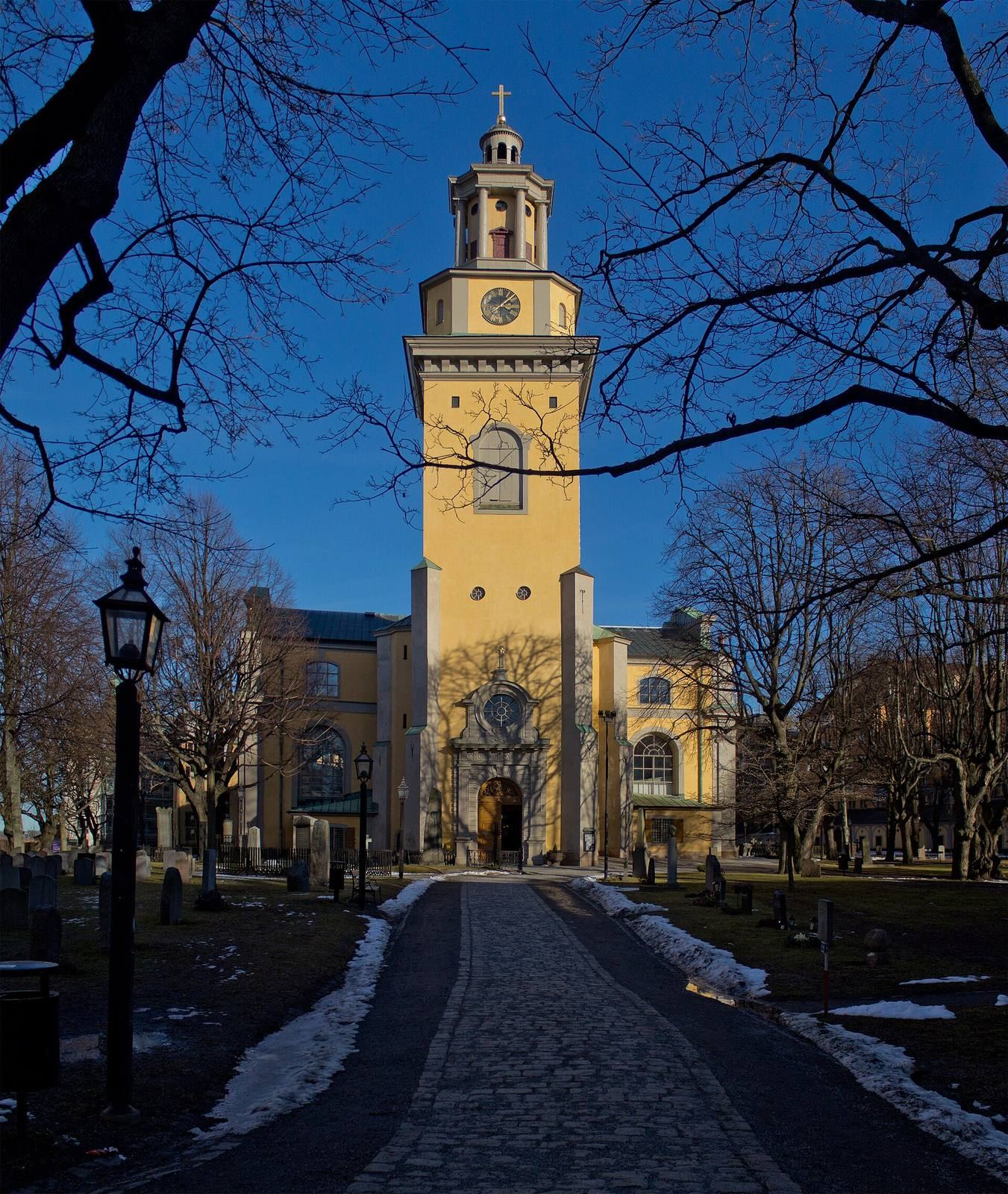
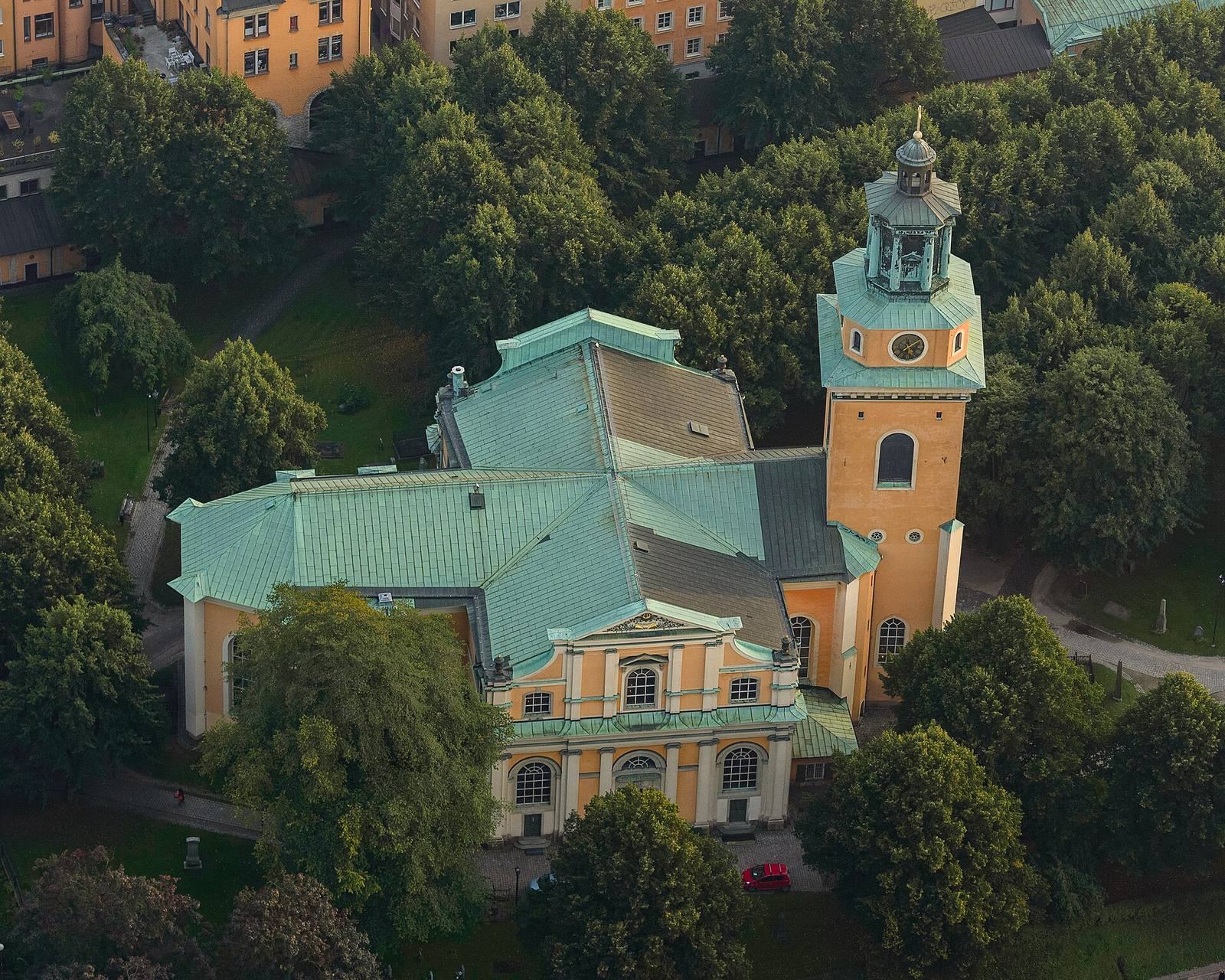
The church has a cross-shaped plan, with a single nave, or main worship space, a three-sided choir at the east end, and a crosswise transept, the part that intersects the nave, spanning three bays. The main entrance and tower stand on the west side. The brick building has yellow-plastered façades, a red-sandstone base, and a copper-covered roof. Smaller additions fill the four angles between the nave and transept: a sacristy, a room for preparing and storing items for worship, to the northeast; a kitchen to the northwest; a vestment room to the southeast; and a chapel to the southwest.
West portal, tower, and bells
West portal
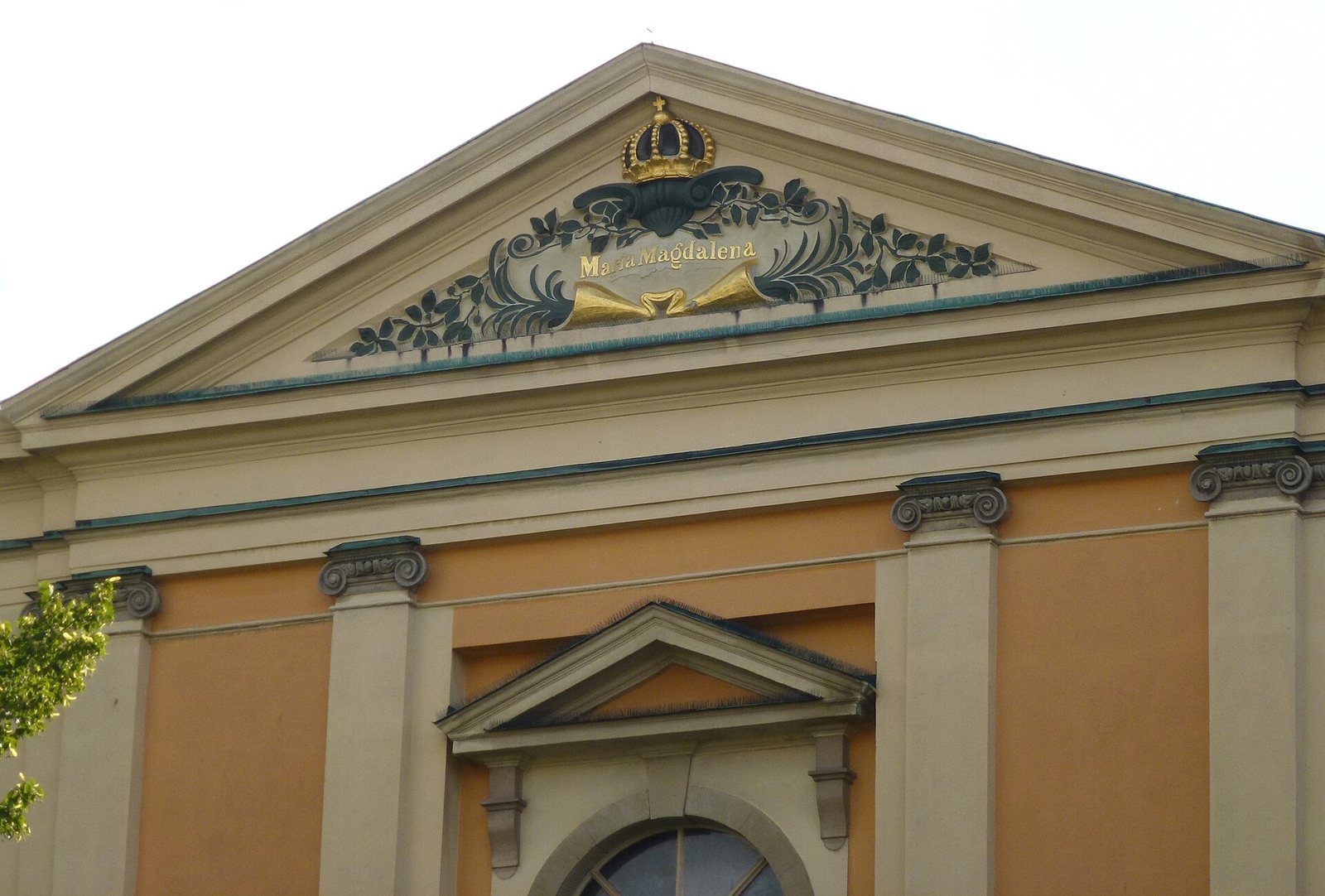
The present main entrance is a west portal designed by Nicodemus Tessin the Younger and dated 1716. It survived the 1759 fire. The north transept has a gable panel bearing the words “Maria Magdalena.”
Tower
The present tower was designed by Carl Fredrik Sundvall in a Neoclassical style, which draws on classical forms, and completed in 1825. A temporary tower erected after the 1759 fire remained until a replacement was built in 1824. The current tower stands slightly askew from the church’s central axis. Its copper-covered circular temple form is topped by a lantern, a raised structure crowning a tower, and a gilded cross. It rises 55 metres above ground, or 72.98 metres above sea level, and has 180 steps leading to its viewing platform. It may incorporate building material from the former chapel.
Earlier versions of the tower were taller and more pointed, as shown in an engraving dated 1650 to 1652. The tower top built by Nicodemus Tessin the Elder in 1676 was also more slender and taller than the present one.
Bells and clocks
The large bell was recast in 1898 by Stockholm’s Bergholtz foundry using metal from bells that melted in the 1759 fire. Its inscription reads, “Praise our God, O people! Let his praise be widely heard! Psalm 66:8.” Bergholtz cast another bell in 1912 from a bell dating to 1760. Two more bells were cast by the Meyer foundry in 1759 and 1760.
An original clock mechanism made at the Stjärnsund manufactory is now held at Stockholm’s Technical Museum. Linderoth’s clockworks installed a mechanical mechanism in 1910; the tower’s four clocks are now powered by an electric mechanism from Westerstrand & Söner.
Interior and furnishings
Floor and painted decoration
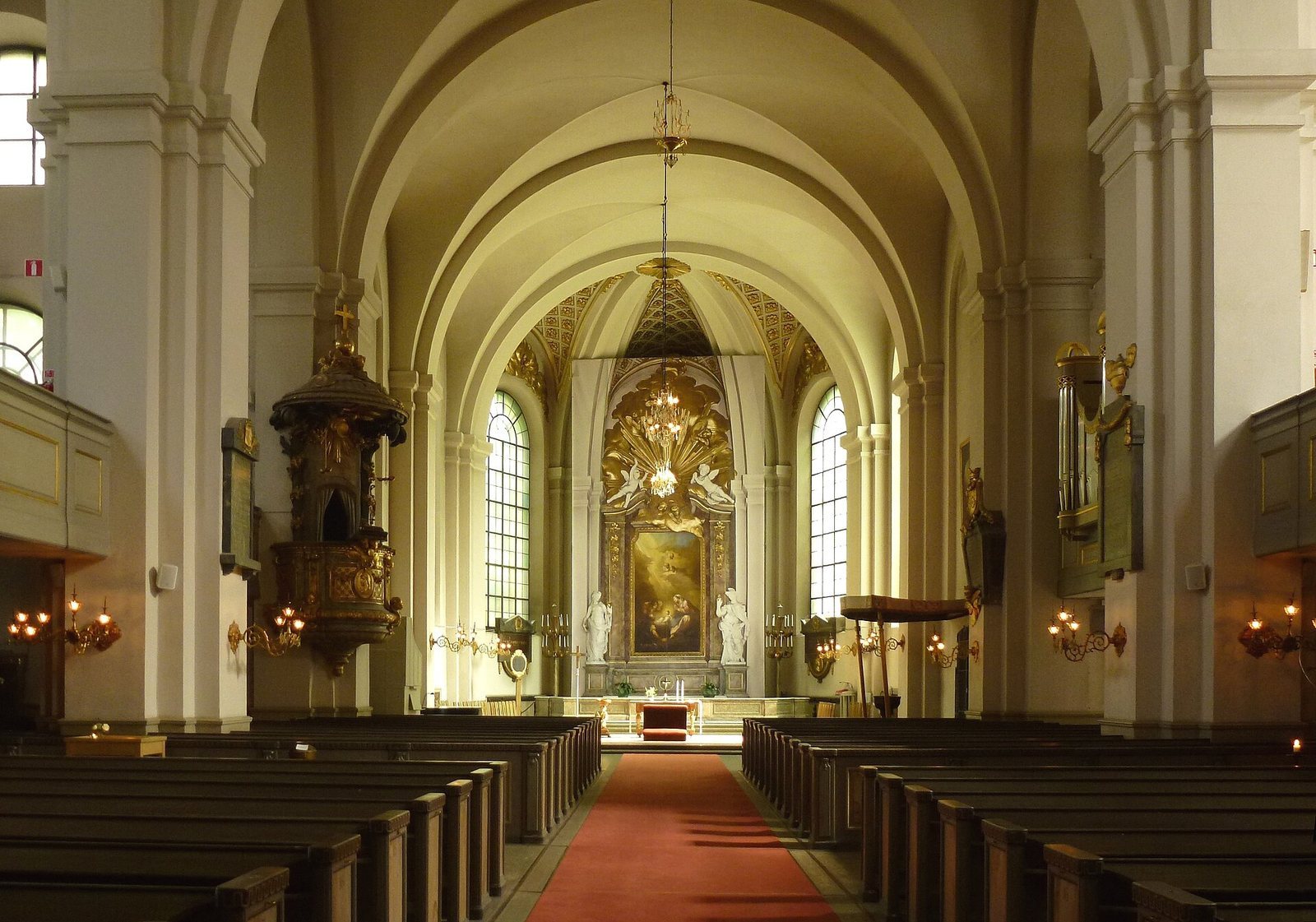
The church has a grey-painted wooden floor and a pink carpet along the central aisle. Metal wall lights dating from the 17th century were electrified and fitted with openwork shades designed by Lars Israel Wahlman. Three small brass chandeliers hang from the ceiling vaults. Painted decoration by Johan Hafwersatt and Christian von Thum dates to 1683 and 1684.
Altarpiece
The high altarpiece shows the Adoration of the Shepherds. Artist Louis Masreliez made it around 1800.
Pulpit and baptismal furnishings
Carl Johan Cronstedt designed the Baroque pulpit, inaugurated in 1763. A medallion on it depicts Mary Magdalene. The baptismal font dates to 1638. A copper sacramental vessel with capital-letter inscriptions survived the 1759 fire and is the church’s oldest surviving object.
Memorials
Epitaphs inside the church commemorate Christopher Polhem and Carl Michael Bellman.
Organs
Main organ
The main organ’s façade was designed by Carl Fredrik Adelcrantz in 1774 and is an outstanding example of Swedish Rococo organ design. The instrument supplied by Åkerman & Lund in 1878 had 30 stops, which control sets of pipes, two manuals, or hand-operated keyboards, and a pedal keyboard. The firm enlarged it in 1927 to 50 stops. After being rearranged in 1961, it was restored in 1994 and 1995 to its 1927 disposition, meaning its arrangement of stops. Its late-Romantic design, associated with music of the late 19th and early 20th centuries, enables it to perform the full Swedish late-Romantic repertoire. With its original disposition, it is Sweden’s largest Swedish-built late-Romantic organ.
Other organs
S. Magnusson built a second organ, installed in the south gallery in 1986. A smaller third organ was placed in the choir in 1993.
Cemetery and burial structures
Burial vaults
Older burial chambers lie beneath the church. Along the cemetery’s southern edge, a row of burial vaults was built between 1709 and 1777. Their yellow façades are decorated with flat, attached columns and white arches. The cemetery’s earliest gravestones date to the early 18th century.
Burial chapel
A burial chapel designed by Lars Israel Wahlman was built beside the cemetery in 1929. It now houses a church of the Finnish Orthodox congregation in Sweden.
Graves and memorials
The cemetery includes the graves of poets and songwriters Lasse Lucidor, Erik Johan Stagnelius, Johan Runius, Karl August Nicander, Werner Aspenström, and Evert Taube, as well as actor Gösta Krantz. Maria Kristina Kiellström, associated with Bellman’s character Ulla Winblad, is also buried there. Taube’s grave is marked by a bust sculpted by his wife, Astri Taube.