Small Fort at Hillscheid: A Roman Frontier Fort in Germany
Site at a Glance
- Popularity
- Low
- Country
- Germany
- Primary era
- Classical
- Eras represented
- Classical
- Civilizations
- Roman
- Site type
- Military
- Remains
- Fort
On this page13 sections
History
Roman Frontier Post
The Small Fort at Hillscheid was a Roman military installation in Germany, on the Upper German-Raetian Limes, Rome’s frontier system across parts of what is now the country. Its garrison is uncertain, but it probably housed a detachment from a larger auxiliary unit, troops who served alongside the legions. The nearby fort at Niederberg may have been the detachment’s base.
Construction of the Limes crossed the fort’s enclosure at several points and cut through buildings inside it. Since 2005, the fort and associated archaeological monuments have formed part of the Upper German-Raetian Limes UNESCO World Heritage Site. The fort is also protected as a cultural monument under Rhineland-Palatinate law.
Nineteenth-Century Damage
In 1833, Limes and Roman-road researcher Friedrich Wilhelm Schmidt recorded well-preserved ramparts and ditches, as well as substantial standing masonry. By 1857, Carl August von Cohausen found that only small portions remained visible. Stones had been taken for road construction, much of the ground had been levelled, and treasure hunting caused further damage. The disturbed remains later made the fort difficult to interpret.
Excavation and Conservation
In spring 1894, the Imperial Limes Commission, a German body that investigated and documented the Roman frontier, excavated the fort under the local direction of section commissioner Otto Dahm. The poor condition of the remains made interpretation difficult, so the commission’s records require caution.
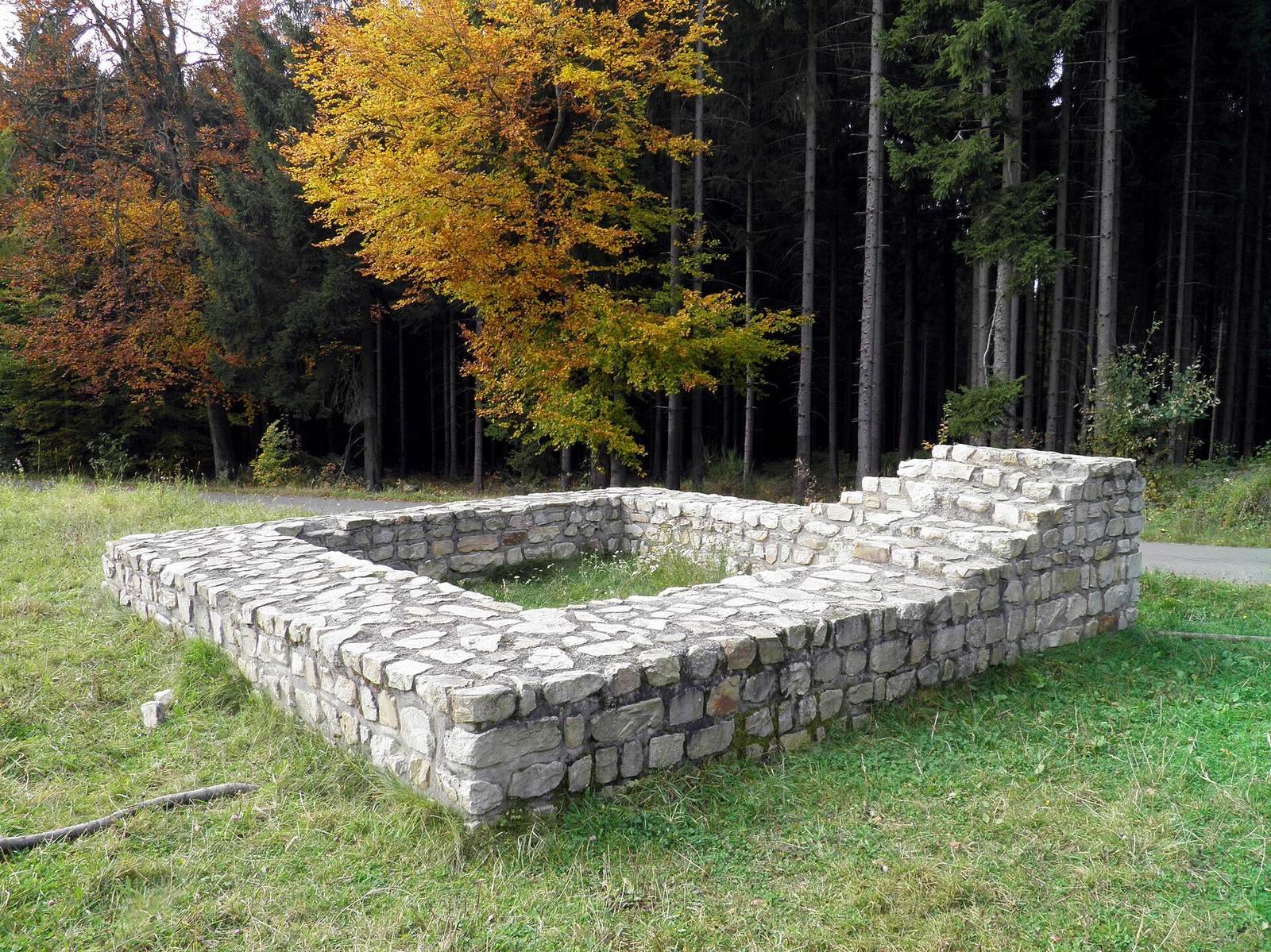
After more than a century without further investigation, the Archaeological Heritage Service’s Koblenz office carried out new investigations in 1999. In 2003, Hillscheid’s municipality conserved and partly reconstructed the foundations of the fort and the neighboring watchtower.
Remains
The site comprises a stone outer enclosure around a smaller inner fort, with a separate watchtower formerly standing between the fort and the frontier line.
The Fort Enclosures
Outer Enclosure
The outer enclosure measured 43.10 by 36.60 metres and covered nearly 0.16 hectares. Its stone wall, about 1.20 metres thick, had rounded corners. A single gate, roughly two metres wide, faced southeast. Outside the wall, a strip of ground between 0.35 and 1.10 metres wide separated it from a ditch about six to eight metres across. The ditch survives to a depth of 70 to 100 centimetres. The garrison may have lived in tents.
Inner Fort
The inner fort had an almost square plan, measuring 15.90 by 15.40 metres and covering just over 0.025 hectares. Its rounded-corner defensive wall was 1.20 metres thick. A single gate, about 2.50 metres wide, faced northwest, and a ditch separated this enclosure from the outer one. The inner fort was probably built later, although the first excavators interpreted the two enclosures as parts of one contemporary plan.
Corner Building and Anteroom
A tower-like building stood in the inner fort’s southern corner. It had an internal usable area of about 25.5 square metres and may have risen two or three storeys. An anteroom, probably a single-storey structure with an internal area of just over 5.5 square metres, adjoined its northeast side. The walls of both buildings were about one metre thick.
Frontier Setting and Associated Remains
Terrain and Routes
The fort lies in Hillscheid Forest, about one kilometre northeast of Hillscheid in a straight line, at an elevation of roughly 420 metres. It occupies a high terrace on a spur extending southwest from the Montabaur Heights. In Roman times, the fort stood about 22 metres behind the Limes wall, near the convergence of two routes from the Rhine plain toward the Westerwald heights. One approached from the southwest, from the larger garrison at Niederberg; the other came from the Vallendar area. Both crossed the frontier.
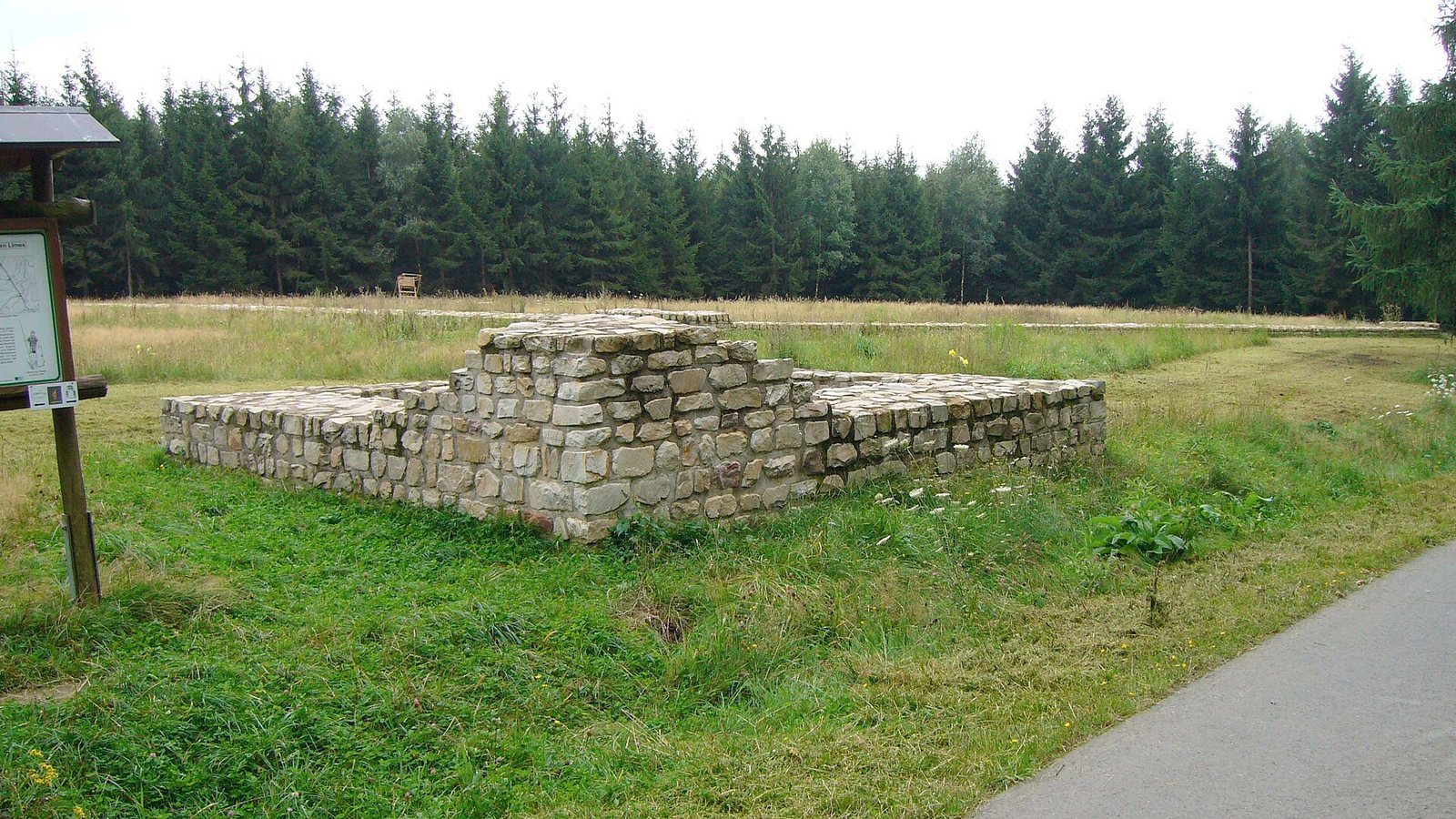
Watchtower Wp 1/71
Watchtower Wp 1/71 stood roughly halfway between the fort and the Limes. Its foundations, like those of the fort, were conserved and partly reconstructed in 2003.
The Limes Corridor
The Limes and its watchtower sites along the stretch from Hillscheid toward Arzbach are generally well preserved. In cultivated areas, some sections can be seen only in aerial images, while parts in less accessible woodland have survived particularly well.