Ahlat Tombstones: A Medieval Cemetery in Türkiye
Site at a Glance
- Popularity
- High
- Country
- Turkey
- Primary era
- Medieval
- Eras represented
- Medieval, Early Modern
- Civilizations
- Ottoman, Seljuk
- Site type
- Burial
- Remains
- Necropolis
On this page8 sections
History
Ahlat Tombstones form a medieval cemetery in Ahlat, Türkiye, in and around the town’s citadel on the shore of Lake Van. The cemetery’s history reaches back roughly a thousand years, and burials predate the Marwanid period; an establishment date of 1200 is also assigned to it. Its stones are generally dated to 1203–1300.
Ahlat from Urartu to the Shah-Armens
Ahlat’s history reaches back to about 900 BC, during Urartu, an ancient kingdom centered in the Armenian Highlands and eastern Anatolia. The town’s name changed across historical periods: it was Khelath in Assyrian times, Khlat in Byzantine times, Halt in Arab usage, and Ahlat in Iranian and Turkish contexts.
After 1071, Ahlat served as a Turkish base for movement from east to west. From the early 12th century it was the capital of the Shah-Armens, also called the Ahlatshahs, a ruling dynasty in eastern Anatolia. Ahlat was associated with scholars, religious leaders, artists, Sufis (practitioners of Islamic mysticism), and other believers. In the Islamic world it was called the “Dome of Islam” and compared with the historic Central Asian cities of Bukhara and Balkh.
A cemetery across communities and dynasties
Although commonly described as Seljuk-era tombstones, the cemetery’s wider historical associations span the 12th to 15th centuries. Burials are linked to successive communities and authorities, including Armenians, the Kurdish Rojekî ruling house, the Dilmaçoğulları, Saltukids, Marwanids, the Bitlis Emirate, Ahlatshahs, Ayyubids, Seljuks, and Ottomans; the tombstones are also associated with Mongols and Safavids. Muslim, Christian, and Yazidi graves have been identified, and Christian and Yazidi graves together may outnumber Muslim ones. Among Ahlat’s identified cemeteries, Kale alone contains Ottoman tombs.
The cemetery remains in use and functions as an open-air museum. It was added to UNESCO’s World Heritage Tentative List, which includes properties proposed for possible future nomination to the World Heritage List, on 25 February 2000. Maintenance and restoration work began in 2010 through a project involving the Ministry of Culture and Tourism and Van Yüzüncü Yıl University; inscriptions on 700 tombstones were deciphered during the work.
Remains
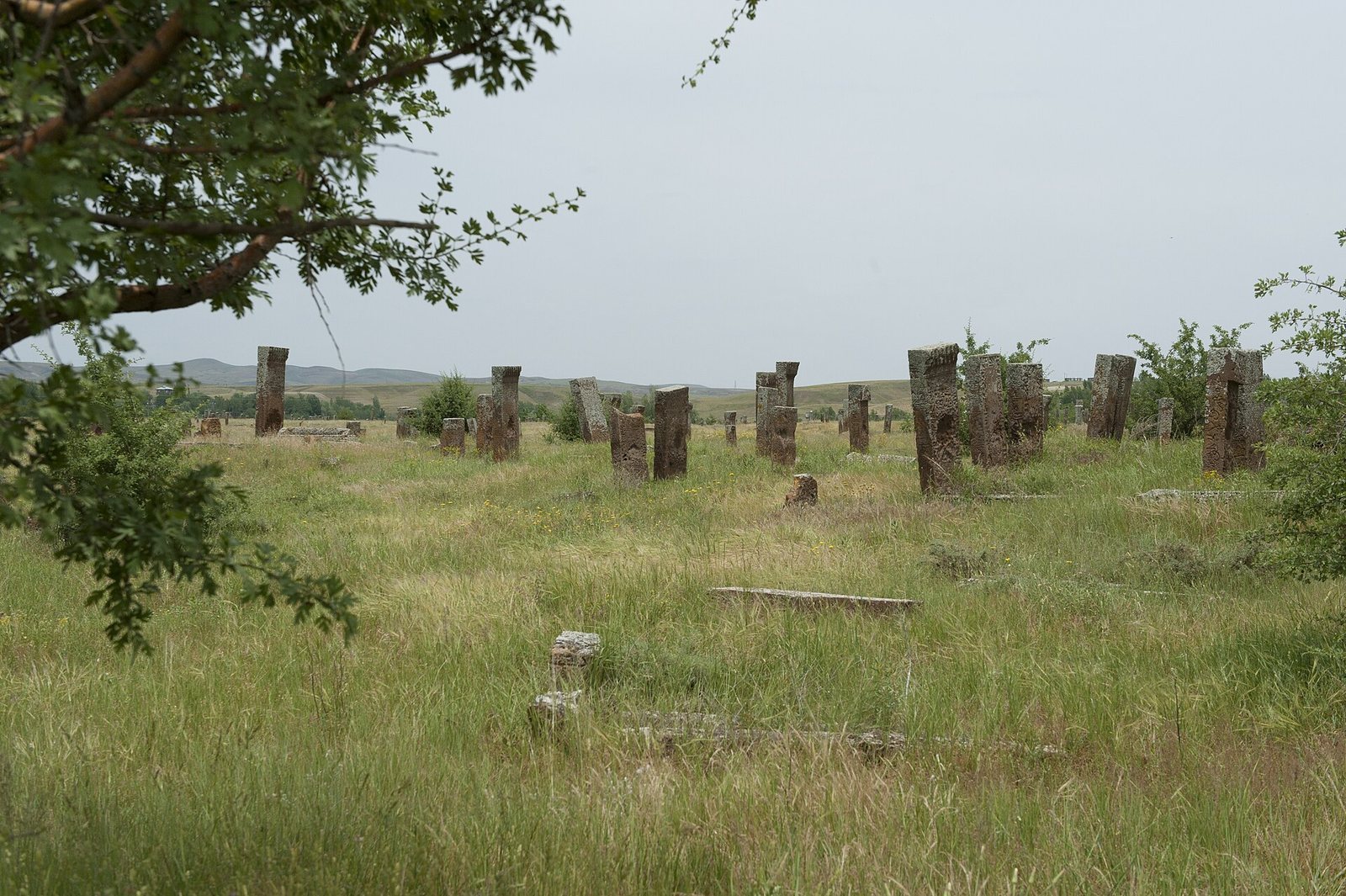
The cemetery covers about 21 hectares in and around Ahlat’s citadel beside Lake Van. It contains approximately 8,200 tombstones, including 118 considered monumental. Hundreds stand above ground, while additional stones remain buried. The grave markers include headstones, paired head- and footstones, stone coffins, and underground chamber tombs. An archaeological research center affiliated with the Ahlat Museum Directorate is located at the cemetery entrance.
Grave forms and carved stonework
Chamber and slab graves
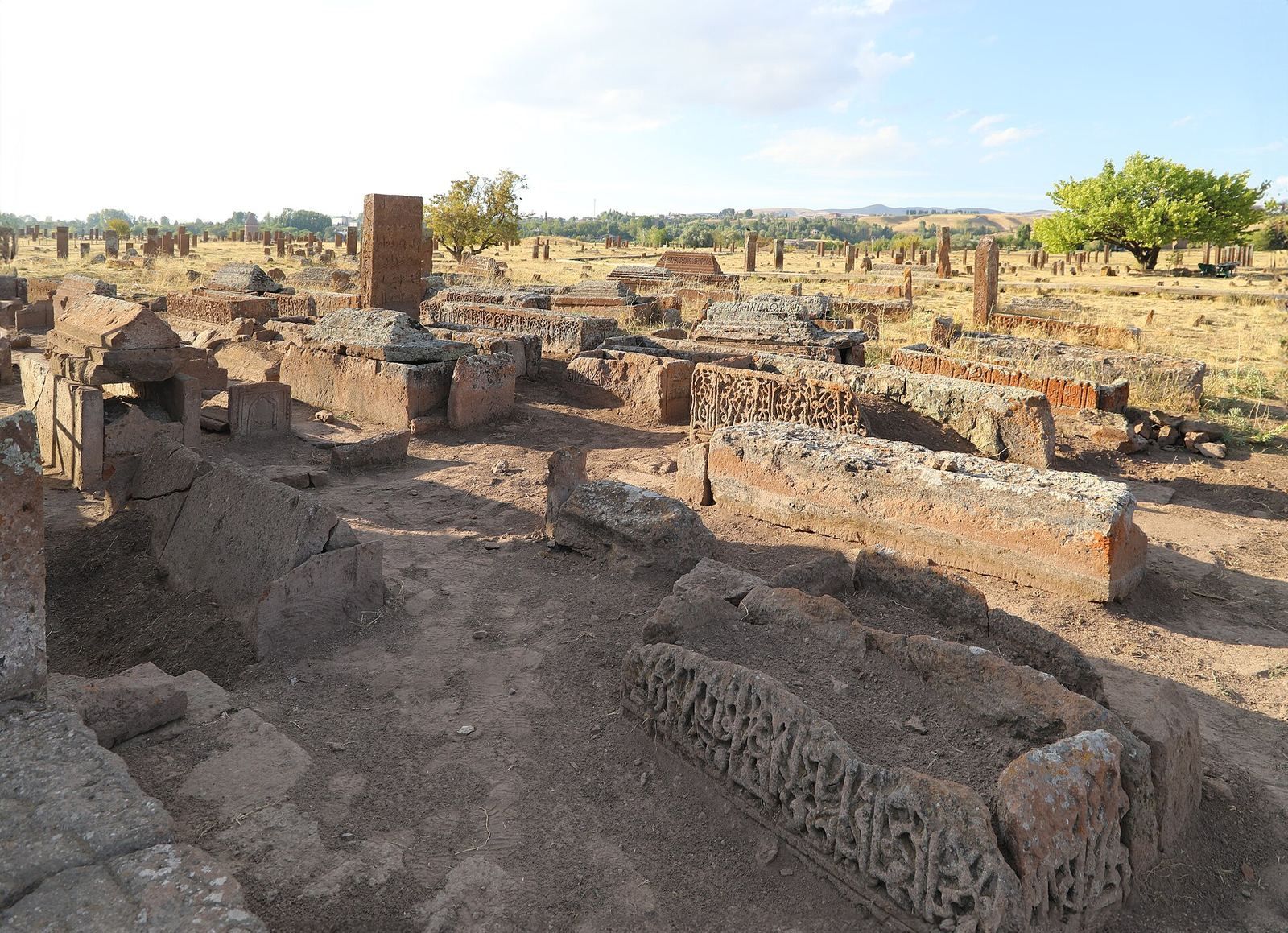
Some burials are underground chambers resembling Central Asian Turkish burial types. Other graves are marked by two long slabs of grey tuff, a rock formed from volcanic ash, joined along their upper edges to make an angled form. Small blocks close the triangular openings at the head and foot. Some examples carry Kufic inscriptions, written in an angular style of Arabic script.
Stone coffin-shaped graves
Stone coffins include simple forms carved from a single block, sometimes set on a low, narrow stepped base. Others have a hollow body and a separate lid with five angled sides. Their sides bear Kufic inscriptions naming the deceased and verses from the Qur’an. Further forms are cylindrical or column-shaped, including open-topped examples made in three pieces, as well as boat-shaped and rectangular forms carved from one stone.
Headstones and carved decoration
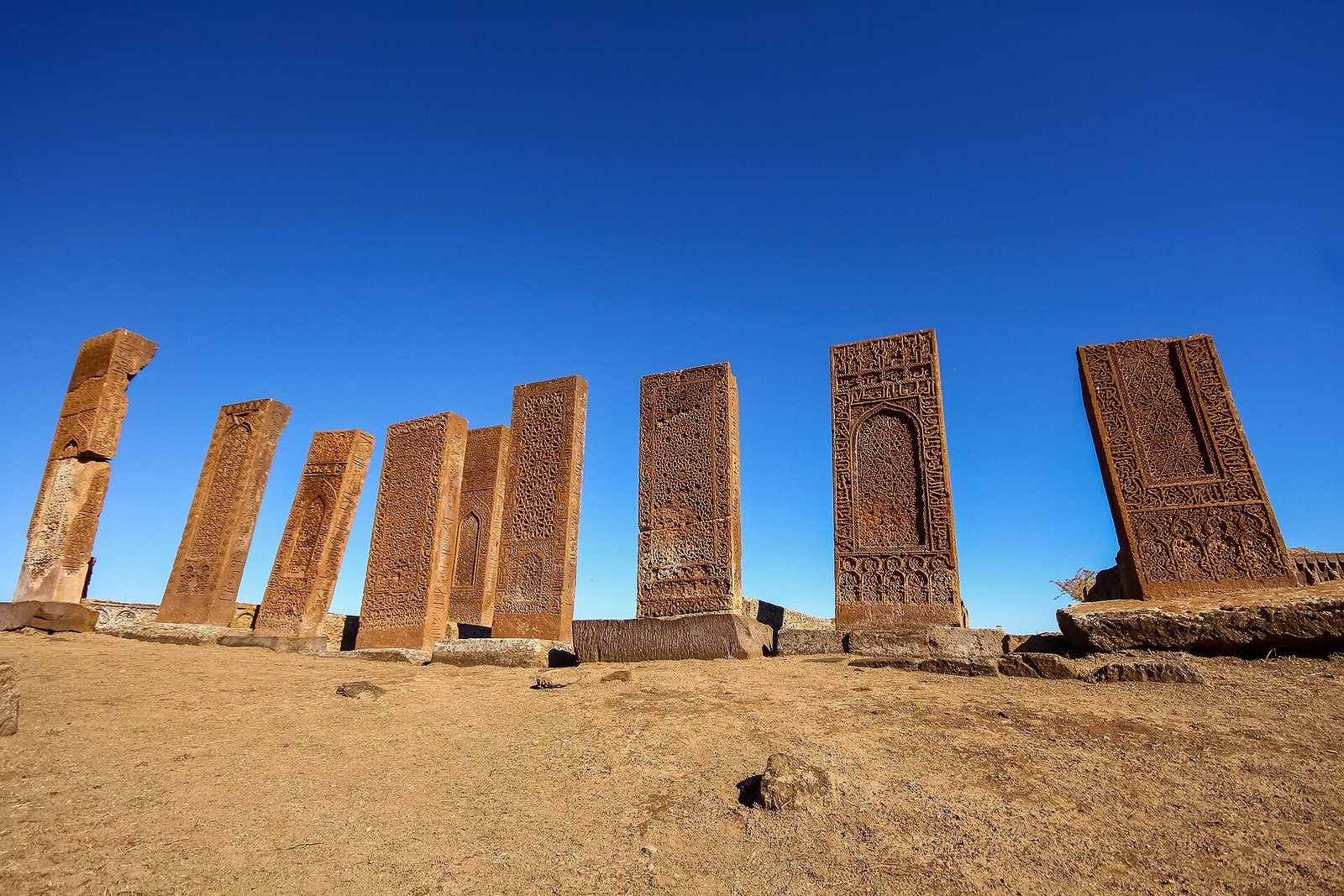
Large rectangular headstones reach up to 3.5 metres high and are carved on every face. Markers range from a single headstone to paired head- and footstones. Their decoration includes geometric patterns, dragons, lamps, and palmettes, fan-shaped palm-leaf motifs associated with Central Asian Turkish culture. The carving also shows influence from Armenian Christian cross-stones. Some stones dated to 1203–1300 bear the word “Axa,” an epithet applied to Turks during that period.