Kernic Gallery Grave: A Final Neolithic Tomb in Plouescat, France
Site at a Glance
- Popularity
- Medium
- Country
- France
- Primary era
- Stone Age
- Eras represented
- Stone Age
- Civilizations
- Unclassified
- Site type
- Burial
- Remains
- Tomb
On this page12 sections
History
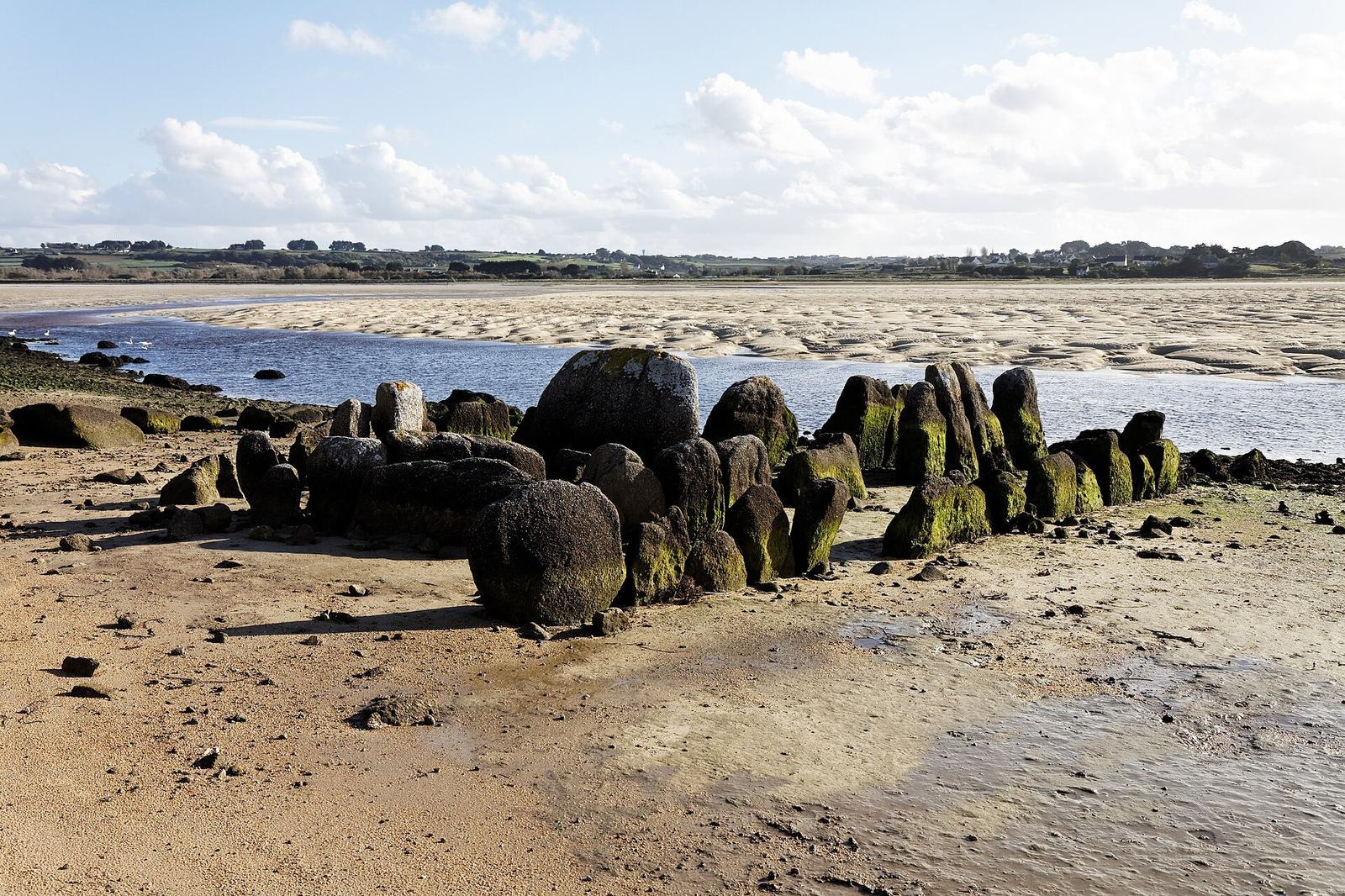
The Kernic gallery grave is a long-chamber tomb built from large stones on the shore of Anse de Kernic in Plouescat, France. Dating to the Final Neolithic, the late part of the Neolithic period, it is associated with the Seine-Oise-Marne and Bell Beaker traditions, two prehistoric archaeological cultures.
Early descriptions and interpretations
In 1896, French archaeologist and antiquarian Paul du Châtellier described two galleries arranged between three lines of upright stones. He measured them at about 10 metres long, with interior widths of approximately 1.8 and 2 metres. Crosswise stones closed the ends of each gallery, and he noted traces of three chambers. Sand covered the monument, which the sea submerged at every high tide.
In 1912, Alfred Devoir interpreted the structure as a gallery tomb with annex chambers and an enclosing stone circle. He proposed that the circle aligned with a small standing stone across the shore, which he believed had been adapted as a Breton marker associated with Christian memorial or burial use. A plan made by Commandant Morel around 1920 showed fewer blocks on the southern side than on the northern. It is uncertain whether this reflected a deliberate choice of intact stones or greater sand coverage at the time.
Damage, protection, and excavation
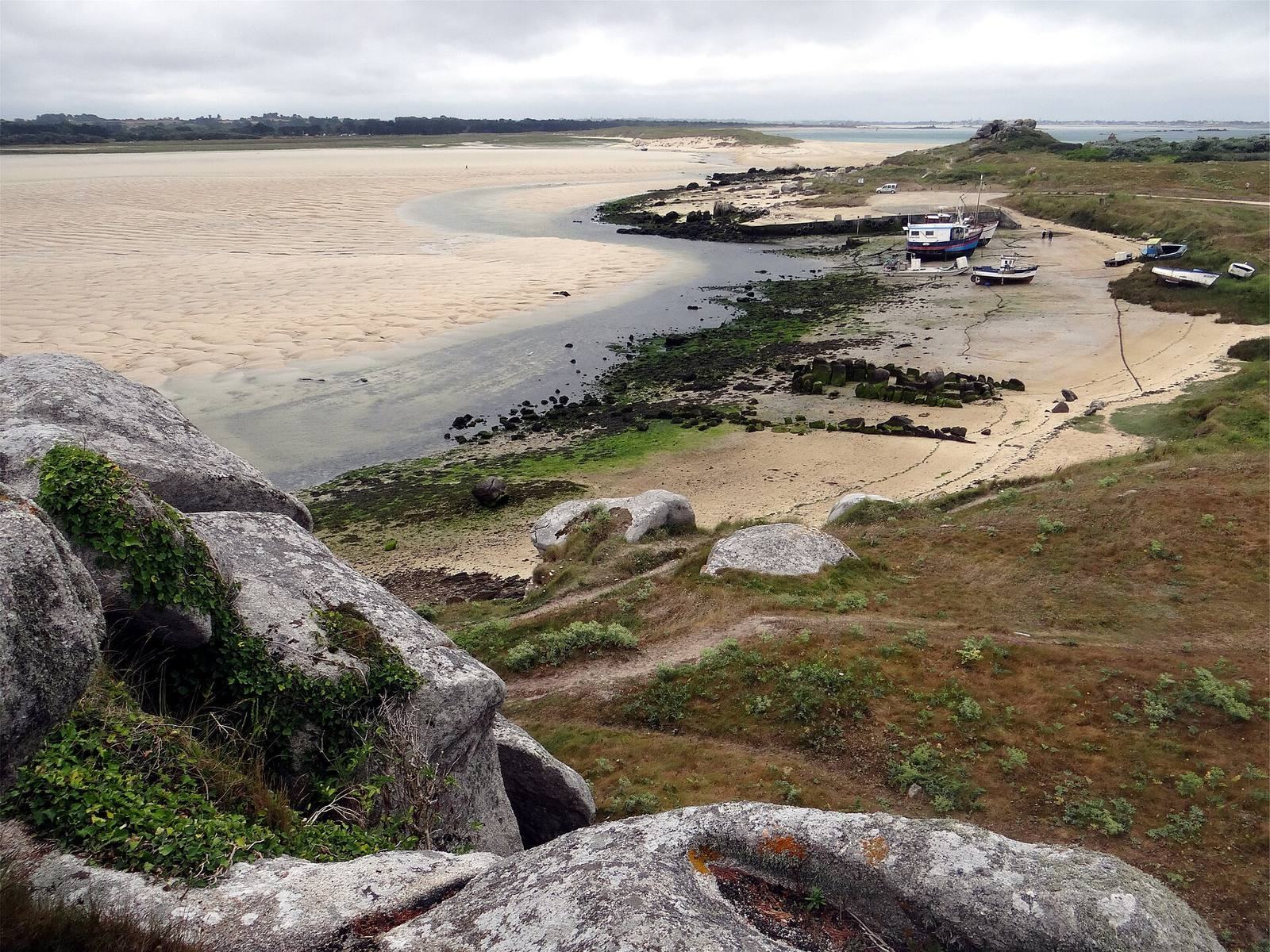
Construction of a slipway for seaweed collectors damaged the tomb, which was later reused for mooring boats. Prehistorian Pierre-Roland Giot sought its protection in 1957, and it was classified as a historic monument in 1960. Progressive erosion by the sea led to excavation campaigns in 1983 and 1984, directed by Y. Lecerf, followed by restoration. Finds from the 1983 work indicate that the tomb remained in use during a late phase around 2000 BC.
Remains
The granite tomb stands on a tidal foreshore, exposed at low tide, partly submerged at high tide, and covered during spring tides. Its southwest-facing chamber, end extension, and surrounding stone settings form the principal elements of the surviving structure.
Chamber and terminal extension
Main chamber
The slightly trapezoidal main chamber is 9.5 metres long. Fifteen upright stones remain, five of them cut down. A massive end slab terminates the chamber; it measures 1.60 metres long, 1.50 metres wide, and 0.75 metres thick, with an estimated weight of more than four tonnes. At the entrance, another slab stands on edge across the chamber and partly closes it.
Terminal chamber
Beyond the end slab, a triangular chamber extends for 2.80 metres. Its long axis bends northeast relative to the main chamber. Four of its slabs have been cut down, and an incomplete ring of large blocks surrounds it, with an opening on the east side.
Surrounding setting and excavated features
Outer stone setting
An outer setting of stones ran along the west and east sides, enclosing a cairn, a mound of stones covering a tomb. The eastern side collapsed, and four upright stones were cut away.
Stone foundations and paving
Excavation revealed pits for setting stones, averaging 0.75 metres deep and reaching the bedrock. Rough paving made from quartz and granite blocks covered areas in both chambers. A flat threshold stone lies halfway along the main chamber.
Ditches and entrance area
Two ditches northeast of the tomb may belong to an enclosure built after it. The larger ditch measures 15.50 metres long. Traces of an open area measuring 8 by 4 metres in front of the entrance have been interpreted as a ritual space.
Finds
Excavations yielded objects in front of the entrance, inside the chamber, and around the monument, alongside pieces collected earlier, including by Giot. The finds include flint cores and numerous flakes from toolmaking, quartz and flint tools such as hammerstones, scrapers, and bladelets, and three flint arrowheads, two with barbs and tangs. More than 100 pottery sherds were recovered; most bear comb impressions and are attributed to the Seine-Oise-Marne and Bell Beaker traditions. A pendant made from fibrolite, a fibrous form of sillimanite, was also found.