Basilica of Our Lady of Hanswijk: A Baroque Pilgrimage Church in Mechelen
Site at a Glance
- Popularity
- Medium
- Country
- Belgium
- Primary era
- Early Modern
- Eras represented
- Early Modern, Modern
- Civilizations
- Belgian, Habsburg, Holy Roman Empire, Spanish
- Site type
- Religious
- Remains
- Basilica
On this page15 sections
History
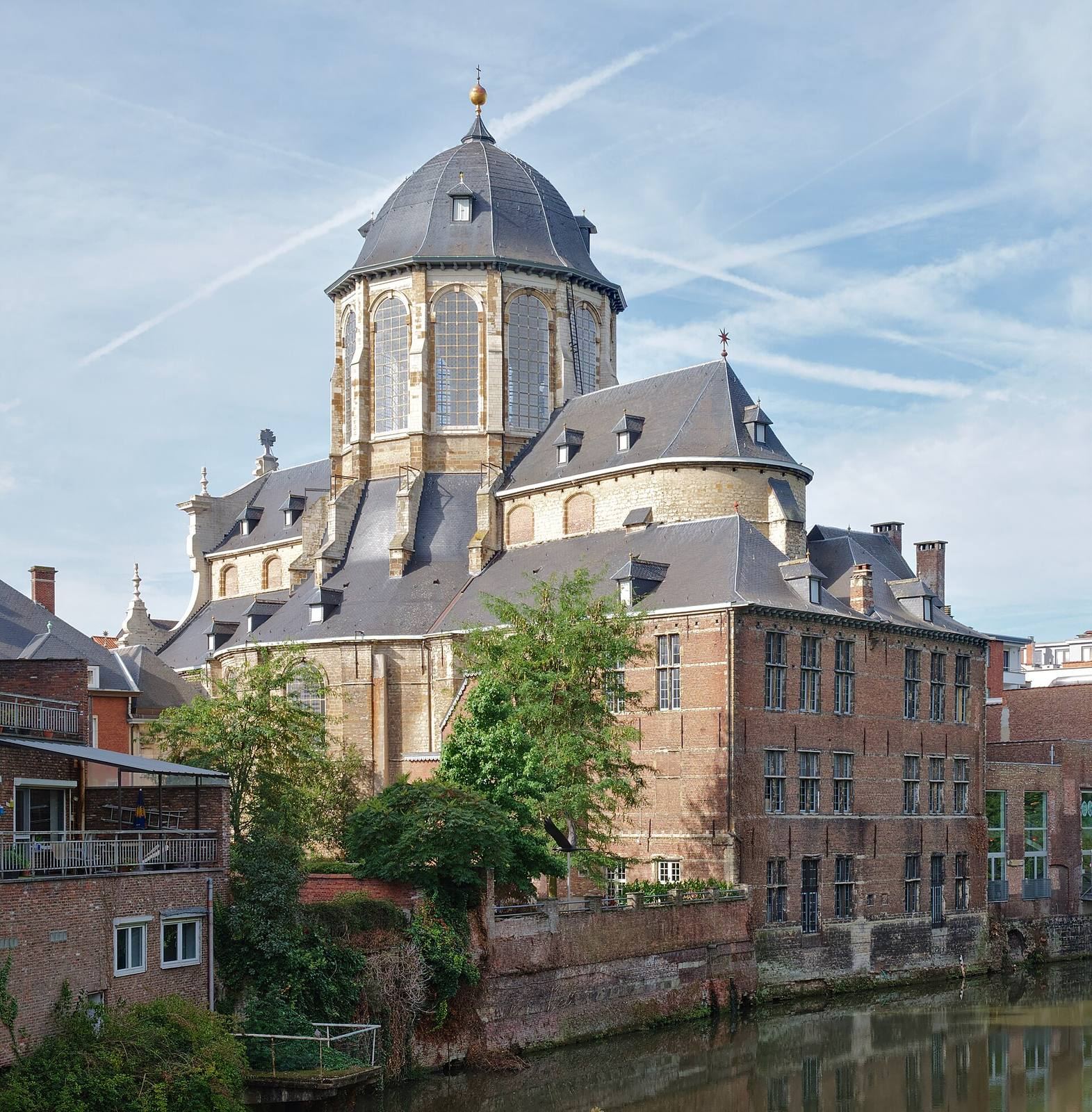
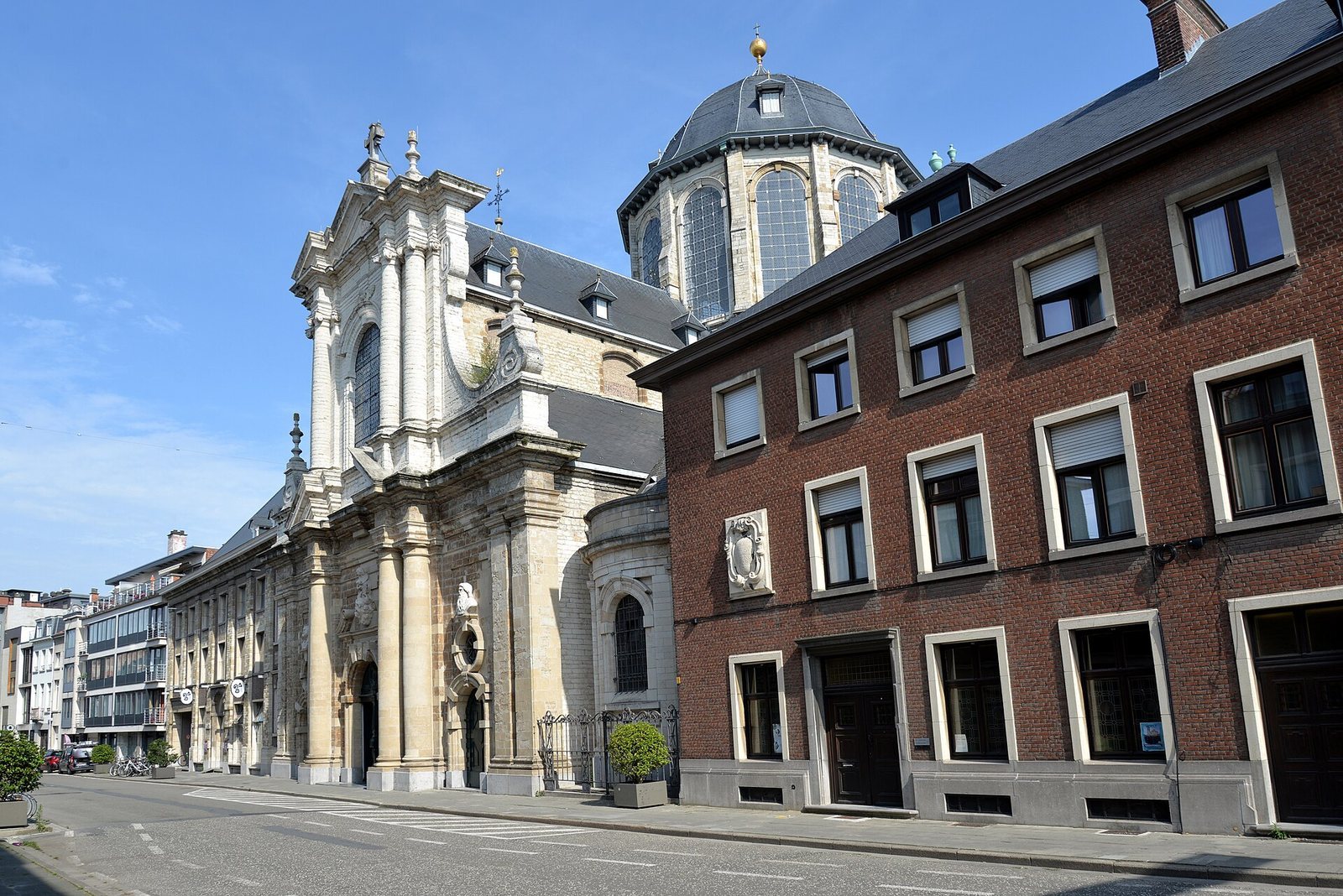
The Basilica of Our Lady of Hanswijk is a Roman Catholic parish and pilgrimage church in Mechelen, Belgium. Its present Baroque building, in a European artistic and architectural style that flourished especially in the seventeenth and eighteenth centuries, was constructed mainly between 1663 and 1681. The church developed around a tradition of devotion to the Virgin Mary that made Hanswijk a destination for pilgrims.
Origins and early pilgrimage
Tradition places the beginning of devotion at Hanswijk, then a hamlet on the Dijle River, in the tenth century. A cargo ship carrying a statue of the Virgin Mary became stranded there. After the statue was taken ashore, the ship was able to continue, and local residents understood the event as a sign that Mary wished to be venerated at that place. They brought the statue to a nearby chapel dedicated to Saints Lambert and Catherine, which became a pilgrimage destination.
Thomas of Cantimpré, a Dominican religious writer who taught at Leuven, mentioned the chapel in 1263. During a plague in Mechelen in 1272, Hanswijk residents carried the statue to the Cathedral of Saint Rumbold. The plague ended soon afterward, and an annual procession developed in gratitude. It carries the statue through Mechelen and ends at the basilica. A church for veneration of the statue was built in 1381. Religious conflicts in 1578 destroyed that church and an adjoining monastery, while the original statue disappeared during the sixteenth century.
Construction of the present church
A hall church was built in 1647. The present church followed plans by Lucas Faydherbe, a Flemish Baroque sculptor and architect. Archbishop Andreas Creusen laid its first stone in 1663, and the church was put into use on May 30, 1678. Its construction continued mainly until 1681.
A celebration in 1738 marked 750 years of devotion to Our Lady of Hanswijk. In connection with that celebration, a historical procession called the Hanswijk Cavalcade began to be held every 25 years. Work on the church’s pulpit began on May 4, 1743, and the ensemble was completed in 1746.
Modern history
On July 30, 1876, Cardinal Victor-Auguste Dechamps crowned the present statue on behalf of Pope Pius IX. This canonical coronation was a formal authorization within the Catholic Church for the ceremonial crowning of a venerated image. The church received monument protection in 1938. An air raid on May 1, 1944, damaged two reliefs above the columns of the rotunda.
Pope John Paul II made a pilgrimage to the church on May 18, 1985, his 65th birthday. In 1987, in connection with the millennium of the pilgrimage, the church received the honorary title of minor basilica, a distinction granted to a church by the pope. Further restoration took place from 2014 to 2016.
Remains
Plan and structure
Central plan and dome
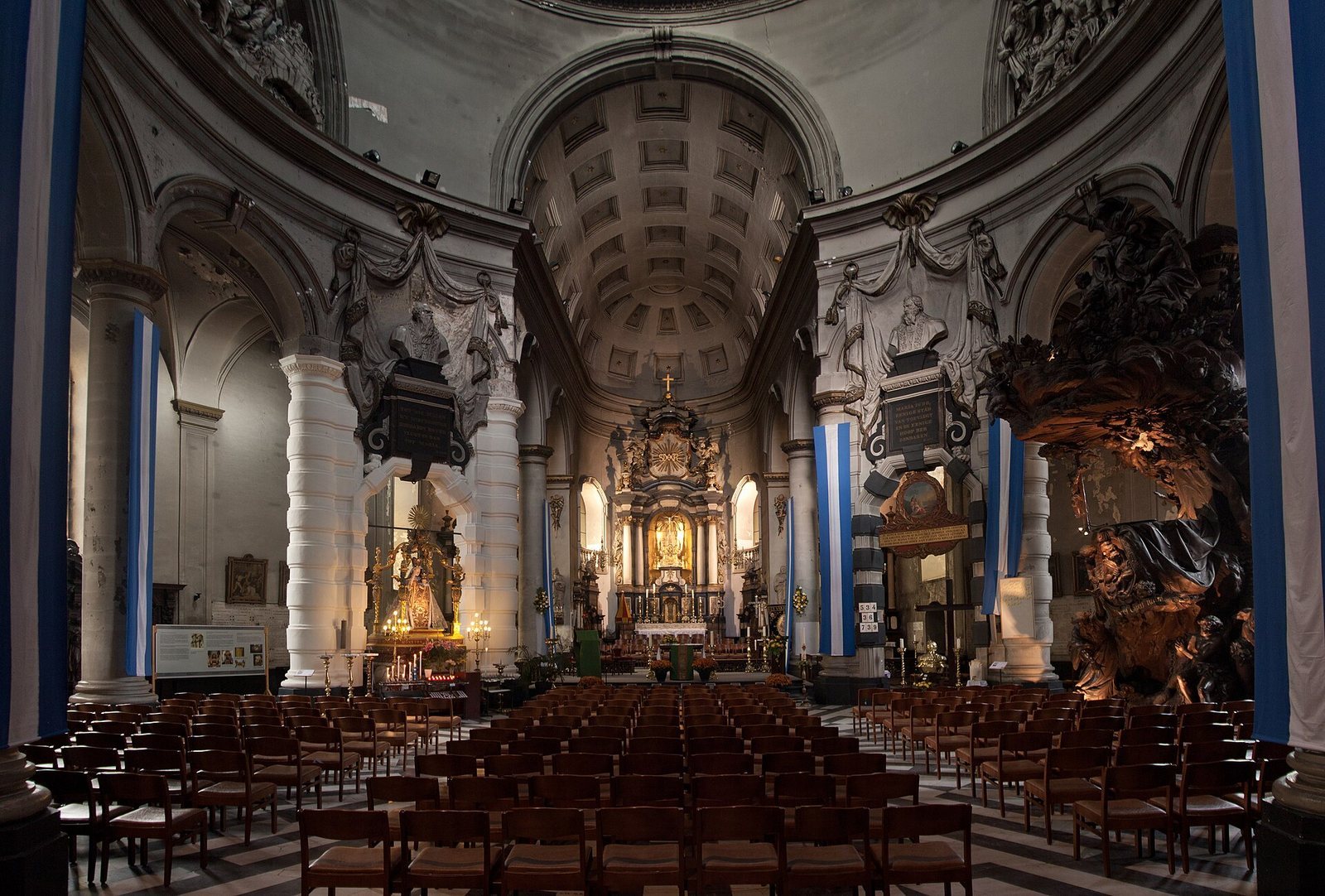
The Baroque church combines a long main body with a centralized plan. Its entrance section has three aisles. Beyond the third bay, the section between supports, the space opens into a broad circular rotunda. A crosswise section of the church is integrated around the rotunda, while the side aisles continue around it. The rotunda measures 15.50 metres across, and the dome and its supporting cylindrical structure, or drum, rise to a height of 34 metres.
Columns, façade, and ceiling
The dome’s pressure required additional support for the columns. Iron ties and anchors link them in pairs, and stucco covers these reinforcements to maintain the interior appearance. Ornament also conceals the distortion of the arches. The façade follows an Italian style, while stucco work by Faydherbe decorates the ceiling.
Interior sculpture
Porticoes and rotunda reliefs
Four covered entrance porches carry busts of the Latin Church Fathers, influential early Christian bishops and theologians. Faydherbe made the busts of Ambrose and Augustine. Jan-Frans Boeckstuyns, a sculptor from Mechelen, created those of Gregory and Jerome in 1729. Above the rotunda’s columns, two large reliefs show Jesus falling beneath the cross and the Adoration of the Shepherds. The latter is attributed to Faydherbe.
Pulpit
The pulpit forms an elaborate sculptural ensemble. Life-size figures of Adam and Eve, from the biblical account of humanity’s beginnings, stand at its base. Above them, an elderly, bearded figure of God addresses Adam, pointing toward a serpent on the ground and toward a medallion on the pulpit bowl. The medallion shows Mary with the child Jesus and presents forgiveness and deliverance as promised. Angels carry Mary upward above the canopy, while a large branching tree with angels holding drapery crowns the composition. The pulpit cost 4,000 florins; Alexander-Jozef Rubens, a grandson of painter Peter Paul Rubens, contributed 2,994 florins.
Floor, statue, and crypt
Marble labyrinth
A marble labyrinth set into the church floor has a single entrance and a path leading to its central point. Installed during the 1892 restoration, it has a black path of Noir de Basècle and a white path of Carrara marble.
Statue of the Virgin Mary
The 1.45-metre statue kept in the church for veneration is carved from walnut. Mary’s curled braids fall down her back and partly over her shoulders. She holds a sceptre in her right hand and the child Jesus on her left arm; he leans against her chest and holds an apple. The statue is in good condition and retains traces of its earlier multicolored paint. Two interlocking triangles on its back mark the work of an unidentified artist.
Crypt and Saint Rumbold
The crypt, a chamber beneath the church, and the basilica contain several depictions of Saint Rumbold, the Christian saint associated with Mechelen.