Co-Cathedral of St. Nicholas of Bari: Alicante’s Shared Cathedral Seat
Site at a Glance
- Popularity
- High
- Country
- Spain
- Primary era
- Early Modern
- Eras represented
- Medieval, Early Modern
- Civilizations
- Crown of Aragon, Kingdom of Valencia, Spanish
- Site type
- Religious
- Remains
- Cathedral
On this page16 sections
History
Foundation and medieval church
The Co-Cathedral of St. Nicholas of Bari is a Catholic church in Alicante, Spain, and shares the seat of the Diocese of Orihuela-Alicante with Orihuela Cathedral. Its present building was completed in 1662, but the church’s history begins in the 13th century. On 6 December 1244, after Alicante was handed over by its Muslim inhabitants, Alfonso, then a Castilian prince who later became King Alfonso X, ordered a church dedicated to St. Nicholas and placed the city under the saint’s protection.
The early church stood beyond Alicante’s walls, in a Christian suburb, and was distinguished from Santa María as the “New Church Outside.” Its origins are uncertain. It may have replaced a mosque that was purified and consecrated, been built anew, or resulted from the renovation of an earlier Visigothic cathedral.
On 21 November 1265, Alicante was under Castilian rule and Alfonso X was king. James I, King of Aragon, met Bishop Arnau de Gurb of Barcelona and local religious and civic leaders at the church. Travelling toward Murcia after subduing Villena, Sax, Petrel, and Nompot, James discussed the campaign against a Muslim uprising in the Kingdom of Murcia. The meeting brought Alicante’s population to support the Castilian cause.
Expansion and replacement
The medieval church grew through several building campaigns. Around 1310, it was enlarged and given a bell tower, a choir, and a space behind the choir. Its decoration included the arms of Castile. After Alicante came under Aragonese sovereignty, those arms were chipped away, while an enlargement added a sculpted Aragonese coat of arms. In the early 16th century, two more aisles were added, following the example of Valencia Cathedral.
The church served as a parish until 1600. Pope Clement VIII granted it collegiate status in 1596, with the change taking effect in 1600. The medieval building was then demolished, and the present church was built on the same site. Agustín Bernardino’s plans date to 1610–1615; construction belonged to the early 17th century and was completed in 1662.
Co-cathedral and continuing use
On 9 March 1959, Pope John XXIII raised the church to co-cathedral status, making it the shared seat of the diocese with Orihuela Cathedral. The church is served by diocesan clergy who are not members of religious orders. It was declared a Historic-Artistic Monument in 1974 and is designated an Asset of Cultural Interest in Spain in the monument category.
St. Nicholas is Alicante’s patron saint. On his feast day, 6 December, the co-cathedral holds a solemn mass followed by a procession through the city.
Remains
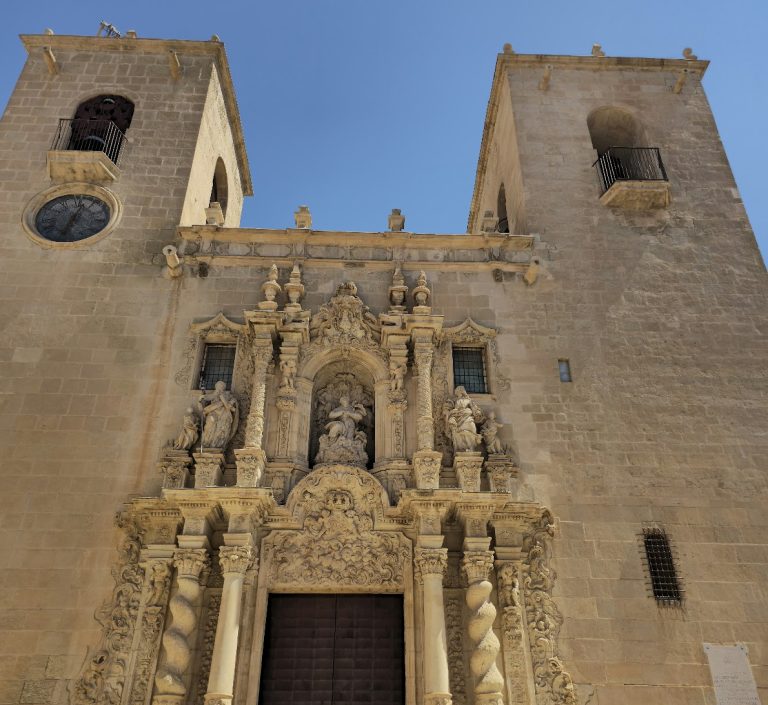
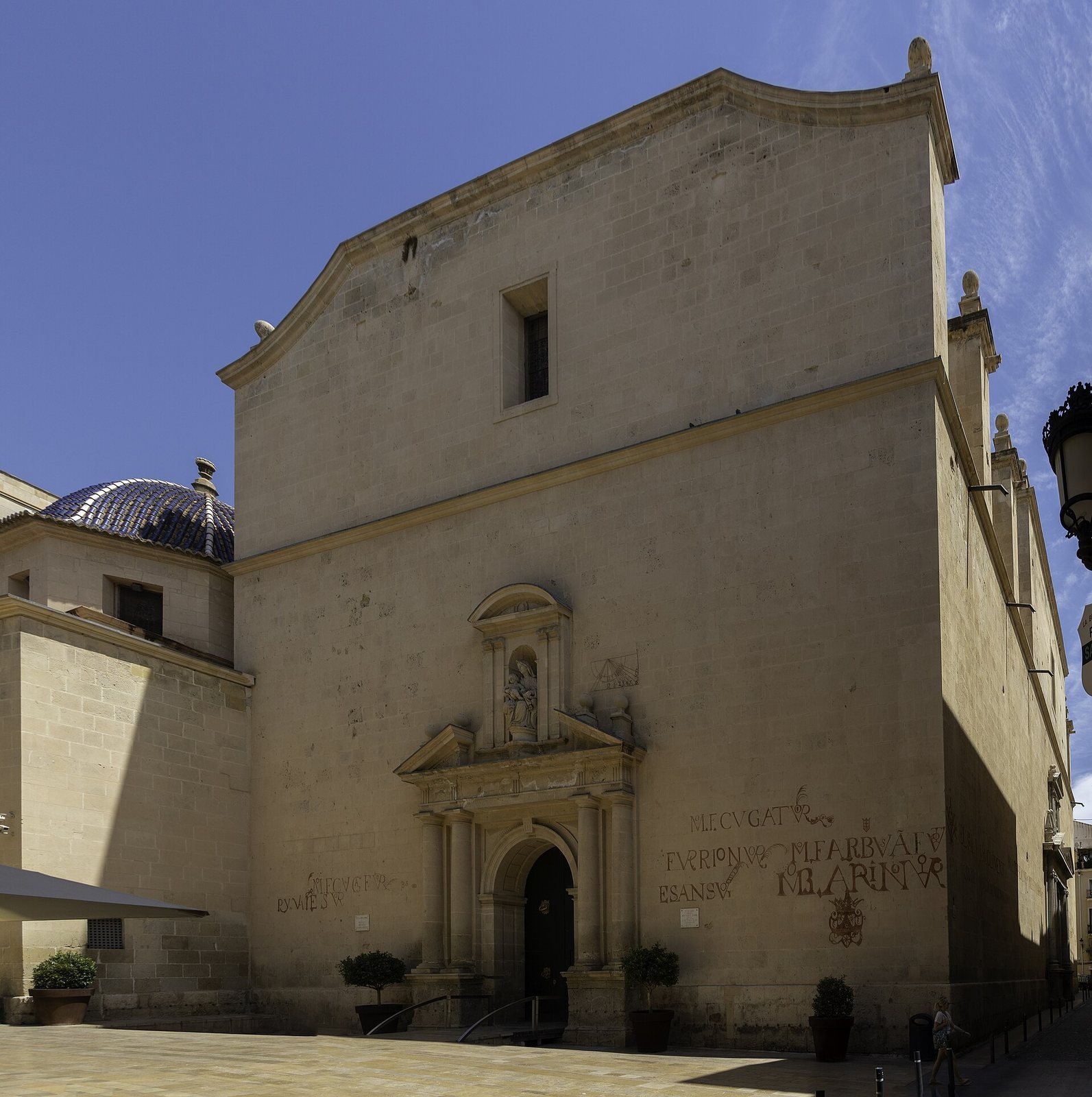
Built of stone masonry and lime mortar, including finely dressed ashlar, the church has an austere exterior in the restrained late-Renaissance Herrerian tradition, alongside early, unornamented Baroque qualities. Its Latin-cross plan, with a long nave crossed by shorter transepts, leads to a large sanctuary end surrounded by a passageway. Arches connect chapels set between the buttresses, and the plan is repeated on an upper level, adding to the building’s height.
Plan and chapels
Side and apse chapels
Thirteen chapels occupy spaces between the buttresses, including groups between the entrance and transept and around the apse. On the Epistle side are chapels dedicated to Christ of the Good Death, St. Raphael (formerly St. William), St. Anthony of Padua, Our Lady of the Rosary (formerly St. Francis), Our Lady of the Pillar, and St. Joseph. On the Gospel side are the Immaculate Conception and Our Lady of the Forsaken, with the sacristy doorway between them. Near the entrance are the chapels of Our Father Jesus and St. Michael, along with the entrance to the Chapel of Holy Communion.
Chapel of Holy Communion
Built in the 18th century, the richly decorated Chapel of Holy Communion has a Greek-cross plan, with arms of roughly equal length, and occupies a space outside the main nave. Ornate Baroque portals connect it directly to the street and cloister. The chapel is attributed to Joan Baptista Borja and is an example of Spanish and Valencian Baroque architecture.
Chapel of St. Nicholas
At the center of the apse, the Baroque Chapel of St. Nicholas dates to 1676 and is attributed to Villanueva. Its upper level contains a painted Calvary, a scene of Christ’s crucifixion, with a carved crucifix. Below it, a standing image shows St. Nicholas in bishop’s clothing, accompanied by a tub containing three children and a boy carrying a chalice. The group recalls a legend in which the saint brought back to life children murdered by a butcher.
Beneath the image is a 15th-century bust-shaped reliquary, a container for a saint’s remains, dedicated to Alicante’s martyr St. Felicitas. Her bones are displayed in a glass urn below it. An altar on the Gospel side of the apse holds images of the city’s co-patrons, St. Roch, traditionally invoked against plague, and St. Francis Xavier, a 16th-century Jesuit missionary.
Dome and associated spaces
Dome
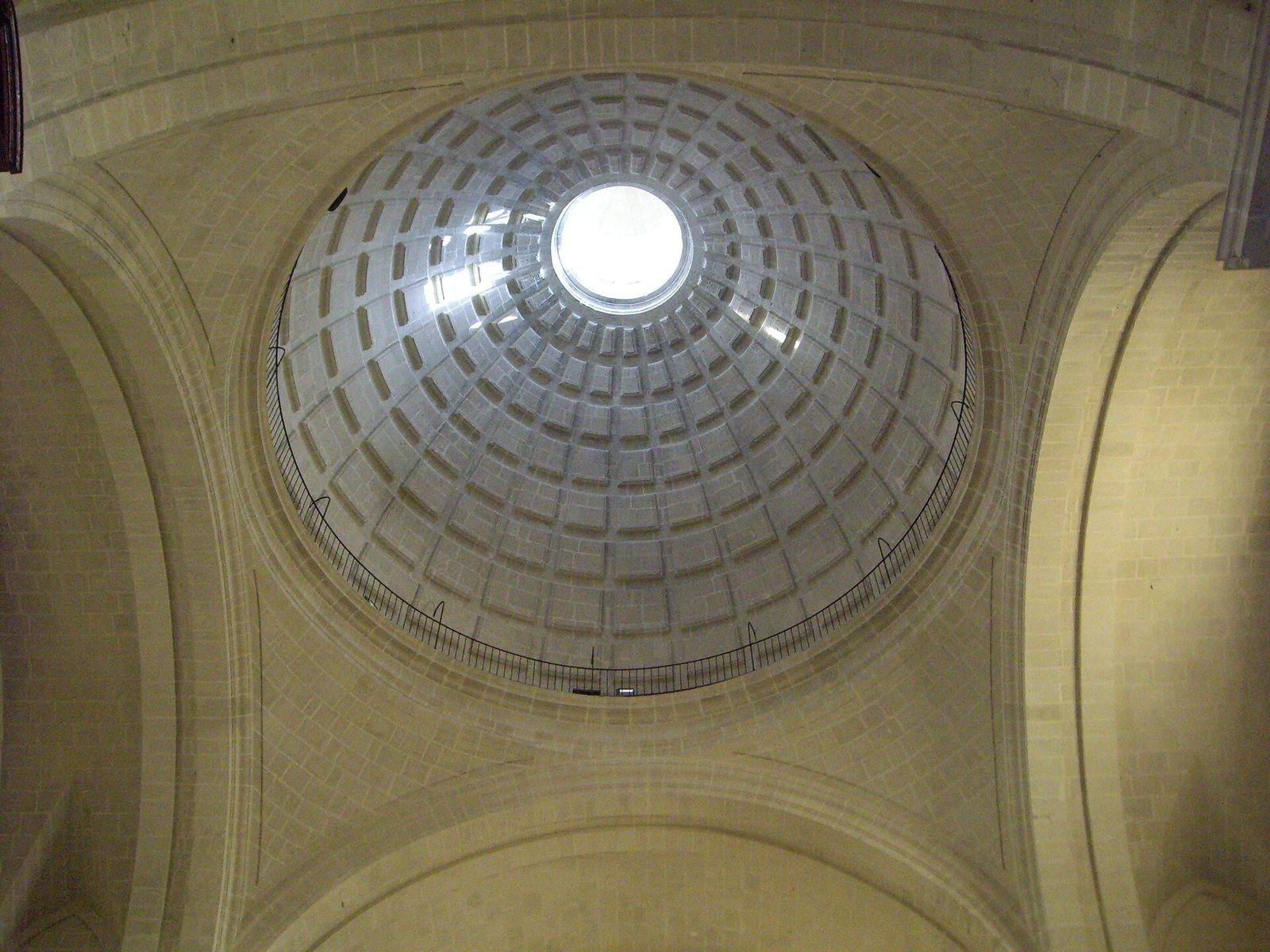
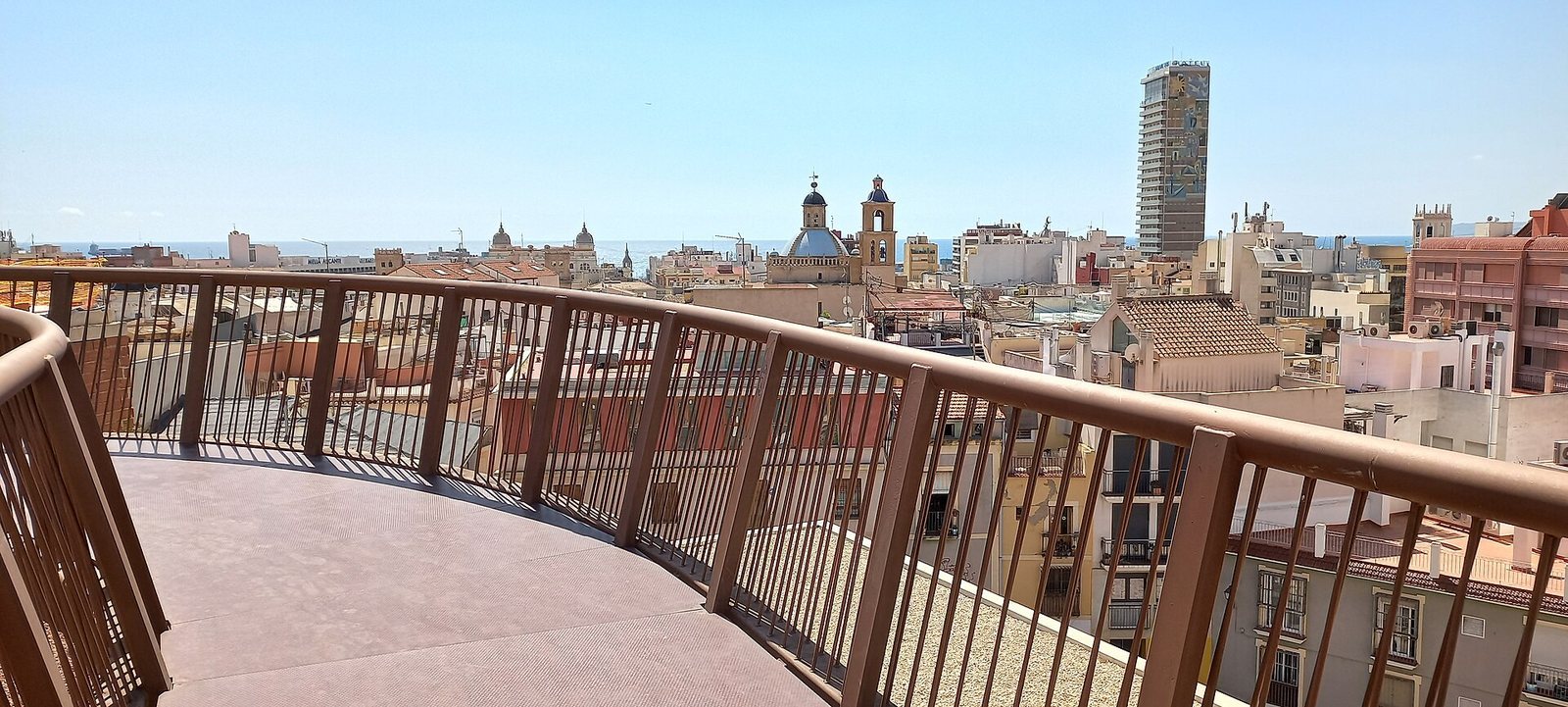
Designed by Alicante architect Miguel del Real, the blue dome rises approximately 45 metres. Its interior is decorated with recessed panels in a Roman-style pattern; the oculus and lantern reach a height of 44.79 metres.
Cloister and chapter spaces
The church complex also includes an antechamber to the sacristy, the sacristy, and a chapter house, where a cathedral chapter meets. The square, single-storey cloister retains traces of a 15th-century predecessor in Valencian Gothic style and was later renovated. Its portals are Baroque.
Facades, artworks, and organ
Facades
The main east facade follows the Doric order, a classical column style, while the south facade uses the Ionic order. A sundial and red-ochre inscriptions appear on the exterior; the inscriptions have been restored.
Artworks
The church’s works include the Altarpiece of the Souls, painted by Nicolás Borrás in 1574, and the 17th-century carved Christ of the Good Death by Nicolás de Bussi. An Italian baldachin, an ornamental canopy of marble and jasper, was brought to the church in 1688.
Organ
The historic pipe organ dates to 1591 and is the oldest in the Valencian Community, as well as one of the oldest in Spain. During an assault on the church under the Second Spanish Republic, Spain’s republican regime from 1931 to 1939, almost all its pipes were looted. A later reconstruction using poor-quality materials deteriorated. The organ was ultimately rebuilt by the Frédéric Desmottes Organ Workshop and inaugurated in 2021, retaining its old exterior case. The rebuilt instrument has 2,382 pipes.