Wallroda Village Church: A 17th-Century Church in Saxony, Germany
Site at a Glance
- Popularity
- Very Low
- Country
- Germany
- Primary era
- Early Modern
- Eras represented
- Medieval, Early Modern, Modern
- Civilizations
- Electorate of Saxony, Holy Roman Empire, Margraviate of Meissen
- Site type
- Religious
- Remains
- Church
On this page17 sections
History
Wallroda Village Church is a 17th-century church in Wallroda, a district of Arnsdorf in Saxony, Germany. A church at Wallroda appears in a register from the mid-14th century, but its original building date and location are uncertain, including whether it stood where the present church does.
Medieval church and pilgrimage
An earlier church may have stood on the right bank of the Große Röder, near Schafberg, while the village’s first houses were on the left bank. Flooding could prevent people from reaching the church, and a new building was erected across the river at the present location. Wallroda’s church drew pilgrims until the Reformation, the 16th-century movement that brought about the formation of Protestant churches in western Europe.
The present church and its organ
The present church dates to the 17th century and is now Evangelical-Lutheran. Its organ history links Wallroda with the work of Gottfried Silbermann, a German organ builder of the Baroque period. Silbermann built an instrument in 1732–33 with one keyboard, eight stops, which control sets of pipes producing distinct sounds, and no pedal keyboard. It was installed at the old village church in Etzdorf in 1734. In 1796, organ builder Benzky added a pedal keyboard and two stops.
When work on a new church at Etzdorf began in 1865, that congregation sold the Silbermann organ to Wallroda. In 1902, Wallroda obtained a new organ built by Dresden organ builder Eduard Berger. Berger incorporated three Silbermann stops in 8-, 4-, and 2-foot registers, along with both of Benzky’s additions, into the new instrument. The Silbermann organ, then reduced to five stops, went to Berger as payment. It was taken first to Bischofswerda and, in 1919, into private ownership in Dresden, where Julius Jahn later added stops typical of the period.
In 1939, Bremen Cathedral cantor Richard Liesche, a musician who leads music in worship, and organist Käte van Tricht found the altered instrument in Dresden and brought it to the cathedral. In 1993, Wallroda’s parish and the Evangelical-Lutheran Church of Saxony transferred the three Silbermann stops that had remained in Wallroda to Bremen. The Wegscheider workshop restored the organ in 1994, returning those stops to it.
War memorials and repairs
In April 1945, three Soviet prisoners were murdered on a country road near the church during a death march from the labor education camp of Sachsenwerk Licht und Kraft A.G., a German electrical engineering company. They were buried nearby, exhumed in October 1945, and reburied in the village cemetery. During the German Democratic Republic (GDR), the socialist state in eastern Germany from 1949 to 1990, lower-grade pupils at Arnsdorf’s Kurt Schlosser Polytechnic Secondary School maintained the Second World War memorial as a school-pioneer project.
Lightning caused major damage to the church’s roof structure and covering. Repairs to the roof and bell-tower mechanism took place during the 1990s and 2000s, and the organ received extensive maintenance in the 1990s.
Remains
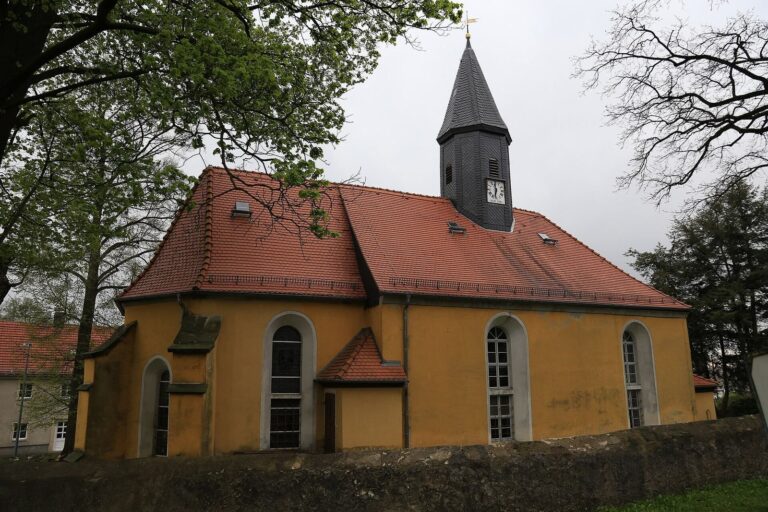
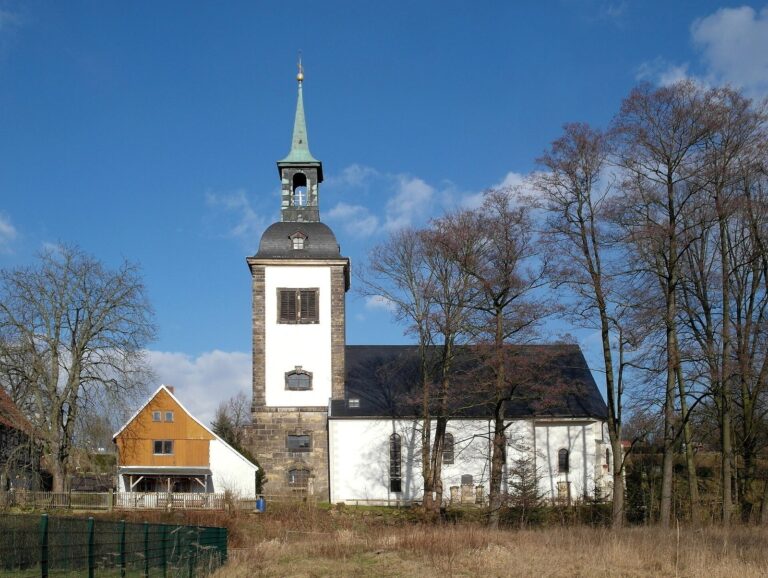
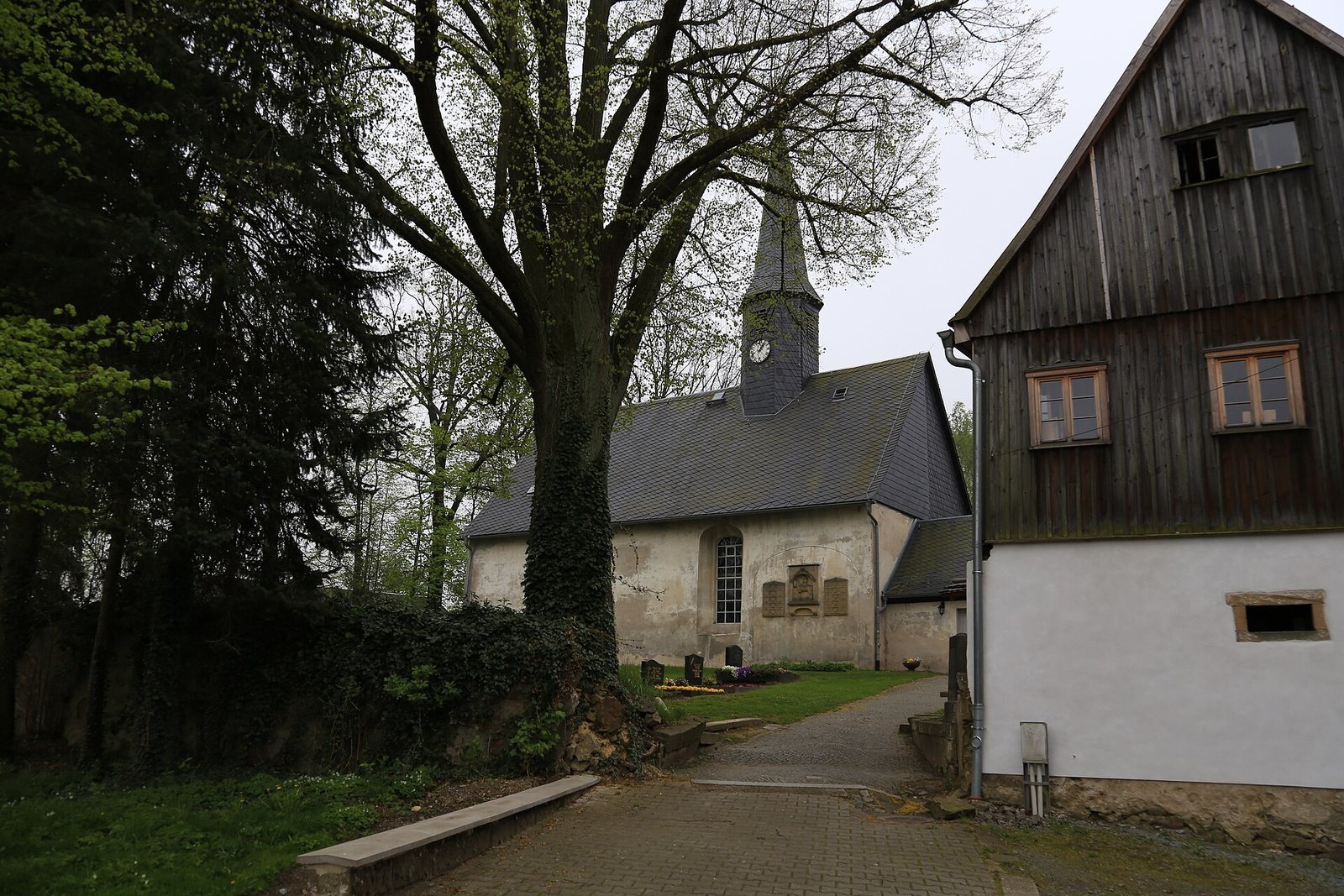
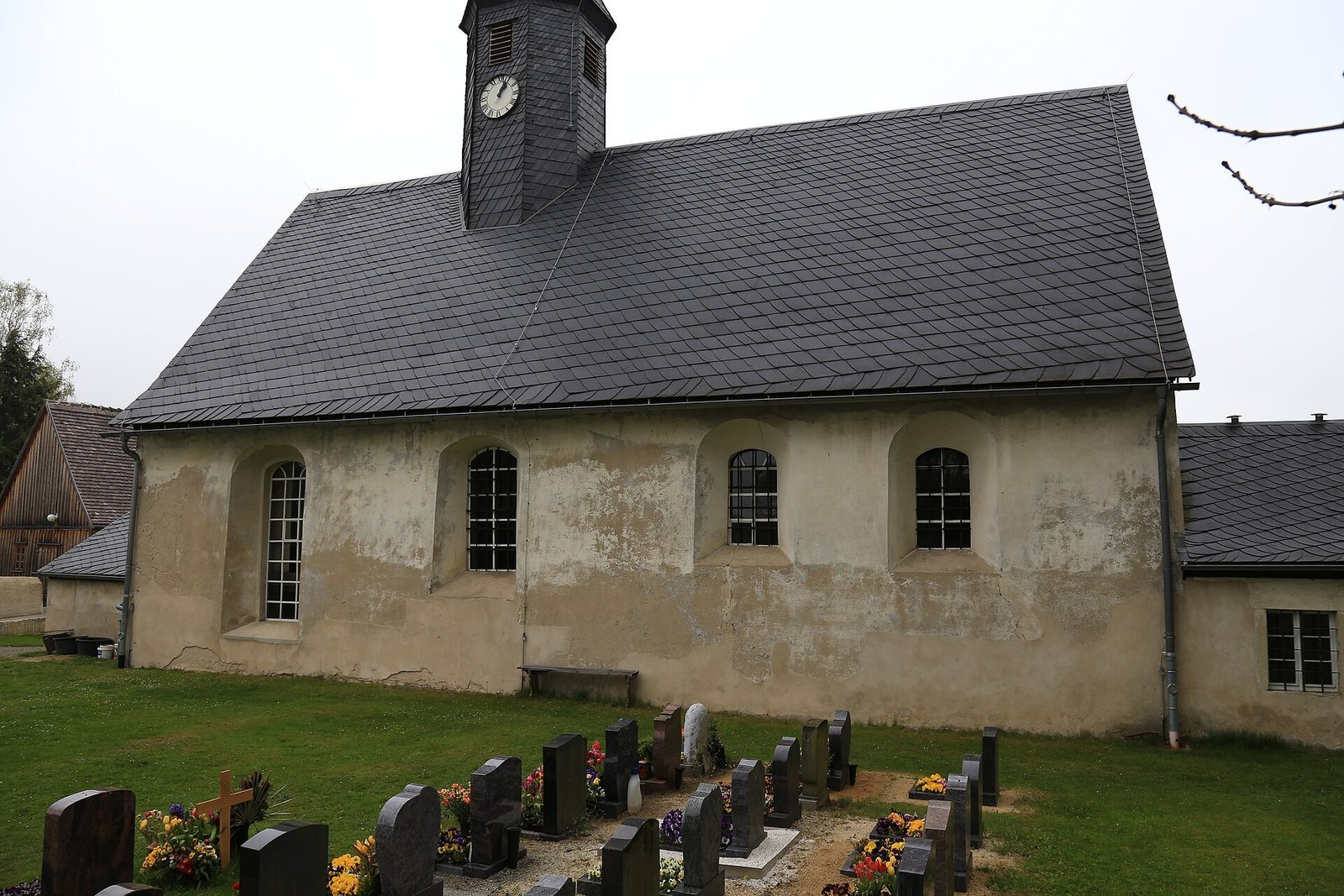
The church has a plain rectangular plan, a steep gabled roof, and a small enclosed entrance space attached to the building. An octagonal tower houses its clock and bell frame and rises to a slender, pointed spire. A gold-colored ball and weather vane crown the roof peak.
Churchyard and adjoining buildings
A cemetery surrounds the church, with an older section to the north and a newer one to the south. A rubble-stone wall borders the older section. Beside the church, the rectory consists of a dwelling and two barns.
Bells
The tower’s bell frame is made of oak. Its two bronze bells date to 1410 and 1420. The larger bears the inscription “O king of glory, come in peace” in inverted letters; the smaller carries the same words in small Gothic lettering. An unidentified mark on the smaller bell’s bolt may be a coin impression or a founder’s mark. A separate small Mass bell dates to the early 16th century, when the church was Catholic.
Interior furnishings
Interior arrangement
A wooden winged altarpiece and wooden pulpit furnish the interior, with a baptismal font in front of the altar. The pews, galleries, and ceiling lining are plain woodwork.
Baptismal font
The sandstone font was made around 1650 in the Renaissance style with financial support from the parish. It is about one metre high and approximately 74 centimetres across. Three leaf ornaments decorate its base. Reliefs of children’s heads and quotations from Matthew 28, Mark 10, and John 3 appear around the basin rim, referring to baptism and entry into the kingdom of God.
Winged altarpiece
The late-Gothic altarpiece dates to around 1520 and was extensively renovated in 1885. With its panels open, it measures about 1.45 metres high and more than 2.10 metres wide. It stands on a predella, the platform beneath an altarpiece, measuring 50 centimetres high and 2.15 metres wide. Paintings in tempera, made with pigment bound in a medium, show the Annunciation on the outer panels, with Gabriel announcing Jesus’s birth to Mary. Inside, the left wing shows Paul of Tarsus before and after his conversion to Christianity; the two pictures on the right wing depict the apostle Peter. The central niche holds carved and painted figures of Mary with the infant Jesus, flanked by Paul and Peter. A painting on the predella shows Christ with the twelve apostles.
Pulpit
The pulpit dates to the 1620s. A written board found inside its parapet during renovation in 1902 gives 1625 as its completion year. It rests on an octagonal column and is covered in colored wooden reliefs. The parapet shows the four Gospel writers, separated by female, pillar-shaped figures. An inscription on the upper frieze cites John 20 and says the signs were written so that people might believe Jesus is Christ, the Son. Reliefs on the stairs represent faith, love, hope, and patience. Their unusually revealing female figures draw on depictions of Demeter, an ancient Greek goddess associated with grain and harvest.
Baptismal jug
A baptismal jug from 1895 has an engraving on its base listing the Wallroda families who donated it to the church.
Silbermann organ
The Silbermann instrument is now installed in the west crypt of Bremen Cathedral. A plaque on it records its history and former location in Wallroda.
War memorials
First World War tablets
Three stone tablets set into the church’s north wall commemorate Wallroda’s First World War dead. A mounted soldier appears on the large central tablet, alongside the inscription, “And whoever found death in the fierce battle rests also in foreign soil in the fatherland.” The two smaller tablets list 28 local war dead by name.
Second World War memorial
A memorial stone on the eastern side of the cemetery wall commemorates the three Soviet prisoners killed in April 1945. Its inscription calls them “three unknown resistance fighters” and states that they were killed on the country road.