Chapel of Our Lady of Europe: A Baroque Chapel and Foundational Landmark of Algeciras
Site at a Glance
- Popularity
- Low
- Country
- Spain
- Primary era
- Early Modern
- Eras represented
- Early Modern, Modern
- Civilizations
- Spanish
- Site type
- Religious
- Remains
- Chapel
On this page8 sections
History
The Chapel of Our Lady of Europe is a Roman Catholic chapel in Algeciras, Spain, first built in 1690 as a hermitage, or small place of worship, dedicated to Saint Bernard. Its present character reflects a rebuilding in 1769 in the late Baroque style, an ornate European architectural tradition. The chapel is regarded as a foundational landmark of modern Algeciras.
Algeciras was captured and destroyed in 1379 by the Muslim-ruled Kingdom of Granada. After Castilian forces conquered Gibraltar in 1467, people from Gibraltar maintained agricultural farmsteads in the area. By the mid-seventeenth century, they were seeking a local chapel so they would not have to travel long distances to attend worship.
Foundation and settlement after 1704
The wealthy Gálvez family built the hermitage on their farmstead with the authorization of Martín de Barcia Zambrano, bishop of Cádiz. The chapel was dedicated to Saint Bernard of Clairvaux, a twelfth-century Cistercian abbot who was patron saint of Gibraltar and the Campo de Gibraltar.
After Anglo-Dutch forces captured Gibraltar in 1704, many of its residents settled among Algeciras’s ruins. Their first city-council meeting in exile took place in the chapel, which was then still dedicated to Saint Bernard. Although the nearby houses were initially meant to be temporary, the settlement grew into the beginnings of modern Algeciras.
The chapel also sheltered the statue of the Virgin and Child venerated at Gibraltar’s Shrine of Our Lady of Europe, a Catholic title for the Virgin Mary. During the capture of Gibraltar, the shrine was looted and the statue broken. A fisherman recovered its fragments, which had been cast into the sea, from the Bay of Gibraltar and gave them to Juan Romero de Figueroa, priest of the Church of St Mary the Crowned and St Bernard. He brought the pieces to Algeciras, where the statue was reassembled and the chapel rededicated to Our Lady of Europe.
Parish service and rebuilding
In 1721, the chapel became an auxiliary parish church of Los Barrios, serving the growing settlement. It held this role until 1736, when the nearby church of Our Lady of the Palm was completed. The chapel then returned to use as a hermitage, though it retained symbolic importance. The 1755 Lisbon earthquake, a major earthquake that caused destruction in Portugal and elsewhere, severely damaged the building. It was demolished and partly rebuilt in 1769, giving it the late-Baroque character and facade it retains today.
At the request of Catholics living in Gibraltar, the original statue was returned there in 1864. A replacement copy, commissioned by the bishop of Gibraltar, was installed in the chapel.
Disuse and modern preservation
The chapel was plundered in 1931 and sold by the bishopric to a private owner in the mid-1930s. It was abandoned during the latter part of that decade and into the 1940s, when a mechanical workshop used it for storage. The municipality acquired the building in 1943 and later transferred it to the bishopric on the condition that it be restored and reopened for worship.
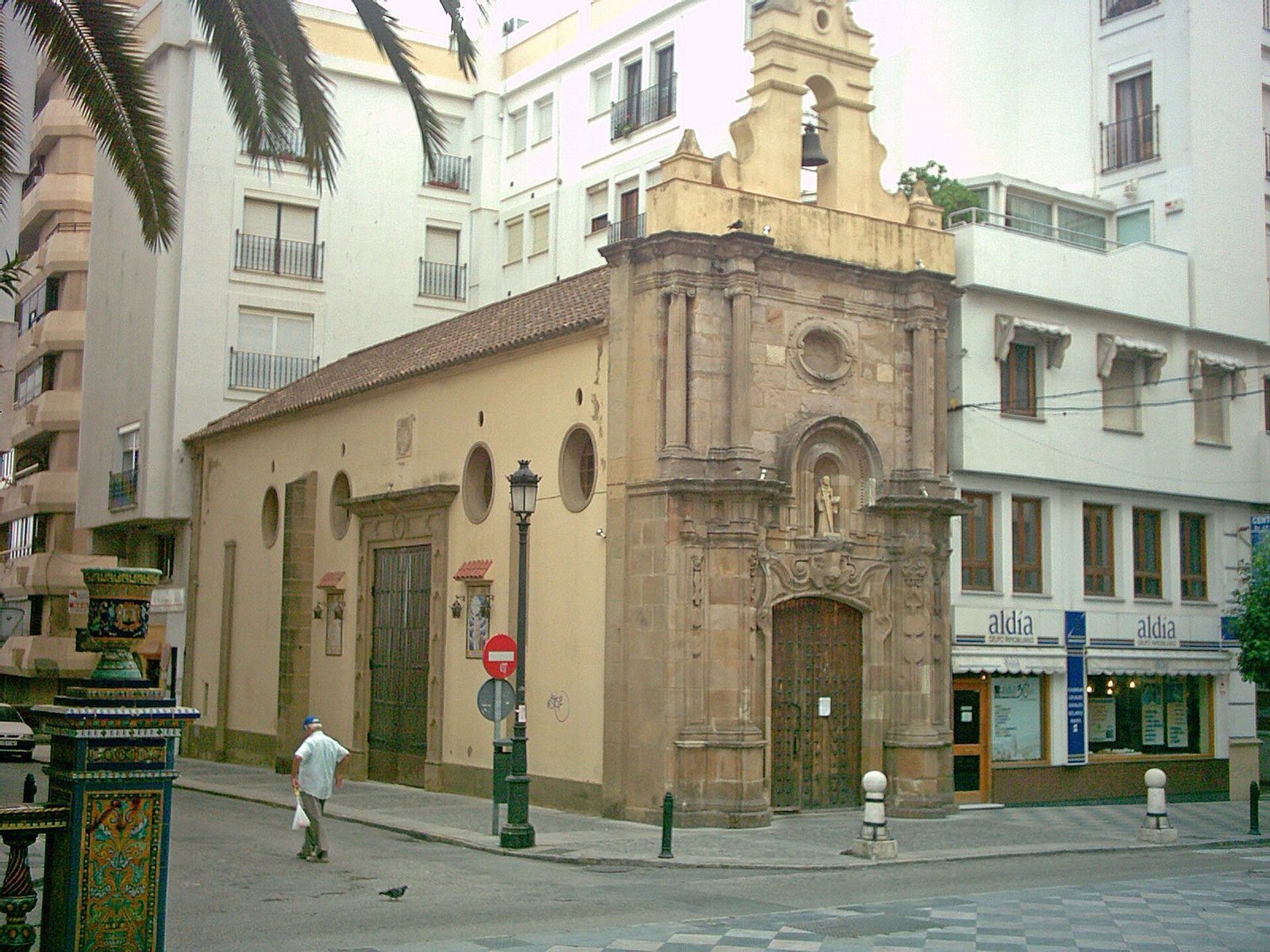
In 1981, the chapel received Spain’s Asset of Cultural Interest designation, a protected status for cultural heritage, classified as a monument of provincial historic-artistic interest. A further restoration in 1989 followed the demolition of the neighboring building on its left. Work involved dismantling the facade, strengthening the foundations and roof, and rebuilding the bell gable, which risked collapse. The chapel belongs to the Diocese of Cádiz and Ceuta; it serves as an auxiliary chapel to Our Lady of the Palm and as the official center of a local religious brotherhood, an association organized around devotional practices.
Remains
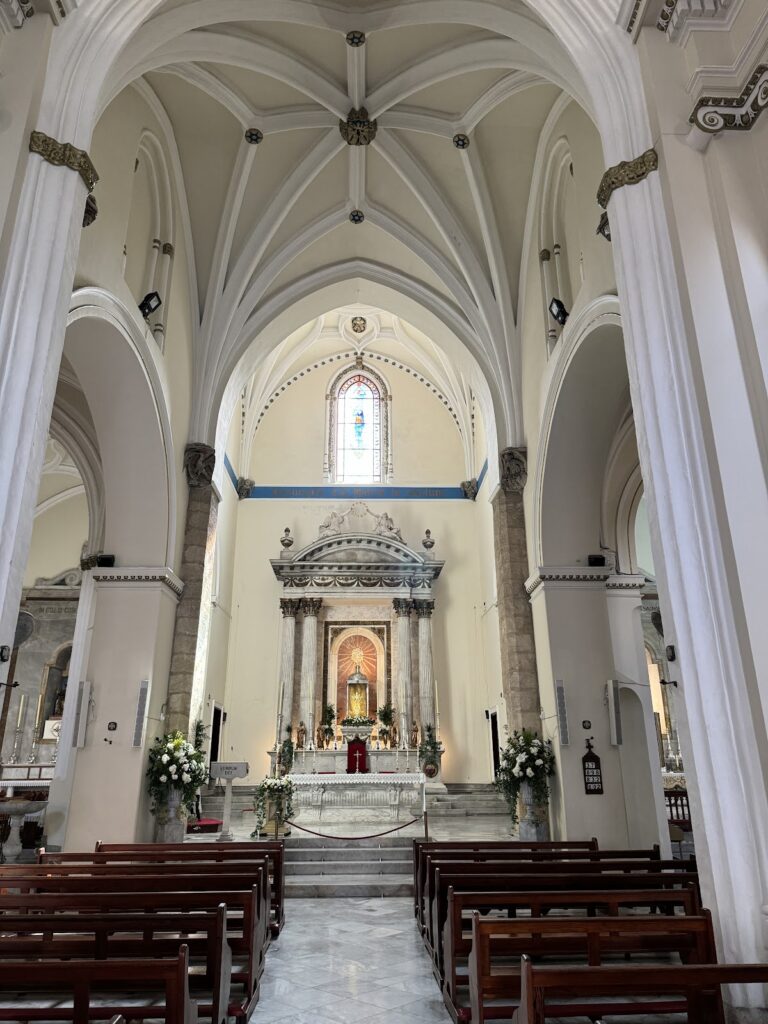
The chapel has a single elongated main space and a stone facade, with Baroque features shaping both its interior and exterior. The interior extends from the entrance through the nave, the main body of a church, to a flat-ended altar area.
Plan and vaulted interior
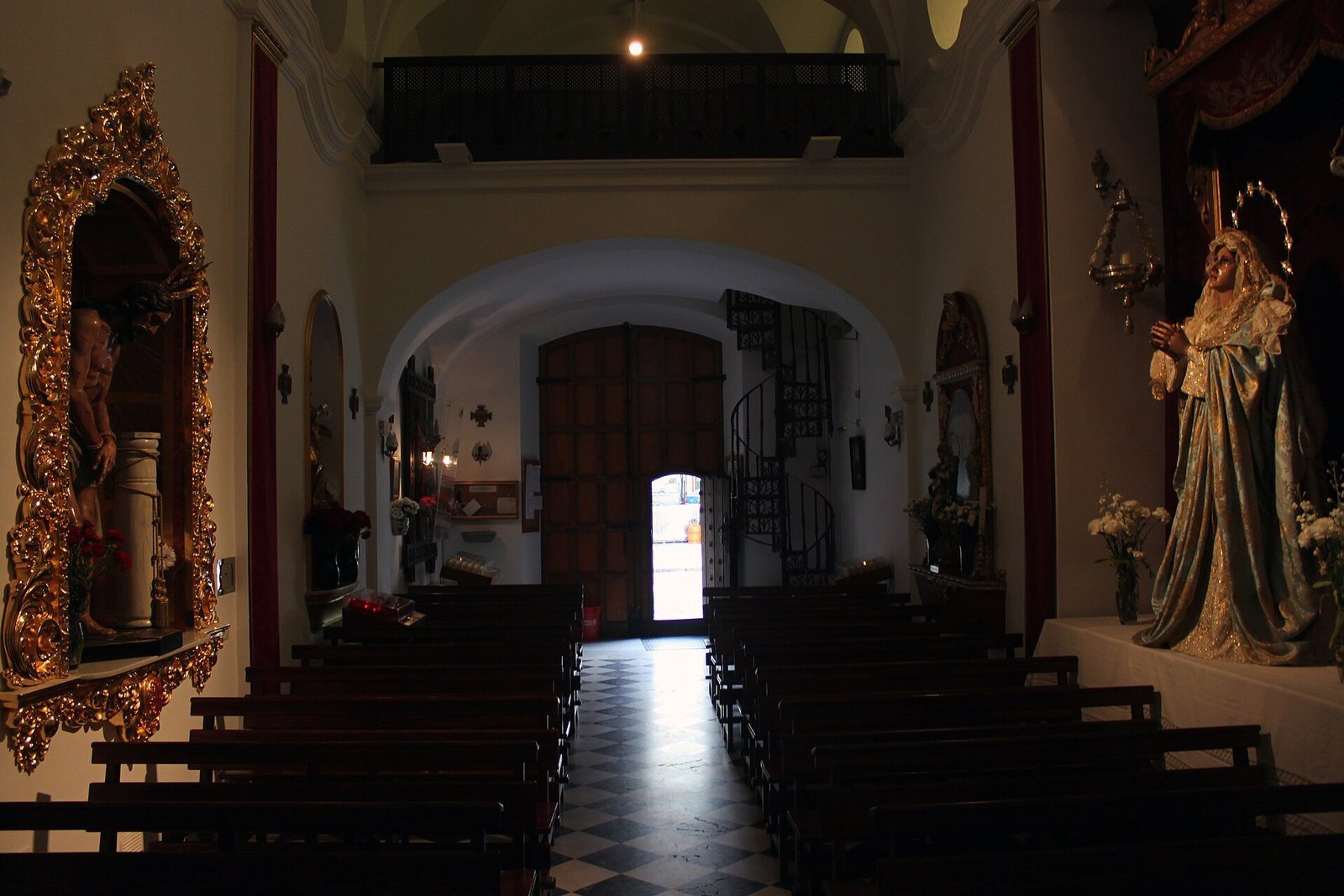
The original front entrance is joined by a side entrance opened in 1985 to allow processional exits during Holy Week. Plain Tuscan pilasters, shallow column-shaped projections from the walls, reinforce the sides of the nave. A barrel vault, or continuous arched ceiling, covers this space, with arched openings in the vault called lunettes and circular openings. At the far end, the altar area is covered by a dome supported on pendentives, curved sections that allow a dome to rest over a square space. The dome is divided into eight sections.
Interior ornament and devotional image
Baroque paintings and reliefs show the twelve Apostles on the dome and its pendentives. Along the side walls, a continuous entablature, a horizontal architectural band, frames round-arched niches containing images of Christ Bound to the Column, Our Lady of Tears, and Saint Francis. Behind the altar, a devotional chamber holds the enthroned image of Our Lady of Europe.
Stone facade and bell gable
The facade is arranged in two tiers of Baroque decoration. On the lower tier, pilasters support the projecting upper section, which features four fluted Ionic columns, a classical style with scroll-shaped capitals. A bell gable, a wall-like structure for holding bells, was added after the chapel’s original construction. Between the two facade tiers, a niche above the entrance contains an image of Saint Bernard. A Christogram, a symbol formed from letters representing Christ, sits above the image; both features were installed in recent times.