Saint Catherine Church in Vspolie: An Orthodox Church in Moscow
Site at a Glance
- Popularity
- High
- Country
- Russia
- Primary era
- Early Modern
- Eras represented
- Early Modern, Modern
- Civilizations
- Russian
- Site type
- Religious
- Remains
- Church
On this page12 sections
History
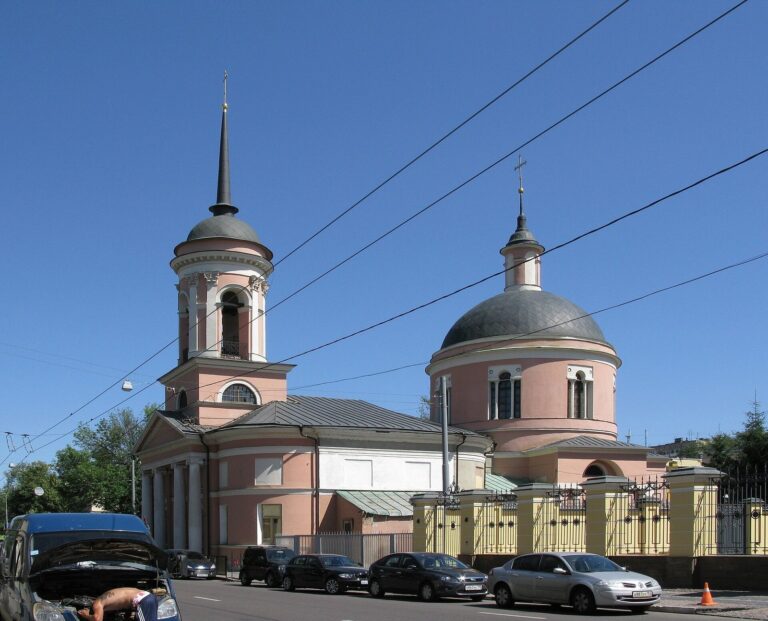
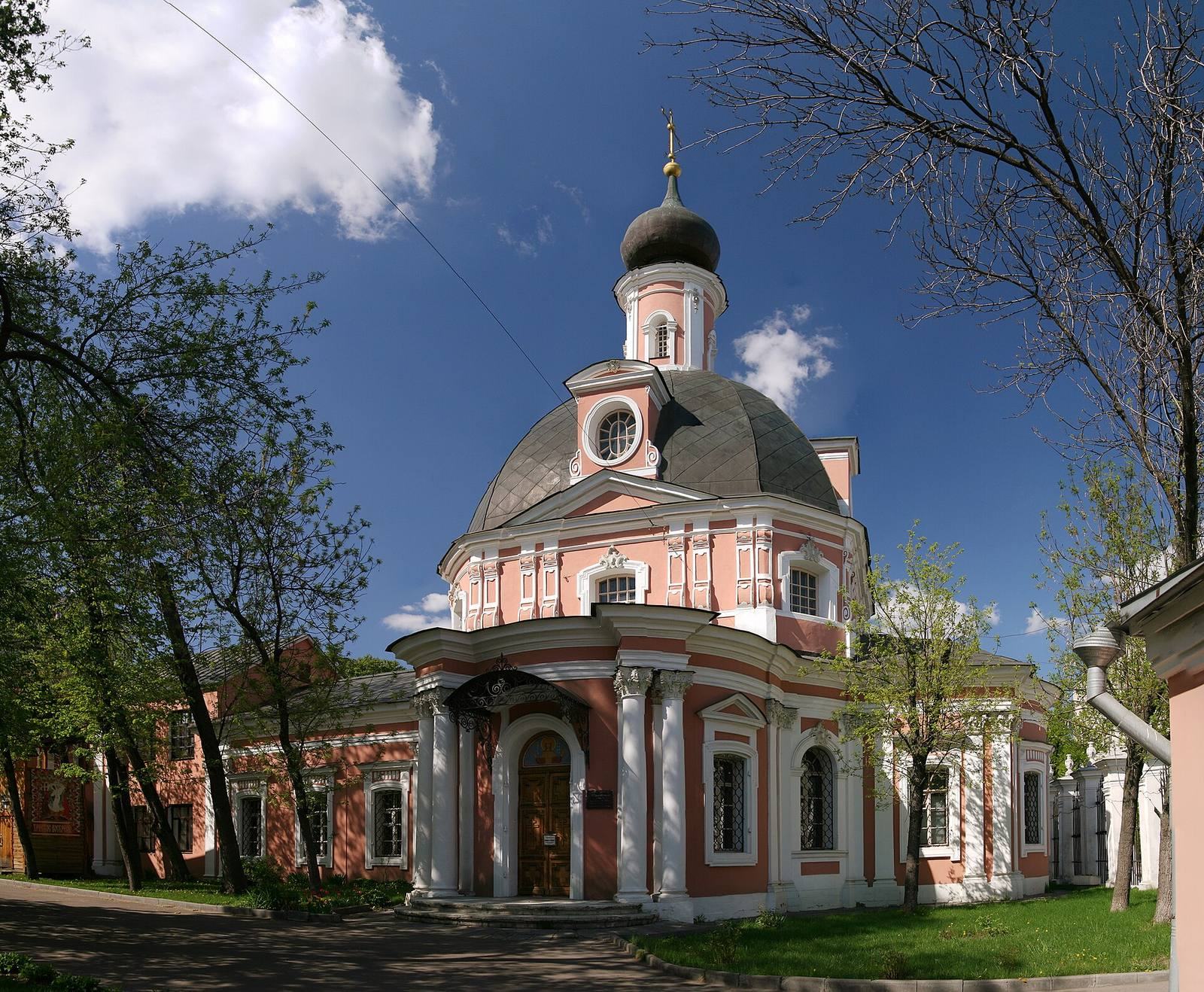
Saint Catherine Church in Vspolie is an Orthodox church complex on Bolshaya Ordynka Street in Moscow, Russia. Its origins lie in a wooden church established in the sixteenth-century Catherine Bleaching Settlement, founded on Moscow’s outskirts by order of Tsarina Anastasia Romanovna. The complex took its late-Baroque form through rebuilding designed by Karl Blank, a project dated 1766–1775.
Origins and the Seventeenth-Century Church
The church is sometimes dated to 1612, when the Second Militia, a Russian force organized in the early seventeenth century, defeated troops commanded by the Polish-Lithuanian leader Jan Karol Chodkiewicz. Historian Sergei Solovyov argued that the church already existed when the militia was formed, and fighting took place nearby. The church also appears in the New Chronicle.
A chapel dedicated to Theodore the Studite, a Byzantine monk and religious writer, was in use by 1625; a chapel to Saint Nicholas followed by 1636. The parish had 87 households in 1651. In 1657, the wooden church was replaced by a stone building. Tradition links the rebuilding to funding from Tsar Alexei Mikhailovich, who ruled from 1645 to 1676. According to the story, Saint Catherine appeared to him in a dream and foretold the birth of a daughter. The Theodore chapel may have been replaced at this time by one dedicated to Saint Theodore Stratelates, a Christian saint associated with military service.
Catherine II’s Rebuilding and Nineteenth-Century Changes
After her coronation in 1762, Empress Catherine II spent time in Moscow, founded the Imperial Foundling Home, and pledged public funds to rebuild the deteriorated church dedicated to her namesake. She commissioned Karl Blank to design the late-Baroque complex. A copper inscription records that the foundation stone was laid on May 25, 1766, that construction was completed in 1767, and that Archbishop Ambrose of Moscow and Kolomna consecrated the church on September 28, 1768.
The complex’s enclosure was erected in 1769 using parts of a fence made for Cathedral Square in 1731. The church suffered heavy damage in the 1812 Moscow fire. Architect Fyodor Shestakov later restored it, added a one-storey guardhouse at a corner, and oversaw a separate enclosure on the western side. The main enclosure was rebuilt in the 1820s. From 1870 to 1872, the old winter church was entirely reconstructed. Pavel Petrov is associated with the work, though Dmitry Chichagov may have directed it. Its main altar was rededicated to the Savior Not Made by Hands, with side chapels for Saint Nicholas and Alexander Nevsky. An almshouse, a charitable home for people in need, was built on the grounds in 1879–1880 by Dmitry Pevnitsky.
Confiscation, Closure, and New Uses
On April 4, 1922, amid a nationwide seizure of church valuables, authorities took items weighing about 195 kilograms. The summer church’s sacred doors, icon covers, and liturgical vessels were among them. Patriarch Tikhon of Moscow celebrated the church’s patronal feast there between 1920 and 1924.
The church closed in 1931. Its Saint Catherine icon was transferred first to the Church of the Resurrection in Monetchiki and later to the Church of Saints Florus and Laurus at Zatsepa. The former winter church was converted to housing, while offices occupied the eastern part of the complex. The premises were also used by the Central Design and Engineering Bureau for Instrument Making and the Grabar All-Union Art Workshop.
Restoration and Return to Religious Use
A major restoration took place from the 1970s through 1983, with work carried out by the Grabar All-Union Art Workshop. During this period, a research institute for instrument standardization occupied the western part of the grounds, while the Grabar art-restoration center used the eastern part. By 1990, the workshops occupied the whole complex.
The church began returning to the Russian Orthodox Church in 1992, and the transfer of its premises continued until 2006. In 1994, Patriarch Alexy II designated it as the Moscow representation of the Orthodox Church in America, an Eastern Orthodox church with its own ecclesiastical hierarchy. Alexy II and Metropolitan Theodosius (Lazor) consecrated the church on June 11, 1999. The first rector, Daniel Goubiak, served until 2000. Archimandrite Zacchaeus (Wood) was appointed in 2002 and suspended from ministry in 2011; Archimandrite Alexander (Pikhatch) succeeded him in 2012 and served until his death in 2016. Daniel Andreiouk was appointed rector and representative on December 6, 2017. The active church is associated with the Moscow Diocese of the Russian Orthodox Church and is designated a cultural heritage monument of federal significance in Russia.
Remains
The brick complex has a late-Baroque design and comprises a summer church dedicated to Saint Catherine and a winter church dedicated to the Savior Not Made by Hands. The two buildings are linked by a two-storey bell tower. The central church volume has adjoining side chapels and vestibule spaces, with an apse, a projecting sanctuary end.
Church Buildings
Summer Church
The main church has a square plan with corners cut off diagonally. A low, eight-sided upper section rises above it, supporting a large attic and a dome pierced by round dormer windows. Paired columns frame the entrances, while large window surrounds and raised stucco decoration enrich the exterior. Blank retained the older refectory church and the Saint Nicholas chapel as part of his design, while the Theodore chapel was removed. The bell tower’s lower level also served as the main church’s entrance vestibule, and additional tiers were added to the tower in the mid-nineteenth century.
Winter Church and Bell Tower
The winter church forms the other part of the complex, joined to the summer church by the bell tower. After the church closed in 1931, the tower and church cupolas were dismantled, and the winter church’s dome was also removed. The winter building was then used for housing and other purposes.
Enclosure and Furnishings
Enclosure
The enclosure’s central grille bars were topped with double-headed eagles, and sculpted eagles adorned the entrance piers. A later guardhouse replaced the addition made by Shestakov. It had arched niches, some of which may have been open.
Icon Furnishings and Devotional Objects
Dmitry Levitsky and V. I. Vasilyevsky painted icons for the Baroque iconostasis, the screen separating the sanctuary from the main worship space. Court manufacturer Ignaty Sazikov made its silver Royal Doors, the central doors of the screen, and covers for some icons. Catherine II gave the principal Saint Catherine icon a cover bearing her monogram. In the winter church, the icon stood beneath a small metal canopy by the south wall; in the summer church, its place was to the right of the south entrance. A belt associated with Saint John of Shanghai and San Francisco was displayed for veneration in 2012, 2014, and 2017–2019.