Robert Schumann House: Birthplace Museum and Research Centre in Zwickau
Site at a Glance
- Popularity
- Medium
- Country
- Germany
- Primary era
- Medieval
- Eras represented
- Medieval, Modern
- Civilizations
- German, Holy Roman Empire
- Site type
- Domestic
- Remains
- House
On this page14 sections
History
The Schumann family in Zwickau
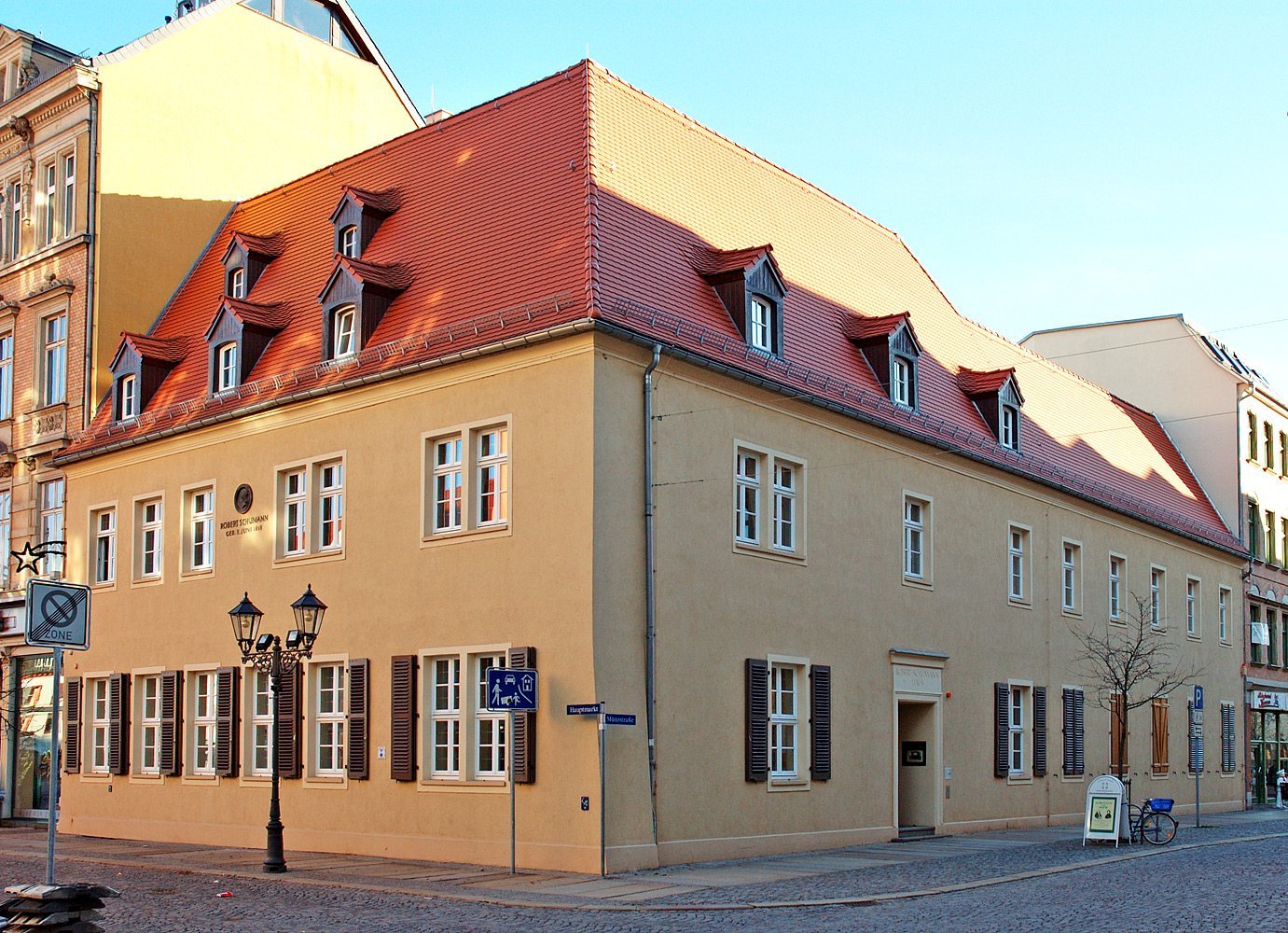
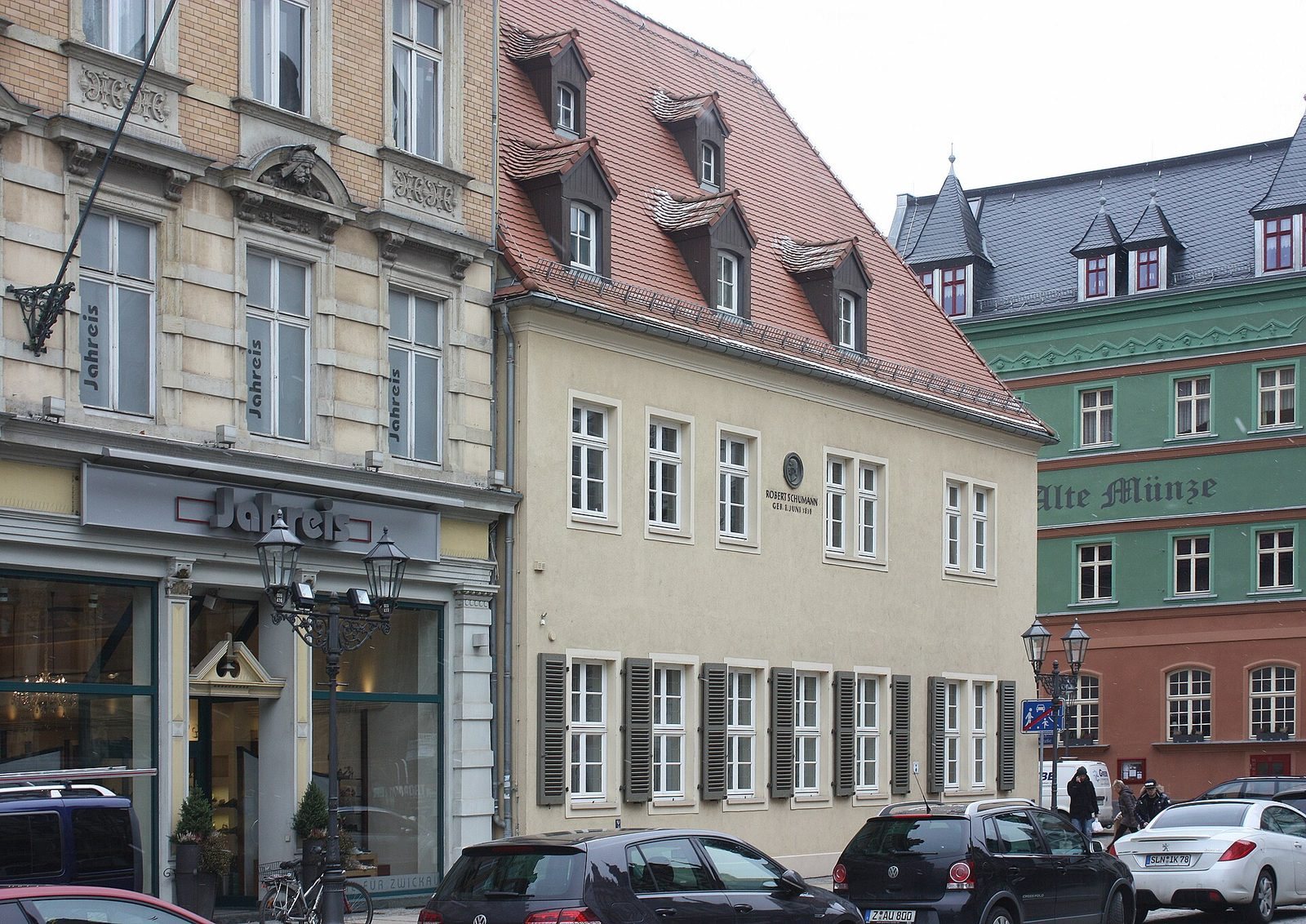
The Robert Schumann House is a museum, concert hall, and research centre at Hauptmarkt 5 in Zwickau, Germany, occupying the reconstructed birthplace where composer Robert Schumann was born on June 8, 1810. The house’s history reaches back to the fifteenth century. Its later association with the composer grew from his family’s home there and the publishing business established by his father.
In 1808, August and Christiane Schumann moved to Zwickau from Ronneburg in Thuringia with their children Eduard, Carl, Julius, Emilie, and Robert. August, already a writer, bookseller, and publisher, founded the Schumann Brothers publishing house with his brother Friedrich. The firm operated at the western end of the Hauptmarkt, at the site now numbered 5. Its publications included Remembrance Pages for Educated Readers, an 18-volume Postal, State, and Newspaper Lexicon of Saxony, and small editions of classical works regarded as Germany’s first pocketbooks.
The family rented the building. Robert lived there for seven years, then attended a respected local school from 1820 to 1828 before moving to Leipzig to study law. After the family left, August acquired another house nearby for his family. That building was destroyed during the Second World War; paving plaques installed in 2010 mark its former location.
From birthplace to museum
Zwickau established the Robert Schumann Museum on June 8, 1910, the centenary of the composer’s birth. Its first exhibition was in the Council School Library, and in 1914 the museum moved to the King Albert Museum. Martin Kreisig, its first director, developed the collection during almost three decades in the post. His correspondence with Schumann’s daughters Marie and Eugenie helped the museum acquire documents and handwritten music belonging to their parents.
After Kreisig retired in 1940, museum director Rudolf von Arps-Aubert took temporary charge. Following the war, Georg Eismann became the museum’s second independent director. In the aftermath of the 1954 flood, Eismann led the complete rebuilding of Schumann’s birthplace. The museum, concert hall, and research centre opened in the reconstructed house in 1956. Eismann also shaped the exhibition’s basic form, which remained in place through its modernization in the early 1990s.
Eismann retired because of illness in 1963. Gerhardt Blank succeeded him briefly, followed in 1965 by Martin Schoppe, the museum’s first director with formal musicological training. Gerd Nauhaus took over in 1993, and Thomas Synofzik became director in 2005.
Schumann’s life and the exhibition
The exhibition follows Schumann from his student years in Leipzig and Heidelberg, where he turned from law to music, studied piano intensively, and pursued composition. His piano practice led to a chronic condition in his right hand. It also traces his founding of the New Journal of Music with Friedrich Wieck and members of the Davidsbund, a fictional artistic association Schumann created as a literary device.
The exhibition presents Schumann’s growing relationship with Clara Wieck, a pianist nine years younger than he was and already known across Europe. They married on September 12, 1840. Robert’s wedding gift, Myrthen, Op. 25, and their only joint work, twelve poems from Rückert’s Love’s Spring, Op. 37, listed under Clara’s Op. 12, are part of this story. The account of their first married years in Leipzig includes Robert’s symphonies, chamber music, and oratorio, his work at the newly founded conservatory, his friendship with Felix Mendelssohn Bartholdy, and the couple’s journey to Russia, which lasted several months.
After Robert became ill during the Russian journey, doctors recommended a temporary move to Dresden while he recovered. The family’s stay lasted almost six years. During this period his reputation grew, he composed new works, and he was elected to lead the Dresden Liedertafel, a German male-voice choral society. He founded the Dresden Choral Society on January 5, 1848. The exhibition also recounts the May 1849 uprising in Dresden and the family’s flight to Maxen and Kreischa to escape the unrest. Their first son, Emil, had died in 1847.
In 1850 Schumann became music director in Düsseldorf. His Third Symphony, known as the “Rhenish,” belongs to this period; the city’s Catholic environment also informed his Mass, Op. 147, and Requiem. The exhibition covers his worsening health, difficulties with members of the Düsseldorf Music Association, and his new acquaintances Johannes Brahms, in 1853, and Joseph Joachim. After jumping into the Rhine and being rescued, Schumann spent the final two years of his life in the Endenich asylum near Bonn. It also follows Clara’s teaching and concert career, her work to spread Robert’s music, her role in the first complete edition of his works, and her appointment to the Hoch Conservatory in Frankfurt.
Festivals and research
Zwickau held its first Schumann Festival in 1847. The family initially could not attend because of Emil’s death, but after the event was postponed Robert conducted and Clara performed as soloist. A second festival marked Robert’s fiftieth birthday. The festival continues annually during the week of his birthday.
The house’s collections support research on the Schumanns and their period. The periodical Schumann Studies, which publishes conference reports and original research on the composer and his circle, has appeared periodically since 1976. A complete-edition project for Schumann’s works entered the Union of German Academies of Sciences’ support programme in 1985, at the initiative of the Robert Schumann Society in Düsseldorf. A research centre opened there in 1986. After political conditions changed and the museum became more international, the Mainz Academy established a second centre in Zwickau in 1992, reflecting the research value of the house’s collections. Work on an edition of the Schumanns’ letters and correspondence began with an initial project phase in 1998; the edition, planned to exceed 40 volumes, began in 2005.
Remains
Building and exhibition layout
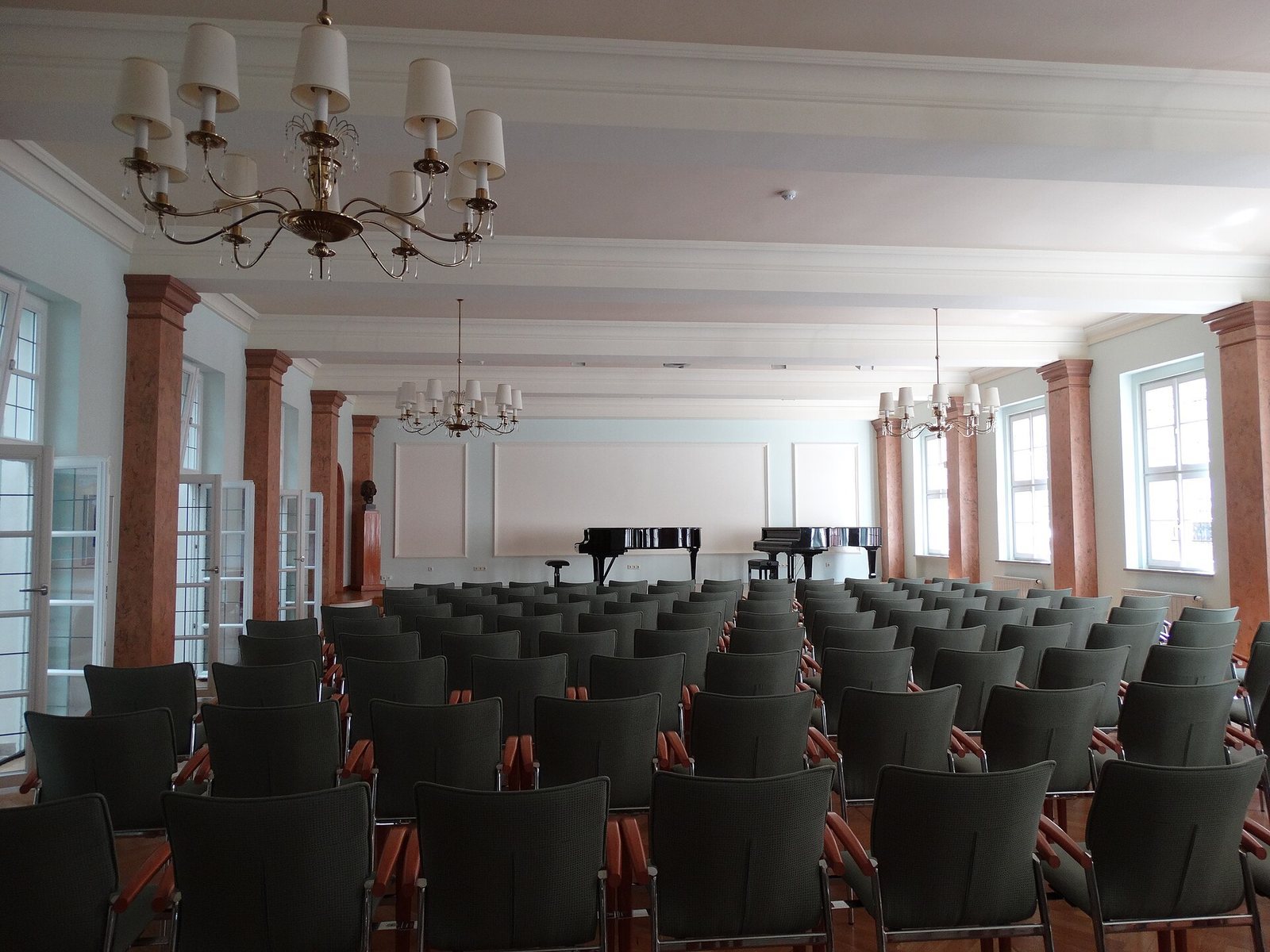
The reconstructed and expanded birthplace contains the museum, concert hall, and research centre. The permanent exhibition is arranged in eight rooms, each devoted to a period in Schumann’s life. The room where he was born serves as a memorial room. The concert hall accommodates 140 people, and a covered winter garden adjoins it. The garden was roofed in 2001.
Archive
Documents and music
The archive holds original scores in Robert and Clara Schumann’s handwriting, title pages, dedications, letters, sketches, their marriage diaries, and first editions of their works. Its manuscripts include sketches for Genoveva, Op. 81, and A Poet’s Love, Op. 48, as well as the working copy for Album for the Young, Op. 68. The collection also contains portraits, paintings, and other images. Schumann’s letter indexes, registers of letters he sent and received, are held here as well.
Correspondence
An estimated 20,000 letters by Robert and Clara survive in public collections and private hands around the world. Zwickau holds about 300 letters by Robert and more than 2,000 by Clara, along with correspondence from the Wieck, Schumann, and Bargiel families. Nearly all of the approximately 5,500 letters addressed to Robert survive in 28 bound volumes, now held by the Jagiellonian Library in Krakow.
Objects and instruments
The memorial room
Objects associated with Robert and Clara include Robert’s standing desk and a hammer grand piano, an early form of grand piano, made by the André Stein firm in Vienna. Friedrich Wieck commissioned the instrument for Clara, and it was delivered to her on March 4, 1828. She played it at her first public concert, at the Leipzig Gewandhaus on October 20 that year, aged nine. Friedrich later sold it to the Focke family. After it passed through a Focke descendant, collector Alfred Wiede acquired it and gave it to the museum in 1911. The piano also served as the model for the instrument pictured on the reverse of the former 100-DM banknote.
Pianos and other keyboard instruments
A square piano made around 1840 came from the factory founded by Ernst Rosenkranz in 1797. Friedrich Wieck often traded in Rosenkranz instruments through his Dresden piano business, and Clara often played instruments from the firm. Compact and relatively inexpensive, square pianos were popular household instruments. The museum received this one as a gift in 1970. A grand piano made around 1870 by Ludwig Bösendorfer is displayed in the room on Schumann’s Leipzig years. Its Viennese action, a historical piano mechanism, and large, heavy hammer heads give it a heavier touch than the older Stein grand piano, which uses the same mechanism. The collection has also included a grand piano made by Clara’s cousin Wilhelm Wieck since the 1970s.
The memorial room also contains a physharmonica, a free-reed keyboard instrument supplied with air by bellows. Friedrich Wieck bought it as a travel instrument for Clara and her sister Marie. Alfred Wiede later bought it from Marie and donated it to the museum on April 21, 1917. Another instrument in the collection is a separate pedal keyboard, probably made in the nineteenth century and formerly used by the Paulus congregation in Marienthal. Placed beneath a piano or raised grand piano, it allowed musicians to practise organ pedals. Robert composed Studies in Canonic Form, Op. 56, Sketches, Op. 58, and Fugues on B-A-C-H, Op. 60, for this type of keyboard.
Artworks and family objects
The displayed artworks include Friedrich Hausmann’s 1896 portrait of Clara, Johann Peter Götting’s 1852 bust of Robert, a bust of Felix Mendelssohn Bartholdy, and Ernst Rietschel’s 1846 marble relief of Robert and Clara. Edmund Schorisch’s 1935 work depicting Robert is also in the collection. Other objects associated with the family include a chess set, a domino set, and gifts presented to Clara for her stage anniversaries. A medal connected with Robert’s rescue from the Rhine and a painting of the bridge are displayed as well.