Schloss Planitz: A Baroque Castle in Zwickau


Site at a Glance
- Rating
- 4.8
- Popularity
- Very Low
- Country
- Germany
- Primary era
- Early Modern
- External website
- Open
- Eras represented
- Early Modern, Modern
- Civilizations
- Electorate of Saxony, German, Holy Roman Empire
- Site type
- Domestic
- Remains
- Castle
On this page10 sections
History
Medieval origins and destruction
Schloss Planitz is an urban castle in Zwickau, Germany, whose origins reach back to the twelfth century. A foundation date of 1150 is also associated with the site. During the twelfth and thirteenth centuries, Planitz was held by the bailiffs of Weida, who granted the estate to the Lords of Planitz as a fief. Ludewicus de Planize appears in a document of 1192 as the earliest person associated with the Planitz name in this record. From 1406, the Lords of Planitz held the estate as vassals of the Margrave of Meissen.
In January 1430, Hussite forces attacked Planitz. The Hussites were followers of the Bohemian religious reformer Jan Hus, and their armies campaigned across parts of Central Europe during the early fifteenth century. The attack devastated the village and burned the castle, farmsteads, and houses. Several decades later, the Lords of Planitz rebuilt a castle on the same site. They financed the work partly by selling Unterplanitz, now Vorderneudörfel, to the city of Zwickau, which established the Pietzschgut there.
Ownership changes and the Thirty Years’ War
Christoph von Planitz sold the family estate in 1572 for 40,000 florins to Georg von Schönburg of Glauchau and Waldenburg. Schönburg sold it in 1579 for 40,500 florins to Joachim von Beust, a law professor at Wittenberg. In 1617, Beust’s son Heinrich exchanged Planitz with Christoph von Reibold for Schloss Netzschkau. Reibold transferred it in 1618 to Rudolph Apel Vitzthum von Eckstedt, the chief chamberlain, a senior court official responsible for aspects of a ruler’s household and administration. The Zwickau council then acquired the estate, before Elector Johann Georg I bought Planitz, including Voigtsgrün, in 1623.
The Thirty Years’ War, fought from 1618 to 1648 amid religious, dynastic, and political struggles, brought renewed destruction. In August 1632, the imperial general Holk plundered Planitz while occupying Zwickau. In 1640, Swedish cavalry serving under General Banér burned the castle and manor during a sortie from Zwickau against imperial troops. The main building was completely destroyed, while ancillary buildings remained habitable. The estate was subsequently pledged several times.
The von Arnim rebuilding
In 1689, Elector Johann Georg III exchanged the Planitz manor and two other chamber estates with three brothers of the von Arnim family for Schloss Pretzsch near Wittenberg. A chamber estate was property administered directly for a territorial ruler rather than held as an ordinary private manor. Johann Georg von Arnim began rebuilding the castle and estate buildings in 1691, following an entirely new ground plan. Construction continued until 1712.
Hans Christoph von Arnim became the first member of the family to establish a permanent residence at Planitz, in 1768. The castle was reportedly completed after four decades of work. He converted the southern garden into a Rococo pleasure garden. In the eighteenth century, the grounds also acquired a Chinese-style tea pavilion.
Coal mining, industry, and the later estate
Georg Heinrich Wolf von Arnim opened a coal-mining district on the estate in 1835. As a royal Saxon chamberlain, he promoted coal mining and local industry. His initiative led to the foundation of the Queen Marie Ironworks at Cainsdorf. His second wife, Isolde von Arnim, enlarged the pleasure garden between 1868 and 1872 and transformed it into an English landscape garden.
Georg Heinrich Wolf von Arnim’s heir was Alexander von Arnim-Planitz, also a royal Saxon chamberlain. Alexander married Martha von Schlegell in 1875. Her father was the general Rudolf von Schlegell. In 1925, the estate associated with the manor house covered 240 hectares. It belonged to Arno Hans von Arnim of Planitz and Thürmsdorf, was administered by Wilhelm Gretschel, and had Erik von Arnim of Burg Kriebstein as its beneficiary.
Municipal and institutional uses
At the end of 1933, the Planitz portion of the estate, including the castle and park, was separated from the wider property and sold to the Planitz Savings Bank for 100,000 Reichsmarks. The von Arnim family retained the outlying estate at Voigtsgrün until its expropriation during the 1945 land reform in the Soviet occupation zone, when large landed estates were redistributed or taken into state control.
In March 1935, the Planitz Savings Bank bought the castle and remodelled it for use as both a savings bank and the town hall. The castle later became a military hospital and then served successively as command headquarters for the American and Soviet armies. From about 1948, it housed employees of Wismut, the state-controlled East German uranium-mining enterprise. From 1955, the buildings accommodated a school of the German People’s Police and the headquarters of the Transport Police, the German Democratic Republic service chiefly responsible for security on railways and other transport systems.
The castle was renovated and restored between 1991 and 1993. Its buildings subsequently became the home of the Clara Wieck Gymnasium, a secondary school with a musical focus that serves approximately 500 pupils. On 7 December 1970, the castle grounds had been registered as an archaeological monument marking the site of the predecessor hilltop or spur castle. The site’s history therefore links aristocratic ownership and municipal administration with coal mining, local industry, wartime destruction, and later educational use.
Remains
Castle complex and grounds
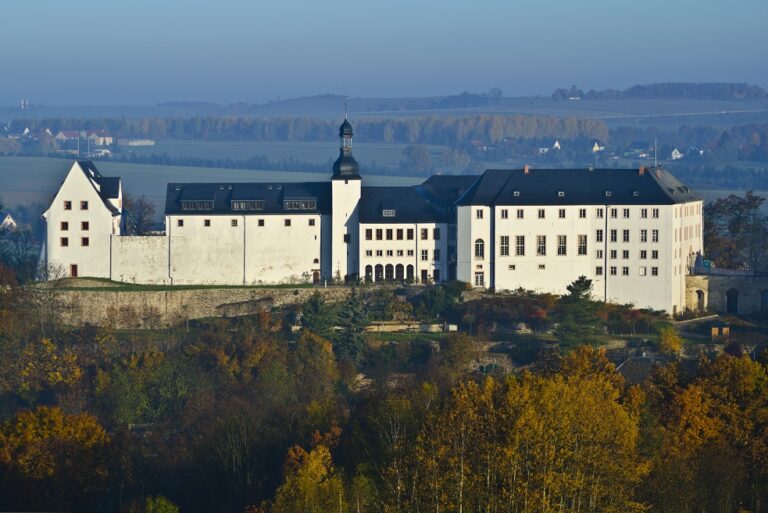
Schloss Planitz stands on a westward-pointing spur in the centre of Planitz. The western side rises approximately 25 to 30 metres above the valley of the Planitzbach, while the ground falls gently toward the east. The spur consists of Upper Carboniferous tuff and basalt formations historically called melaphyre. The present castle and estate buildings form a large Baroque complex built between 1691 and 1712 on a new ground plan.
Baroque castle
Each facade facing the inner courtyard has a Greek-inspired classical pediment supported by pilasters. The current main building belongs to the rebuilding undertaken by Johann Georg von Arnim after the destruction of the earlier castle and the complete loss of the later main building in the 1640 fire. The buildings were remodelled in 1935 to contain a savings bank and town hall, then adapted for use as a military hospital, military command headquarters, employee accommodation, a police school, and Transport Police headquarters. Following restoration in 1991 to 1993, they were adapted for the Clara Wieck Gymnasium.
Gardens and park
The southern garden was first arranged as a Rococo pleasure garden. Between 1868 and 1872, Isolde von Arnim enlarged it and reshaped it as an English landscape garden. The park also includes a Chinese-style tea pavilion dating from the eighteenth century. Together, the garden changes and surviving pavilion reflect the successive development of the grounds alongside the Baroque castle.
Nearby sites