Basilica of Sant’Anastasia al Palatino: An Early Christian Church in Rome
Site at a Glance
- Popularity
- High
- Country
- Italy
- Primary era
- Early Modern
- Eras represented
- Classical, Early Modern, Modern
- Civilizations
- Papal States, Roman
- Site type
- Religious
- Remains
- Church
On this page14 sections
History
The Basilica of Sant’Anastasia al Palatino is a Roman Catholic church in Rome, Italy, founded around the turn of the third and fourth centuries. Its present architecture is Baroque. The church was consecrated in 330, and its completion is also dated to 1656. Its central location near the Palatine, an area of political importance, made it an early Christian presence in the heart of the city.
Early Christian church and title
The original founder and namesake are uncertain. One tradition credits a Roman woman named Anastasia. Archaeologist Andrea Carandini connected the name with Anastasia, sister of Constantine I, while nineteenth-century guidebook writer Melchiorri attributed the foundation to Apollonia. An earlier building beneath the church may have belonged to Publius, described as Anastasia’s husband.
The church’s cardinal title is traditionally traced to about 105, when Pope Evarist is said to have established it. By the Roman synod of 499, the church was listed as titulus Anastasiae, an early Roman church designation that also formed an ecclesiastical title. The church was later dedicated to Anastasia of Sirmium, a Christian martyr. Tradition associates it with Saint Jerome, a fourth-century priest, theologian, and biblical translator, who is said to have preached and celebrated Mass there. Another tradition identifies Jerome as the title’s first cardinal-priest.
Sant’Anastasia’s position within the city walls gave its title an unusual location. In the time of Pope Marcellus I, the other 24 titles lay outside the walls. A catalogue compiled by Pietro Mallio during Pope Alexander III’s pontificate linked the title to St Peter’s Basilica and noted that its priests took turns celebrating Mass there.
After the Edict of Milan in 313, officials generally favored less central locations for new churches, reflecting concern about conflict with pagans. Sant’Anastasia’s position near the Palatine, where representatives of the Byzantine emperor exercised imperial administration, helped establish it as an official church associated with authority.
Restorations and liturgical traditions
The church was restored under several popes and rulers, including Damasus I, Hilarius, Theodoric the Great, John VII, Leo III, Gregory IV, Innocent III in 1201, and Sixtus IV in 1471. Theodoric was the Ostrogothic king who ruled Italy in the late fifth and early sixth centuries. During Damasus’s pontificate the church received frescoes, and Hilarius’s restoration added mosaics.
Sant’Anastasia also had a place in Rome’s seasonal worship. Pope Gregory I celebrated a Mass of Dawn there. Until the eighteenth century, the pope’s Ash Wednesday penitential procession began at the church and continued to Santa Sabina, where the first Lenten stational Mass took place. Roman clergy assembled at Sant’Anastasia before joining the procession. Other solemn observances included Eucharistic celebrations on the first Tuesday of Lent and the Tuesday after Pentecost. The church remains a station church, one designated for a particular liturgy in Rome’s religious calendar, on the first Tuesday of Lent.
Baroque rebuilding and later history
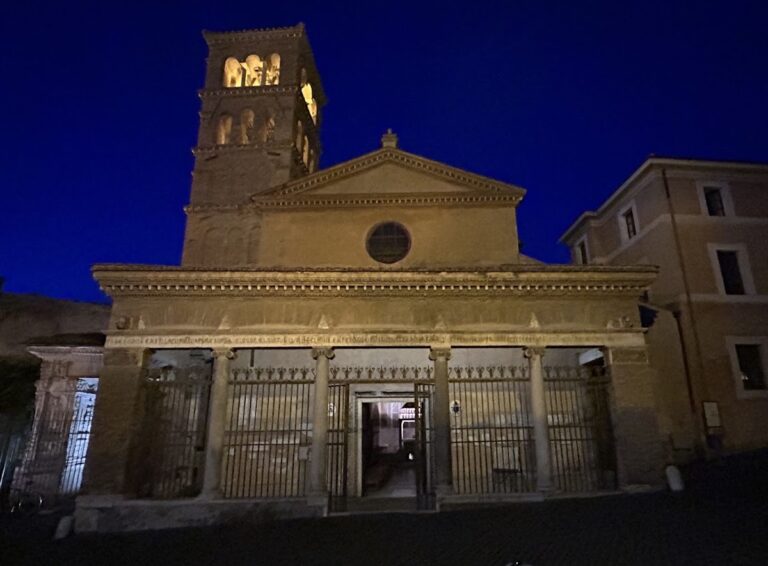
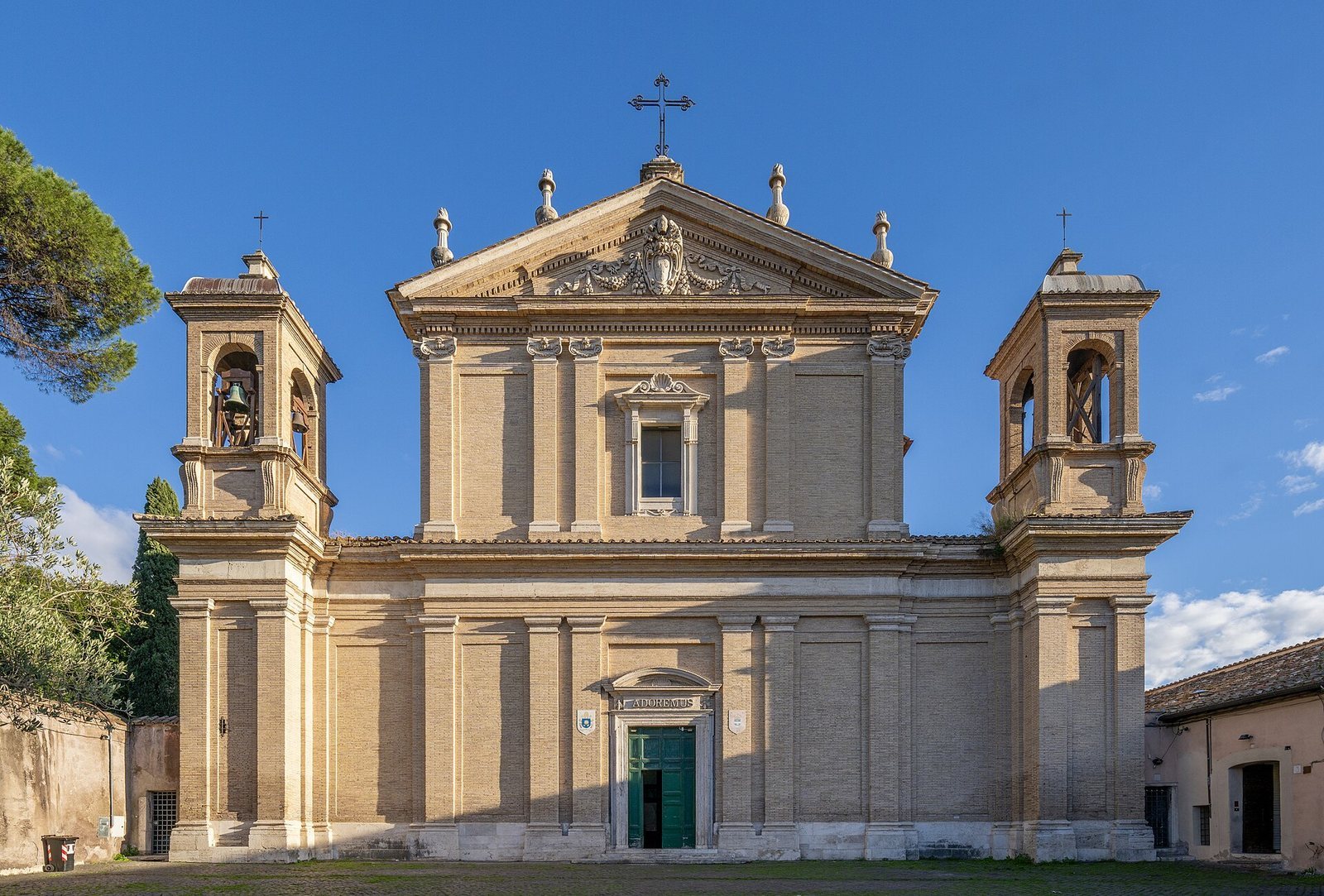
After the portico and façade collapsed in 1634, Pope Urban VIII ordered their reconstruction in 1636 and commissioned architect Luigi Arrigucci to carry it out. The church’s completion is dated to 1656. Architect Carlo Gimach substantially renewed the interior in 1721–1722. Pope Pius VII and Pope Pius IX later ordered further restorations, including a refurbishment under Pius VII in 1817.
Following serious deterioration in the late twentieth century, the Rome Superintendency for Environmental and Architectural Heritage directed a major restoration. The church had been closed for more than 35 years. During the 2000 Jubilee, a large sacristy was created for World Youth Day. It held 700,000 consecrated hosts, tens of thousands of which were consumed during celebrations at the Circus Maximus.
On 2 March 2001, the church’s then rector, diocesan priest Alberto Pacini, began perpetual Eucharistic adoration, continuous devotional prayer before the consecrated Eucharist. The practice later spread to parishes in Rome and churches in Colombia, Peru, Sri Lanka, Tanzania, and Uganda. Sant’Anastasia is a minor basilica, a titular church assigned to a cardinal-priest, and a rectorial church within the parish of Santa Maria in Portico in Campitelli. It serves Rome’s Peruvian community as a national church. In July 2020, Pope Francis granted it to the Syro-Malabar Catholic Church, an Eastern Catholic church of the East Syriac tradition, which manages it.
Remains
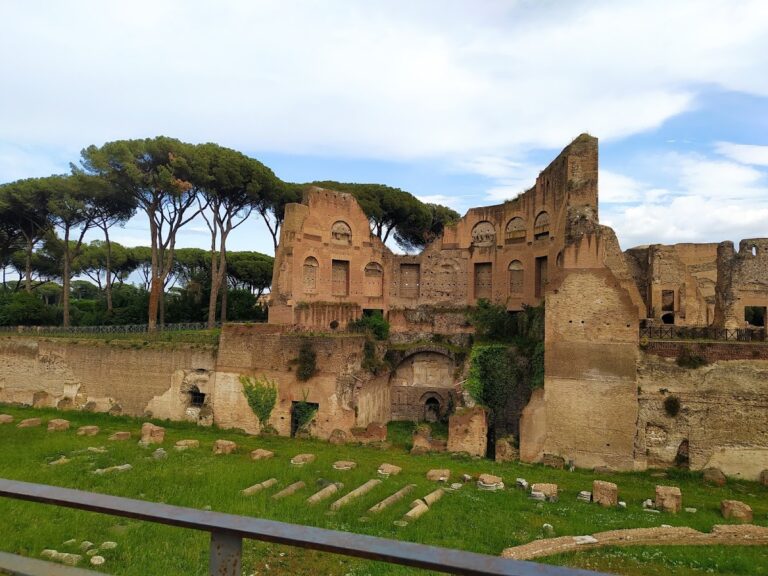
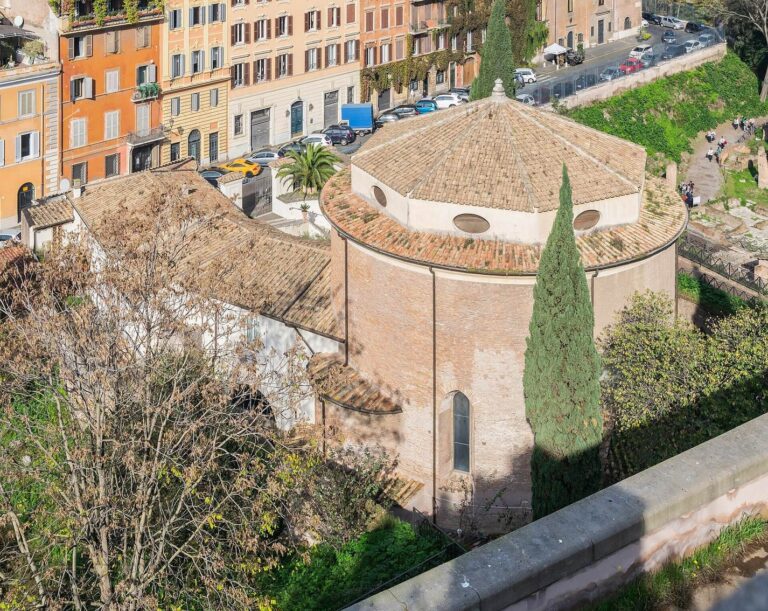
The church has three aisles and two towers, with its main axis shaped by the alignment of two Roman roads. It stands at the foot and on the slopes of the Palatine Hill, above earlier buildings in the outer precinct of the Circus Maximus and structures along the hill’s southwest slope.
Roman structures beneath the church
Residence and underground complex
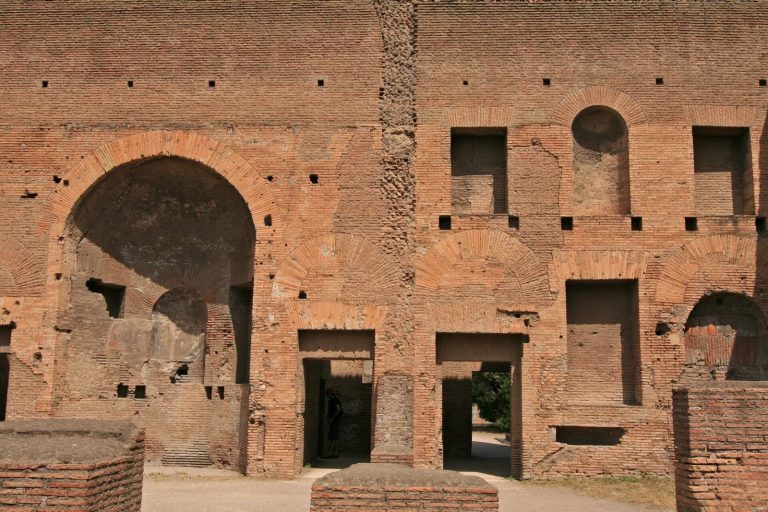
The church occupies the first floor of a substantial building from the late second or early third century, which served as a residence above large ground-level shops. Beneath it, an archaeological complex includes structures dating from the Roman Republican period through the fifth century. The remains include rooms facing Via dei Cerchi, houses beneath the right aisle, and buildings along the Palatine slopes.
First-century shops
A particularly extensive part of the underground complex consists of first-century shops. Their fronts were formed by a row of pillars cut from volcanic tuff blocks. Massive brick pilasters were added during a later building phase.
Church architecture and decoration
Façade and main space
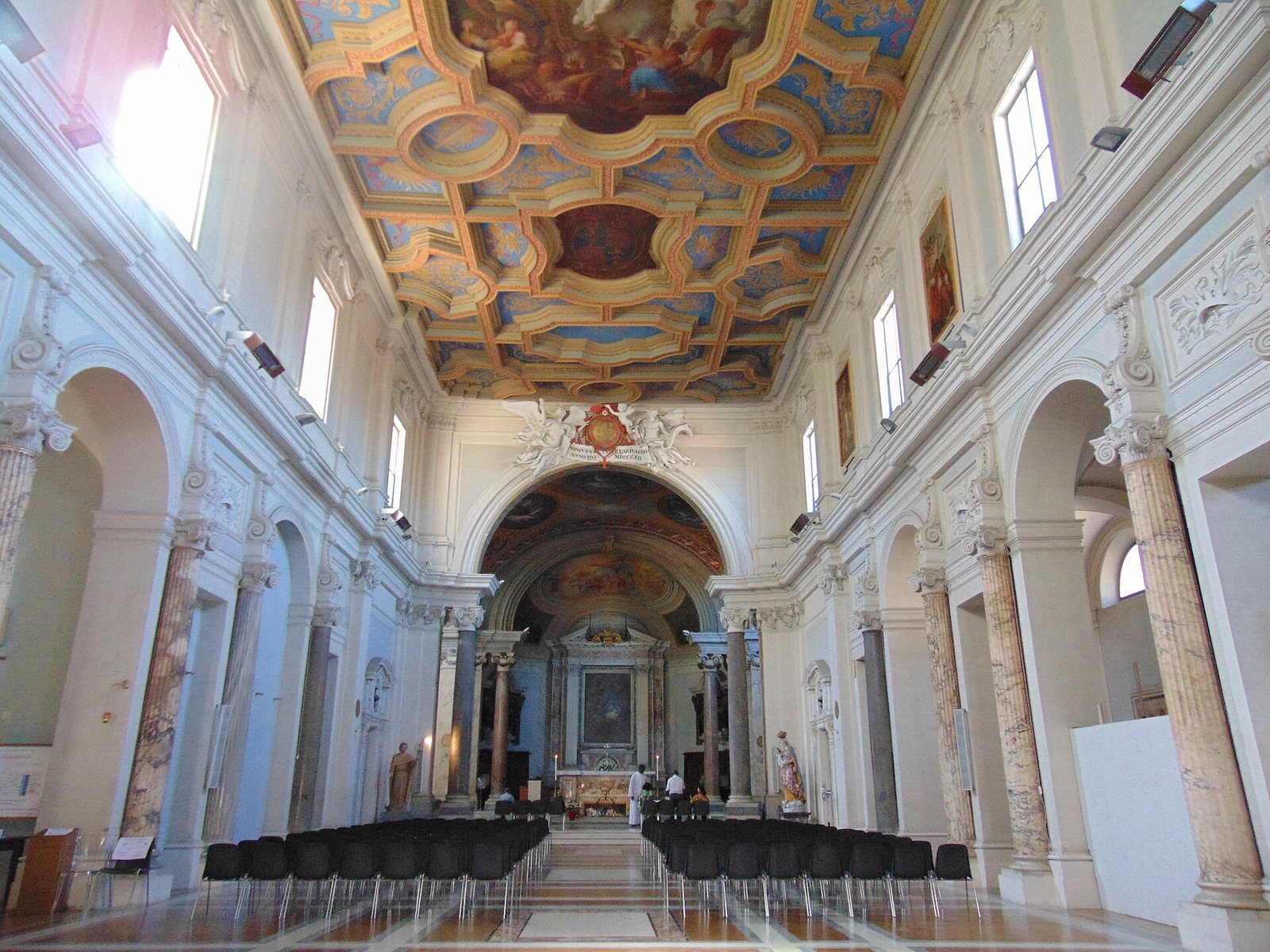
The façade has a lower level in the Doric order and an upper level in the Ionic order, two forms of classical architectural design. Along the nave, the church’s main lengthwise space, shallow rectangular pilasters incorporate ancient Roman marble and granite columns thought to have come from the former Temple of Neptune on the Palatine. The nave’s coffered ceiling is divided into framed recessed panels. Its central panel shows the Martyrdom of Saint Anastasia in a 1722 fresco by Michelangelo Cerruti, made with the patronage of Cardinal Nuno da Cunha e Ataíde.
Transept ceiling
The transept, the crosswise part of the church, has a nineteenth-century ceiling fresco depicting the Lamb of God surrounded by the four Evangelists.
Presbytery and main altar
The presbytery, the sanctuary area around the main altar, received rich marble decoration from the Febei family in 1705 and was later rebuilt with an endowment from Cardinal Giambattista Costaguti. Relics said to belong to Saint Anastasia lie beneath the main altar. Above it is Lazzaro Baldi’s Nativity altarpiece and a recumbent statue of Anastasia on a martyr’s pyre. Francesco Aprile began the statue and Ercole Ferrata completed it; its composition was influenced by Bernini’s sculpture of the Blessed Ludovica Albertoni.
Right-side chapels and transept
The first chapel on the right, near the entrance, contains Pier Francesco Mola’s 1658 painting of Saint John the Baptist, a Jewish preacher revered in Christianity, in the desert. A fresco by Lazzaro Baldi in the last right-hand chapel depicts episodes from the lives of Charles Borromeo, an archbishop and Catholic reformer, and Philip Neri, an Italian priest. The right transept holds Francesco Trevisani’s 1726 painting of Toribio de Mogrovejo, a Spanish missionary and archbishop of Lima.
Left-side chapels and transept
The left transept contains Baldi’s Madonna of the Rosary, an image of Mary associated with rosary devotion, and the monumental tomb of Cardinal and philologist Angelo Mai, sculpted by Giovanni Maria Benzoni. The last chapel on the left is dedicated to Saint Jerome and has an altarpiece depicting him by Domenichino. A chalice said to have been used by Jerome was also said to be kept in this chapel. Another chapel contains Étienne Parrocel’s painting of Saints George, venerated as a Christian martyr, and Bishop Publius. The church also holds numerous other paintings by Baldi and his collaborators.