Museum of the Abbey of Borgo San Dalmazzo: A Museum of Monastic and Town History
Site at a Glance
- Popularity
- Very Low
- Country
- Italy
- Primary era
- Early Modern
- Eras represented
- Classical, Medieval, Early Modern
- Civilizations
- Duchy of Savoy, French, Roman
- Site type
- Religious
- Remains
- Monastery
On this page17 sections
History
The Museum of the Abbey of Borgo San Dalmazzo is an archaeological and historical museum in Borgo San Dalmazzo, Italy, presenting the abbey’s development and the town’s history from Roman origins through the eighteenth century. The site’s first church was built around the sixth century beside a Roman cemetery at the edge of the settlement. After the burial ground fell out of use, burial slabs and church masonry, particularly from its rounded apse, helped identify the early building.
Early church and abbey
Between 701 and 712, King Aripert II, a ruler of the Lombards, founded the first abbey complex. The Lombards were an early medieval dynasty that governed much of Italy before the Carolingian period. Eighth-century carved decoration supports the foundation date, and the tomb of Saint Dalmazzo was moved to the abbey soon afterward.
The abbey first appears in a document in 902, in a diploma issued by Louis III, a ruler of Italy who was crowned Holy Roman emperor. During the ninth century, devotion to Saint Dalmazzo grew. Pilgrims came to Pedona each day, and the settlement also drew people for commercial activity.
Relics, growth and decline
In the following century, the saint’s body was taken to Quargnento, after which the monastery declined. Some of his relics returned to Borgo San Dalmazzo in 1176. In 1246, Pope Innocent IV sent a bull to Abbot Anselm listing the abbey’s dependencies. It showed that the estate had contracted from its earlier extent but remained substantial. The document is now held in the diocesan curia archive at Mondovì.
By the fifteenth century, the abbey was in crisis. In 1438 it was permanently joined to the bishop’s estate at Mondovì.
Damage and renewed devotion
French forces occupied Borgo in the mid-sixteenth century, fortified the monastery and caused severe damage. During a pastoral visit in 1583, Bishop Gerolamo Scarampi described the harm to the complex. More orderly management of church property had begun by that time.
Efforts to revive devotion to Saint Dalmazzo included publications about his life, an examination of his relics and the making of a silver container for a fragment of his skull in 1594. In 1636, his tomb was solemnly moved for the last time, to the elevated chapel.
Restoration and museum
In the early eighteenth century, Bishop Gianbattista Isnardi del Castello ordered a major restoration of the monastery. The earliest discoveries of Roman and early medieval archaeological material at the site date to this period.
The museum opened in November 2005. Its creation was initiated by Father Giovanni Quaranta, then parish priest, and Egle Micheletto of the Superintendency for Archaeological Heritage of Piedmont and the Museum of Egyptian Antiquities. Architect Alessandro Scapolla directed the architectural and exhibition design, and the Parish of San Dalmazzo manages the museum.
Remains
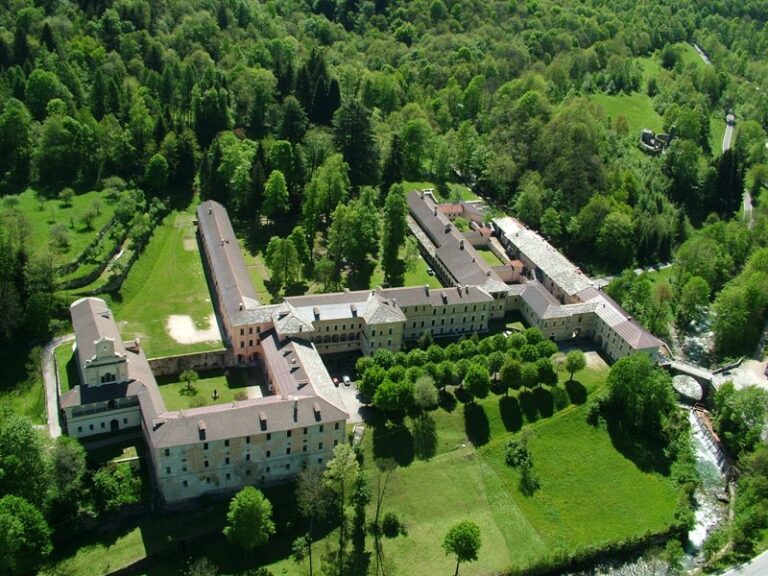
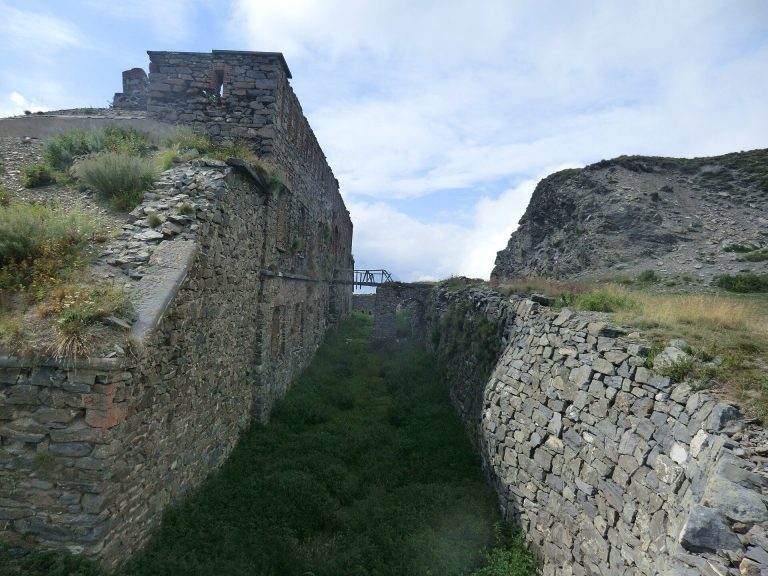
The abbey stands near Cuneo, where the Gesso, Vermenagna and Stura valleys meet. It is now within Borgo San Dalmazzo, whose built-up area extends beyond the former medieval settlement. The adjoining museum connects exhibition rooms with an archaeological route through the church complex and with the parish museum.
Exhibition rooms
The abbey and the saint’s cult
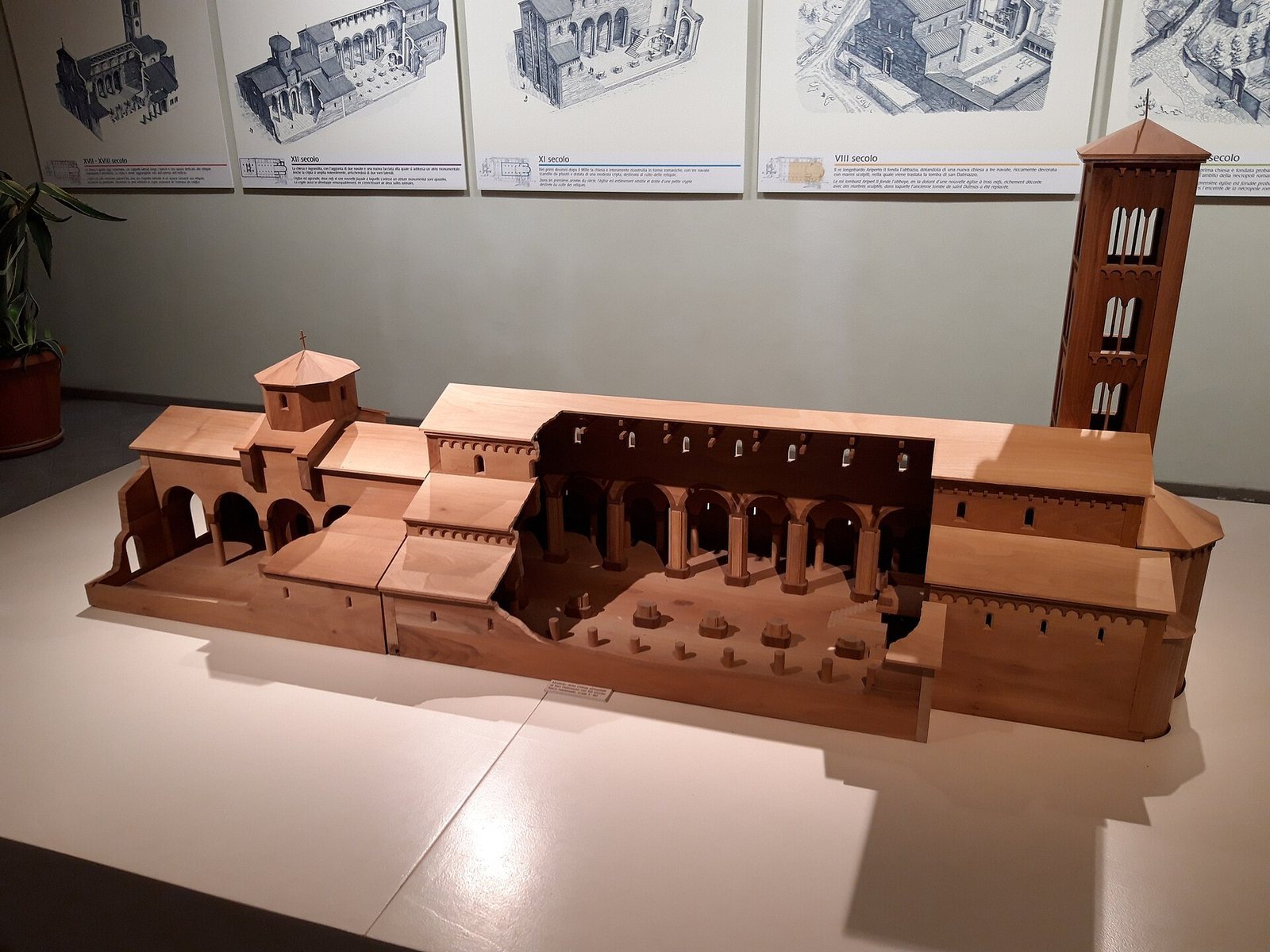
The first room traces the settlement from the Roman cemetery to the present church and presents the cult of Saint Dalmazzo. Images portray him as a warrior, monk and bishop, although he held none of these roles; the depictions were intended to exalt him. A three-dimensional model conveys the scale of the twelfth-century abbey church, while wall panels show its development and later changes.
Roman finds
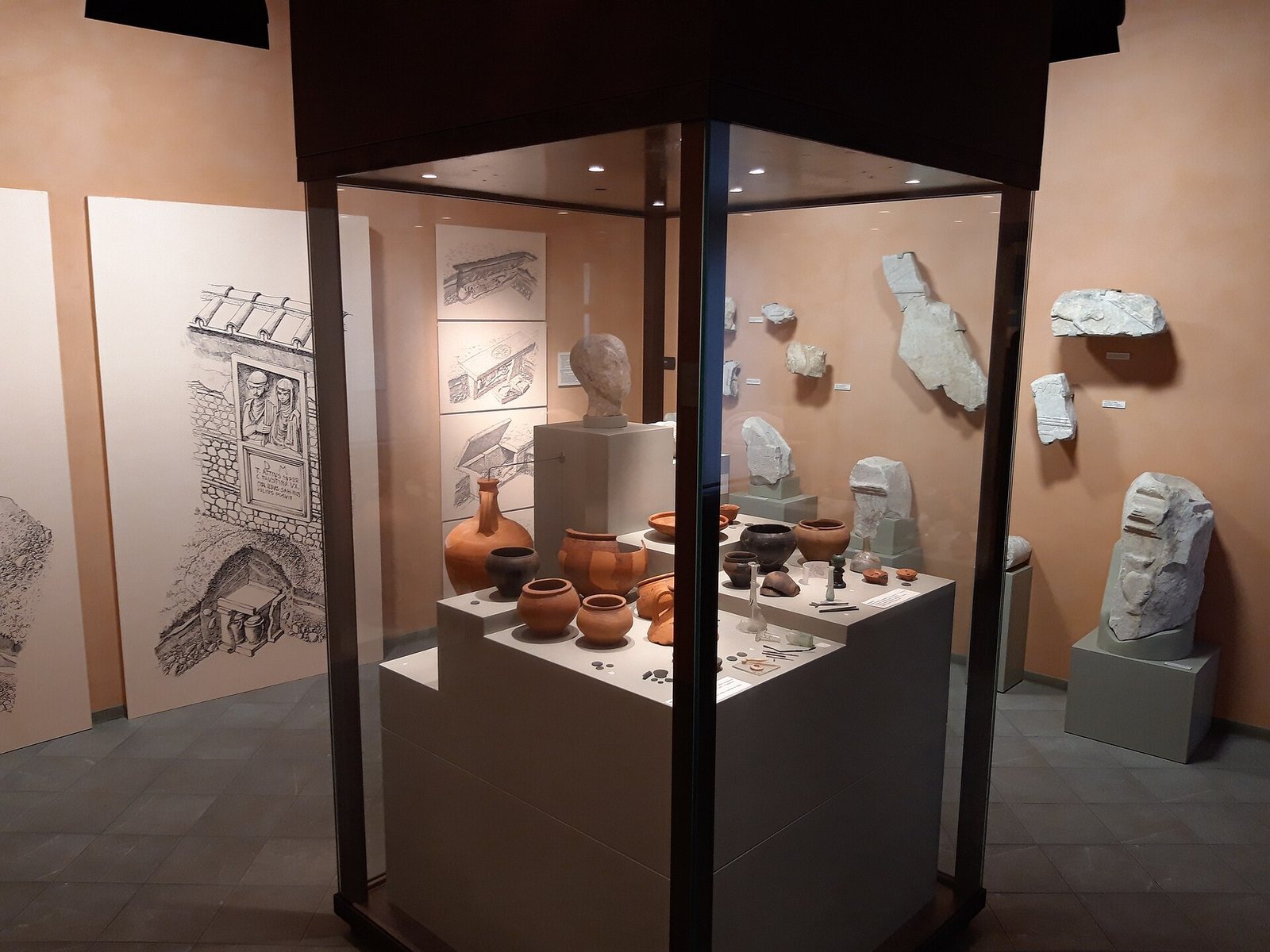
The second room contains everyday and funerary objects found in the town centre and church area. Most date to the second and third centuries AD and came from cremation burials in the Roman cemetery beneath the abbey complex. Among them is a funerary marker for a worker at a customs station of the Quadragesima Galliarum, a Roman system that taxed goods passing through Gaul. A poorly preserved male portrait may have commemorated a benefactor who set aside a substantial sum for the town; his identity is unknown.
Medieval marble and stucco
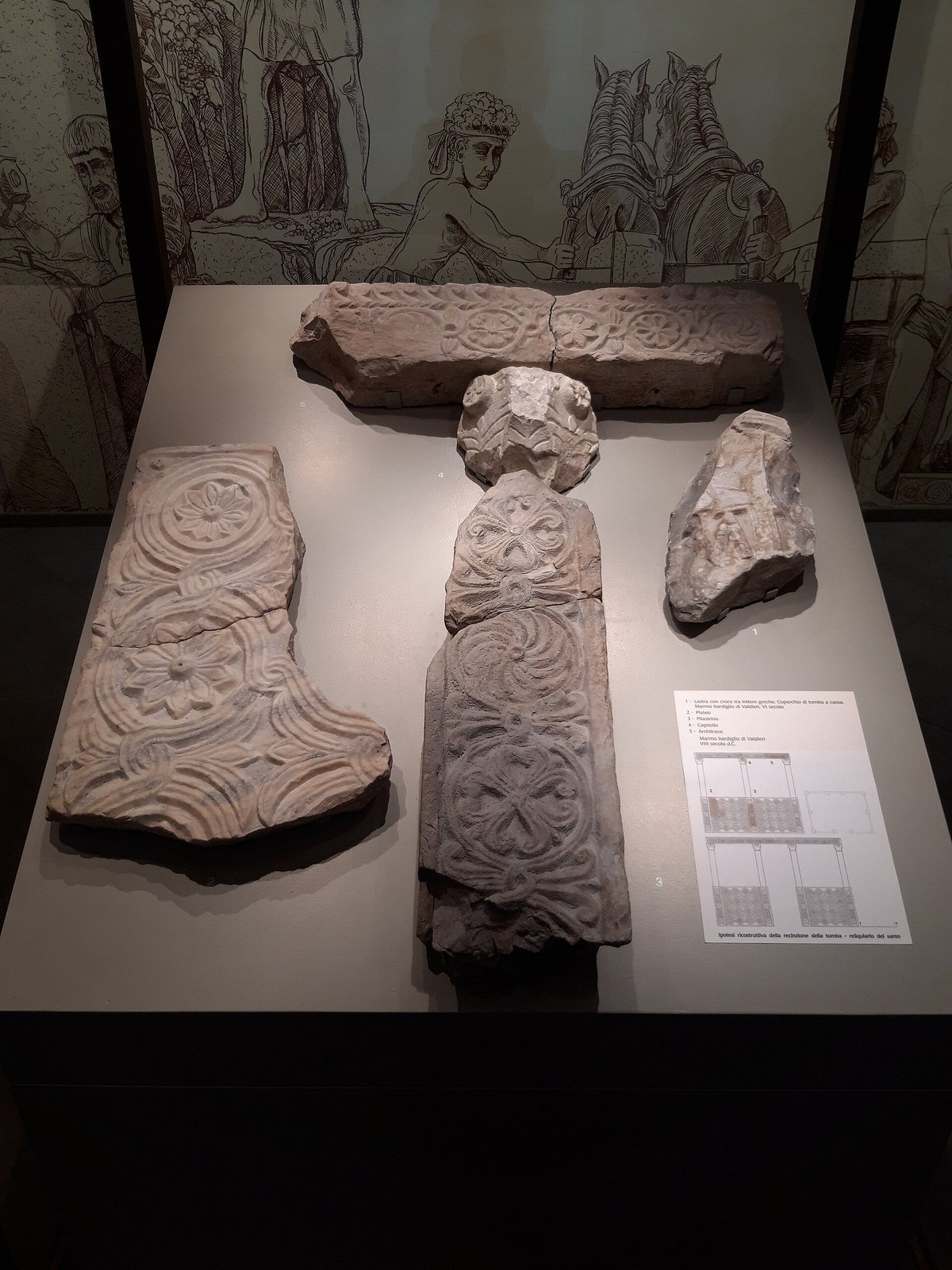
The third room displays carved marble from the Lombard and Romanesque periods. Lombard here refers to early medieval artistic traditions, while Romanesque describes a medieval European architectural style. One case holds fragments with interlinked circles, along with parts of a screen slab, a small pillar, a pillar top and an architrave, the horizontal member spanning supports.
A second case contains pieces from a substantial screen around the presbytery, the area surrounding the altar. The enclosure was about ten metres long and had three arched openings that allowed worshippers to pass around the saint’s tomb during services. A third case displays remains of the stucco decoration from the church built in the early twelfth century.
Archaeological route
Crypt and early church
A staircase descends to the ancient southern Romanesque crypt, an underground chapel. Traces of a colored twelfth-century floor, made from stucco and a lime-based mixture containing crushed pottery or brick, partly cover the semicircular apse of the early Christian church.
Cemetery and Roman burials
An eighteenth-century corridor, built as part of the abbey residence, leads to a glass-covered area where several eleventh- to thirteenth-century tombs can be seen. They reflect the importance of the cemetery that once surrounded the church. Beneath the portico on the church’s south side are two Roman cremation graves: an underground masonry chamber with side niches and a brick cist, a box-shaped burial container.
Chapel and former monastic rooms
The route re-enters the church through the chapel traditionally called the Angevin Chapel, which has a fifteenth-century fresco cycle. It continues through the Romanesque crypt and several rooms formerly used by the monks.
Parish museum and upper chapel
Parish museum collection
A short flight of steps leads to the parish museum. Its first room contains reliquaries, containers for sacred relics, and liturgical vestments from the seventeenth and eighteenth centuries. The collection reflects the parish’s wealth after the abbey was abandoned.
Upper chapel
Built in the late seventeenth century in line with the parish presbytery, the upper chapel may have served as the seat of the Confraternity of San Dalmazzo. Gilded stucco and paintings depict the saint’s death, the transfer of his remains and his glory, subjects that held particular importance for the local community. The chapel overlooks the central nave of the present Baroque parish church.
The chapel houses the original bust-shaped reliquary of Saint Dalmazzo, made from silver sheet; the museum displays a faithful copy. The original was created in 1594.