Stüssibrunnen: A Renaissance Fountain in Zürich
Site at a Glance
- Popularity
- Low
- Country
- Switzerland
- Primary era
- Early Modern
- Eras represented
- Early Modern, Modern
- Civilizations
- Holy Roman Empire, Swiss
- Site type
- Civic
- Remains
- Fountain
On this page7 sections
History
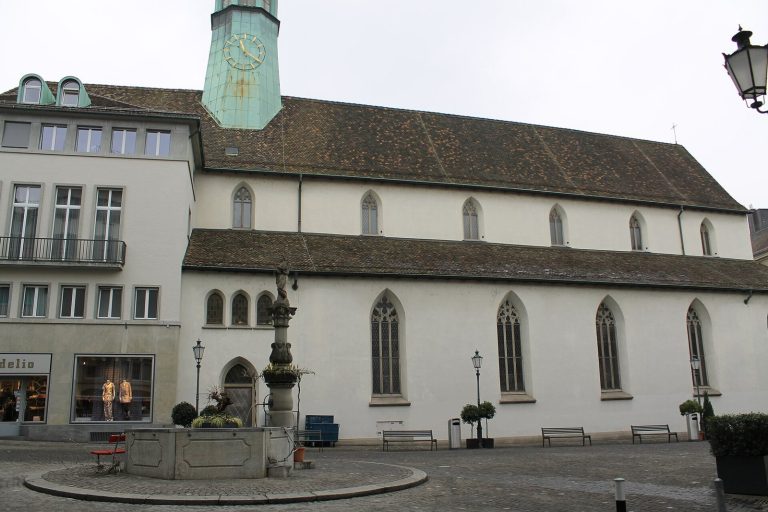
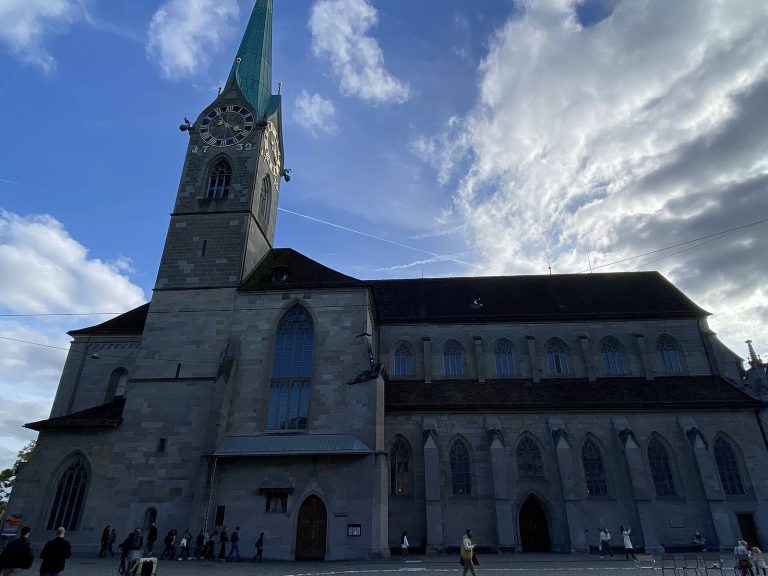
The Stüssibrunnen is a Renaissance fountain on Stüssihofstatt in Zürich, Switzerland. Its sixteenth-century form belongs to the Renaissance, a European cultural and artistic period. A water conduit at the site is first recorded in 1421. The fountain, including its column and figure, was probably erected in 1573 or 1575; its old trough was said to bear the date 1575. The fountain appears on the Murer plan of Zürich, made in 1576.
Early repairs and changes
In 1588, locksmith Peter Albrecht supplied new brass pipes and iron fittings. Sculptural work was replaced in 1644–1645, when Hans Ludwig Stadler also painted the column and figure. Further work in 1667–1669 renewed the column and included repainting the fountain.
In 1811, the trough was replaced with one brought from Münsterhof. The change included an unexplained alteration to the fountain’s arrangement.
Restoration and later damage
After the statue was damaged in 1888, it underwent extensive restoration. By 1919, the column and figure had become worn. They were dismantled and replaced in early June with a replica made by Hans Gisler. Otto Schärer restored and repainted the column and figure in 1960.
In July 1991, unknown perpetrators pulled the statue from its pedestal and stole its head and flag. The damage was estimated at 80,000 Swiss francs. The fountain was renovated again in 2004 using a bequest from Hans Emil Naegeli-Osjord, father of the artist Harald Naegeli. The bequest was intended to pay for the repainting of antique fountains that were then gray. Harald Naegeli sued the city to recover the money, arguing that the Stüssibrunnen was already colored and had never been gray. He also maintained that no other Zürich fountain could be shown to have been painted in the past, making the bequest’s terms impossible to fulfil.
The Stüssibrunnen is included in Switzerland’s Inventory for the Protection of Cultural Property as an object of regional importance.
The figure’s identity and literary presence
Whether the fountain’s figure represents Zürich mayor Rudolf Stüssi, who died in 1443, remains disputed. Definite attributions to Stüssi appeared in the eighteenth century, when the identification was not yet generally accepted; it became more familiar in the nineteenth century. Swiss art historian Salomon Vögelin considered it possible that the connection was made later because Stüssi had lived at the square that bears his name. In 1919, the Neue Zürcher Zeitung judged a portrait plausible but unlikely, on the grounds that it would presumably also show the Stüssi family arms.
Vögelin noted that banner-bearer figures appear on many Swiss fountains. In 2008, historian Georg Kreis argued that such figures had first represented the Swiss Confederacy, an alliance of Swiss communities and cantons, and its independence in military and judicial affairs. He suggested that later generations assigned individual identities to them, and considered a portrayal of Stüssi especially unlikely because he died fighting against the Confederacy. Kreis also pointed to disputed identifications at the Tellenbrunnen in Schaffhausen, Kolinbrunnen in Zug, Albrechtsbrunnen in Rheinfelden, Vennerbrunnen in Bern and Klausbrunnen in Lenzburg. Zürich’s Old Town fountain guide, by contrast, supports the Stüssi identification, citing the figure’s distinctive appearance.
Gottfried Keller’s novel The Green Henry, published in 1854, opens with a description of the fountain. Keller evokes the sound of four water jets and morning light on gilded details, including the figure’s sword pommel and breastplate.
Remains
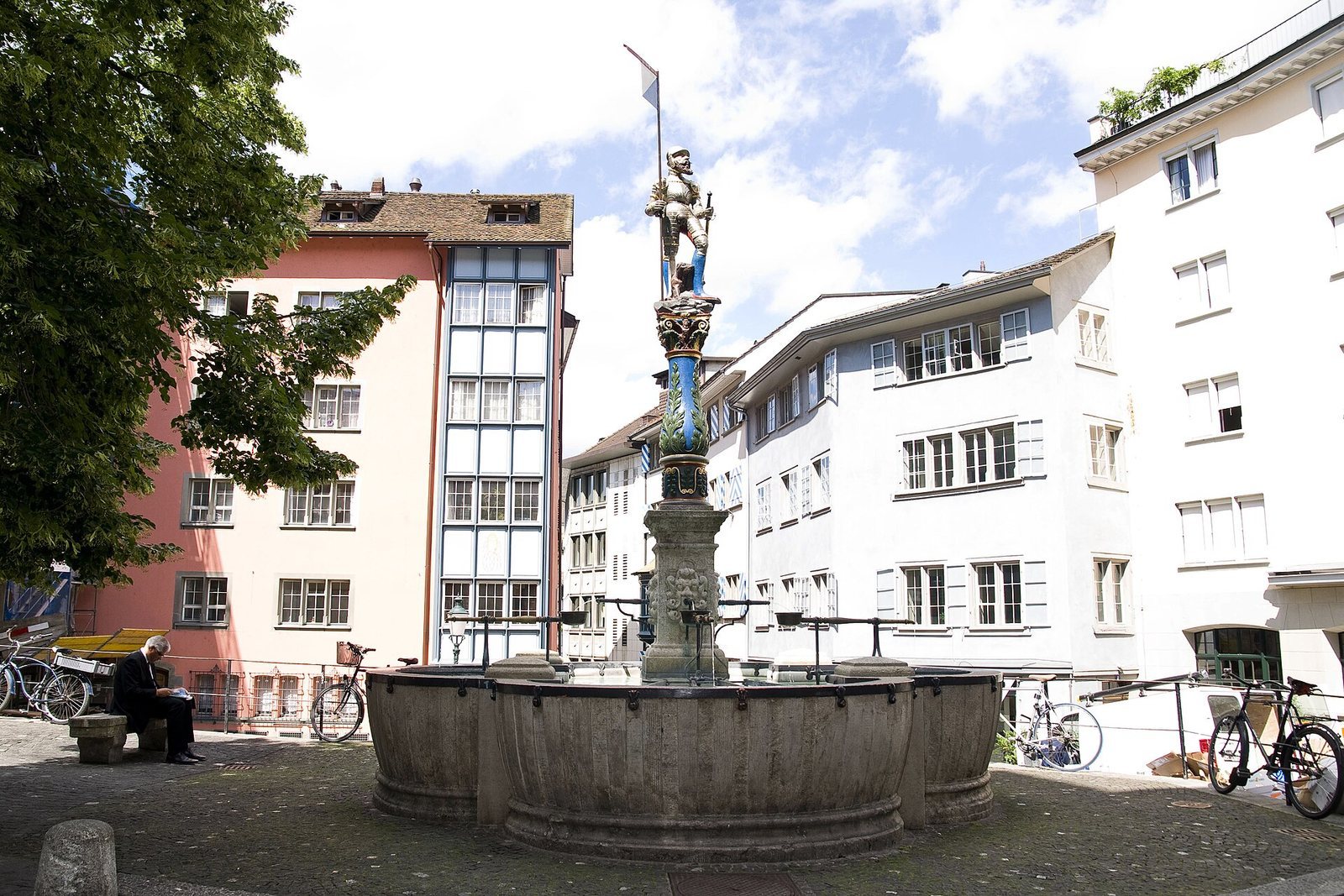
The Stüssibrunnen is a painted Renaissance fountain and Zürich’s only polychrome fountain, meaning it is decorated in several colors. Its shell-shaped trough encloses a square fountain block, which supports a column and a sculpted banner-bearer.
Basin and column
The square block is made of shell limestone from Saint-Blaise in the canton of Neuchâtel. Grotesque masks decorate three sides, and water pipes project from their mouths. Vögelin interpreted the masks as lion heads. Above the block rises a painted baluster column, a shaped column support, with rounded molding at its base and top. Its swollen shaft carries acanthus ornament, a conventionalized leaf design. The ornate Corinthian-style capital has four spiral ornaments, or volutes, above leaves at its corners. Between them are alternating female and male fantastical figures, possibly representing water spirits and woodland spirits.
Banner-bearer and emblems
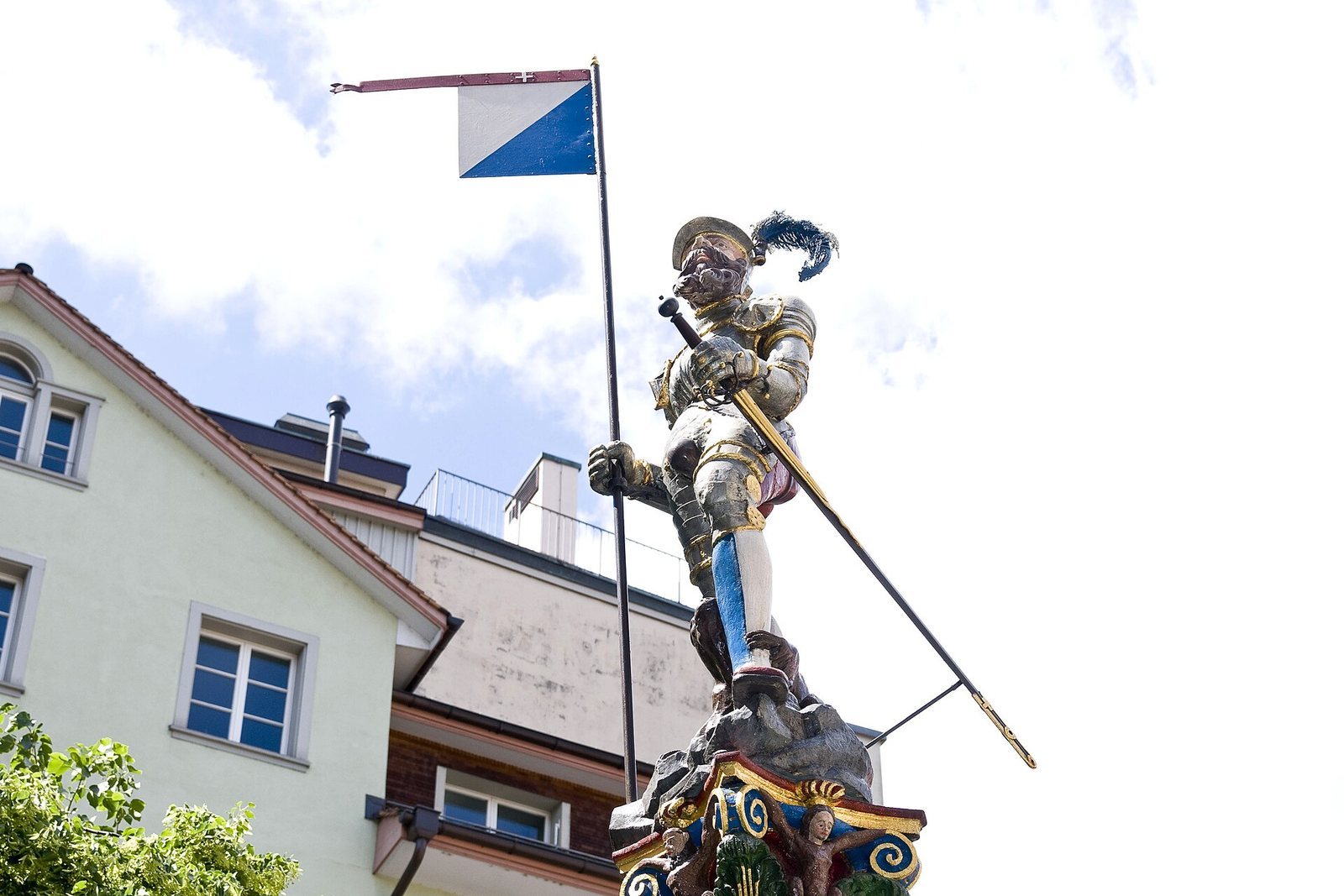
The sculpture presents a full-bearded, partly gilded figure in armor, standing on a stack of stones. The figure holds a sword in its left hand and the standard of the Republic of Zürich, the early modern city-state, in its right. Above the coat of arms is a red strip bearing a white cross. Tradition holds that the Habsburgs granted this emblem to Zürich after the Battle of Dürnkrut in 1278, when Habsburg ruler Rudolf I defeated Bohemian king Ottokar II. Five blue-and-white ostrich feathers decorate the helmet, and a dog between the figure’s feet represents fidelity. The pommel and tip of the original sword are held at the Swiss National Museum.