Temple du Marais: A Former Visitation Church and Protestant Temple in Paris
Site at a Glance
- Popularity
- Medium
- Country
- France
- Primary era
- Early Modern
- Eras represented
- Early Modern, Modern
- Civilizations
- French
- Site type
- Religious
- Remains
- Church
On this page14 sections
History
Foundation and convent church
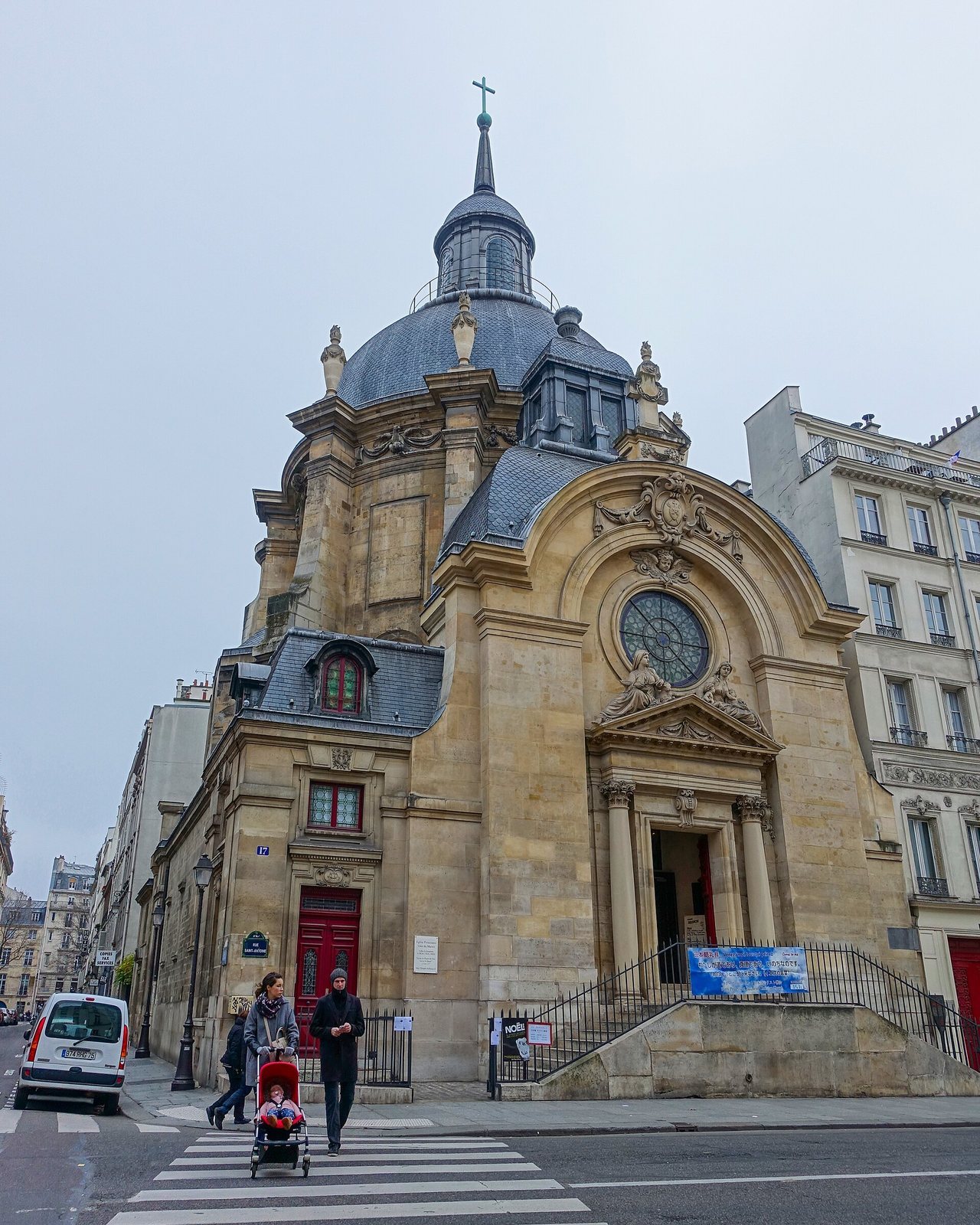
The Temple du Marais is a former Visitation convent church at 17 Rue Saint-Antoine in Paris, France, built for the Catholic Order of the Visitation of Holy Mary between 1632 and 1634 in the Baroque style. The order was founded in Annecy in 1610 by Francis de Sales and Jane Frances de Chantal. Its Paris convent began in 1619 at the Hôtel du Petit-Bourbon, a private urban mansion near the rues du Petit-Musc and de la Cerisaie. In 1628, the sisters enlarged their grounds by acquiring the Hôtel de Cossé and an adjoining house on Rue Saint-Antoine.
The church, dedicated as Sainte-Marie-des-Anges and also called the Church of the Visitation of Holy Mary, was designed by François Mansart, with the building work supervised by master mason and contractor Michel Villedo. The church and convent served as the Paris mother house of the order. Noël Brûlart de Sillery was an important benefactor, and the Catholic priest Saint Vincent de Paul directed the convent’s spiritual life for 28 years.
Completed in 1665, the church crypt served as a family mausoleum for Nicolas Fouquet, superintendent of finances under King Louis XIV. Fouquet died in 1680, and his remains were moved from Pignerol to the family vault in Paris in 1681. Henri, Marquis de Sévigné, husband of the writer Marie de Rabutin-Chantal, was also buried at the church. Other burials included Marie de Bèze, who died in 1634; Philippe I de Coulanges, who died in 1636; André II Frémiot, who died in 1641; and Christophe de Coulanges, who died in 1687. Frémiot was an abbot, Archbishop of Bourges, and the brother of Jane Frances de Chantal.
Revolution and Protestant worship
During the French Revolution, authorities seized the convent in 1790 and sold its furnishings. The church was used to store books taken from emigrants. The sisters were expelled in 1792, and that year the Society of Friends of the Law, led by revolutionary activist Théroigne de Méricourt, held meetings in the chapel. On 14 December 1792, the Convention, the revolutionary assembly governing France, abolished religious orders, and the church was desacralized.
The convent buildings and dependencies were sold in 1796 and 1797. When Rue Castex was opened across the former grounds in 1805, the church was the sole convent building still standing. The street commemorates infantry colonel Pierre Castex, killed at the Battle of Austerlitz that year. The sisters later re-established their convent at 68 Avenue Denfert-Rochereau. In 1836, the remains of Brûlart de Sillery and André Frémiot were transferred there rather than left in a Protestant church.
After the 1801 Concordat, an agreement between Napoleon Bonaparte’s government and the papacy that reshaped religious arrangements in France, Sainte-Marie was assigned to Reformed believers in Paris. The revocation of the Edict of Nantes in 1685 had renewed restrictions on French Protestants, forcing them toward secret worship or services in foreign embassies. On 3 December 1802, Napoleon, then First Consul, assigned the church to the Reformed Consistory of the Seine, a church governing body. Protestant services began on 1 May 1803. At his first sermon there, pastor Paul-Henri Marron welcomed the congregation’s ability to worship openly between the Bastille and the Jesuit establishment at what is now the Lycée Charlemagne, places associated with the oppression of earlier Protestants.
Parish changes and later history
The church hosted the state funeral of political thinker and writer Benjamin Constant in 1830. Fighting at a barricade directly in front of the building damaged it during the Paris Commune, the revolutionary government in the city in 1871. Marcellin Varcollier restored the church in 1874. In 1887, it was classified as a historic monument under the name Temple Sainte-Marie.
In 1881, the Reformed Consistory divided into autonomous parishes. Evangelicals won the 1882 church-council elections in Paris except at the Oratoire du Louvre. To challenge later elections at Sainte-Marie, a liberal committee recruited pastor Charles Wagner. He established a new congregation in the district, which built the Temple du Foyer de l’Âme in 1907. Élisée Lacheret became pastor at Sainte-Marie in 1902, moving from the more liberal Oratoire du Louvre to the more evangelical congregation. As president of the permanent commission of the Union of Evangelical Reformed Churches of France, he took part in debates around the 1905 law separating church and state. He opposed compromise with liberal Protestants; the two tendencies did not unite within the Reformed Church of France until 1938, after his death.
The parish opened an annex, the Temple de Bercy, in 1902. It first met at 5 Rue Taine and later moved to 13 Rue de la Lancette. The Bercy congregation became independent in 1953, and its temple has since been demolished. During both World Wars, the crypt provided shelter from bombardment. In the Second World War, under German occupation, Jews were hidden in the church organ.
In 2015, the parish opposed a national synod decision permitting pastors to bless same-sex couples. It issued a communiqué on 20 May and, after a meeting at the temple, a further declaration on 15 June. The association Les Attestants formed in the wake of the dispute and has held meetings at the church. The Temple du Marais continues as a parish of the United Protestant Church of France, with Reformed origins and an evangelical identity. The City of Paris owns the building.
Remains
Plan and exterior
Centralized plan
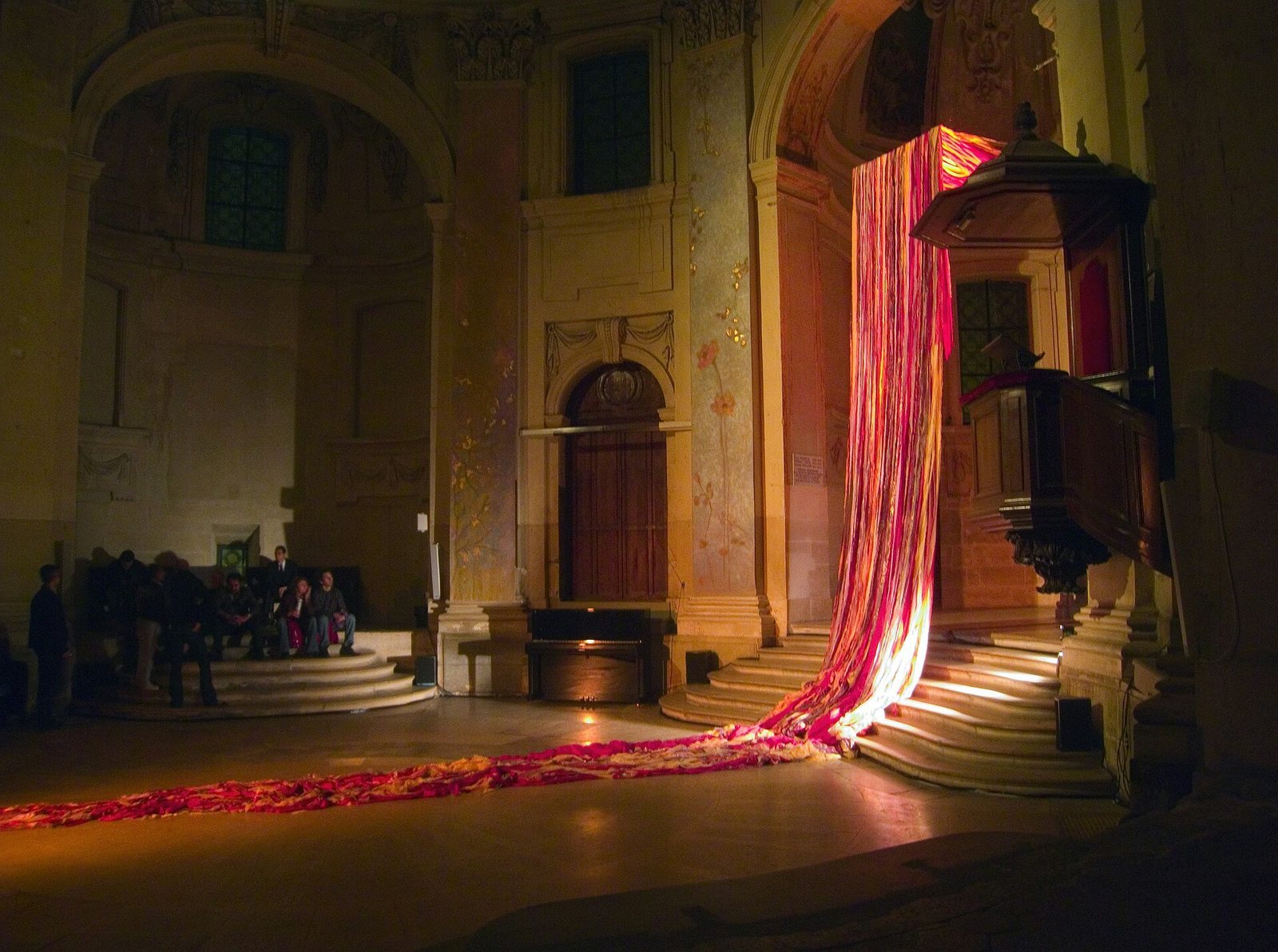
Mansart’s Baroque design uses a centralized plan rather than the rectangular layout customary for Visitation convent churches. A circular central space, or rotunda, measures 13.5 metres in diameter and is topped by a dome about 13 metres across. Eight connected spaces surround it: a sanctuary to the south, a vestibule to the north, three chapels, two sacristies, and the nuns’ choir to the west. The design drew on the Pantheon in Rome and may also have been influenced by the chapel at the Château d’Anet. Brûlart de Sillery, an admirer of the Pantheon, had wanted a centralized plan.
Street façade
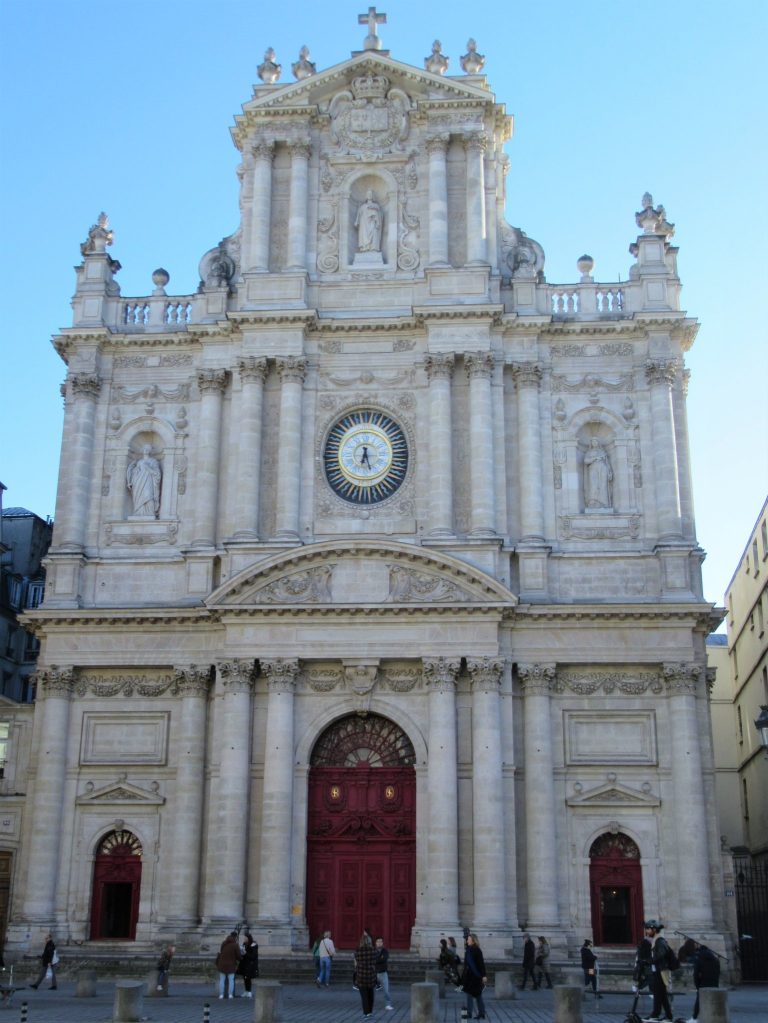
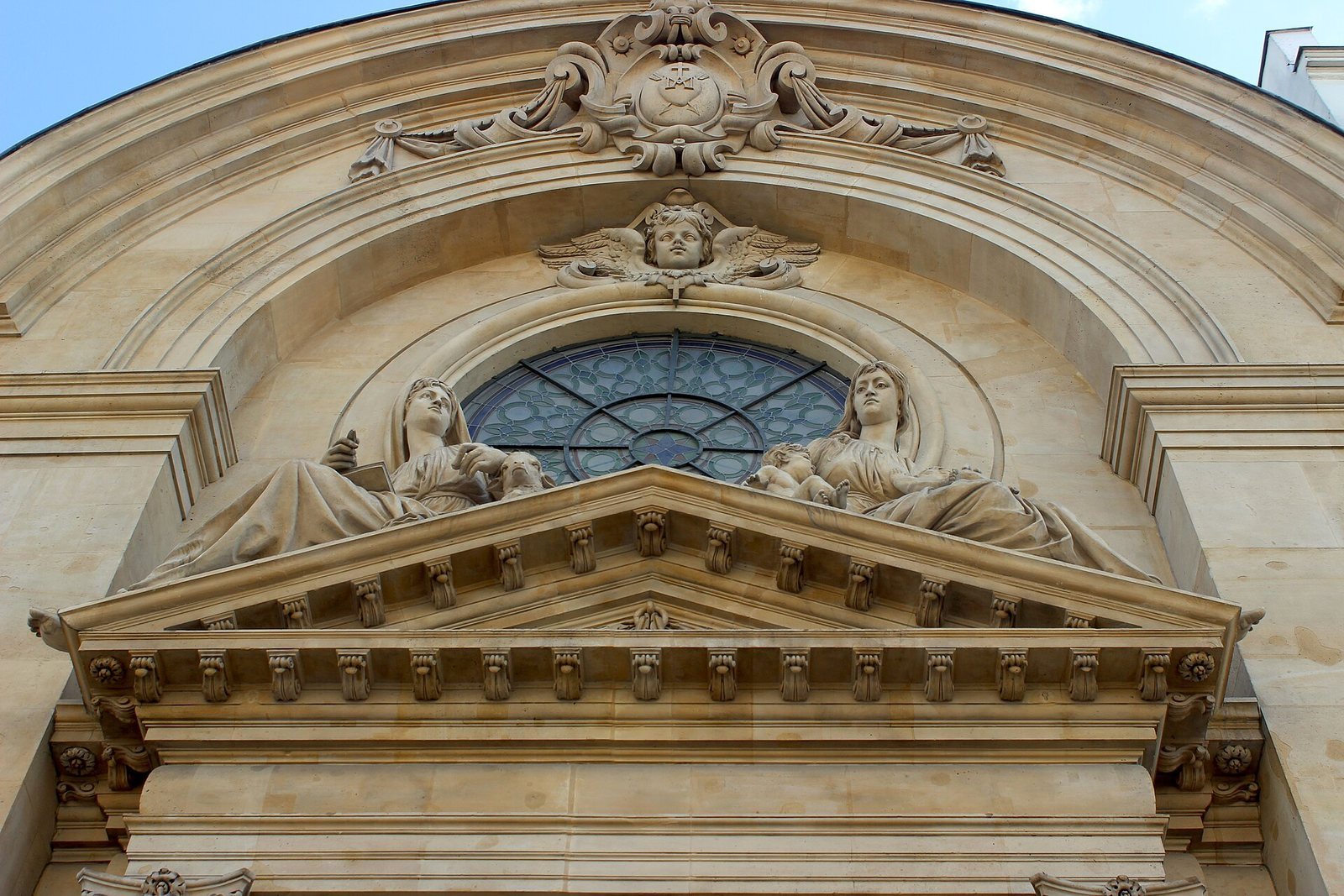
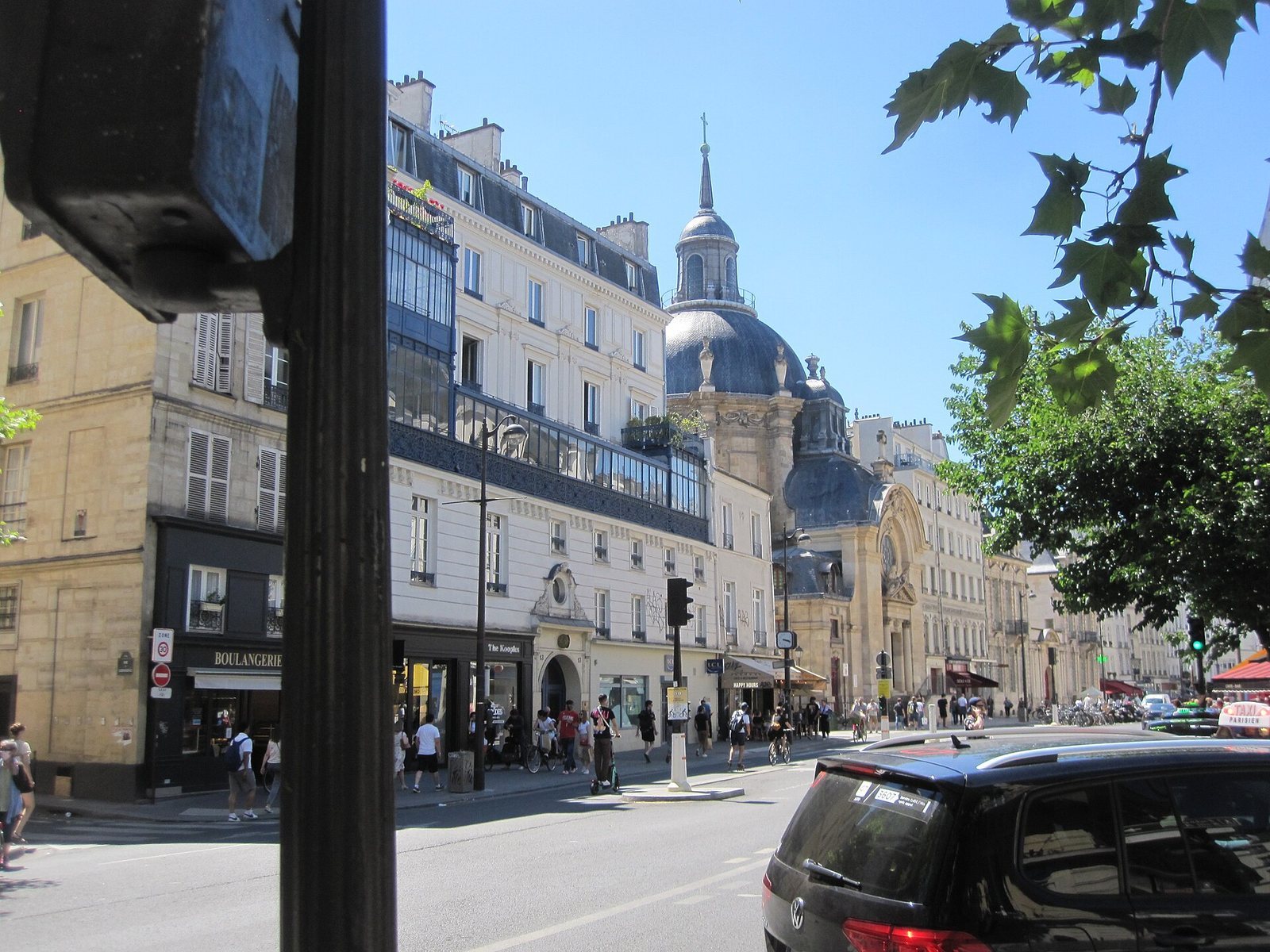
The church is oriented north to south, with its entrance facing north and the communion table at the southern end. This arrangement follows the street and directs worship symbolically toward the altar and tabernacle rather than a geographic direction. The street façade combines an arched portal inspired by Michelangelo, with a projecting cross, an imperial-style roof topped by a lantern, and a spire crowned by a cross. The Visitation order’s crest appears above the entrance rose window. A Phrygian cap above a doorway recalls the church’s revolutionary-era history; in France, the cap became a symbol of liberty and revolution. The figures of Charity and Religion on the façade are replacements for statues damaged during the Commune. Ernest-Eugène Hiolle carved the figures on the pediment.
Interior and furnishings
Chapels and domes
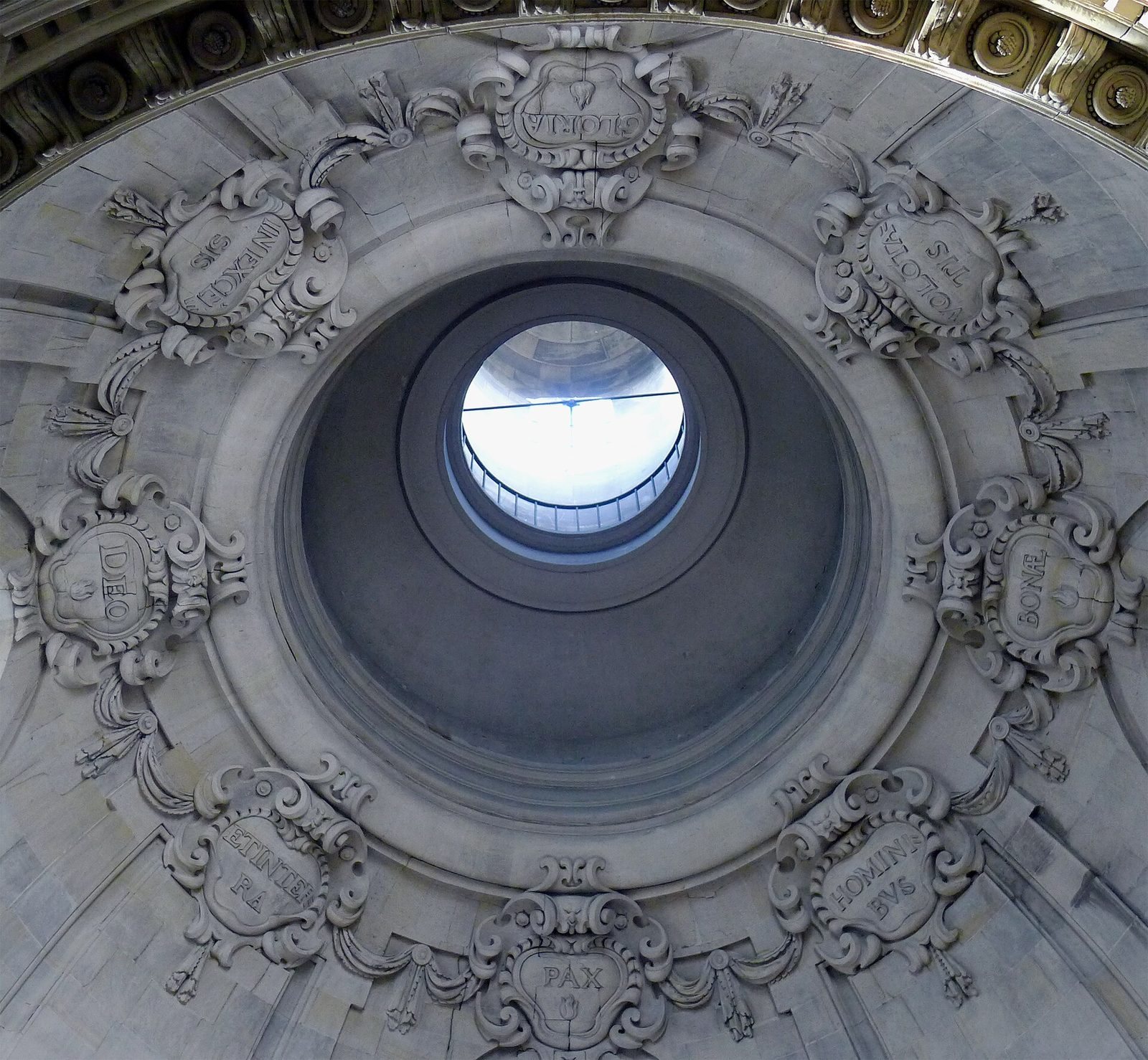
The four chapel-like niches include the sanctuary. The southern chapel holds the communion table, while the eastern and western niches once had altars with altarpieces, decorative works placed behind altars; traces of those arrangements remain visible. A circular dome with a lantern, a raised structure that admits light, covers the central space, with motifs around its opening. The nuns’ choir has a separate ellipsoidal dome decorated with frescoes and sculpted motifs.
Communion table, organ, and memorial
King Louis XIII gave the convent the central marble communion table. It was separate from the former principal altar, which stood against the rear wall and was richly decorated and covered in silver. An open French-language Protestant Bible, printed in Amsterdam by the Elzevir brothers, is displayed on a lectern at the table. A gallery organ arrived in the entrance niche in 1806. The church organ was built by Joseph Merklin in 1895 and received further work by Haerpfer in 1960 and Heddelin in 1992. A plaque inside the church commemorates Lacheret’s support for free religious practice and his work organizing the evangelical wing of the Reformed church.
Crypt and convent grounds
Crypt and tombs
The crypt lies beneath the eastern niche and contains the now-sealed family vault of Nicolas Fouquet. The church is also associated with a tomb for Henri, Marquis de Sévigné.
Former convent garden
A garden lay behind the convent buildings. In the 1740s, the grounds expanded eastward through the acquisition of part of the garden belonging to the Hôtel de Lesdiguières.