Saints Philip and James Church, Sękowa: A Gothic Wooden Roman Catholic Church
Site at a Glance
- Popularity
- Medium
- Country
- Poland
- Primary era
- Early Modern
- Eras represented
- Early Modern, Modern
- Civilizations
- Kingdom of Poland, Polish–Lithuanian Commonwealth
- Site type
- Religious
- Remains
- Church
On this page8 sections
History
Construction and alterations
Saints Philip and James Church is a Gothic wooden Roman Catholic filial church in Sękowa, Poland, built around 1520 and no later than 1522. Dedicated to the apostles Philip and James, it remains affiliated with the parish of St Joseph, Spouse of the Blessed Virgin Mary. The church was enlarged in the 17th century. In 1819, its sacristy and music gallery were rebuilt, and before 1888 the interior received multicolored painted decoration in Neo-Gothic motifs.
War damage and reconstruction
The church suffered severe damage during the fighting around the Battle of Gorlice in 1914–1915, part of the First World War’s Gorlice–Tarnów Offensive. Timber was removed for trenches and firewood, leaving few interior fittings. Reconstruction took place in 1918 and again in the second half of the 20th century.
Recognition and cultural record
Often called the Pearl of the Low Beskids, the church was regarded before 1914 as the most beautiful wooden church in Małopolska. Artists drawn to it in the 19th and early 20th centuries included Stanisław Wyspiański, Józef Mehoffer, Teodor Axentowicz, Włodzimierz Tetmajer, Jan Sas Zubrzycki, and Kazimierz Skórewicz. Their depictions contribute to the church’s visual record. A postage stamp showing the church was issued on 5 March 1974 in a Polish folk-architecture series. Designed by Franciszek Winiarski, it had a face value of 1.50 złoty.
For its conservation, the church received a Europa Nostra medal in 1994. Europa Nostra is a European heritage organization that recognizes conservation work. The church also received the Brother Albert Prize and an award from the Ministry of Culture and Art of the Polish People’s Republic, the official name of communist Poland from 1952 to 1989. In 2003, UNESCO inscribed it as part of the Wooden Churches of Southern Małopolska World Heritage property. The inscription recognized its aesthetic, architectural, and landscape values, and the criteria describe it as testimony to a cultural tradition and an outstanding example of a building type or architectural ensemble.
Remains
Plan and roof
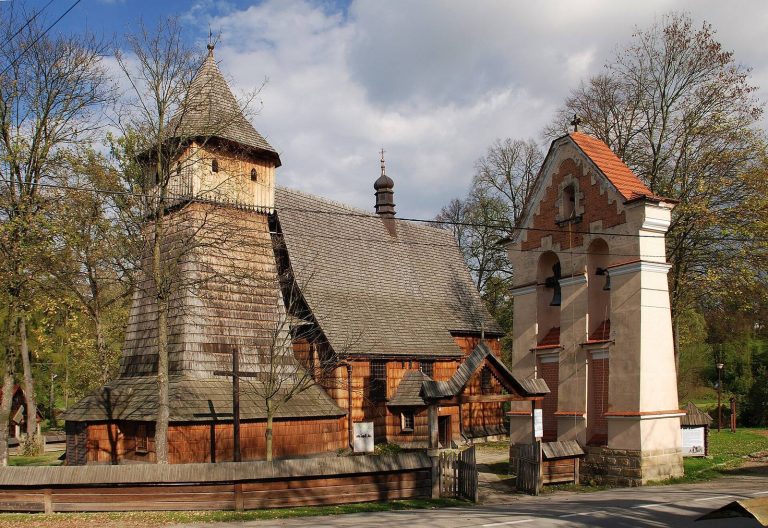
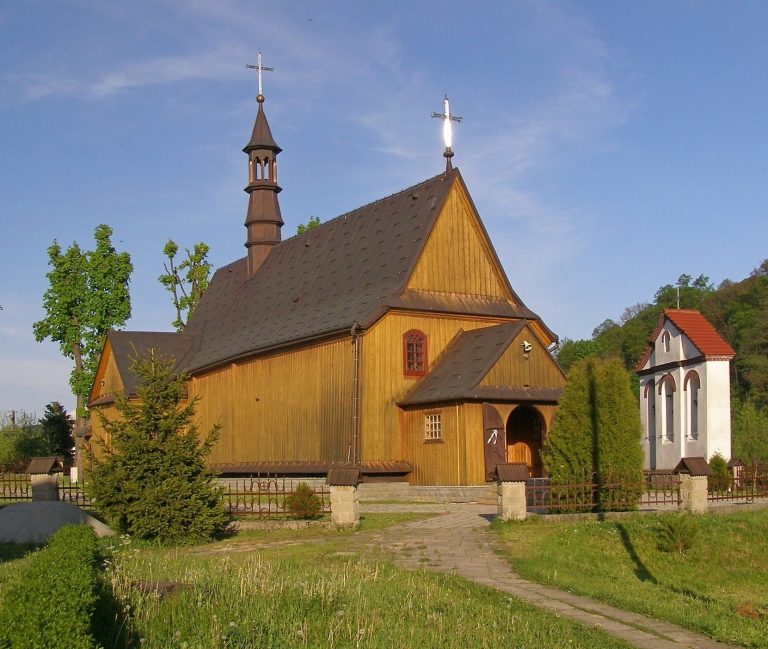
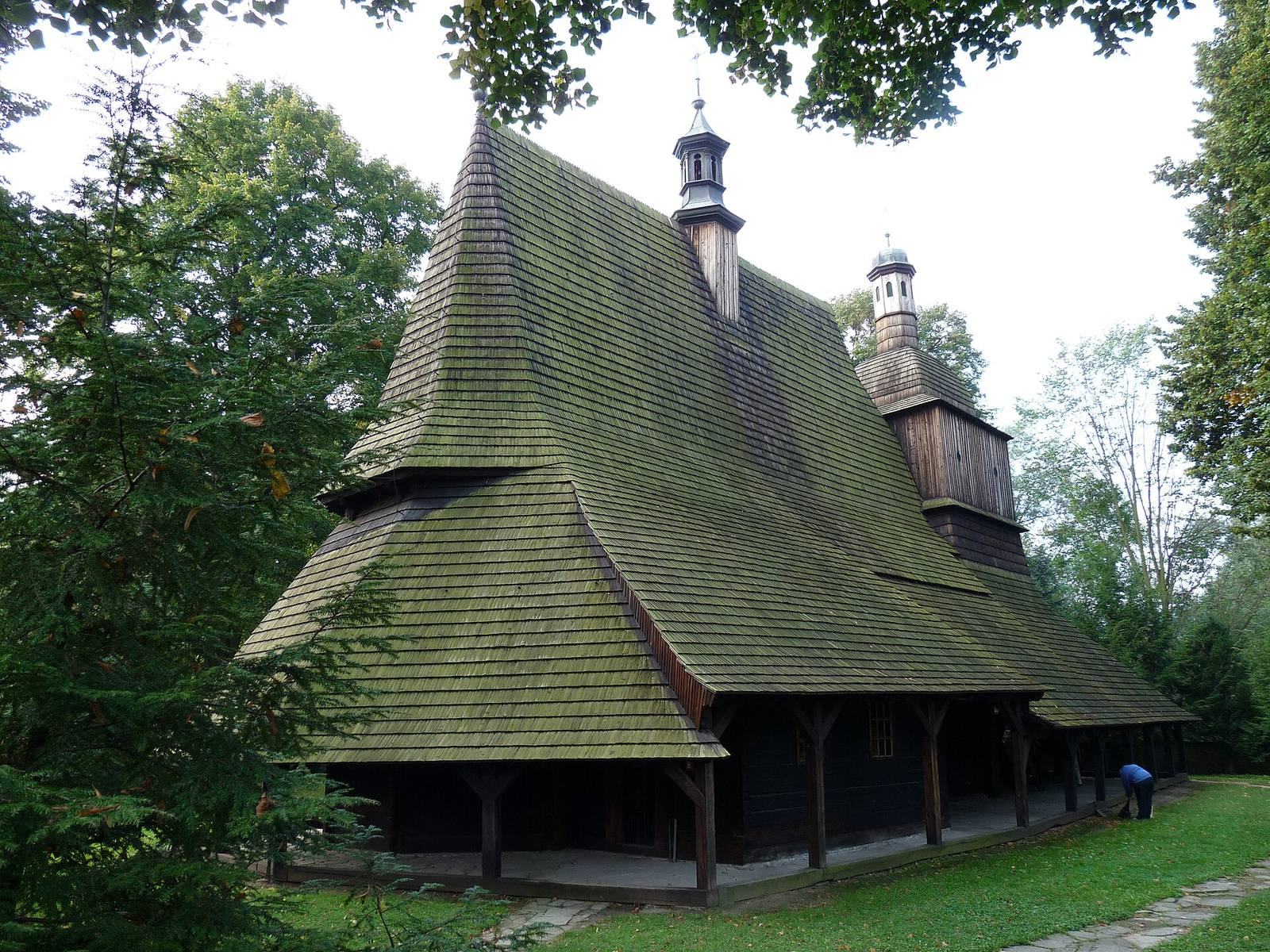
The church has a single nave, the main body of the building, and a narrower, three-sided chancel, the area near the altar. Its log-built walls rest on a rubble-stone foundation and are made from hand-hewn larch, covered on the outside with wooden shingles. A steep, high roof unites the nave and chancel beneath one ridge, with gently shaped planes and a king-post timber truss, a roof frame supported by a central upright post.
Tower, shelters, and entrances
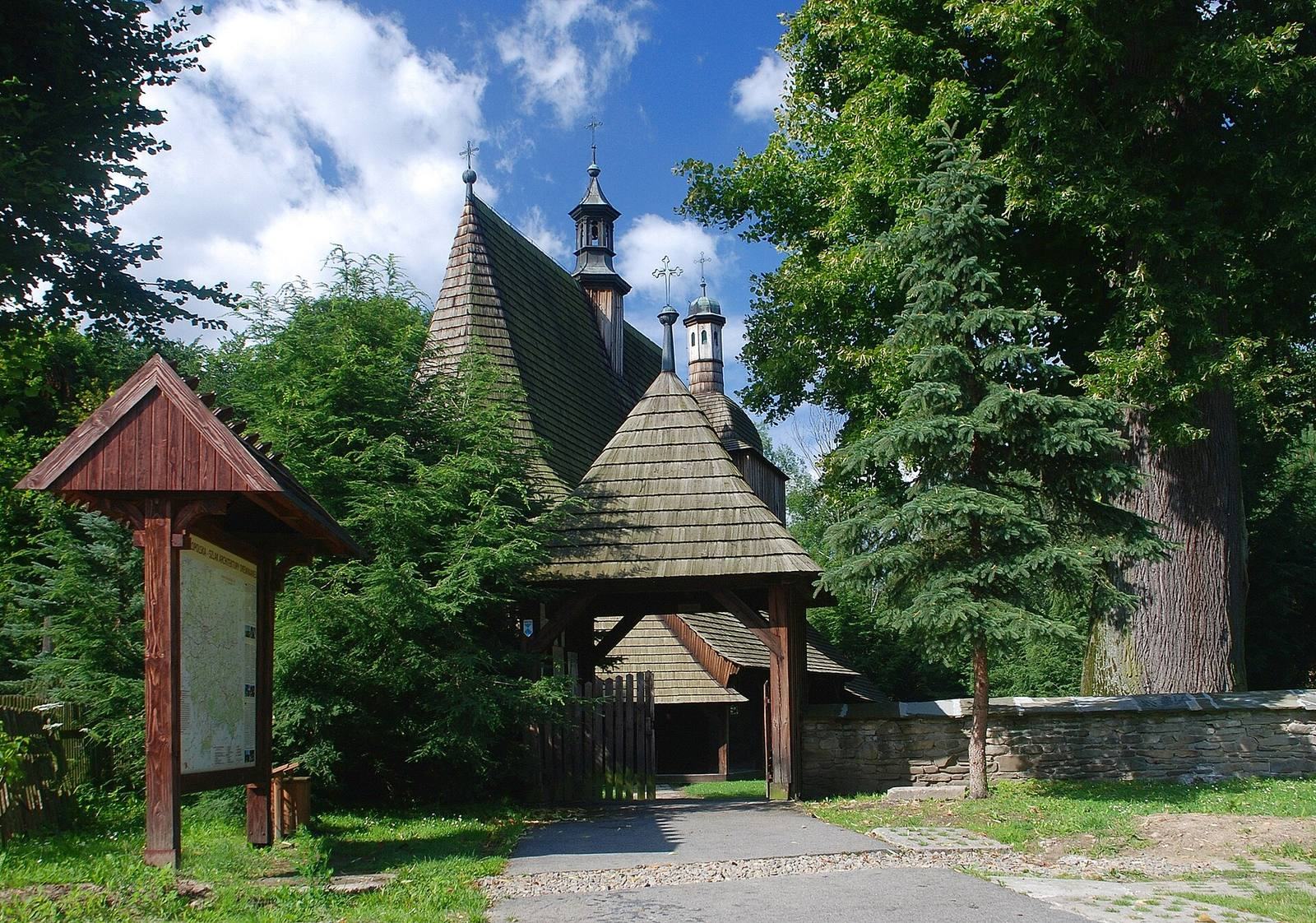
Among the 17th-century additions is a post-and-frame tower, open at ground level and topped by a boarded section shaped like a bell chamber and a domed roof. Broad shelters with open sides are carried on posts. A separate polygonal bell turret has a lantern and a pyramidal sheet-metal roof. The church has three doorways, two into the nave from the west and south and one through the sacristy. All are late Gothic; the western doorway has an arch with three lobes and a double-curved profile. Double windows face south in the nave, while the chancel has windows to the south and north.
Interior and furnishings
The nave has a flat ceiling with curved sections. An opening in the wall between nave and chancel contains a moulded rood beam, a crossbeam spanning the opening, with a wooden crucifix from the 16th century. The interior retains a painted late Renaissance high altar from the 17th century and a cup-shaped stone baptismal font dated 1522. Small fragments of the 19th-century painted decoration also survive. Other furnishings include 17th-century folk-Baroque paintings of the Stations of the Cross, two 18th-century processional devotional panels, and side altars made in the second half of the 20th century in a Renaissance-inspired style.