Schloss Kaulsdorf: A 17th-Century Castle in Thuringia
Site at a Glance
- Popularity
- Low
- Country
- Germany
- Primary era
- Early Modern
- Eras represented
- Medieval, Early Modern, Modern
- Civilizations
- German, Holy Roman Empire
- Site type
- Domestic
- Remains
- Castle
On this page10 sections
History
Medieval origins and early transfers
In 1074, Archbishop Anno II of Cologne, an influential church and political leader in the Holy Roman Empire, gave the village of Chulisdorf to the Benedictine Saalfeld Abbey. The village and its noble estate later passed to the Counts of Orlamünde. In 1346, the counts transferred the village by the Saale to the Burgraves of Kirchberg, officials who administered a castle and its territory. A moated castle already stood on the site of the present Schloss Kaulsdorf, and a manor estate was also noted that year, probably referring to the fortified complex.
Kaulsdorf belonged to the County of Orlamünde as a fief, land held under a feudal agreement with the Wettins. In 1426, the Elector of Saxony, a prince entitled to take part in choosing the Holy Roman Emperor, acquired the castle estate and village.
Disputed lordship and the present Schloss
In 1427, the Lauenstein portion of Orlamünde territory was granted as a fief to the Margraviate of Brandenburg-Bayreuth, under Bohemian overlordship. It passed to the Schwarzburgs in 1438 and was sold by them to Mansfeld-Vorderort in 1503. In 1506, the Mansfelds sold Kaulsdorf to the von Thüna family, subject to conditions concerning the knightly fief and a right to buy it back. In 1560, the von Thüna family acquired the von Enzenbergs’ share, which comprised one-third of the usable land. The Wettins, the margraves and the Mansfelds disputed authority over individual villages.
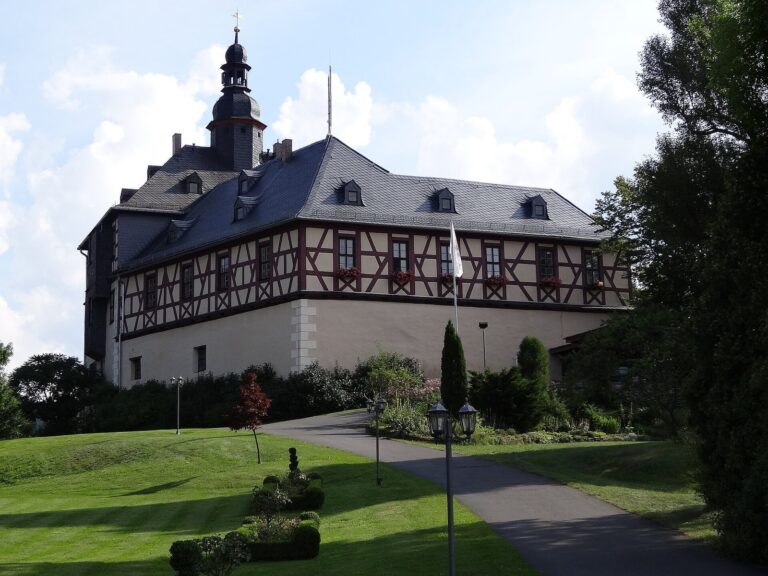
Lauenstein became an imperial fief of the von Thüna family in 1600. They sold it to the margraves in 1622, after which Kaulsdorf remained among the margraves’ disputed possessions. The estate passed to the von Streitbergs in 1631 and to the von Dobenecks in 1645. The present Schloss Kaulsdorf was built in 1678 on the earlier castle’s foundation walls. In 1687, the von Dobenecks joined their estate to holdings at Könitz, which had existed since about 1370. A von Dobeneck coat of arms hangs in the church. The Wettins exercised effective overlordship from the sixteenth through the eighteenth century.
Territorial disputes and later use
In 1776, the Mansfelds prevailed at the Imperial Aulic Council, one of the Holy Roman Empire’s highest courts, in their claims against Saxe-Saalfeld. After the Mansfeld line ended in 1780, Electoral Saxony occupied the exclave, a territory separated from the state to which it belonged, citing a pledge made by the Ernestine branch of the Wettins in 1567. The margraves protested to the Council, and the territory returned to them in 1787. When they gave up governing in 1791, the exclave passed to Prussia.
Prussia bought the estate in 1795 and divided it for resale to farmers and townspeople. The Schloss itself was sold in 1814. From the late nineteenth century into the twentieth, the municipality used the building as a poorhouse. In 1920, it was sold to Walter Treupel, a gynecologist in Jena, and also served as a restaurant during this period.
Remains
Setting and plan
Schloss Kaulsdorf stands on a rocky, spur-like outcrop above the old road from Saalfeld to Nuremberg, below Schloss Eichicht. The site lies on the right bank of the Saale, in the eastern part of a river bend within a broad valley of meadows, fields and high hills. The Bundesstraße 85 passes through the village along a route that formerly served as a north-south trade and military road. The Schloss has a T-shaped plan.
Architecture and defenses
Main building
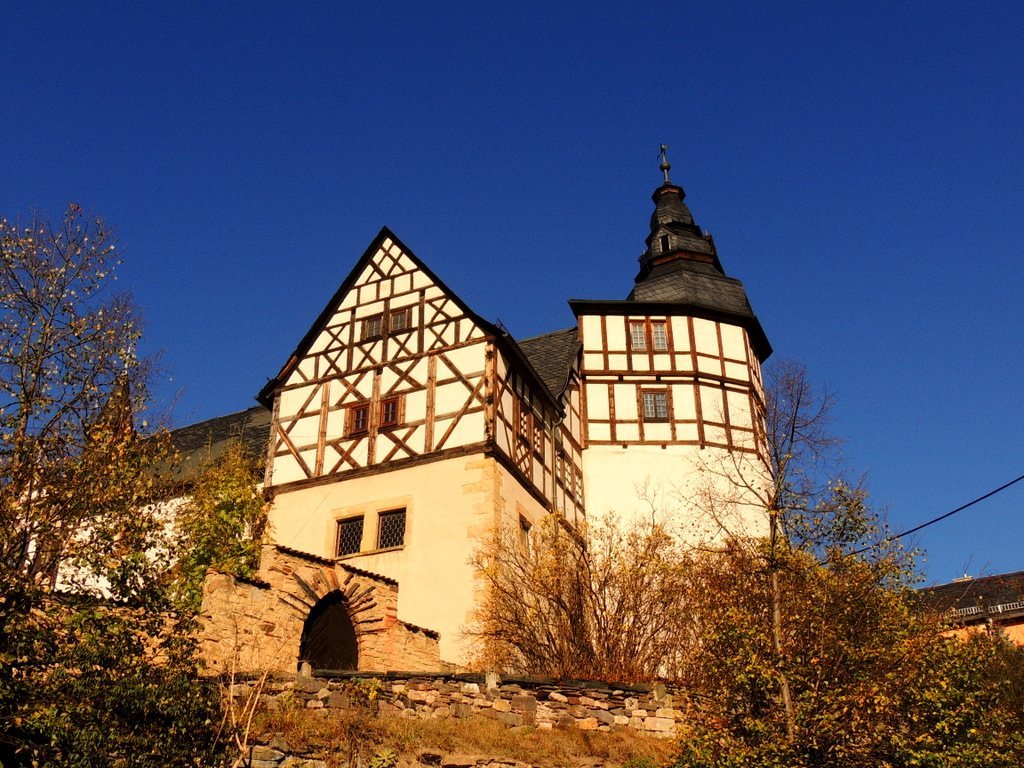
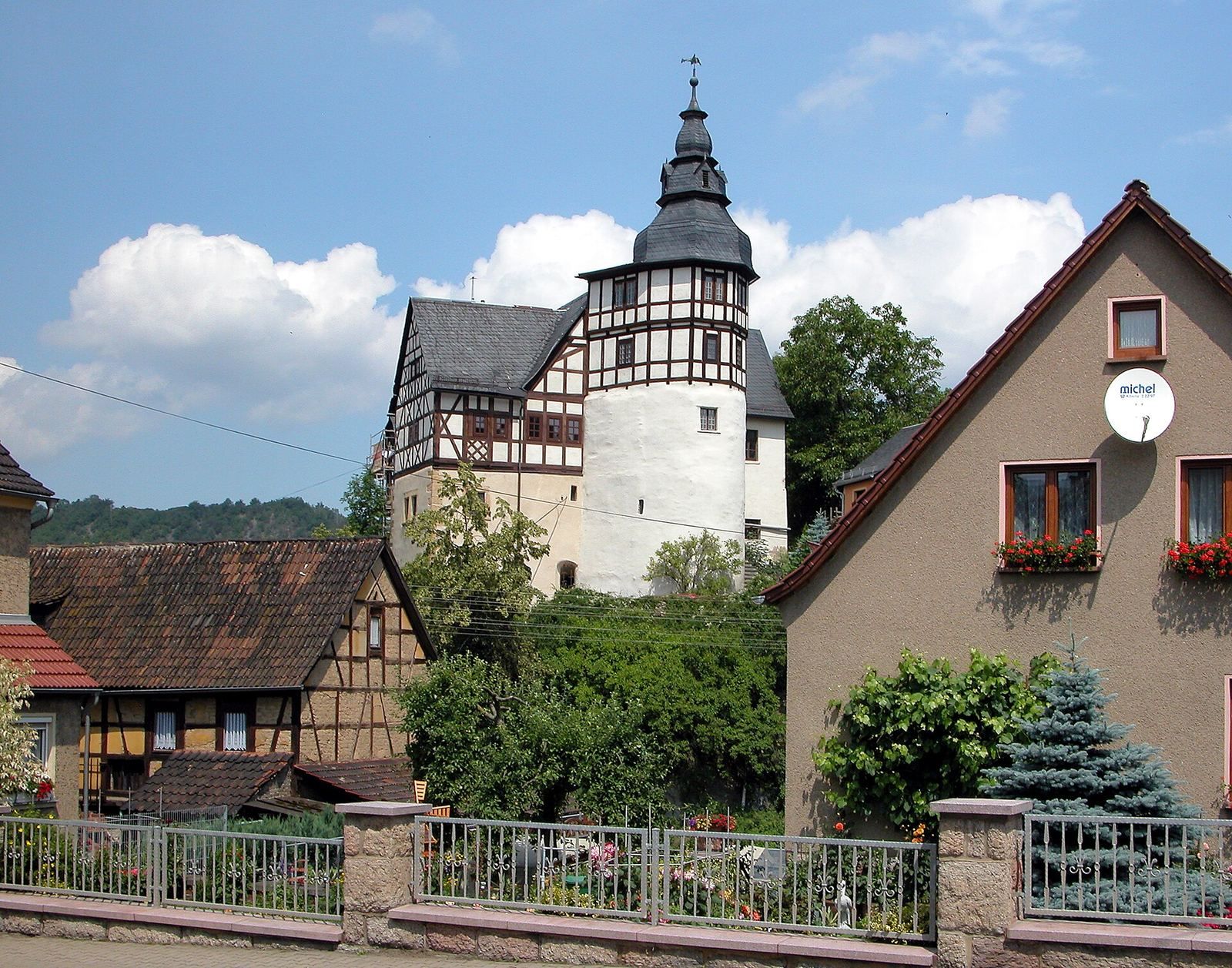
The building is block-shaped and resembles a residential tower. Parts of it are half-timbered, and the castle is well preserved.
Tower
A semicircular tower stands at the shorter end of the building. In 1921, an octagonal half-timbered upper structure was added, bringing the tower to a height of 25 metres.
Moat
Traces of the moat remain visible. A drawbridge once crossed it.