Castle of Touffou: A Medieval and Renaissance Château in France


Site at a Glance
- Rating
- 3.8
- Popularity
- Very Low
- Country
- France
- Primary era
- Medieval
- Eras represented
- Medieval, Early Modern
- Civilizations
- French
- Site type
- Military
- Remains
- Castle
On this page12 sections
History
Castle of Touffou is a château in Bonnes, France, whose origins reach back to a Romanesque keep built in the twelfth century by the Oger family. First recorded in 1127 as “Tolfol,” the site developed through medieval and Renaissance phases and occupies a prominent place in the history of the surrounding estate.
Medieval Origins and Family Ownership
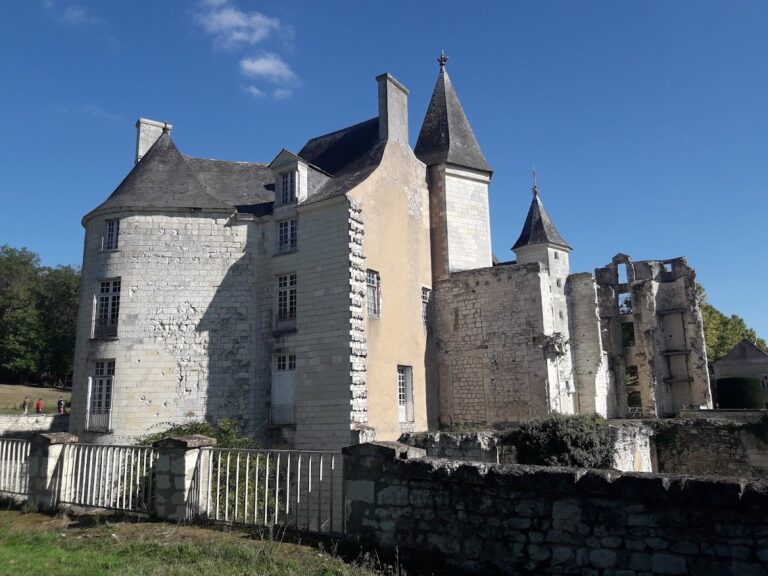
The Oger family held Touffou from 1127 until 1280. During this period, the first keep was constructed as the core of the castle. Ownership then passed to the Montléon family, who retained it until 1519. The medieval wing includes an eastern section from the twelfth century and a western section built in the early fifteenth century.
The fifteenth century brought major changes to the residence. A new residence keep was enlarged while round towers were built, and the surviving defensive quadrilateral plan reflects this stage of development. These works expanded the castle beyond its earlier fortified core while preserving its defensive character.
The Chasteigner Renaissance
In 1519, Touffou passed to the Chasteigner family, which retained the property until 1821. Jean III Chasteigner de la Roche-Posay, chamberlain to Francis I, a senior court official connected with the king’s household, and his wife Claude de Montléon, Lady of Touffou, were responsible for the Renaissance residence and related alterations. Francis I ruled France from 1515 to 1547 and was a major patron of Renaissance art and architecture.
The sixteenth-century Renaissance wing transformed the complex into a residence combining older Romanesque and Gothic fabric with newer architectural forms. A room known as the Francis I Bedroom preserves the tradition that the king visited Touffou, although the room’s name commemorates a supposed visit rather than establishing a documented royal stay.
Revolutionary and Modern Ownership
Touffou was sealed in 1794 during the French Revolution, but the estate was returned to its heir in 1803. In 1821, the heir sold it to Alexandre Marie de Gréaulme, a cavalry colonel. After three further owners, the de Vergie family purchased the château in 1897 and remained there until 1966. The family maintained a tradition of mounted pursuit hunting, in which hounds chase quarry over an extended course, and Enguerrand de Vergie carried out major restoration and improvement works.
During the Second World War, Bonnes housed Mosellan refugees from September 1939. Touffou was also required to accommodate 200 German soldiers, who were installed at the château. In 1966, David Ogilvy, a British advertising executive, purchased the property. He died there in 1999, and the Ogilvy family continued to own Touffou after his death.
The château was classified as a French historic monument in 1923. The gardens and southern avenue were registered in 1992, and the remains of the towers were classified in 1994. The garden terraces received classification by an order dated 19 May 1994, while the park has held the “Remarkable Garden” designation since 2004. The medieval wing is used for large business meetings and seminars, while the Renaissance wing remains the owner’s private residence.
Remains
Castle of Touffou stands on a terrace above the left bank of the River Vienne, on a long, elevated riverbank. Its surviving fabric combines Romanesque, Gothic, and Renaissance elements. The complex includes the medieval and Renaissance wings, the enclosure, inner and outer terraces, the Almonry building, towers, gardens, and the southern avenue.
Fortified Residence
The Central Keep
The keep, the principal fortified tower of a medieval castle, occupies the center of the château. It is rectangular, 27 metres long, 13 metres wide, and 18 metres high. Corner turrets flank the structure, while machicolations, projecting parapets with openings used to drop or pour materials onto attackers, crown its northern and eastern faces.
The keep has five storeys, with one room on each level. The room on the second storey preserves thirteenth-century heraldic polychromy. The fifteenth-century residence keep and its round towers form part of the surviving defensive quadrilateral plan, while the medieval wing retains its twelfth-century eastern half and early fifteenth-century western half.
Renaissance Wing and Almonry
The Renaissance wing was added in the sixteenth century by the Chasteigner family. It stands alongside the earlier medieval fabric and gives the complex its combination of fortified and residential forms. The Almonry building, an institution associated with distributing alms, is another protected component of the château.
A Hunting Museum within the château presents its hunting history and contains more than 1,500 hunting buttons. The collection is described as one of the largest in France. Its contents relate directly to the estate’s later hunting tradition and the material culture associated with that activity.
Gardens and Terraces
English-Style Garden
The gardens are documented from the period of the French Revolution, while the contemporary layout has been developed progressively since 1966. The English-style garden contains four enclosed areas of yew. Its most notable section is the rose garden, and a central avenue planted as a “Mix Border” creates a perspective toward the château.
Almonry Garden
Below the English garden lies the Almonry Garden. It is arranged as eleven successive squares planted with giant artichokes and edged with boxwood, creating a distinct geometric garden area within the wider grounds.
Terrace Garden
The terrace garden overlooks the River Vienne and follows an Italian style. Known as the Garden of the Terrace of the Tournaments, it was designed by landscape architect Paolo Perjoné to evoke the organization and atmosphere of Renaissance Italian gardens. Together with the inner and outer terraces, it forms part of the château’s elevated setting above the river.