Nydegg Church: A Gothic Church on Bern’s Former Castle Site
Site at a Glance
- Popularity
- Medium
- Country
- Switzerland
- Primary era
- Medieval
- Eras represented
- Medieval, Early Modern, Modern
- Civilizations
- Holy Roman Empire, Swiss
- Site type
- Religious
- Remains
- Fortified Church
On this page12 sections
History
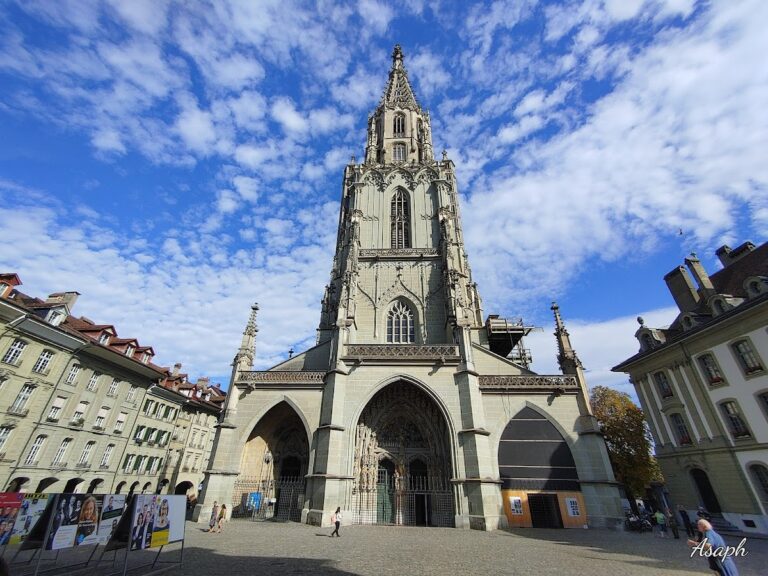
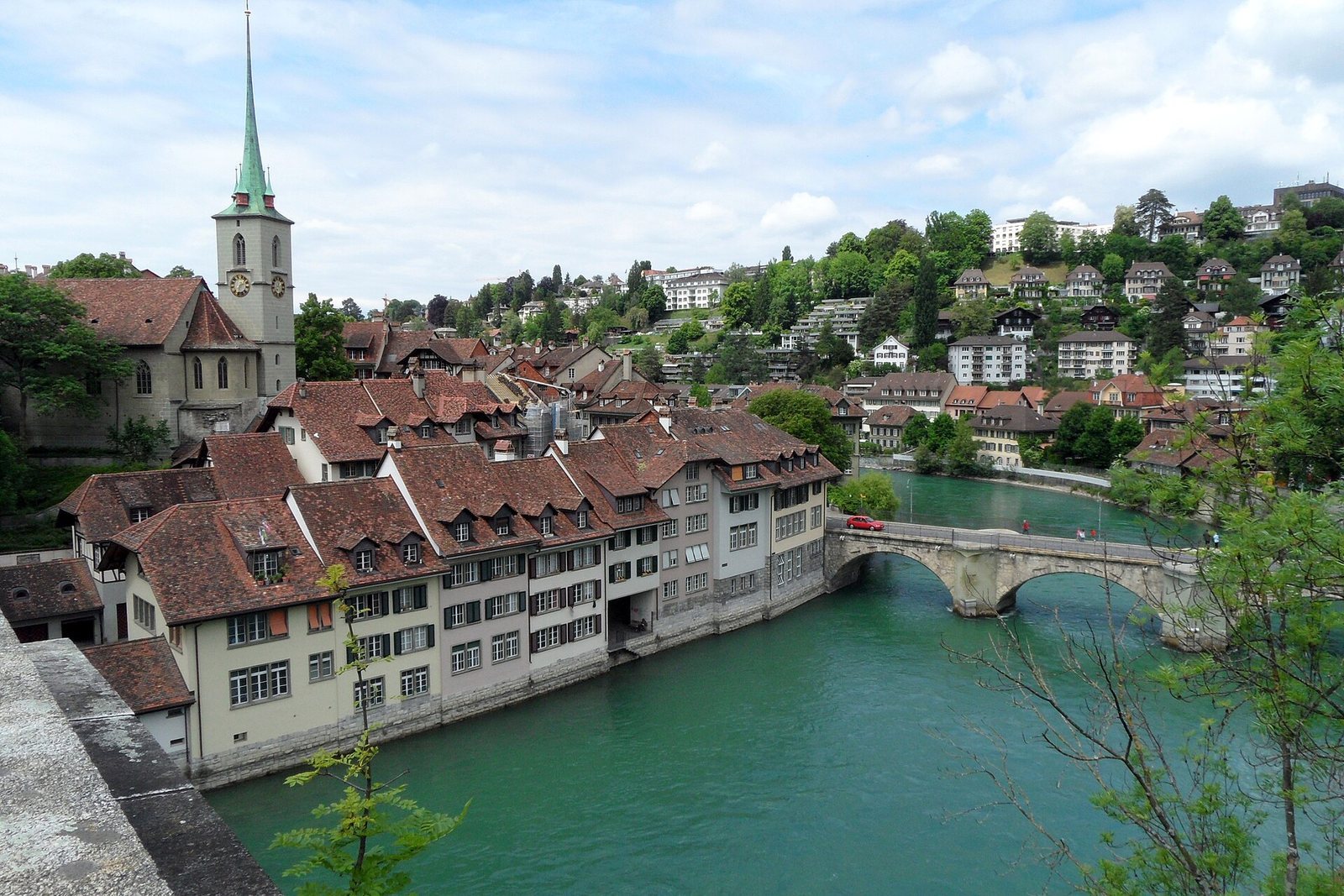
Nydegg Church stands at the eastern edge of Bern’s Old City in Switzerland. Built between 1341 and 1346 on the site of a former castle, it is associated with Late Gothic and Gothic Revival architecture.
City expansion and Nydegg Castle
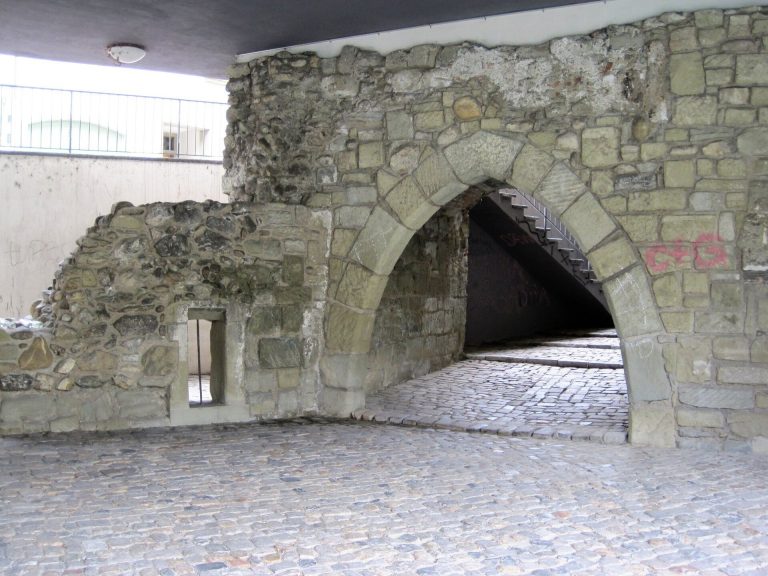
In 1191, Bern’s first expansion extended an existing settlement around the church site toward the Clock Tower. The previous year, Duke Berchtold V of Zähringen had built Nydegg Castle there. After the duke’s death, the castle became an imperial fortress. It later passed to the city after the House of Zähringen died out. Around 1268–70, Bern’s inhabitants demolished it to make room for the Nydegg quarter.
Church construction and rebuilding
A church was built on the castle site from 1341 to 1346. It was consecrated in March 1344 and again on 23 May 1346. In 1469, Bern sought the Teutonic Order’s agreement to give its chapel to the Mary Magdalene Brotherhood, a religious confraternity, and allow payments made to the chapel to fund rebuilding. Bern waited until the end of the Burgundian Wars, conflicts between the Swiss Confederacy and the Duchy of Burgundy in the 1470s, before proceeding. A tower was added in 1480–83, followed by a new nave in 1493–1504.
Reformation and changes to the church
After Bern adopted the Reformation in 1529, a movement that led parts of western Christianity to form Protestant churches, Nydegg Church was used to store barrels, timber, and grain. It returned to worship in 1566 after cleaning and minor repairs to its windows and walls. Until 1721 it served as a branch church of Bern Minster, the city’s principal church. Its congregation is now part of the Reformed Churches of the Canton of Bern-Jura-Solothurn.
Fire destroyed the bell tower’s roof in 1568. By the end of May 1571, a replacement roof was complete and the damaged clock mechanism had been repaired. Four firing slits were cut into the tower in 1625 to help defend the city gate, and eight copper waterspouts were added to the roof in 1631. In 1863, the church was extended westward, and a comprehensive renovation followed in 1951–53.
Ministers and modern worship
Among Nydegg Church’s pastors, Sigmund Ludwig Langhans-Stettler served until 1809, while Jeremias L’Orsa was an assistant from 1801 and pastor from 1809 to 1832. Friedrich Zyro served from 1844 to 1855, Eduard Güder from 1855 to 1882, Friedrich Gerber from 1863 to 1869, Emil Blum from 1934 to 1960, and Kurt Marti from 1961 to 1983. From 1879 to 1886, German Protestant revival preacher Elias Schrenk, who worked for the Evangelical Society, attracted such large audiences that he could lead Sunday evening services in the church.
On 8 July 1995, pastor Klaus Bäumlin led a blessing service for a life partnership between two men.
Remains
The sandstone church is 31 metres long and reaches 21.45 metres to the cornice. Its choir stands approximately where Nydegg Castle’s four corner towers once enclosed the site. The first church was small and had a bell tower. The present tower’s appearance largely reflects its reconstruction in 1571; its main spire carries a large wrought-iron cross made by Caspar Brükessel. Four small firing slits pierce the tower, and eight copper waterspouts extend from the roof.
Portals and bronze reliefs
Design and influence
The courtyard-side main entrance and the entrance from Nydegg Bridge each have door wings bearing bronze reliefs made by Swiss sculptor Marcel Perincioli in 1956. The two portals contain 16 scenes, with medieval examples at San Zeno Maggiore in Verona and Hildesheim Cathedral as models.
Courtyard-side portal
On the left wing, scenes descend from the announcement of Jesus’ birth to the shepherds to his baptism, the Sermon on the Mount, and the healing of a paralytic. The right wing shows his birth in the stable at Bethlehem, the temptation, the miraculous feeding, and the raising of Lazarus.
Bridge-side portal
The left wing depicts, from top to bottom, women coming to Jesus’ tomb, Jesus before Pontius Pilate, the washing of the feet, and the anointing at Bethany. The right wing shows the risen Christ on the Sea of Galilee, Jesus’ burial, his time in Gethsemane, and his entry into Jerusalem.
Choir organ
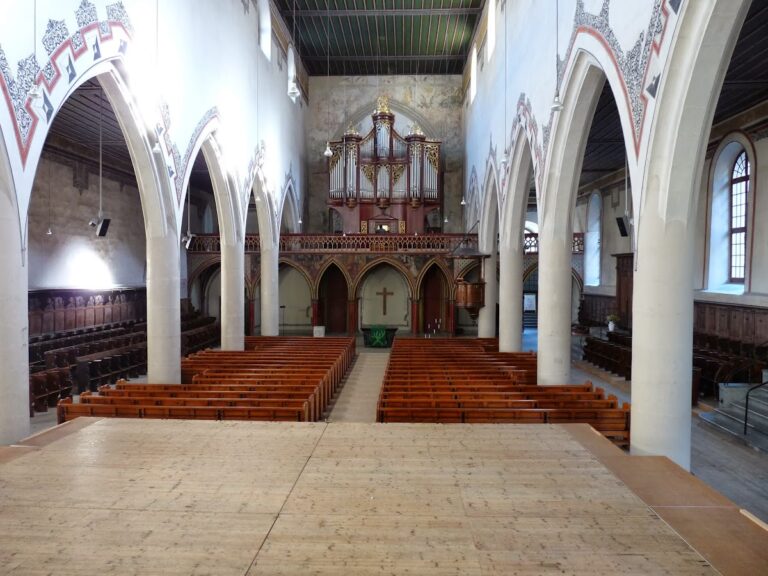
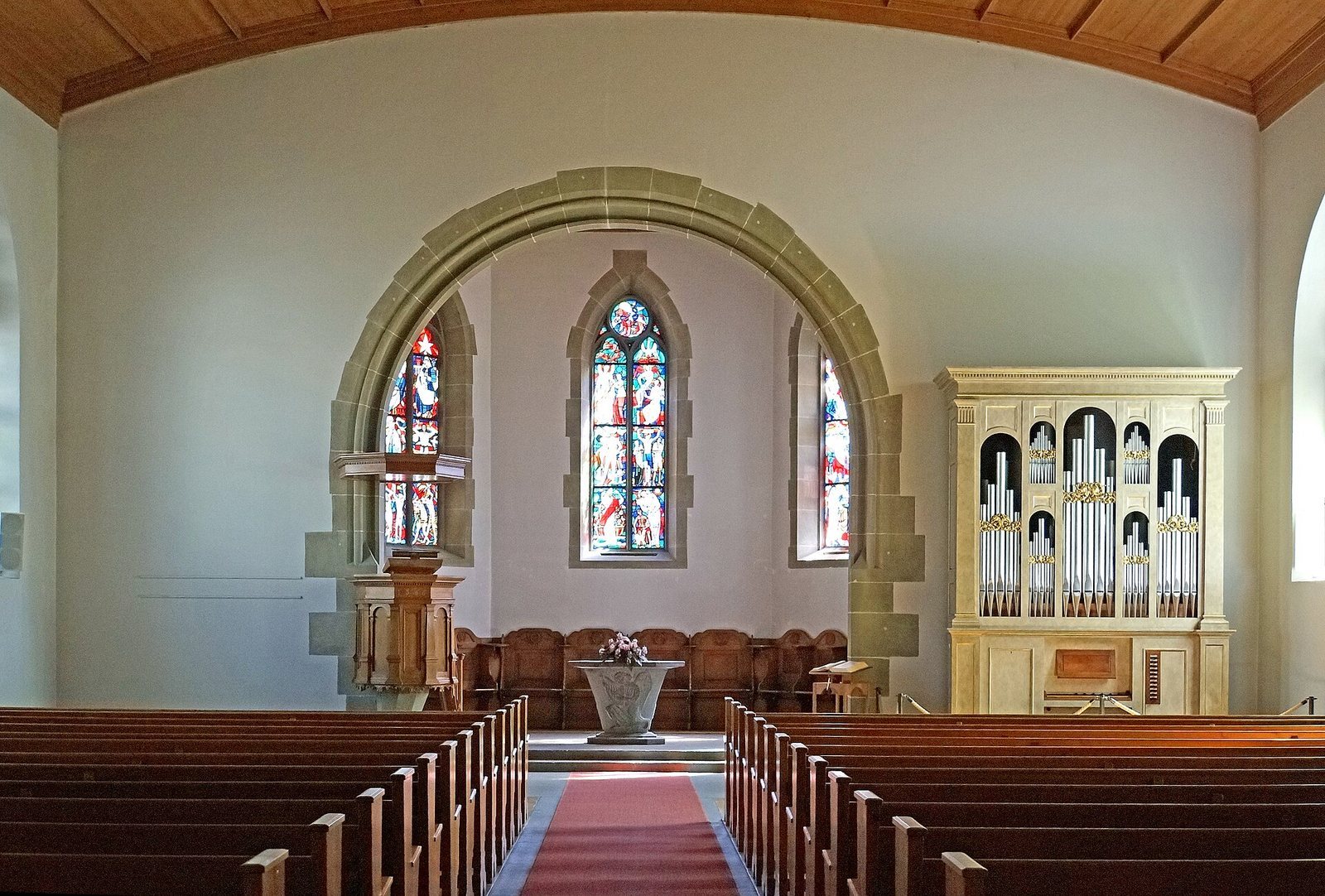
Built in 1995 by Orgelbau Kuhn of Männedorf, the choir organ draws on Italian Renaissance designs and the style of the Antegnati family of organ builders, with 1608 as its stylistic reference. A single hand keyboard controls 11 stops, each of which operates a set of pipes. Its attached foot pedal has no separate stops and has the stated range FF, GG, AA–c0. Some upper keys are divided to suit meantone, a historical tuning system. Two wedge bellows, air pumps shaped like wedges, can supply air by hand or electrically.
Fountain and monument
A fountain installed in 1857 in a niche beneath Nydegghöfli is known as the Nydegghöflibrunnen or Staldenbrunnen. The Zähringer monument was moved to Nydegghöfli from the Münster platform in 1968.