Schloss Möckern: A Castle Adapted for School Use
Site at a Glance
- Popularity
- Medium
- Country
- Germany
- Primary era
- Modern
- Eras represented
- Medieval, Early Modern, Modern
- Civilizations
- German, Holy Roman Empire, Kingdom of Prussia
- Site type
- Domestic
- Remains
- Castle
On this page12 sections
History
Schloss Möckern is a castle in Möckern, Germany, on a site occupied by a Slavic water castle in the 10th century. Its present form largely reflects a 19th-century remodeling in English Gothic style, which draws on Gothic architectural forms associated with England.
Medieval beginnings and rebuilding
The castle complex was destroyed during the Thirty Years’ War, a major European conflict fought from 1618 to 1648. After Christian Wilhelm von Münchhausen became its lord in 1710, he commissioned a rebuilding. A half-timbered castle was constructed during the work, which continued from 1710 to 1715.
The park and 19th-century transformation
In the second half of the 18th century, Baron Ludwig Philipp vom Hagen commissioned an English landscape park, a garden style designed to create natural-looking scenery rather than formal geometric patterns. The garden architect Friedrich Wilhelm von Erdmannsdorff participated in the work, which was completed under Count Christoph vom Hagen in 1810.
Between 1840 and 1863, owner Count Wilhelm vom Hagen remodeled the castle into substantially the form it retains today. He also made the estate a family entail, an inheritance arrangement restricting the estate’s disposal and commonly keeping it within the family.
The estate and modern use
In the early 1920s, the Möckern estate, including the outlying farm of Lochow, covered 1,805 hectares, of which 1,515 hectares were forest. Members of the von Hagen family, including Hilmar vom Hagen and later his son Rüdiger, owned the castle until its expropriation in 1945.
From 1952, the castle served as a state archive depot. In 1991 it was restored and adapted for use as a primary school, its present function. After German reunification, Hans-Dietrich Count vom Hagen, Rüdiger’s grandson, bought back parts of the estate. An association formed in 2017 to preserve the park and restore it as an English landscape park.
Remains
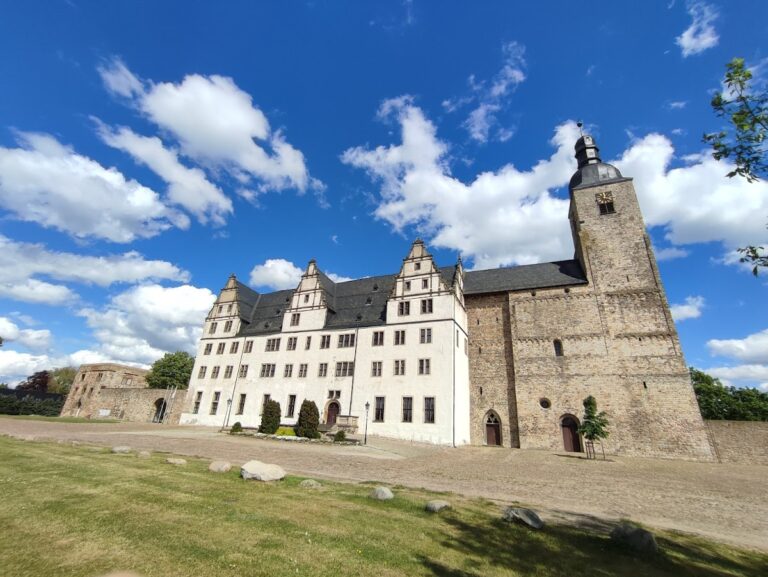
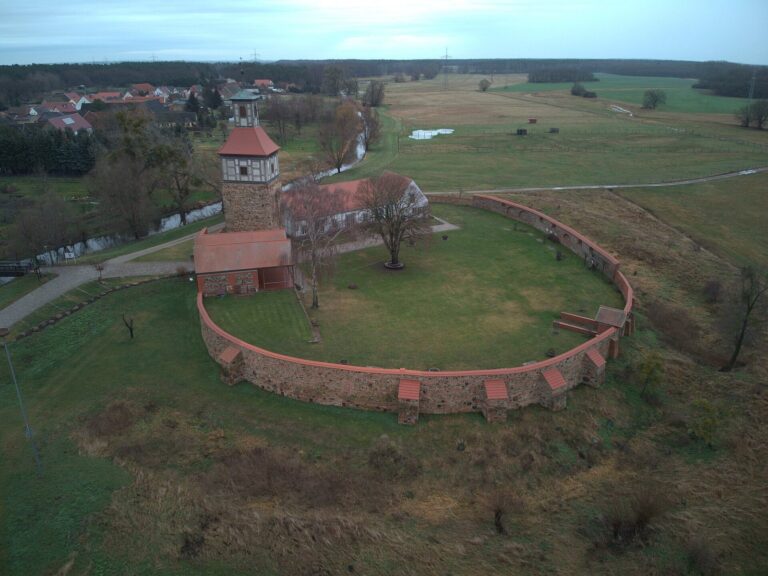
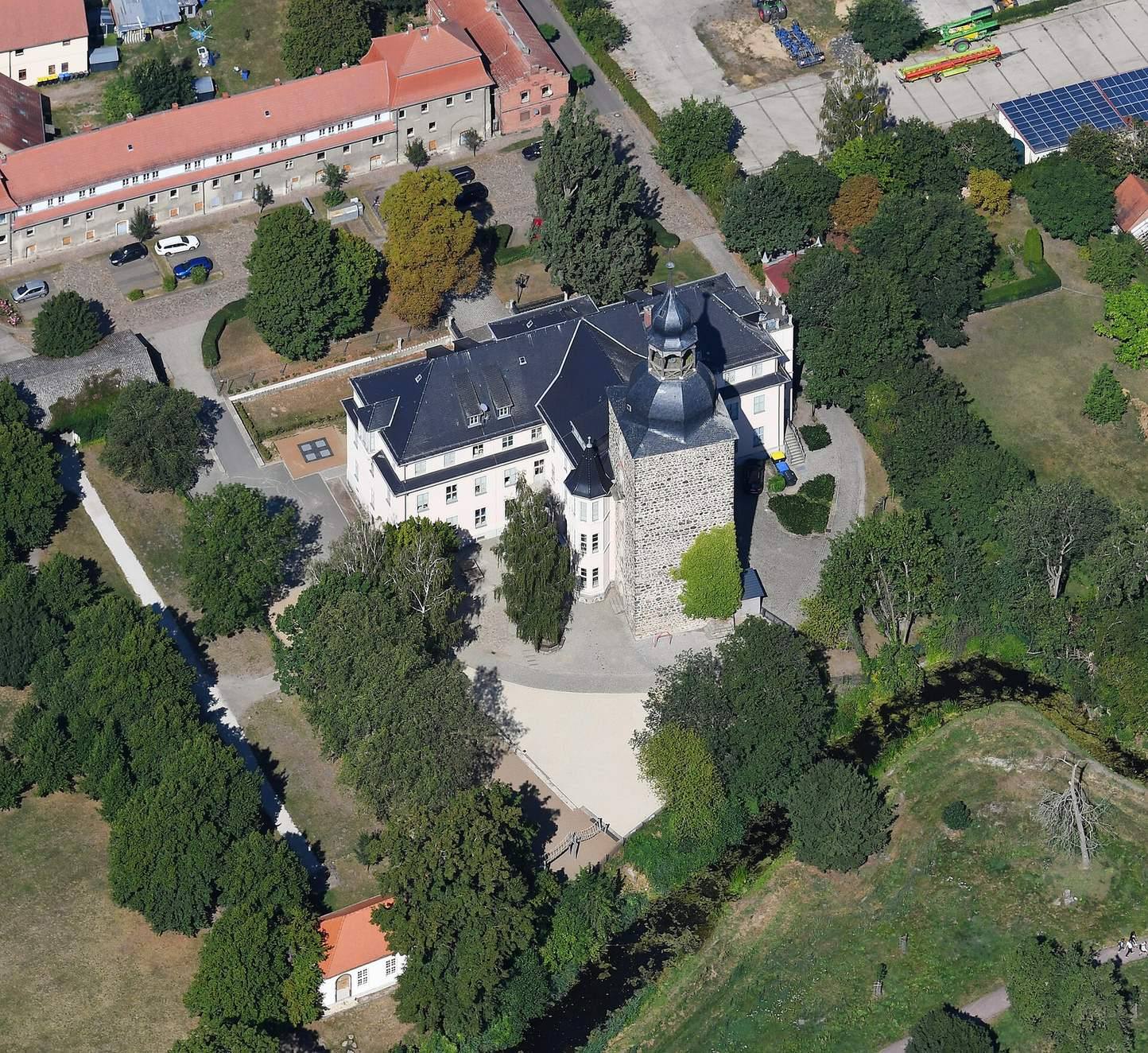
The castle stands east of Möckern’s marketplace, close to the town center, with the landscape park extending to its east. The surviving complex includes a medieval tower, water-filled moats and a main castle building joined to the tower. The park incorporates further historic landscape features.
Castle buildings
Medieval defensive tower
The square fieldstone tower measures 11 by 11 metres and rises five storeys. Its entrance is 9 metres above ground. During the rebuilding of 1710–1715, the tower received a vaulted, many-sided Baroque cap topped by a lantern. It is among the oldest surviving parts of the complex.
Main castle
Southwest of the tower, the main building is a rectangular, two-storey structure with a 13-bay façade. A projecting section, rising three storeys, connects it to the tower. Its English Gothic features included pointed turrets, battlements and window hoods. The 1952 conversion removed these decorative features and added an attic storey with windows.
Landscape park features
Moat, ponds and town wall
The park includes the old castle moat, remains of the town wall and ponds. The town church forms its southern boundary.
Tea house
Near the castle is a tea house in a restrained Neoclassical style.
Mausoleum
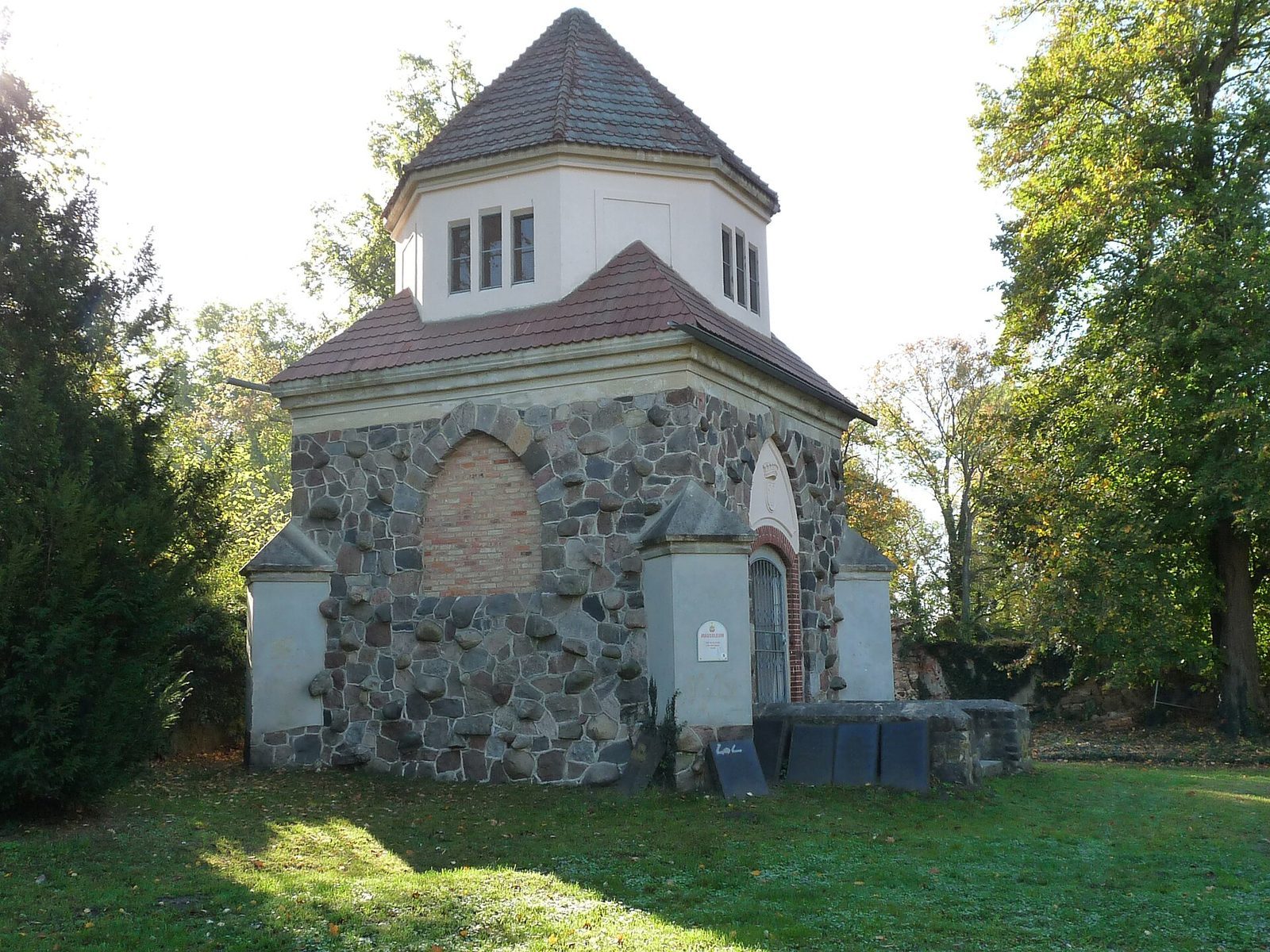
A square mausoleum built from erratic boulders stands in the park. It was made for Countess Erika vom Hagen, born von Itzenplitz, the first wife of Rüdiger vom Hagen-Möckern, who held the family entail. She died in 1906.