Dorfkirche Arnsdorf: A Lutheran Village Church in Germany
Site at a Glance
- Popularity
- Very Low
- Country
- Germany
- Primary era
- Early Modern
- External website
- Open
- Eras represented
- Early Modern, Modern
- Civilizations
- Electorate of Saxony, German, Holy Roman Empire, Kingdom of Bohemia
- Site type
- Religious
- Remains
- Church
On this page17 sections
History
Medieval origins and parish history
Dorfkirche Arnsdorf is an Evangelical Lutheran church in Arnsdorf, Germany. Its origins are unknown, but the church appears in records from 1346 kept by the Diocese of Meissen, a historic ecclesiastical jurisdiction in Saxony. Since at least the Reformation, the sixteenth-century movement that established Protestant churches including Lutheranism, it has been associated with the church at Wallroda. Today it is one of four churches in the Evangelical Lutheran parish of Arnsdorf-Fischbach-Wallroda, within the Bautzen-Kamenz church district of the Evangelical Lutheran Church of Saxony.
Fire and rebuilding
A village fire on 23 November 1631 destroyed the church, which then had a thatched roof. Rebuilding was held up for six years by the aftermath of the Thirty Years’ War, a European conflict fought from 1618 to 1648, and by the plague of 1632-1635. The rebuilt church was consecrated on 1 November 1638.
Later alterations
Renovations over the following centuries shaped the church’s present appearance. Work in 1715 included a striking clock, which sounds a bell to mark the time. The congregation bought a replacement clock in 1941 from the Otto Fischer tower-clock factory in Meissen.
The church acquired its first organ in 1722, a small positive, or compact organ, from the Radeberg parish. A small organ followed shortly afterward. Around the mid-nineteenth century, the church acquired an instrument built in 1805 by Hesse and brought from Niederstriegis. Its poor condition led to its replacement in 1930 by an organ made by the Eule firm.
The church’s two older bells were melted down for armaments in 1917. The following year, churchwarden Bruno Häse, who leased the local hereditary court, donated three replacement bells. Made of inexpensive hard cast iron, they were not sought for armaments during the Second World War.
In 1934, an altar from the Church of St. Kunigunde in Borna replaced the church’s earlier altar. That year, a wooden crucifix that had hung on the south exterior wall was brought inside. Roof repairs in 2001 uncovered a painted panel ceiling from 1719-1720. After several years of restoration, it was largely restored and returned to the church in 2011.
Remains
Church fabric
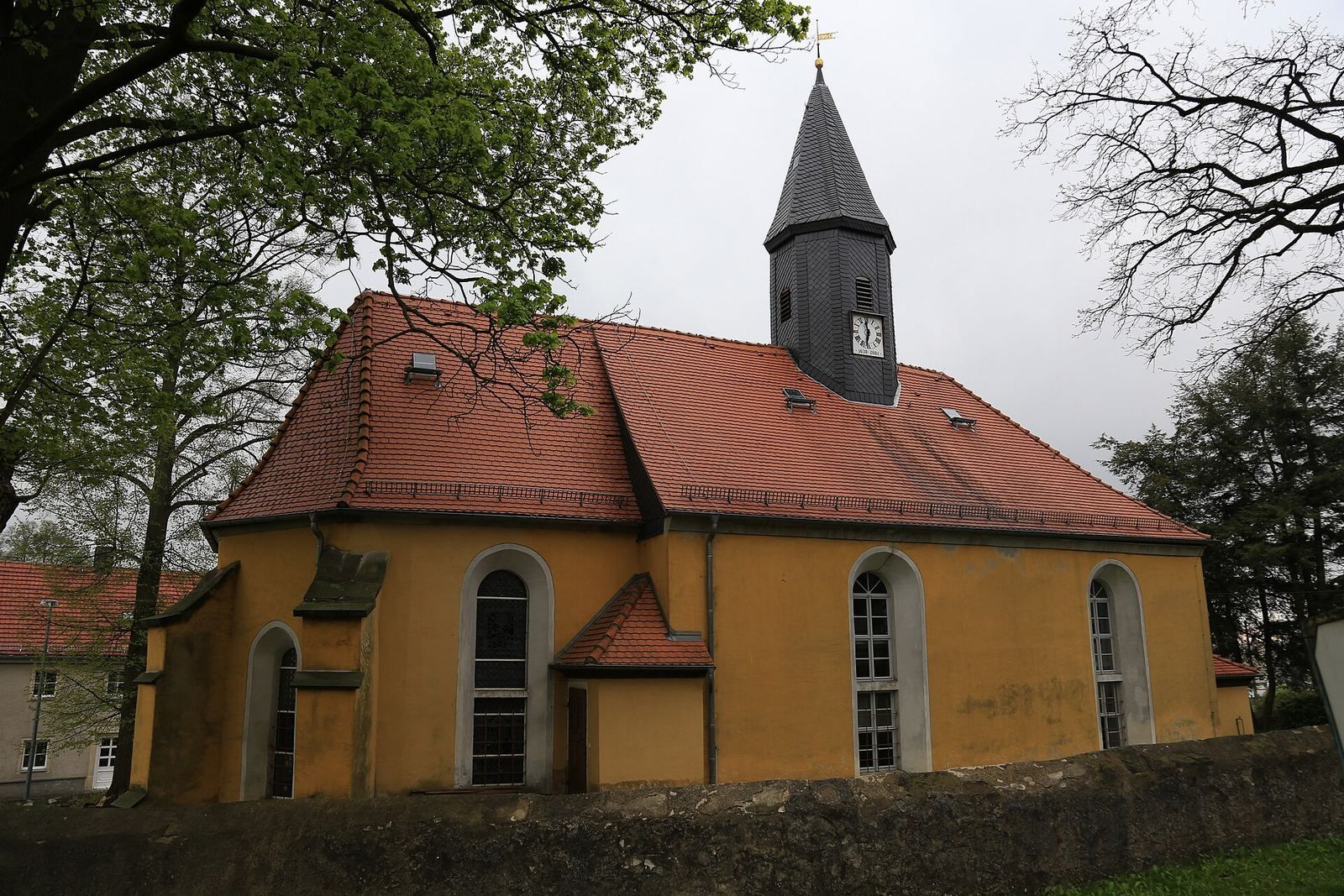
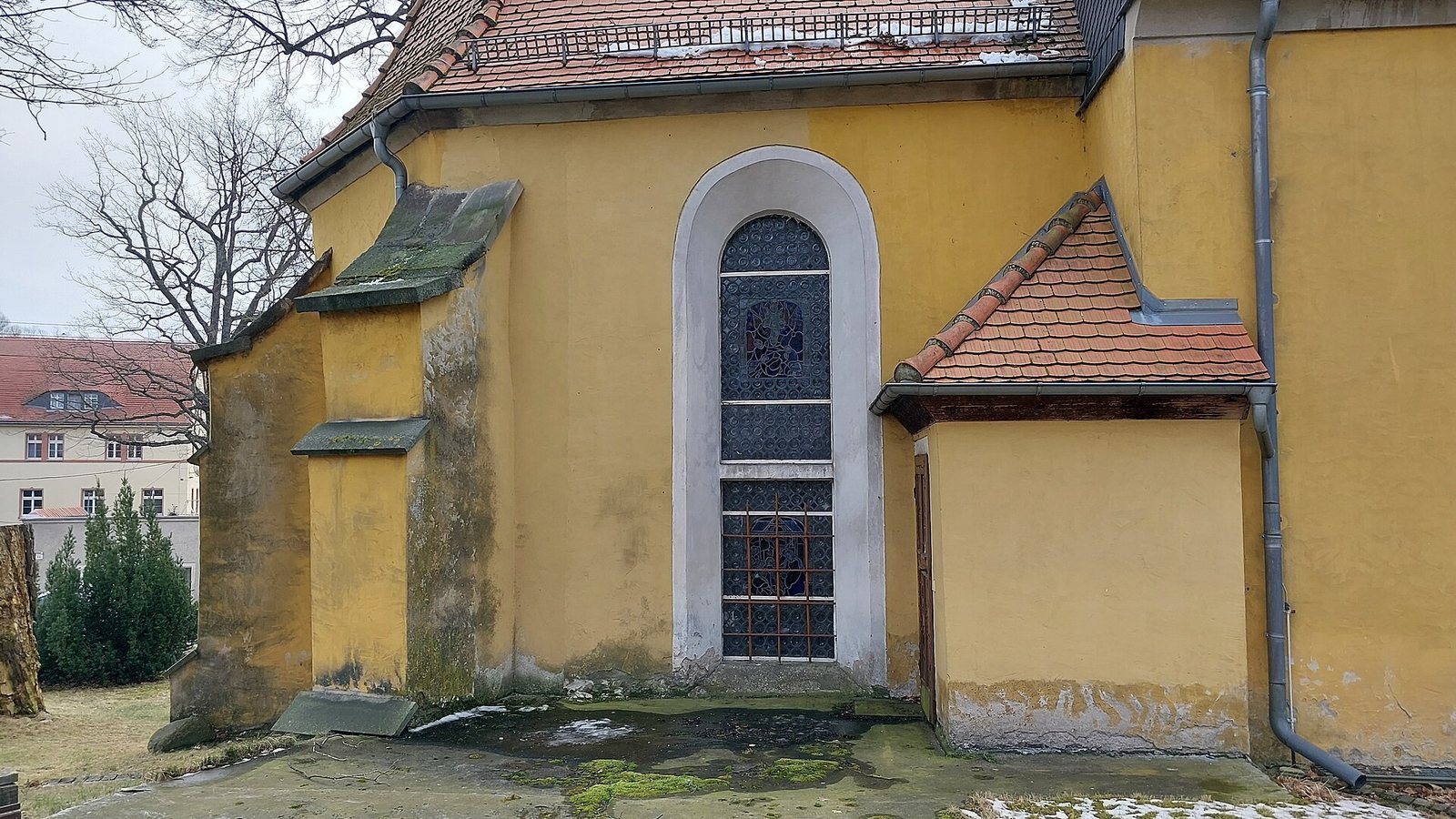
The church’s nave, the main area for the congregation, is wider and was built later than the choir, the area around the altar. A sacristy, a room for vestments and liturgical objects, adjoins the choir on its right. Three buttresses, external wall supports, surround the choir and its cross-rib vault, a ceiling supported by intersecting ribs. The vault and the arch dividing choir and nave survived the 1631 fire, along with the perimeter wall. An octagonal tower rises from the roof.
Interior features
Altar
The altar brought from Borna dates to 1632. Paintings by G. Kleggler depict the Last Supper, the Resurrection of the Dead, a Christian belief that the dead will be raised to life, and Christ’s ascent to heaven after his resurrection.
Pulpit
The pulpit dates to around 1680. Its parapet, the low railing around it, has four panels showing Matthew, Mark, Luke and John, traditionally regarded as the authors of the first four Gospels. An inscription from 1729 says that Johann Walther, the local hereditary and district judge, arranged for the pulpit to be painted.
Baptismal font
A sandstone baptismal font replaced an earlier font made from Rochlitz porphyry, a volcanic stone from Saxony, in 1888. The sandstone font holds a pewter bowl dated 1637. Its inscription says the bowl was renewed in 1888 for the church’s 250th anniversary.
Organ
The present Eule organ bears opus number 176 and has two keyboards and 12 sound controls.
Painted ceiling
The painted panel ceiling dates to 1719-1720. Its central image probably depicted the Twelve Apostles and ten prophets.
Crucifix
The wooden crucifix came from the church at Rammenau and was made before 1750.
Towers and memorial
Roof tower and clock
The roof tower was once braced by a pillar inside the nave, before the bells were moved to their separate tower. The former weather vane bore the date 1875; the present one is dated 2001. Beneath the clock dial is the inscription “1638-2001.”
Bell tower
A separate bell tower stands beside the church. It was built in 1918 for the donated bells.
War memorial
A memorial stone on the south wall commemorates Arnsdorf residents killed or missing in the First and Second World Wars. Its upper portion lists First World War victims. The lower portion refers to John 15:13 and remembers those killed or missing in 1939-1945.