Parnas Fountain: A Baroque Public Fountain in Brno
Site at a Glance
- Popularity
- High
- Country
- Czechia
- Primary era
- Early Modern
- Eras represented
- Early Modern, Modern
- Civilizations
- Austria-Hungary, Habsburg, Holy Roman Empire, Margraviate of Moravia
- Site type
- Civic
- Remains
- Fountain
On this page9 sections
History
The Parnas Fountain is a Baroque public fountain at the center of Zelný trh, Brno’s historic market square in Czechia. Brno’s municipal authorities commissioned it to replace an inadequate fountain, and the new structure was completed in 1696.
Commission and Baroque design
The city decided in August 1690 to replace the existing fountain. A Renaissance fountain shaped like an eagle, dated to 1597, appears in paintings from the mid-eighteenth century. During work on the square in 2014, remains of an older circular fountain were also found; these remains have not been identified as the eagle-shaped fountain.
Viennese architect Johann Bernhard Fischer von Erlach designed the new fountain, taking inspiration from Gian Lorenzo Bernini’s Fountain of the Four Rivers in Rome. Two of Fischer’s proposals survive, one in Vienna’s Albertina and another in Zagreb. The finished fountain gave greater emphasis to a tall, three-sided rocky centerpiece than the original designs had. Brno’s representatives favored that form over proposals in which sculptural decoration would dominate.
City councillor Johann Ignaz Dechau chiefly organized the building work. Fischer, occupied with other commissions, proposed Viennese sculptor Tobias Kracker for the sculpture in 1694, but the authorship is uncertain: contemporary records refer to an Italian sculptor. Stonemason Wolfgang Steinböck of Eggenburg worked on the early construction, while stonemason Bernard Höger and sculptor Antonín Riga received contracts for additional work.
The name Parnas is thought to have originated soon after completion, when students at Brno’s Jesuit college mistook the female figures for Muses, Greek goddesses associated with the arts and inspiration. In Greek mythology, the Muses were associated with Mount Parnassus, giving rise to the name.
Repairs and later changes
Weathering and vandalism have led to repeated repairs. In 1808, a theft removed numerous sculptural details as well as copper and lead pipes, and guarding the fountain was recommended. The figures’ scepters were originally gilded, later replaced with copper, and are now made of imitation stone.
The statue of Europa was restored in 2016. In 2024, concern about its condition led the city council to choose an artificial-stone replica. The fountain underwent renovation and new lighting was installed in November that year. After restoration, the original statue was placed in the entrance area of Brno-střed town hall in February 2025. The fountain is protected as a cultural monument of the Czech Republic.
Remains
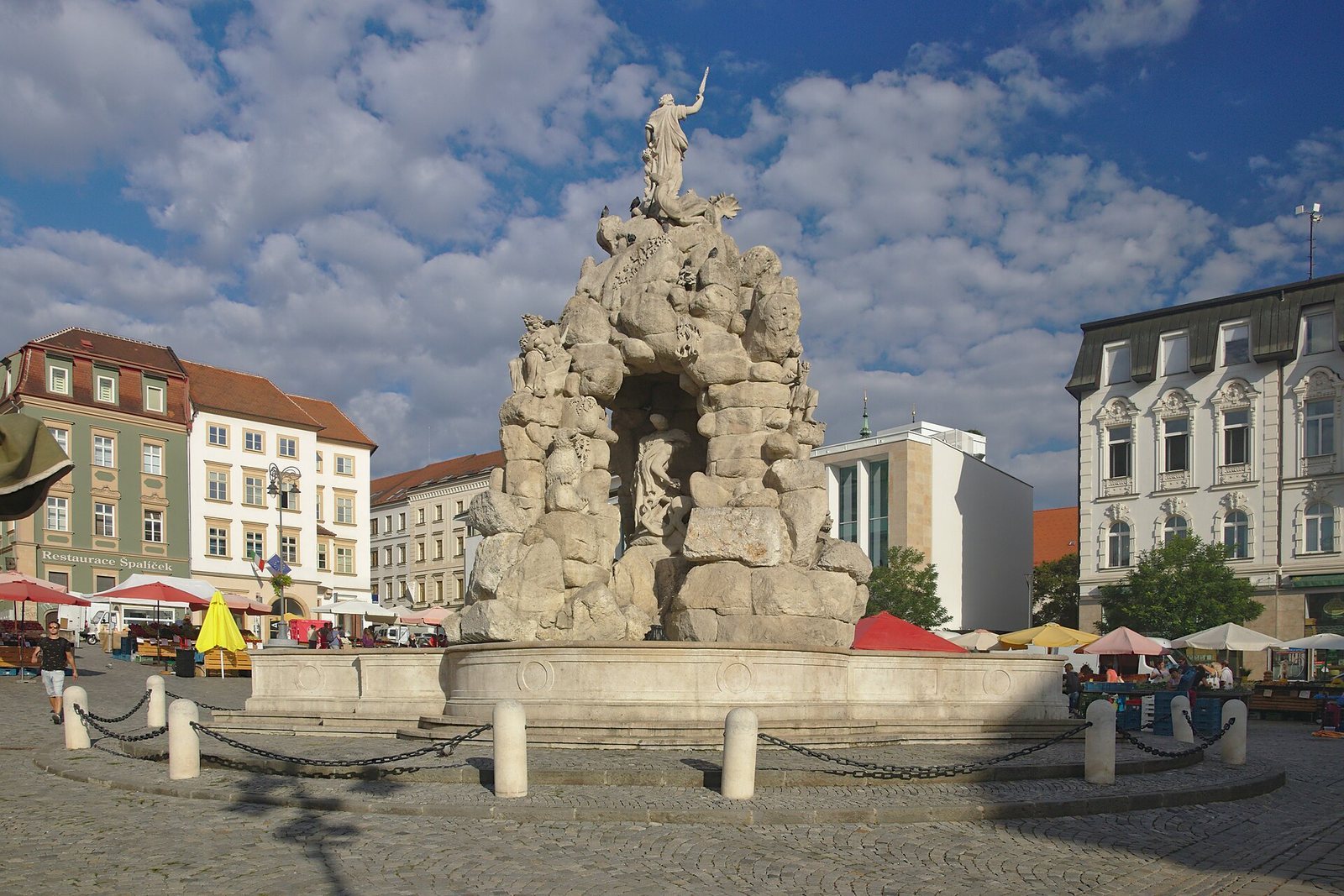
The fountain’s layout centers on a high rocky mass rising from a basin with a six-pointed-star plan. The centerpiece is assembled from large blocks of crinoidal limestone, a rock rich in fossilized marine animals, and contains a small cave open on three sides.
Sculptural ensemble
Central rock and summit
Inside the cave stands Heracles, the Greek hero known to the Romans as Hercules. He wears the skin of the Nemean lion, raises a club in his left hand, and holds Cerberus, the underworld’s guardian dog, on a chain in his right. At the summit, an artificial-stone figure of Europa stands over a defeated dragon, holding a scepter in her right hand. The allegory represents the Holy Roman Empire, a central European political entity that lasted until 1806. Two stone plaques below the summit carry Latin inscriptions with chronograms, inscriptions in which numeral-valued letters encode dates, recalling the fountain’s construction and a later renovation.
Allegories of ancient empires
Three seated female figures flank the rock and face toward Brno’s city hall. Each holds a scepter in her left hand and represents an ancient polity. On the northeast side, Greece leans against a quiver of arrows; a crown lies beside her left foot, with a winged dragon below it. Babylonia, on the northwest side, has a crown beside her right foot and a winged lion beneath it. On the southwest side, Persia holds a cornucopia, with a crown by her left foot and a bear emerging from the rock beneath her. Small plant forms, dragons, and animals decorate other parts of the centerpiece.
Basin, enclosure, and water system
Fifteen stone posts joined by chains encircle the fountain, leaving access from three sides. Three dolphin-shaped stone spouts were later replaced by cast-iron ones. The basin was probably entirely replaced in the late nineteenth century and was reconstructed in 2019 after it began to leak. The original Europa statue, restored after its removal from the fountain, is now housed at Brno-střed town hall.
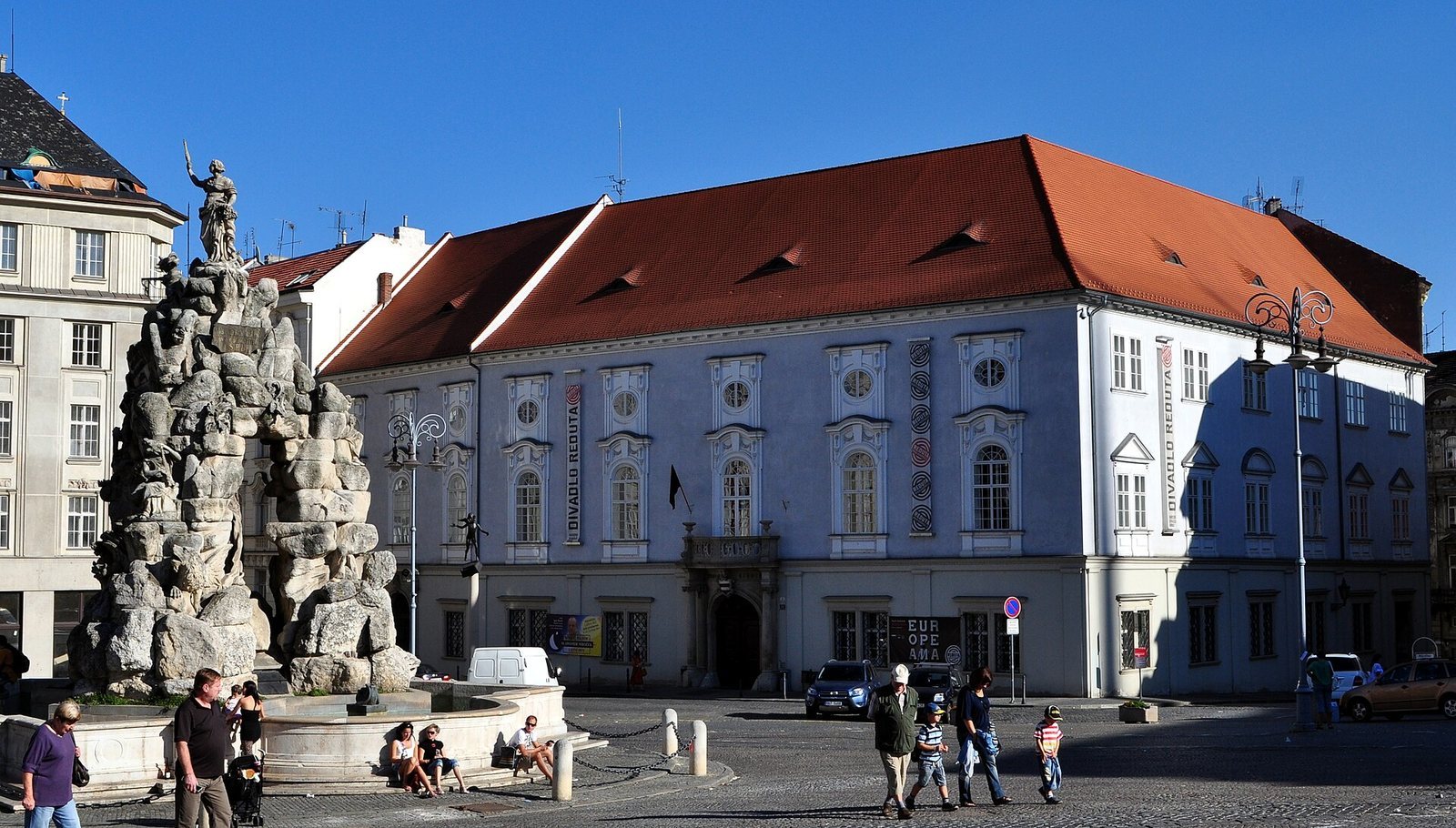
Two brick tunnels pass beneath the fountain, one to the west and one to the south; both were cleaned in 2002. The western tunnel brought water from a reservoir at Petrov, supplied by pumping from the Svratka River via the area of today’s Denis Gardens. Its route follows Starobrněnská and Peroutková streets, passes the Holy Trinity Column, and continues under the fountain. The southern tunnel carried wastewater toward the Reduta Theatre and connected to a sewer.
Time capsule
A time capsule was placed beneath the statue during its installation. It contains a plaque commemorating the fountain’s construction and another marking repairs in 1993–94, along with medals for Brno’s 750th anniversary of municipal rights in 1993 and the Moravian Museum’s 175th anniversary in 1992. Other contents include silver commemorative coins of 200 korunas from 1994 and 100 Czechoslovak korunas from 1992; medals honoring composer Leoš Janáček and bearing the names of Václav Havel and Tomáš Garrigue Masaryk, each dated 1990; and Czech banknotes dated 1993 in denominations from 20 to 1,000 korunas. Coins dated 1994 range from 1 to 50 korunas and include heller denominations of 10, 20, and 50. The capsule also holds an 8-koruna stamp issued for the Brno anniversary, attached to a postcard depicting timely assistance by Brno’s Capuchin monastery, and a wooden cross with a figure of Jesus Christ.