Morges Castle: A Savoyard Fortress and Military Museum
Site at a Glance
- Popularity
- Medium
- Country
- Switzerland
- Primary era
- Medieval
- Eras represented
- Medieval, Early Modern
- Civilizations
- Holy Roman Empire
- Site type
- Military
- Remains
- Castle
On this page15 sections
History
Foundation and Savoyard rule
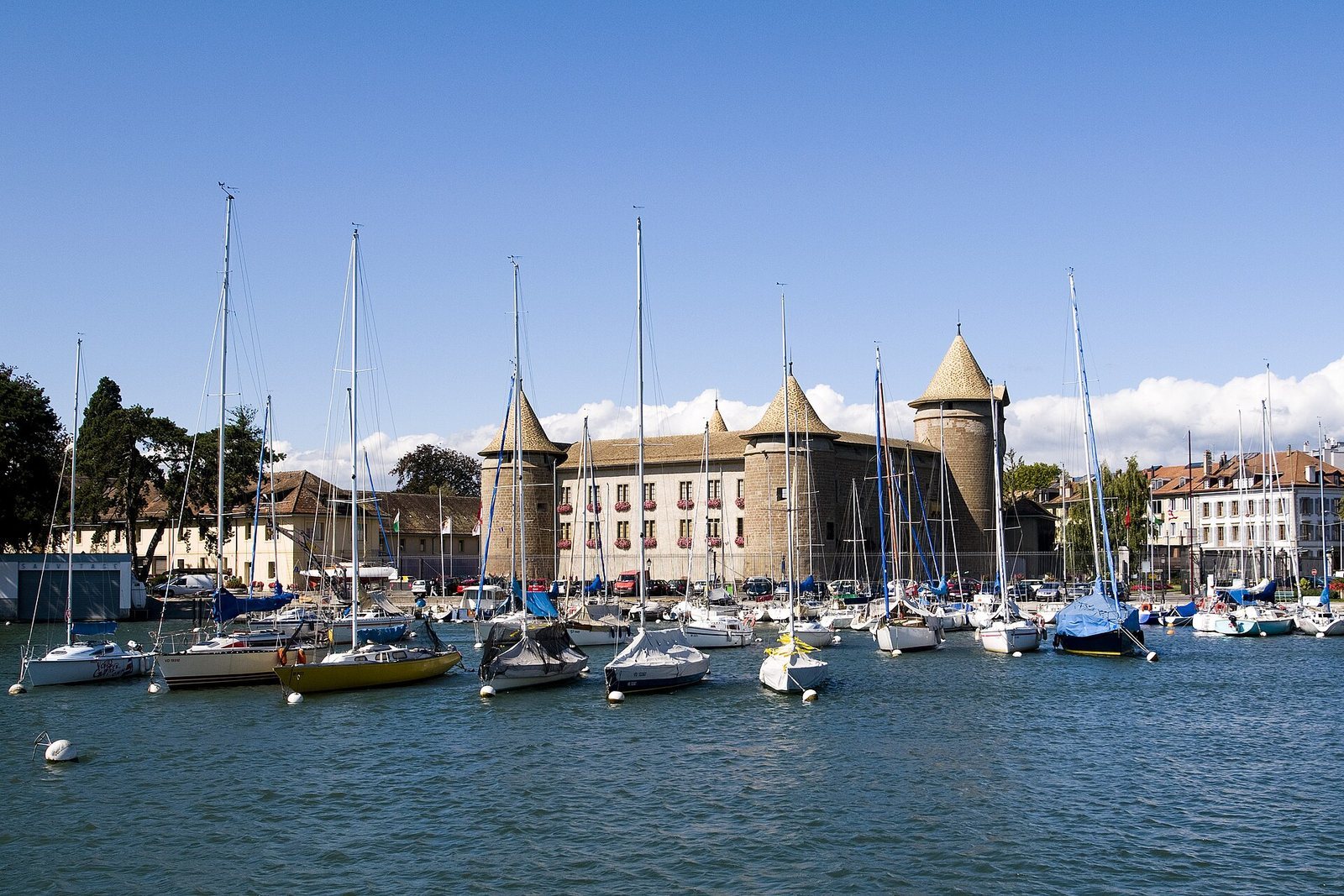
Morges Castle stands near the shore of Lake Geneva in Morges, Switzerland. The House of Savoy built it around 1286–1296 in the Savoyard square-castle tradition to defend a new town and its strategically important port. Louis of Savoy, whose dynasty ruled lands around the western Alps and Lake Geneva, founded Morges in 1286 at the mouth of the Morges River, on a pasture where a gallows had stood. The town developed as an administrative and market center, as well as a hub for moving goods by land and water.
The castle served as the center of a castellany, an administrative district associated with a castle. It suffered an accidental fire in 1391 and a deliberate fire in 1475. The town and castle were plundered in 1475 and again in 1530.
Bernese rule and military changes
During Bern’s conquest of Vaud in 1536, an Italian condottiere, a military commander leading troops for hire, defended the castle for the Duke of Savoy. The defenders abandoned it, and Bern took possession without a fight. The castle became the seat of a bailiwick, a district administered by a bailiff, and Morges became a bailiwick center in 1539. Because the town had not surrendered promptly, Bern ordered its gates demolished. Two gatehouses outlasted that order, one until 1769 and the other until 1803.
After finding the castle in poor condition, Bernese authorities commissioned artillery improvements between 1540 and 1550. The project was carried out by builders from Valsesia, a valley in northern Italy.
Arsenal, explosion, and museum
After Vaud gained independence in 1803, the castle became the cantonal arsenal and housed military administration. Major alterations in 1836–1839 removed the outer defensive wall and added a western depot. In 1871, the depot exploded while old cartridges were being handled there. The blast damaged the castle and killed 26 people, most of them French internees from the Bourbaki army, a French force in the Franco-Prussian War. French troops who crossed into Switzerland during the conflict were interned there.
The proposal for a Vaud military museum emerged in the late nineteenth century, and the castle became a museum in 1925. Its holdings grew through donations, acquisitions, and deposits. Today, the institution, known as Château de Morges et ses Musées, is a cantonal museum attached to Vaud’s civil and military security service. Its work includes documenting military history in Vaud and nearby areas, along with the ways of life, attitudes, and technical skills of past societies.
The castle was designated a historic monument in 1900. Both the building and its military-history collections are recognized as Swiss cultural property of national significance.
Remains
Castle plan and defenses
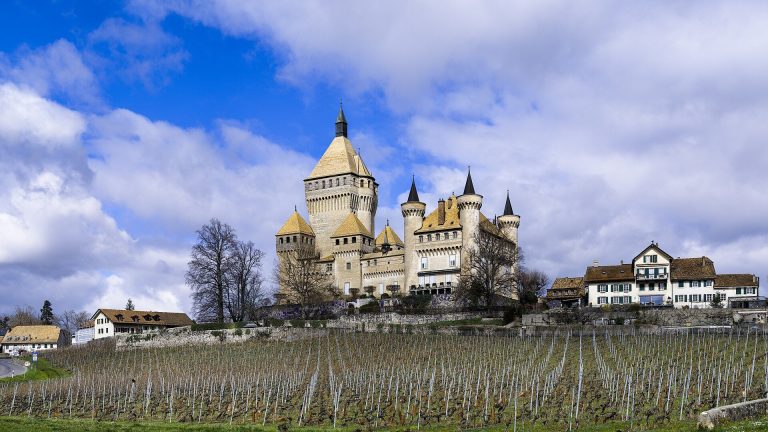
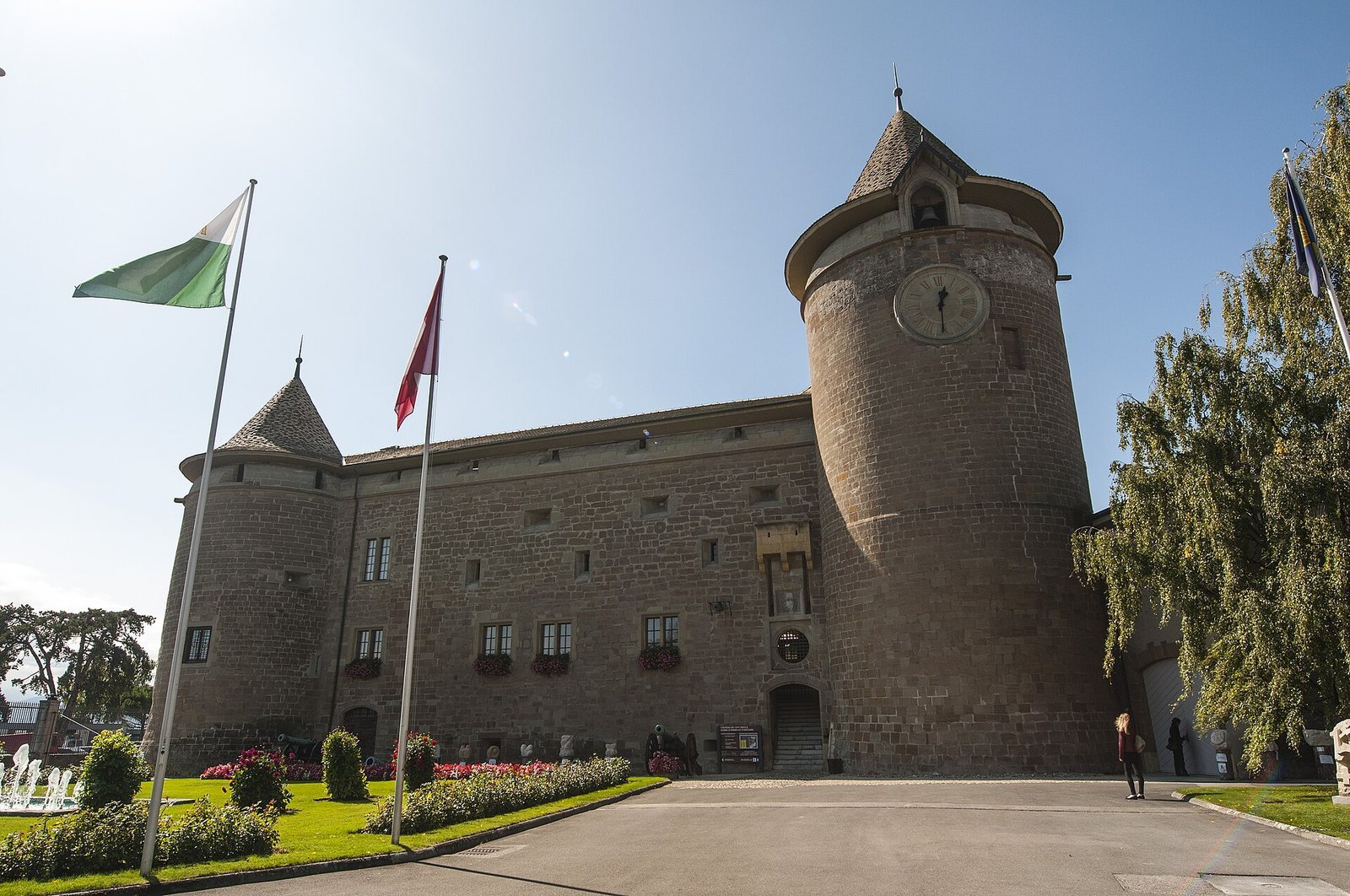
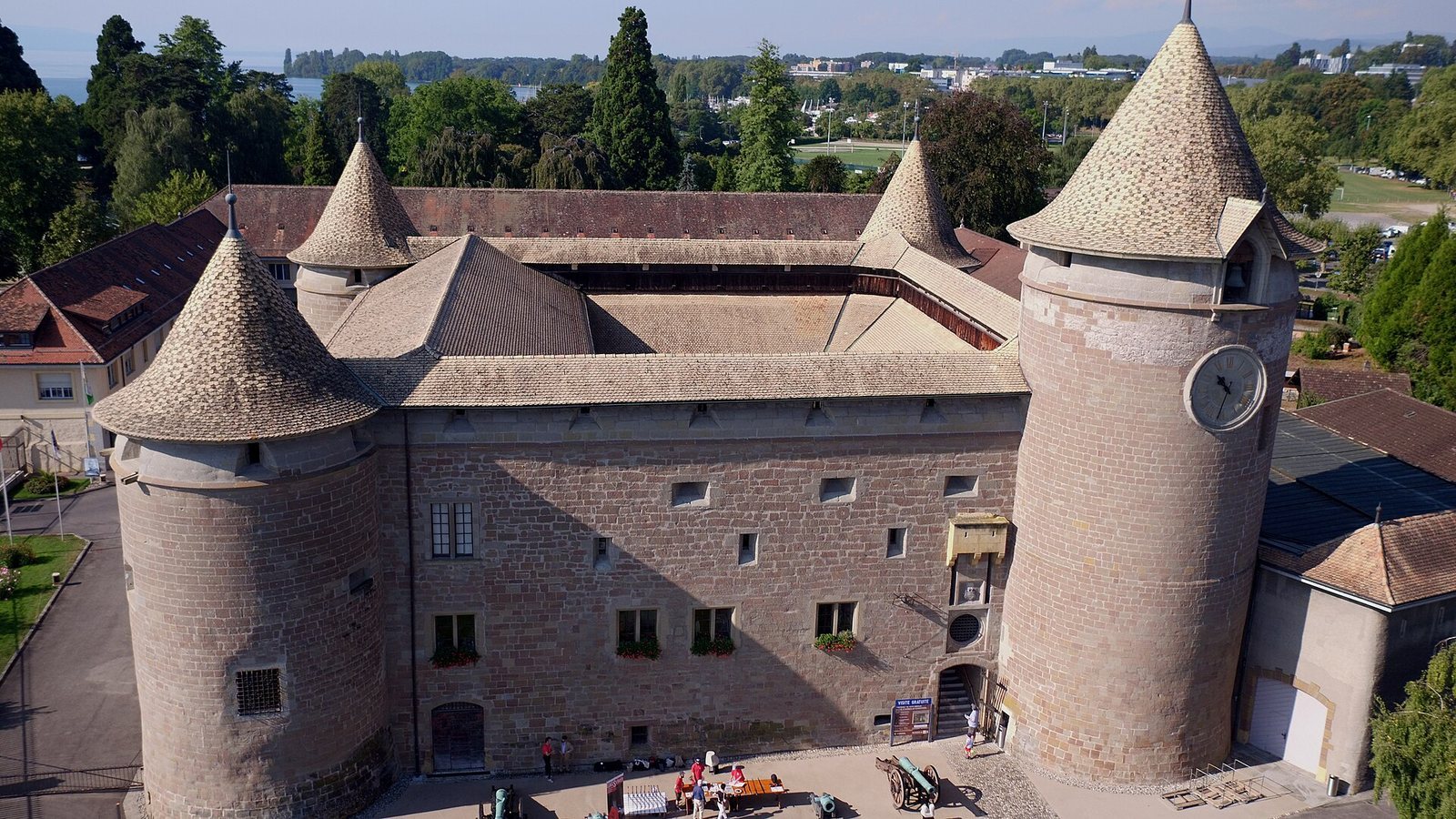
The castle lies south of Morges’ town square, close to Lake Geneva. Its square plan has four round corner towers. The larger main tower stood on the town-facing side, near the entrance. The building follows the Savoyard square-castle type, and its design closely resembles Yverdon Castle, which may have served as a model. Its defensive rooms also relate to examples in the Holy Land, including Krak des Chevaliers, a Crusader fortress, and to building traditions from Île-de-France, the region around Paris. Louis of Savoy may have known these models.
Courtyard and casemates
The raised courtyard contained casemates by 1340. These were protected, usually vaulted spaces built into fortifications.
Entrance and enclosing wall
An exterior staircase led to the entrance, which could be reached by drawbridge. A wall reinforced with towers enclosed the castle.
Fortified kitchen
A fortified kitchen stood outside the castle walls on the lake-facing side, a feature described as unique in Switzerland. It was rebuilt in 1363. After Bern conquered Vaud, its roof served first as a firing platform and later as an observation deck.
Artillery defenses
The artillery modernization substantially lowered the fortifications and rebuilt almost all of their upper half. The new parapets, protective walls along the defenses, had rounded, sloping faces intended to make incoming projectiles ricochet.
Collections and exhibitions
Arms and figures
The museum’s collections contain nearly 70,000 weapons, uniforms, headgear, equipment, and figurines, with a particular focus on Swiss and Vaud military history. The de Mestral family deposited an arms collection between 1947 and 1965. Its approximately 300 objects span almost five centuries of a noble Vaud family’s military history, and its principal pieces appear in a permanent display. Raoul Gérard’s collection of nearly 40,000 flat tin military figures has been at the castle since 1974; a permanent exhibition devoted to it opened in 1982.
Artillery displays
The Artillery Museum occupies underground levels of the castle and presents around 40 artillery pieces, miniature models, and technical plates. The castle once held part of the artillery collections of the Swiss national museums, later managed by the Federal Artillery Office; some of those objects remain in the collection and are displayed here. The exhibits trace Swiss artillery from the Burgundian Wars, late-fifteenth-century conflicts involving the Duchy of Burgundy and the Swiss Confederacy, to the present.
Other permanent displays
Exhibitions include miniature reconstructions of notable battles and objects relating to Swiss soldiers’ service in foreign armies. Vaud’s military history is represented by the sword used to execute Major Davel, a Vaudois officer executed after opposing Bernese rule, and a uniform worn by Henri Guisan, Switzerland’s commander-in-chief during the Second World War. The Vaud Gendarmerie, the canton’s police force, is represented by objects and uniforms maintained by its historical association, founded in 2002. A selection has been on permanent display since 2006.
The Paderewski collection consists mostly of original objects and documents relating to Ignace Paderewski, a Polish pianist, composer, and statesman. The Paderewski Society of Morges began assembling it in 1977, and the collection passed to the Paderewski Foundation in 2014. A selection is displayed at the castle.
Documents and library
The museum holds documentary collections of national importance covering military history, war, uniforms, weapons, and their use. Its library contains about 15,000 documents, including the former Morges arsenal library, collections from the former Swiss Institute of Antique Arms, and the library of the Center for Military History and Foresight.