Khornabuji Castle: A Medieval Fortress and Castle-Town in Georgia
Site at a Glance
- Country
- Georgia
- Primary era
- Medieval
- Eras represented
- Classical, Medieval
- Civilizations
- Georgian
- Site type
- Military
- Remains
- Castle
On this page15 sections
History
Khornabuji Castle is a medieval fortress and former castle-town near Dedoplistsqaro, Georgia. The fortress was probably first constructed near the end of the first millennium BCE, in a position controlling the Iori and Alazani valleys. Khornabuji became the center of Kambechovani, a province of Kartli, the historic Georgian kingdom. Its name has been interpreted as sun mountain or support of the sun; other explanations connect it with a sun idol or an ancient Georgian tribe. It is also popularly called the Fortress of Tamar, though a thirteenth-century rebuilding attributed to Queen Tamar may concern another site.
Early fortress and Kartli
The earliest surviving written references to Khornabuji date to the fifth century CE, during the reign of Vakhtang I, king of Kartli. After building Svetitskhoveli Cathedral at Mtskheta, Vakhtang established an episcopal see at Khornabuji, the seat and jurisdiction of a bishop, and appointed a bishop there. He also granted Khornabuji, Cheremi, and Nekresi to his son Dachi I Ujarmeli as an appanage, territory assigned to a member of the ruling family.
Persian attacks badly damaged the town during the fifth century. The Sasanians, a Persian dynasty, conquered Khornabuji in the late fifth or early sixth century. The surrounding town appears to have been destroyed, although part of the fortress survived. A settlement later re-emerged on the plain south of the castle rock.
Persian and regional rule
After Kartli’s monarchy was abolished in the first half of the sixth century, Khornabuji became the residence of a Persian official. The area later broke free of Persian rule. In the 570s, brothers of Guaram Bagratuni killed the Persian commander and seized Kambechovani. They ruled the province and made Khornabuji their residence.
Arab power dominated Khornabuji from the second half of the seventh century. From the latter half of the eighth century, it served as a center of a district in the principality, and later kingdom, of Hereti. After Kakheti, Kukheti, and Hereti united in the early tenth century, Khornabuji became the center of a district in the kingdom of Kakheti. Its regional governors were known as Khornabujelis.
Medieval government and conflict
In the 1040s, Bagrat IV campaigned against Kakheti and captured Khornabuji’s governor along with other regional governors. In 1068, a Seljuk sultan, from a Turkic dynasty expanding across parts of Asia, transferred Khornabuji and other Georgian territories to the emir of Ganja. The emir raided local people. Bagrat IV defeated and pursued him; after the emir was captured, he was taken to the Kakhetian king, who moved him to Khornabuji.
During the twelfth century, Khornabuji became the center of a frontier district and the residence of a local feudal family. In 1193 its governor and his three sons defeated Giorgi the Rus, a Russian prince who contested the Georgian throne, after he raided the Kambechovani plain with a Persian atabeg, a high-ranking political official. Khornabuji’s defenders pursued the raiders, recovered captives and booty, and killed many of their men. Giorgi escaped with two servants.
Under King David Ulu, Khornabuji’s governors again administered Kambechovani. In the 1240s or 1250s, one governor was sent to bring the rebellious Kakhetian ruler Torgva Pankeli to the king. He swore an oath of safe conduct before Saint George, a Christian saint venerated in Eastern Orthodox traditions, at Alaverdi, but broke it and delivered Torgva to the king, who had him thrown from a cliff. The governor later died with two sons in an event associated with retribution by Saint George.
Thirteenth-century destruction and decline
Khwarazmians, people from the Central Asian region of Khwarazm, ravaged Khornabuji during the thirteenth century. Around 1264–65, a Mongol army led by Berke Khan, a thirteenth-century Mongol ruler, raided the area. Kambechovani became desolate, and Khornabuji ceased to function as a city. By the late fifteenth century, Kambechovani was known as Kiziki. The surrounding settlement may have declined after the Mongol raid or during Shah Abbas I’s invasion in the seventeenth century.
Early modern use and archaeological work
In the early seventeenth century, the Kakhetian king imprisoned his conspiratorial brother at Torgi Castle. Of the eighteen conspirators, some were beheaded and others thrown from Khornabuji. During the first quarter of the century, the fortress served as the residence of Peikar Khan, whom Shah Abbas I had appointed to govern part of Kakheti. Giorgi Saakadze freed it from Persian control in spring 1625. Teimuraz I later held leaders of the rival Javakhishvili family there. This continued use indicates that the fortress had been rebuilt repeatedly after its thirteenth-century destruction. It was rebuilt again under Heraclius II of Kartli-Kakheti, while the surrounding township remained in ruins.
Excavations at Khornabuji took place in 1970 under R. Ramishvili, as part of investigations in the area during the 1970s. The excavated material is held at the Gurjaani historical-ethnographic repository of the Georgian National Museum.
Remains
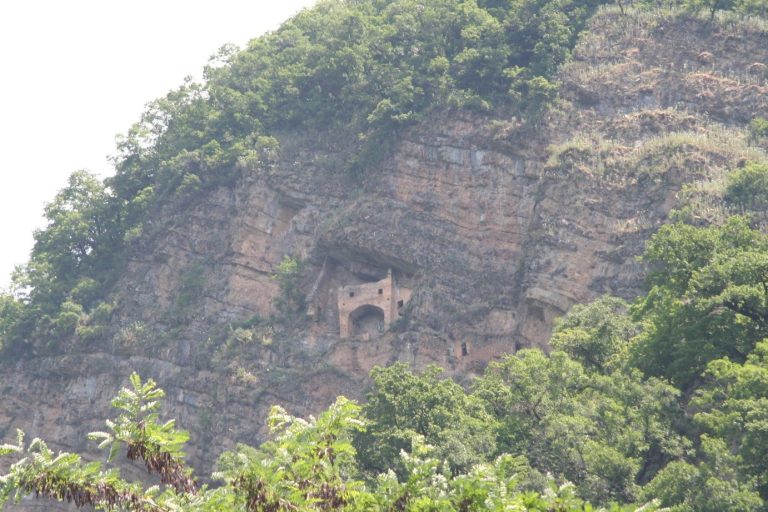
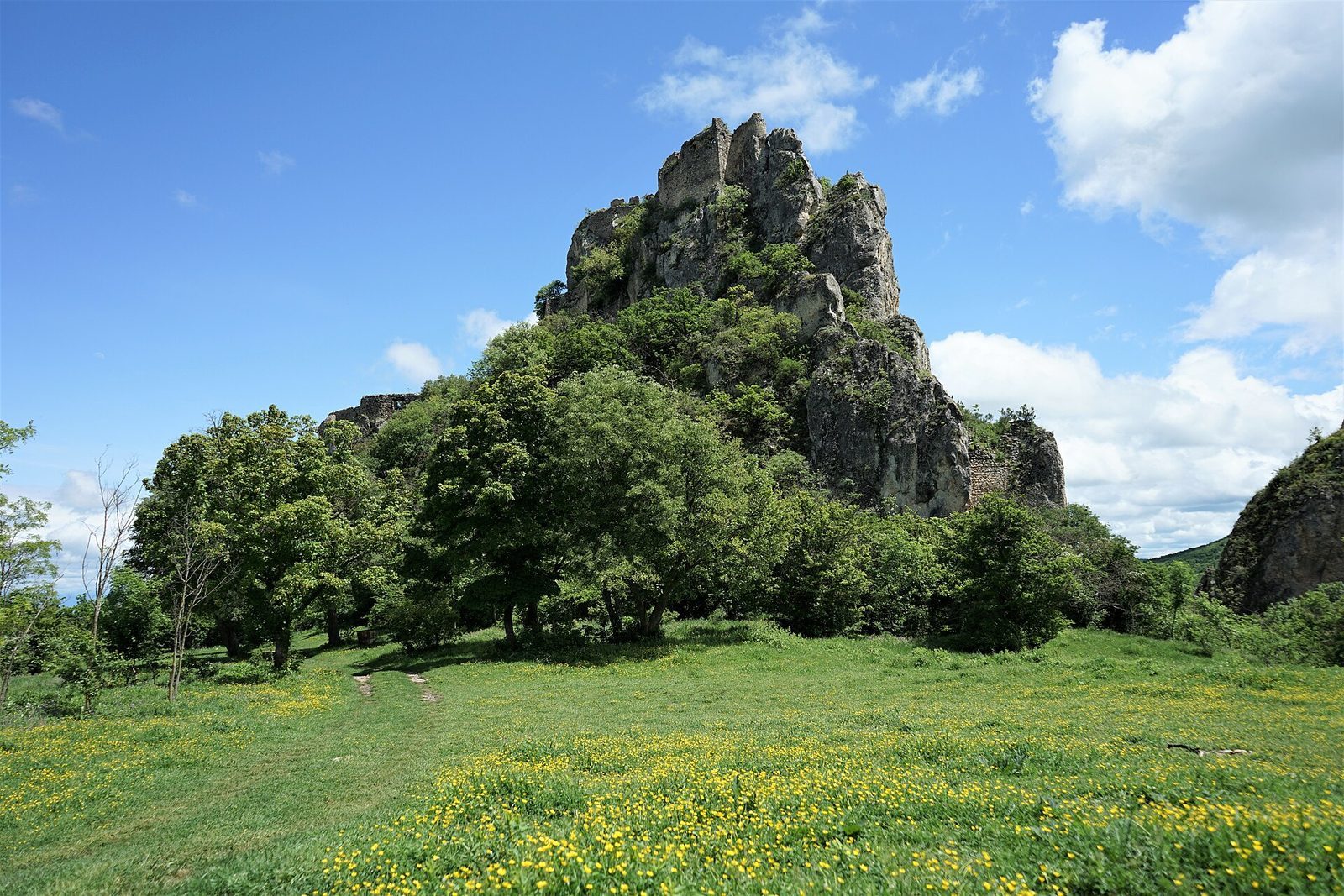
The ruined complex occupies a rocky summit of the Tsiv-Gombori Range, about two to three kilometres north of Dedoplistsqaro. The medieval settlement lay on flatter ground below it. Stone defenses occupy a cleft along a road rising from the Alazani plain, with the main fortress and citadel on one side and remains of smaller defensive buildings on the other.
Fortress layout and defenses
Road cleft and cliff walls
The road passes beneath the fortress through a rocky cleft, partly cut by human effort. Walls were built along the high cliffs on both sides, reinforcing this passage through the mountain. The arrangement linked the approach from the Alazani plain with the fortress defenses above.
Lower fortress
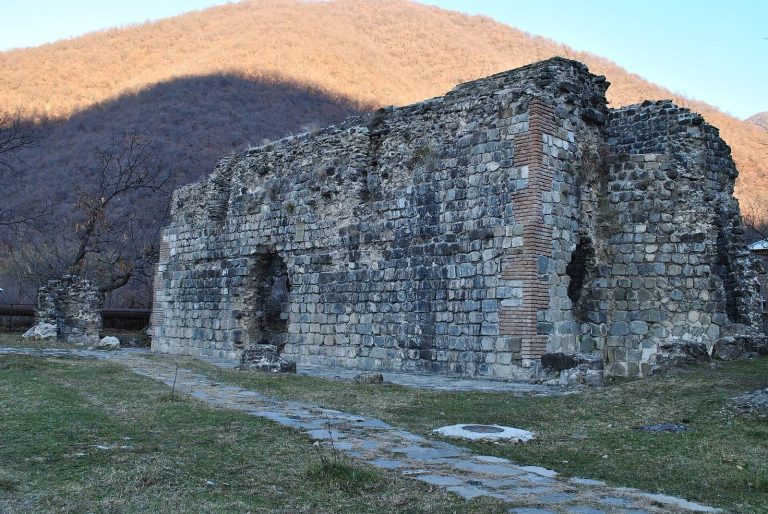
North of the main fortress, a lower enclosure occupies a terrace between two large rock masses. Two parallel walls extend from the rocky base of the main stronghold and enclose a small area identified as a refuge. Their well-preserved stonework is laid in level courses and is thought to date to the time of Vakhtang I. The main entrance stood on this side and was defended by a square tower. At the northern end, a high rock closes the space between the walls; remains of a watchtower on its summit overlook the Alazani valley.
Inner fortress
The inner fortress occupies a rocky mass and contains numerous rooms connected by narrow, steep stairways. Two water cisterns were found in its middle and upper sections. In the lower courtyard, excavators uncovered a medieval gateway and wall that were later adapted for firearms, with narrow openings for weapons and platforms for marksmen.
Citadel and water storage
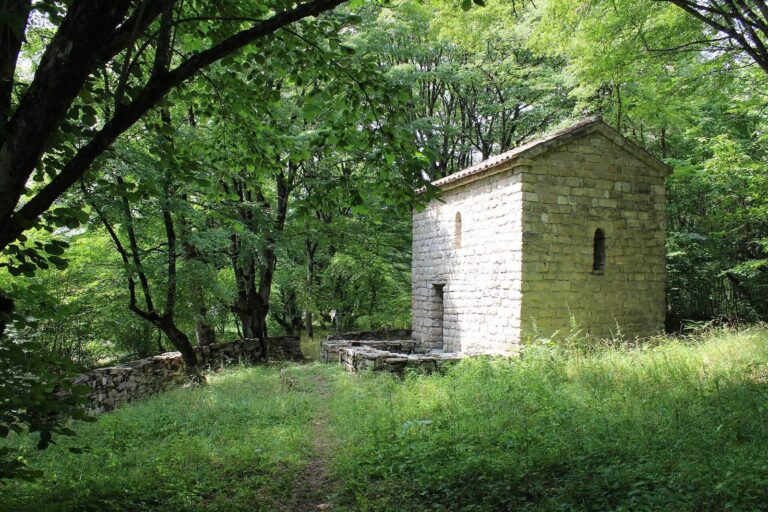
The heavily ruined citadel contains remains of several structures, including an underground cistern with plastered walls. The cistern’s masonry is later than the earliest written reference to Kambechovani; the masonry of a gate church is probably later as well. The chronicler Iskander Munshi counted 560 steps from the gate threshold to the defenders and described the fortress’s rainwater storage.
Settlement and archaeological finds
Town and burial areas
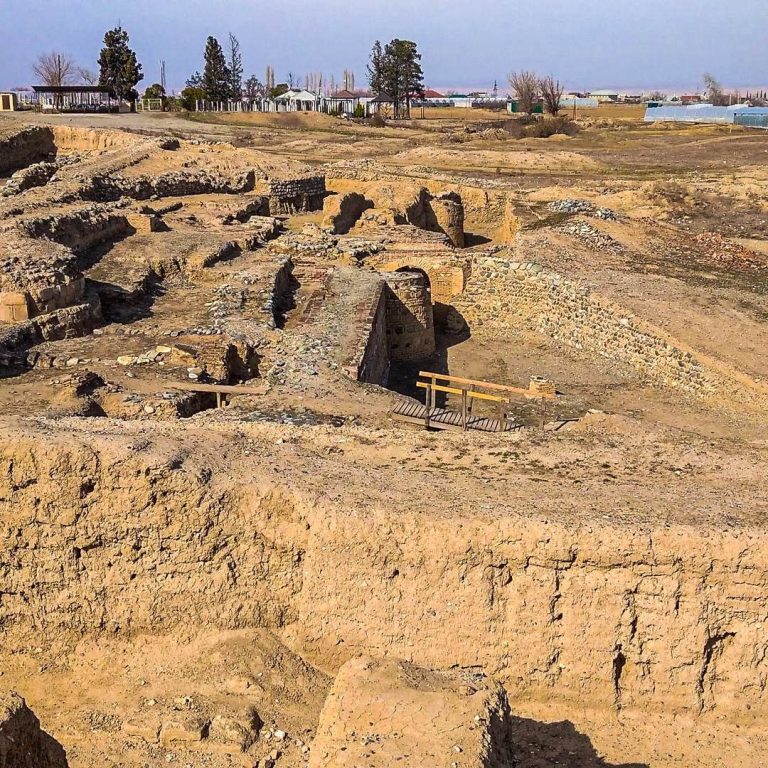
West of the inner fortress, excavations in the old-town area uncovered a group of underground tombs. Investigations in the surrounding area also identified pre-Christian settlements and a cemetery west of the castle-town, cemeteries dating to antiquity, and Bronze Age material at limestone quarries.
Objects from the fortress and town
Finds from the fortress and settlement include fragments of glazed and unglazed pottery, faience, a glazed ceramic, large storage jars, roof tiles, lamps, iron arrowheads from earlier and later medieval phases, stone projectiles, and coins. These objects are associated with Khornabuji’s most intensive period of occupation.