Eskelhem Church: A Medieval Parish Church on Gotland
Site at a Glance
- Country
- Sweden
- Primary era
- Medieval
- Eras represented
- Medieval, Early Modern, Modern
- Civilizations
- Swedish
- Site type
- Religious
- Remains
- Church
On this page17 sections
History
Early church and Romanesque building
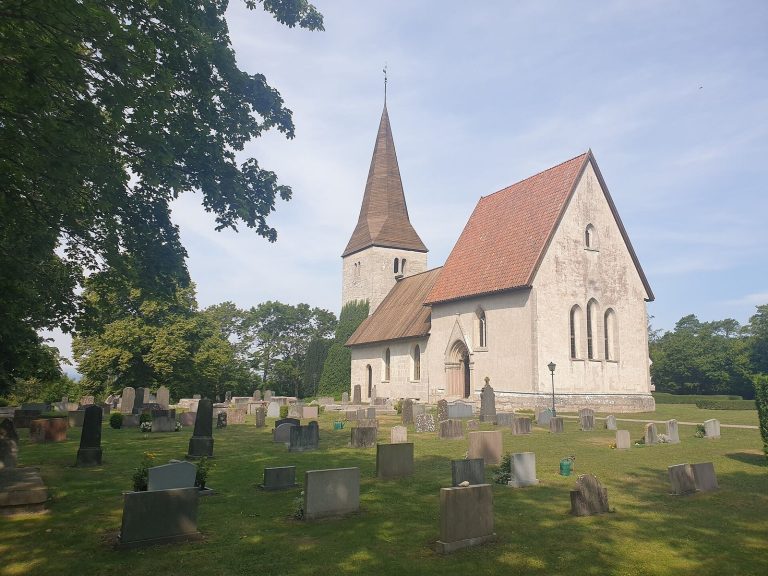
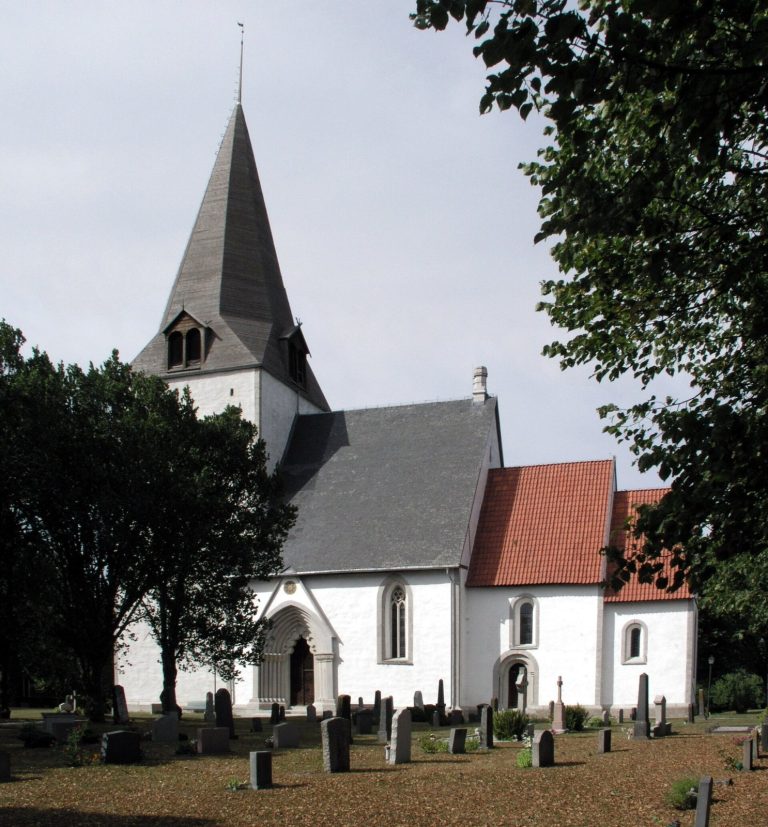
Eskelhem Church is a medieval parish church in Eskelhem on Gotland, Sweden. Its stone construction began around 1200 in the Romanesque style, a medieval tradition associated with rounded arches and heavy masonry. It serves Eskelhem-Tofta Parish, a local congregation in the Diocese of Visby, a regional church district, and is dedicated to Saint Michael, the archangel. The Church of Sweden, to which it belongs, is Lutheran.
A wooden church or chapel stood at the site before the stone building. Its foundations are thought to date from the 11th century, suggesting that Eskelhem may have been a place of Christian worship during Gotland’s early Christian period. The stone church was consecrated around the time construction began, and parts of this first Romanesque building were incorporated into the church that survives.
Medieval enlargement
In the mid-13th century, builders altered the nave, the main area for the congregation, and added a tower. Around 1240 they removed the nave’s western wall to join the tower to the church. The work on these parts is attributed to Master Botvid, a local skilled builder.
During the mid-14th century, the Gothic choir, the area around the altar, and the sacristy, a room for liturgical objects and service preparation, were built. This work gave the church its present form. The choir is larger than the nave, a difference that has prompted the suggestion that a more extensive church may once have been planned. Gothic is a medieval style commonly associated with pointed arches and ribbed vaults.
Restoration and the name Eskelhem
A thorough restoration in 1960 brought the foundations of the earlier wooden church to light. The building was conserved again in 1993.
The name Eskelhem appears in a medieval runic inscription in the form yskilaim. Its second element means “farm” or “dwelling place.”
Remains
Building and painted decoration
Plan and construction
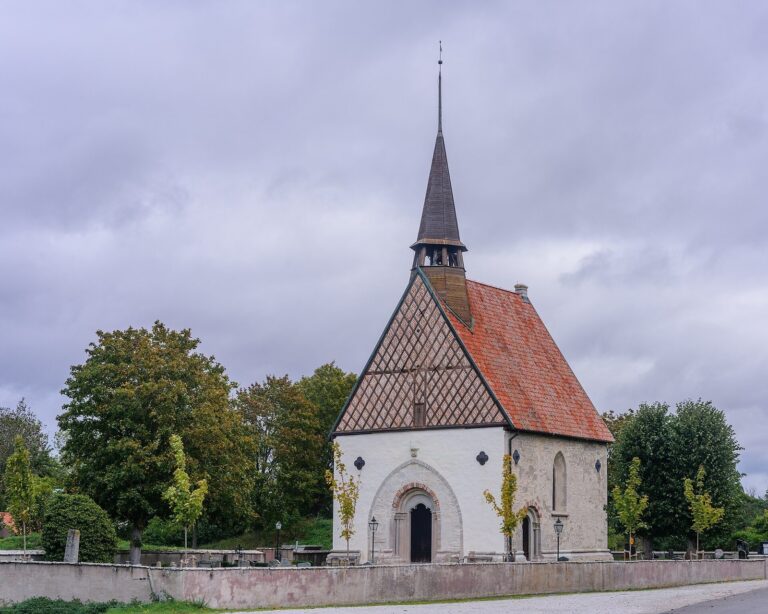
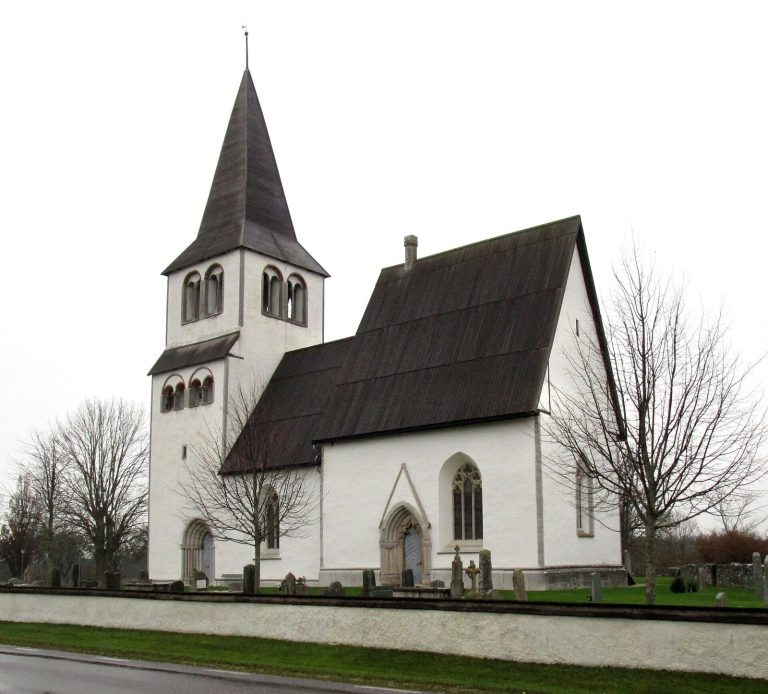
The stone church has a small, elongated nave, a tower, a larger choir, and a sacristy. This arrangement is known as a split-saddle form, with a high, large choir beside a smaller nave and tower. Much of the nave retains the character of the Romanesque building, while the choir and sacristy are Gothic. The tower resembles the one at St. Nicholas Church in Visby. Foundations of the wooden predecessor lie beneath the nave floor.
Vault paintings
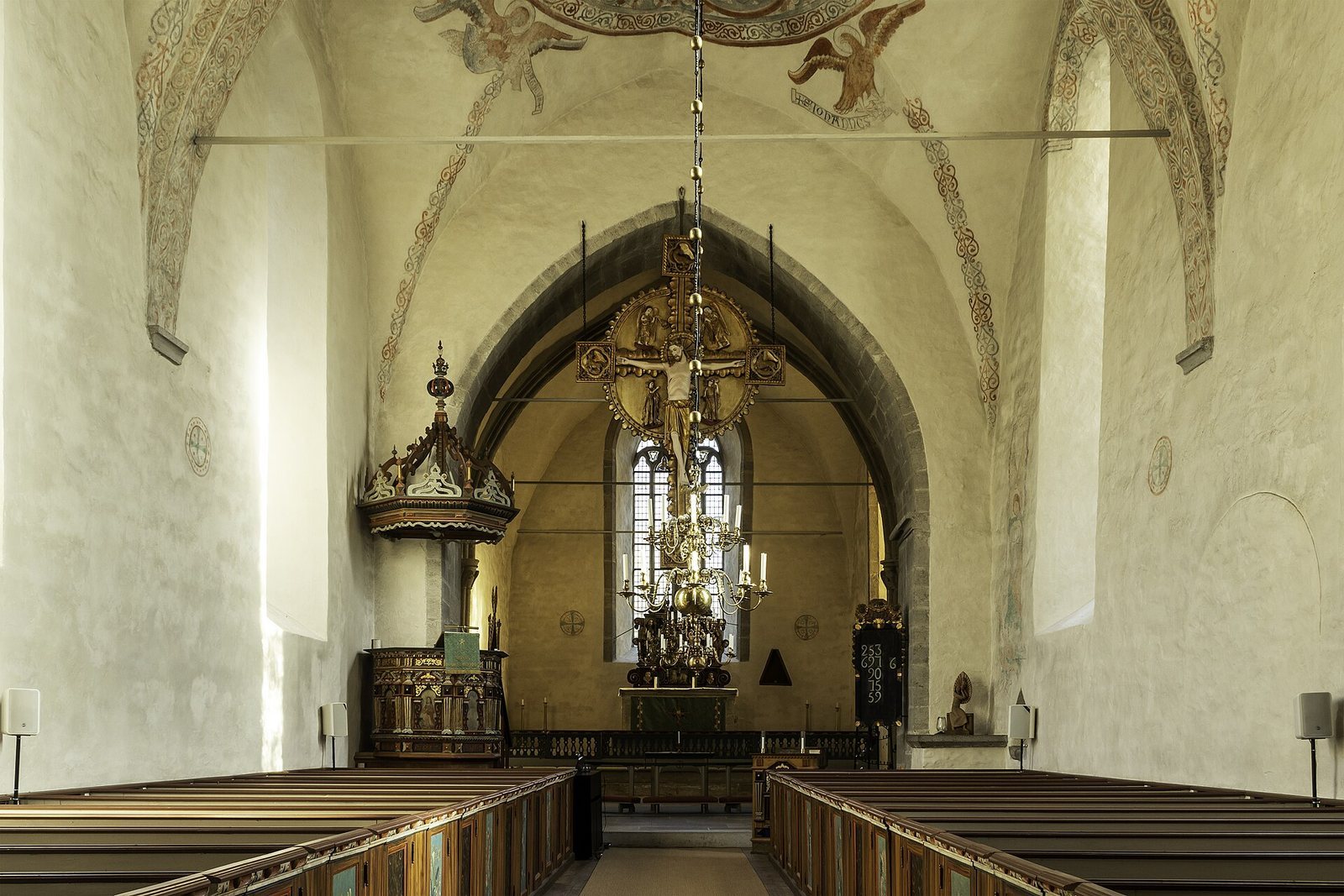
Paintings in the nave vault date from the second half of the 13th century. The choir vault has two large paintings from the late 13th century, attributed to the Master of Michael, a conventional art-historical name for an unidentified painter. Its eastern roundel, or circular painted panel, depicts Paradise and is surrounded by smaller plant-decorated panels and symbols of the Gospel writers. The western roundel shows Christ, the Virgin Mary, and the apostles Peter and Paul.
Arches and tower painting
The eastern arch features Christ as a falcon, John the Baptist as an eagle, Luke as an ox, and Mark as a lion. Saint Michael and Saint Olaf appear on the western arch; Saint Olaf was Olaf II of Norway, a medieval king venerated as a Christian saint. A large painting on the tower’s north wall represents the universe with seven zodiac circles and a tower on which Christ is enthroned.
Later wall paintings and statue
Fragments of 15th-century wall paintings survive in several parts of the church. They are attributed to the Master of the Passion of Christ, another conventional name for an unidentified painter. A badly damaged painting on the north wall of the tower room has been identified as a calendar of the year’s feast days. Near a statue of the Virgin Mary, a wall painting probably dating from the 18th century depicts the Archangel Michael. Bertil Nyström made the statue in 1972.
Furnishings and memorials
Baptismal font
The carved sandstone baptismal font is dated to 1196 and is probably associated with Byzantios, a conventional name for a medieval stone-carving artist, or his workshop. Its carved scenes include the crucified Jesus with the Virgin Mary and John, as well as a lion raising its head and biting a four-footed animal.
Cross and medieval benches
The triumphal cross, a large cross traditionally placed between the nave and choir, dates to around 1250 and is attributed to the Master of Tingstäde, a conventional artist’s designation. A bench in the choir dates from the mid-13th century. A bridal bench, traditionally associated with the wedding rite, dates to the latter half of that century.
Altar and canopy
The stone altar is oval. Its sandstone altarpiece, dated 1722, depicts the Last Supper and bears at its top the monogram of Charles XII, king of Sweden from 1697 to 1718. A ciborium, an architectural canopy over an altar, dates to 1726.
Pulpit and pews
The pulpit dates to the late 17th century. Its panels show Christ, Moses, and the apostle John. The doors of the pews were painted in the 18th century.
Bell and organs
G.S. Meyer cast the church bell in Stockholm in 1775. The church acquired an organ in 1869, built by Olof Niclas Lindqvist of Visby and equipped with 11 stops, which select sets of pipes. A second organ, built by Åkerman & Lund Orgelbyggeri of Stockholm in 1932, uses pneumatic action, in which air pressure transmits the movement of the keys to the pipes.
Memorials
An epitaph on the left side of the choir commemorates Catharina Westphal (1700–1765), the wife of Eskelhem pastor Johan Bahr. In the adjoining cemetery, a gravestone for Halvid bears the death year 1338.