Chaotian Palace: A Historic Daoist and Confucian Complex in China
Site at a Glance
- Country
- China
- Primary era
- Modern
- Eras represented
- Medieval, Modern
- Civilizations
- Chinese, Ming, Qing
- Site type
- Religious
- Remains
- Temple
On this page15 sections
History
Chaotian Palace is a historic complex in China that has served as a Daoist center, a Confucian educational precinct, and a museum. Its name means paying homage to heaven. The complex took its Ming form in a rebuilding begun by the Hongwu Emperor in 1384 and completed in 1395, and its architecture follows Ming-Qing palace style. In the Ming period, it also served as a center for national Daoist administration and court ceremonies.
Early and medieval history
Ye Mountain was used for metalworking in the ancient state of Wu. A settlement called Ye City is described as an early name for Nanjing. Tradition credits Fuchai, a king of Wu, with founding the settlement during the Spring and Autumn period, an era of competing states in early Chinese history. The historicity of that foundation story is disputed.
The site’s institutional history includes a temple built during the Jin dynasty and, in 470 under the Liu Song dynasty, the Zongmingguan Imperial Academy, a state institution of higher learning. A Daoist temple occupied the site during the Tang dynasty. In the Five Dynasties period, a palace called Ziji Palace stood there; later institutions in the Song and Yuan periods bore successive names, including Xiangfu Palace, Tianqing Temple, Xuanmiao Temple, and Yongshou Palace.
The Ming palace and its functions
The rebuilt complex was also known as Mingtian Palace. The Hongwu Emperor, the first Ming emperor, named it Chaotian Palace and established a Daoist Registry there, an administrative office for Daoist institutions. Reconstruction was completed in 1395. The complex served religious purposes and handled national Daoist administration, while also supporting state and court activities.
Its other functions included veneration of royal ancestors, rehearsal of court ceremonies, and instruction for civil and military officials in the etiquette of appearing before the ruler. A traditional ceremonial performance at the site follows Ming court protocol in six scenes and eleven steps, including a ruler’s arrival, the presentation of a memorial, the delivery of an edict, an audience, music and dance celebrating peace, and a return to the palace.
Qing repairs and rebuilding
The principal Daoist buildings remained largely unchanged from the early Qing period through the Daoguang era. During the Kangxi Emperor’s southern tour in 1691, the Empress Dowager provided 1,000 taels for repairs. When the Qianlong Emperor visited in 1756, senior officials organized rebuilding, and further imperial funds supported renovation in 1764.
The Taiping Rebellion, a major nineteenth-century conflict against the Qing dynasty, devastated the complex. Only several dozen buildings, including gates, halls, Feiyun Pavilion, and the Water Palace, survived. The Taiping regime used the remaining structures to make and store gunpowder.
After the Qing-aligned Xiang Army captured Nanjing in 1864, the Jiangning Prefectural School, a government-run local school, and a Confucian Temple moved to the site in 1865, replacing its principal Daoist function. The main rebuilding was completed in 1866, and the larger reconstruction was formally finished in July 1869.
Later institutions and museum use
Daoist activity continued on the rear of Ye Mountain. By the late Qing period, a subordinate sanctuary called Yeshan Daoyuan was associated with Chaotian Palace. During the tenure of Xu Wuchan, the official responsible for sacrifices at the school, buildings belonging to the sanctuary were encroached upon. In the Republican period, its land was progressively sold, seized, or occupied, and the area became a poor district.
During the Republic of China, the site housed the Examination Yuan, a branch of government responsible for civil-service examinations, the Capital High Court, the Ministry of Education, and a Nanjing branch of the Palace Museum. In 1936, the National Beiping Palace Museum established a branch and storage facility on the former school grounds for objects relocated south from the Forbidden City. The work included demolishing Zunjing Pavilion and Gu Tinglin Shrine.
From the 1960s, the storage facility was assigned to the Nanjing Museum to manage the relocated collections. In 1965, tiled houses replaced 2,175 square meters of thatched huts in the Yeshan Daoyuan area. Chaotian Palace now houses the Nanjing Municipal Museum and was designated a National Key Cultural Relics Protection Unit in 2013, a national-level heritage protection status. A local legend claims that the Ming founding emperor was buried beneath Chaotian Palace rather than at the Ming Xiaoling Mausoleum.
Remains
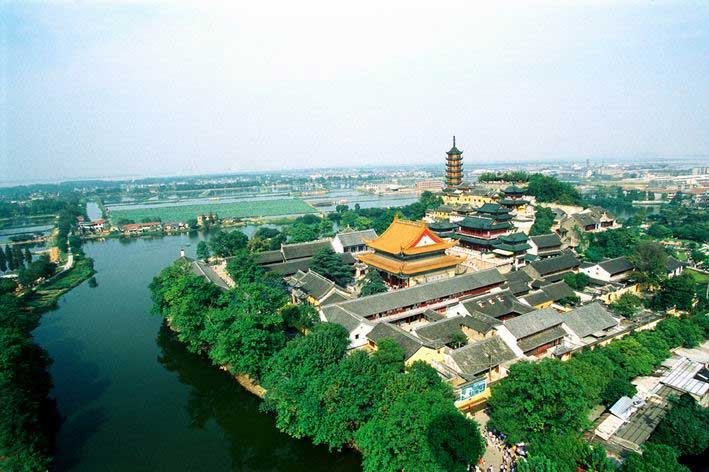
The grounds cover about 70,000 square meters and are arranged in central, eastern, and western sections. The central section contains the Confucian Temple and historic mountain pavilions; the eastern section is associated with the former Jiangning Prefectural School and a storage facility; and the western section includes the former Bian Kun Shrine and the site of his tomb. The complex is regarded as Jiangnan’s largest surviving traditional Chinese architectural group and the region’s largest and best-preserved group of Ming-Qing official-style buildings.
Confucian Temple and school precinct
Temple and ceremonial grounds
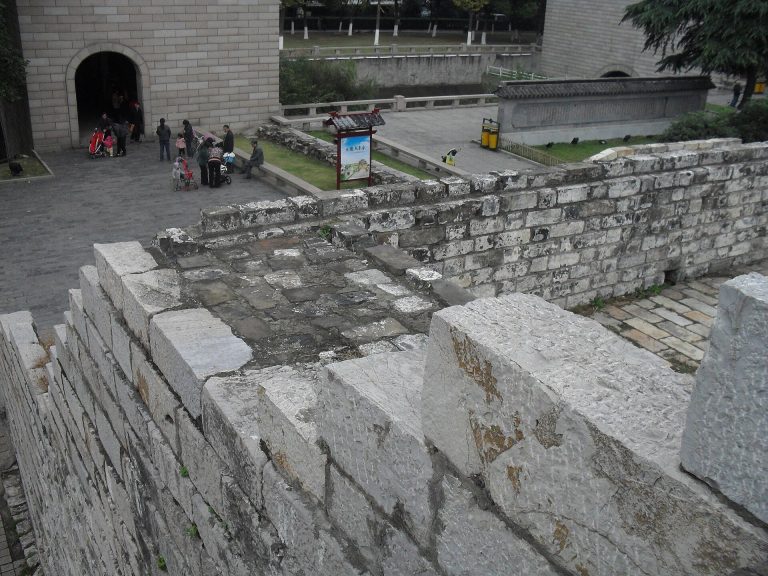
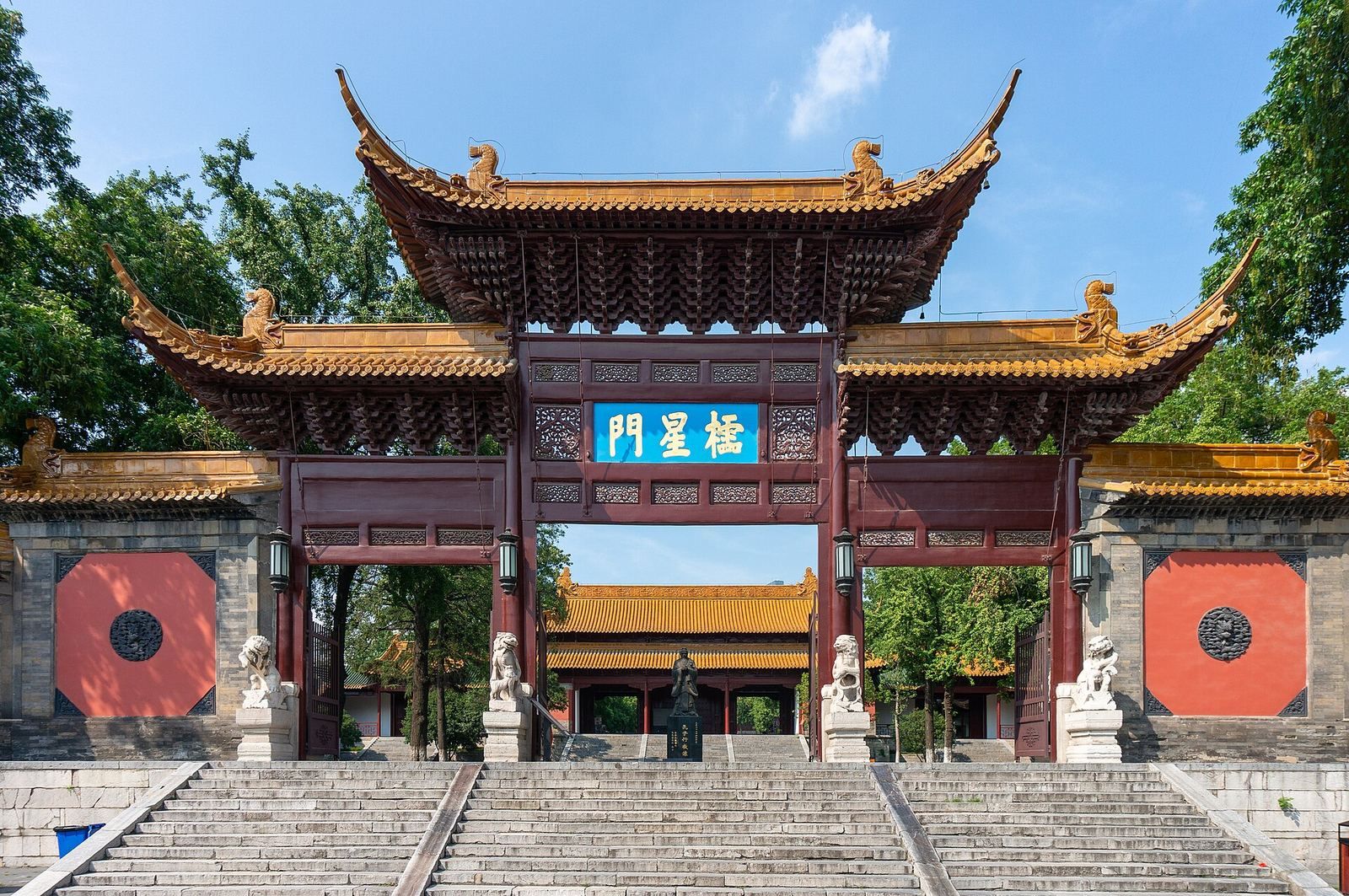
The Confucian precinct is arranged around its principal halls and ceremonial grounds. South of the temple stands the Ten Thousand Ren Wall, an honorific name alluding to the wall’s imposing height, not a literal measurement. A Panchi, a ceremonial pond associated with Confucian schools and temples, lies within the wall, with brick memorial arches to its east and west. Lingxing Gate marks the front of the complex. Wenli Zhai and Sishen Ku stand to its east, while Wuguan Zhai and Siya Ting are to its west.
North of Lingxing Gate, the sequence continues through Dacheng Gate, Dacheng Hall, Chongsheng Hall, and Jingyi Pavilion. Dacheng Hall has twelve pavilions and corridors on each side. These buildings form the central architectural sequence of the Confucian precinct.
School buildings and reconstruction
The Jiangning Prefectural School occupied the area east of the Confucian Temple. Under Zeng Guofan’s direction, rebuilding between 1865 and 1869 included Dacheng Hall, Lingxing Gate, Halberd Gate, side galleries, storehouses, and an official hall. The timber came from overseas, while glazed tiles were supplied from Jingdezhen in Jiangxi.
Additions in 1867 included Chongsheng Hall, Zunjing Pavilion, Minglun Hall, the Ten Thousand Ren Wall, the Panchi, and shrines honoring distinguished officials, local worthies, the loyal and righteous, and exemplary filial piety. Minglun Hall survives as a Qing-period building on the former school site.
Mountain and western precincts
Mountain buildings and pavilions
The central section also includes historic pavilions on Ye Mountain. East of Jingyi Pavilion are Feiyun Pavilion, Feixia Pavilion, and the Imperial Stele Pavilion. In the Ming arrangement on the mountain’s southern part, the principal Daoist building was the Main Hall of the Three Pure Ones, the highest deities in Daoist cosmology. Four side halls were named for divine might, virtuous achievement, manifestation, and a treasure repository.
Bian Kun Shrine and tomb area
The western section contains the former shrine of Bian Kun, a Jin dynasty official, and a cultural-protection stele marking the site of his tomb. The Arch of Loyalty and Integrity is also part of this area.
Park, architecture, and museum collections
Six Dynasties Park and Ye City Pavilion
The Six Dynasties Park occupies the northern part of the former school grounds and Ye Mountain. The Six Dynasties is a conventional name for successive regimes that ruled southern China between the third and sixth centuries. Park features include Ye Xin Pavilion, Qinxin Tower, a representation of the Seven Sages of the Bamboo Grove, a winding-stream wine-cup feature, a Ming imperial kiln, a Qing copper sluice gate, and an iron cannon.
Ye City Pavilion was built on the mountain summit in 2001 as an all-wood structure imitating Six Dynasties architecture. Structural-quality problems led to repair work beginning in October 2006. Buildings inserted into the Chaotian Palace district use Jiangnan vernacular forms that incorporate elements associated with Six Dynasties architecture.
Museum spaces and displays
The museum premises cover more than 50,000 square meters, with over 8,000 square meters of exhibition space, and the site contains more than 100,000 cultural relics. Its urban-history exhibition presents over 1,600 artifacts in five chronological groupings: ancient times, the Qin and Han periods, the Sui through Yuan periods, the Ming and Qing periods, and the Republican period. A separate palace-history exhibition is divided into sections on Ye City’s past, Chaotian Palace, and human history.
The fine-collection exhibition includes blue-and-white, plum-shaped vases depicting Xiao He pursuing Han Xin beneath the moon, as well as gold, silver, and jade objects excavated from Ming imperial tombs. Jiangnan-style exhibition interiors organize objects by material and characteristics across about ten themed spaces. Other displays present Song- and Ming-period clothing, including patterned silk garments, alongside ornaments, images, and accounts of daily customs.