Los Alas Chapel: A Medieval Family Burial Chapel in Avilés
Site at a Glance
- Country
- Spain
- Primary era
- Medieval
- Eras represented
- Medieval, Early Modern
- Civilizations
- Crown of Castile
- Site type
- Religious
- Remains
- Tomb
On this page11 sections
History
Los Alas Chapel is a medieval Roman Catholic funerary chapel in Avilés, Spain, promoted by local resident Pedro Juan and already complete when his will was made in 1346. Traditionally dedicated to the Virgin Mary and also known as the Chapel of Santa María, it has a broadly Gothic character and a vault associated with protogothic experimentation, an architectural phase between Romanesque and mature Gothic forms. The chapel gave Pedro Juan’s family a dedicated burial place and a setting for religious observances for its dead.
A family funerary foundation
Pedro Juan, son of Juan Pelaiz and Juana Alfonso, stated in his 1346 will that his wife, Sancha Pérez, had been buried in the chapel. He intended to be laid beside her in a grave already prepared for him. He also allowed his successors and relatives to be buried at ground level, established a chaplaincy, and provided for masses for the family’s souls.
A stonemason, Juan Alfonso de só la iglesia, witnessed the will and has been proposed as the chapel’s builder or as someone involved in its construction. His precise role is uncertain. The building may have been finished years before the will, which set out Pedro Juan’s intentions rather than serving as a construction contract.
Setting and later history
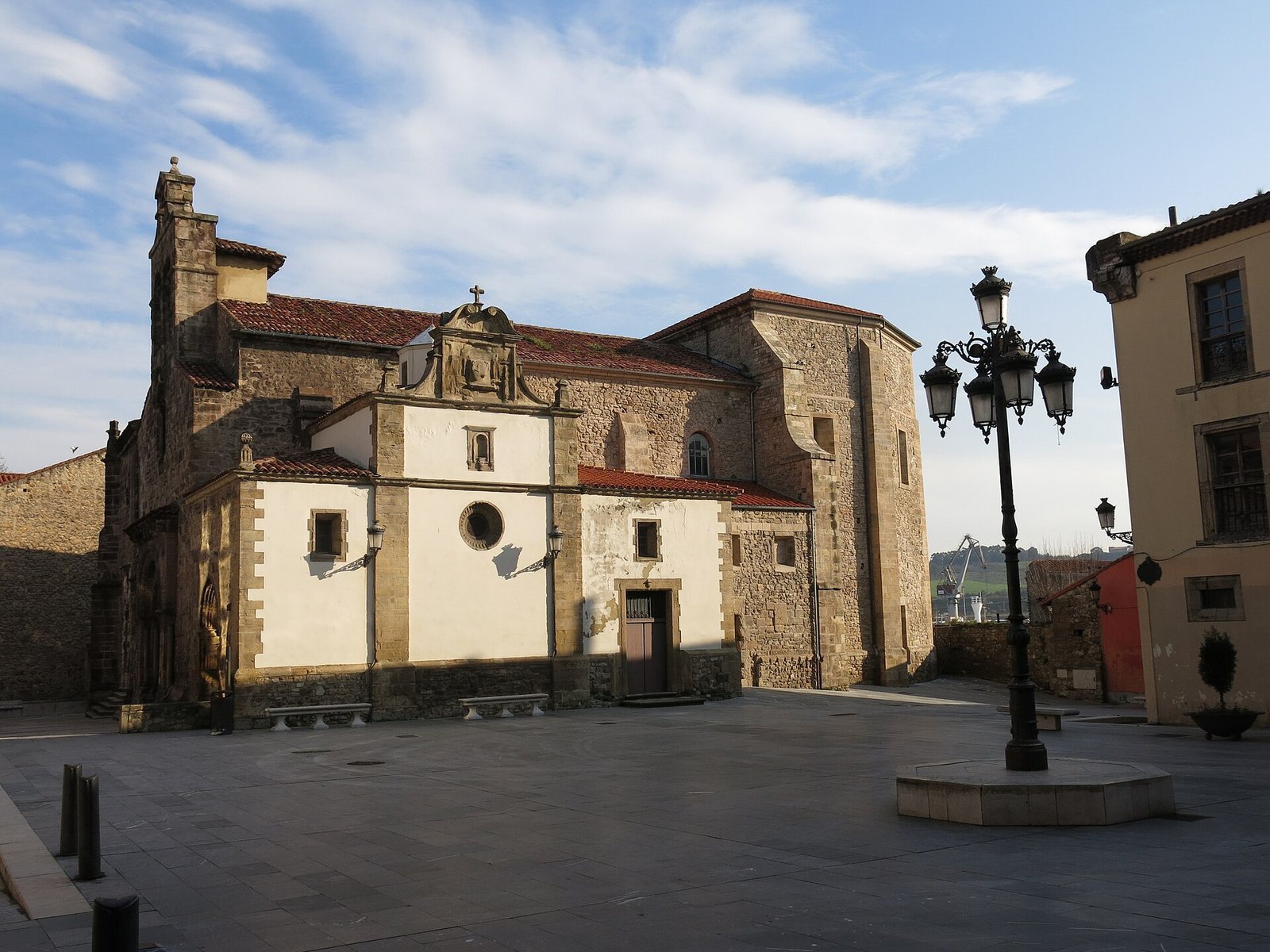
The chapel originally stood as an independent structure north of the church used by the Franciscan Fathers, formerly Avilés’s parish church dedicated to Saint Nicholas of Bari. It was beside the medieval town wall, within the town cemetery, and near the church’s main chapel. Its substantial construction and independent form expressed a focus on family lineage, while its visibility from the estuary was intended to rival that of the parish church. The cemetery remained in this location until 1813, when it moved to a nearby meadow by the former convent of La Merced.
The chapel suffered serious damage during the Spanish Civil War. Luis Menéndez Pidal, an architect and architectural restorer, later said that it had not burned, attributing this to its stone vault and the lack of combustible materials. In 1991, the chapel received Spain’s Bien de Interés Cultural designation, a formal status for cultural property of significant heritage value.
Remains
Architecture
Plan and vault
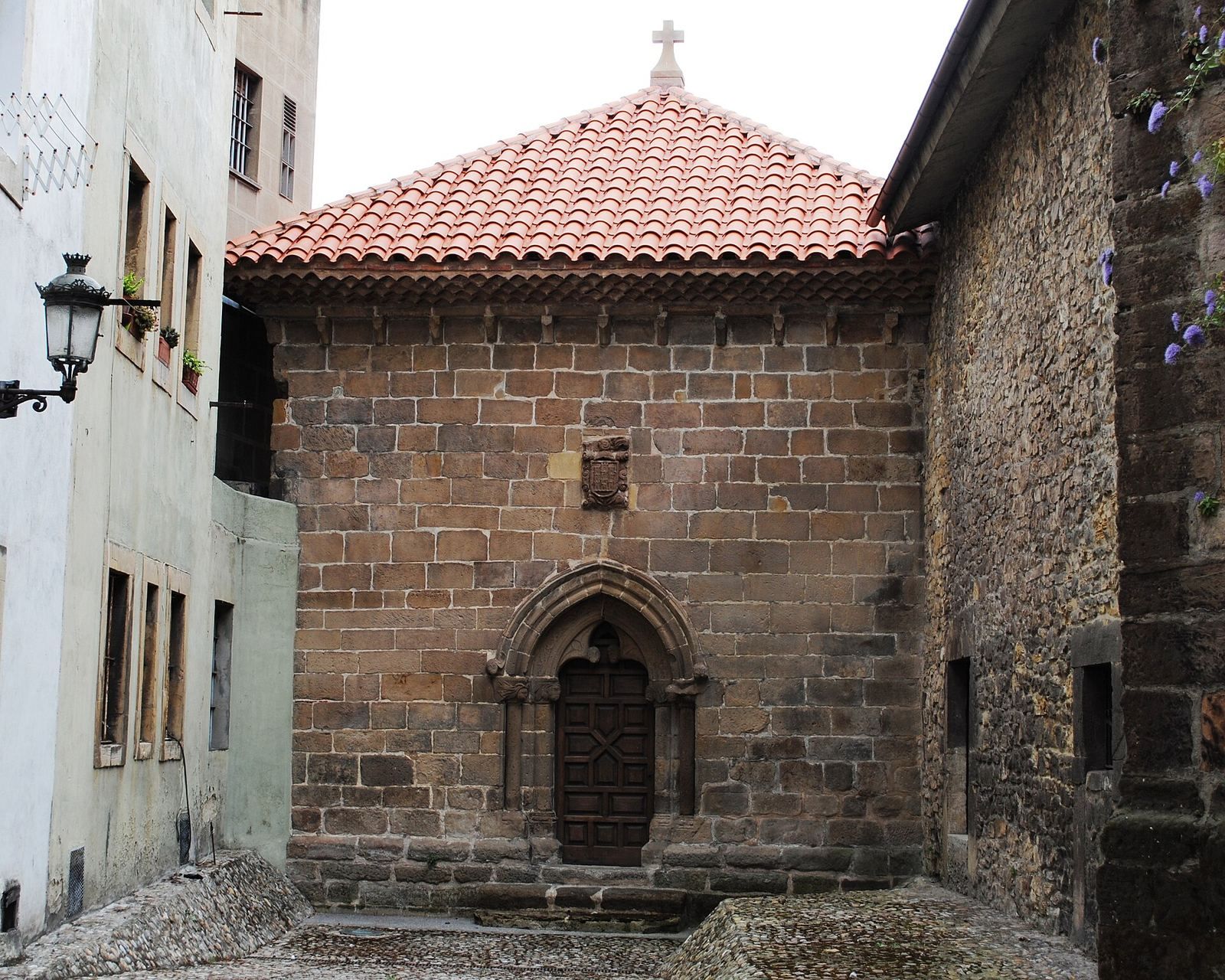
The chapel has a square plan and is described as correctly oriented. Its walls are made of ashlar masonry, squared and carefully dressed stone blocks, finished to an unusually high standard for the period. The interior is covered by an Aquitanian-style domical vault, a ribbed dome with concentric stone courses. Its ribs begin at schematic carved faces in the corners and meet at a carved central stone that appears to show Christ’s face. The ribs reinforce the vault, while the walls carry its outward thrust directly, unlike the load-bearing system of classical Gothic construction.
This vault links the chapel with a group of Asturian buildings that experimented with Aquitanian or Hispano-Aquitanian forms. Related examples include the main chapel of Santa María de Piedeloro, a funerary chapel on the south side of the church at Cornellana monastery, the hermitage of Santiago on Monsacro, and the main chapel of La Oliva. Aquitanian domical forms had reached the Iberian Peninsula by the second half of the 12th century, associated with Zamora Cathedral, and later appeared at Salamanca, Toro, Plasencia, Sahagún, and parts of the Collegiate Church of Santillana del Mar. The Asturian examples explored forms distinct from both Romanesque and mature Gothic architecture, the latter becoming dominant in later centuries.
Doorway and family arms
The entrance has a double moulded arch, edged by a protective band and supported by four columns. The recessed area above the doorway contains what appear to be winged angel heads arranged in a three-lobed design. The tops of the columns bear deeply carved human heads, apparently paired as men and women facing one another; some of the elaborate hair resembles feathers or diadems. A coat of arms above the entrance repeats an original inside the chapel. The original is from the modern period, not the medieval one, and shows the arms of the Alas family: a three-towered castle with wings above waves and an armed warrior at its gate.
Interior and funerary features
Tombs and inscriptions
Two tombs sit beneath arched recesses on opposite sides of the interior. On the epistle side, the side associated with reading the Epistle during a church service, they correspond to two arches outside the chapel enclosure. Separate floor slabs are badly deteriorated but retain traces of inscriptions and family heraldry. Wartime damage makes the tombs difficult to identify. Inscriptions copied by Gaspar Melchor de Jovellanos, a Spanish Enlightenment writer and statesman, identify Juan Estévanez de las Alas, who died in 1467, and Alonso Estévanez de las Alas, who died on 4 September 1475. Another inscription gives Esteban Pérez de las Alas’s death as Friday, 10 November, in year 1407 of the Spanish Era, an older Iberian dating system distinct from the AD calendar.
Alabaster altarpiece
Before the Spanish Civil War, the chapel contained an alabaster altarpiece attributed to the English school. Seven shallow carved panels, joined by wooden frames into a continuous front, depicted scenes associated with the Virgin Mary. Their sequence included Saint Catherine, the Annunciation, the Adoration of the Magi, Christ’s Resurrection, Saint Thomas’s disbelief at the Assumption, the Coronation of the Virgin, and Saint Margaret. The Assumption is the Christian belief that Mary was taken bodily into heaven. A wartime inventory gives a different list, including the Ascension, the Assumption, and an unidentified saint. José María Serrano’s inventory reported that the altarpiece had been smashed, apparently on the basis of testimony. Menéndez Pidal later questioned that account, and theft has also been proposed.
The panels have been tentatively dated to 1420–1460 and show pierced tracery associated with that period. Their orderly compositions resemble English alabaster reliefs. Workshops in London, York, and Nottingham produced such panels in series from the second half of the 14th century. Their painted surfaces and compact format made them easier to transport, while serial production reduced their cost and helped them spread along the Atlantic coast, including to areas without comparable local workshops. The Los Alas panels have been compared with a relief from Miudes parish, now in the Museum of the Church in Oviedo, showing the Coronation of the Virgin and Thomas’s disbelief concerning her Assumption. In the Los Alas version, the Virgin is already crowned.
Virgin and Child
A seated Virgin and Child was also in the chapel before the Spanish Civil War. Photographs from 1918 show a probably 14th-century Gothic sculpture, apparently carved from painted wood. Mary sits enthroned while the standing Christ Child blesses and rests on her left leg.