Kyiv Fortress: A Multi-Period System of Defensive Works
Site at a Glance
- Country
- Russia
- Primary era
- Modern
- Eras represented
- Early Modern, Modern
- Civilizations
- Cossack Hetmanate, Russian
- Site type
- Military
- Remains
- Fort
On this page23 sections
History
Kyiv Fortress is a complex of defensive works in Kyiv, Ukraine, built and altered by successive rulers and military authorities. Its origins lie in the early medieval city, while much of the surviving fortress dates from the eighteenth and nineteenth centuries. The system grew as Kyiv’s political position, military needs, and resources changed.
Early defenses and medieval Kyiv
A fortified settlement on Old Kyiv Hill dates to the late fifth or early sixth century. A separate tradition associated with Nestor, the name traditionally linked to the medieval Primary Chronicle, places an earthen enclosure around the city in the ninth century. Under Volodymyr the Great, work began on a new fortress covering about 10 hectares. Kyiv, a political center of Kyivan Rus, a medieval East Slavic polity, expanded over the next three centuries, and fortified suburbs developed beyond the central settlement.
During Yaroslav the Wise’s reign, from 1019 to 1054, defenses were expanded as part of a broader building program and to protect Rus’s southern frontier. The fortified Upper City, known as the city of Yaroslav, joined defenses associated with the earlier cities of Volodymyr and Iziaslav. Between 1093 and 1113, under Sviatopolk II, another rampart extended the enclosure around St Michael’s Monastery.
In 1169, a coalition from northern Rus led by Andrei Bogolyubsky attacked Kyiv. After the defenders surrendered, the city was burned and plundered for five days, and thousands of residents were killed. The assault weakened Kyiv’s political authority and economic strength. Kyiv was retaken the following year, and Bogolyubsky’s forces failed in another attempt to capture it in 1173.
In 1240, Batu Khan’s Mongol forces besieged and destroyed Kyiv and its fortifications. They entered on 6 December through the frozen Kozine marsh near Lyad Gate. Fortification work did not resume immediately after the Mongol withdrawal.
Lithuanian and Polish rule
Under Lithuanian rule, from 1362 to 1569, Podil became the city’s center and its defenses were renewed. A wooden castle on a height above Podil served as the Lithuanian governor’s residence. After Kyiv passed under Polish rule in 1569, a Polish garrison occupied the castle. It survived a Cossack siege in 1593, but a lightning strike caused a fire in 1605. The castle was rebuilt, then burned by townspeople and Cossacks in 1651. The hill later became known as Castle Hill.
Cossack and Muscovite fortifications
A new phase followed the 1654 Pereiaslav Agreement, a political agreement between Cossack leaders and the Muscovite state, centered on Moscow. From 1679, forces under Hetman Ivan Samoilovych, a senior Cossack military and political leader, repaired and renewed earthworks on the site of Yaroslav’s defenses. They added small bastions, projecting works designed for defensive fire, and removed rampart sections no longer needed. A retrenchment, an additional defensive line, was built across the Old City in case the lower-city rampart was breached.
A separate earthen fort with a wooden palisade enclosed the Kyiv-Pechersk Lavra, a major Orthodox monastic complex, and the Pechersk settlement. Completed in 1682, it was besieged by Ottoman forces that year and later abandoned. In 1684, General Patrick Gordon oversaw further repairs and work on outer defenses in the Old City. From 1696 to 1701, Hetman Ivan Mazepa financed a stone wall around the Upper Lavra, built under the direction of Dmytro Aksamitov.
During the Great Northern War of 1700–1721, a conflict involving Sweden and a coalition that included Russia, Peter I ordered a new fortress on Pechersk after reviewing Kyiv’s defenses. Construction began in 1706 under military engineer Hoffmann, with oversight by Mazepa and Colonel Heisen; army troops and Cossacks carried out the work. It was completed by 1724. Kyiv then had two separate fortresses, Pechersk and Starokyiv, with Pechersk later serving as the citadel, or fortified inner stronghold, of the larger system. In 1712, forces under Hetman Ivan Skoropadsky built a ditch and rampart to connect them.
The imperial fortress
On 7 March 1810, Alexander I ordered the Pechersk Hill defenses transferred to the Engineers Department and kept in permanent repair. Construction of Zvirynets Fortification began on 24 June that year in anticipation of war with France. Its high position was considered to compensate for its relatively light field defenses. Although demolition was planned for a later date, it was not carried out.
After visiting Kyiv, the future Nicholas I commissioned a plan for a new fortress by military engineer Karl Oppermann. Construction under O. O. Freiman began in 1830 and continued chiefly from 1831 to 1851, with some works finished as late as 1872. The revised plan created the New Pechersk Fortress, incorporating the older Pechersk Fortress as its citadel and adding the Vasylkiv and Hospital fortifications, towers, barracks, workshops, and connected defenses. The project required the demolition of 1,180 houses and other structures to clear the fortress esplanade, the open ground intended to deny cover to an approaching enemy. A plan for 1846 provided for a garrison of 16,700 and a normal armament of 670 guns.
During the Crimean War, a conflict in the mid-nineteenth century between the Russian Empire and an opposing coalition, a fortified bridgehead was built in 1854–1855 to protect the Chain Bridge, together with 11 batteries. The introduction of rifled artillery in the 1860s prompted further modernization with forts. E. I. Totleben designed Lysa Hora Fort, built during the 1870s to protect approaches to the railway bridge over the Dnieper.
Prisons, decommissioning, and museum
The fortress also served as a place of imprisonment and execution. After the Polish-led January Uprising against Russian rule in 1863–1864, a military field court sentenced five leaders of insurgent groups to death; they were shot in the moat of the Pechersk Citadel. Kosyi Caponier, a protected work from which defenders could fire along a ditch, became a political prison and was used in that role during the 1900s and 1920s. Lysa Hora was used from 1906 for the execution of convicted political prisoners.
The fortress formed part of the Russian Empire’s western defenses. It was downgraded from first to third class in 1886 and became a fortress-depot on 25 April 1897 after losing strategic importance. The fortress was abolished in 1918 and its military formation disbanded, although buildings continued in military use as barracks, stores, and headquarters, as well as for imprisonment.
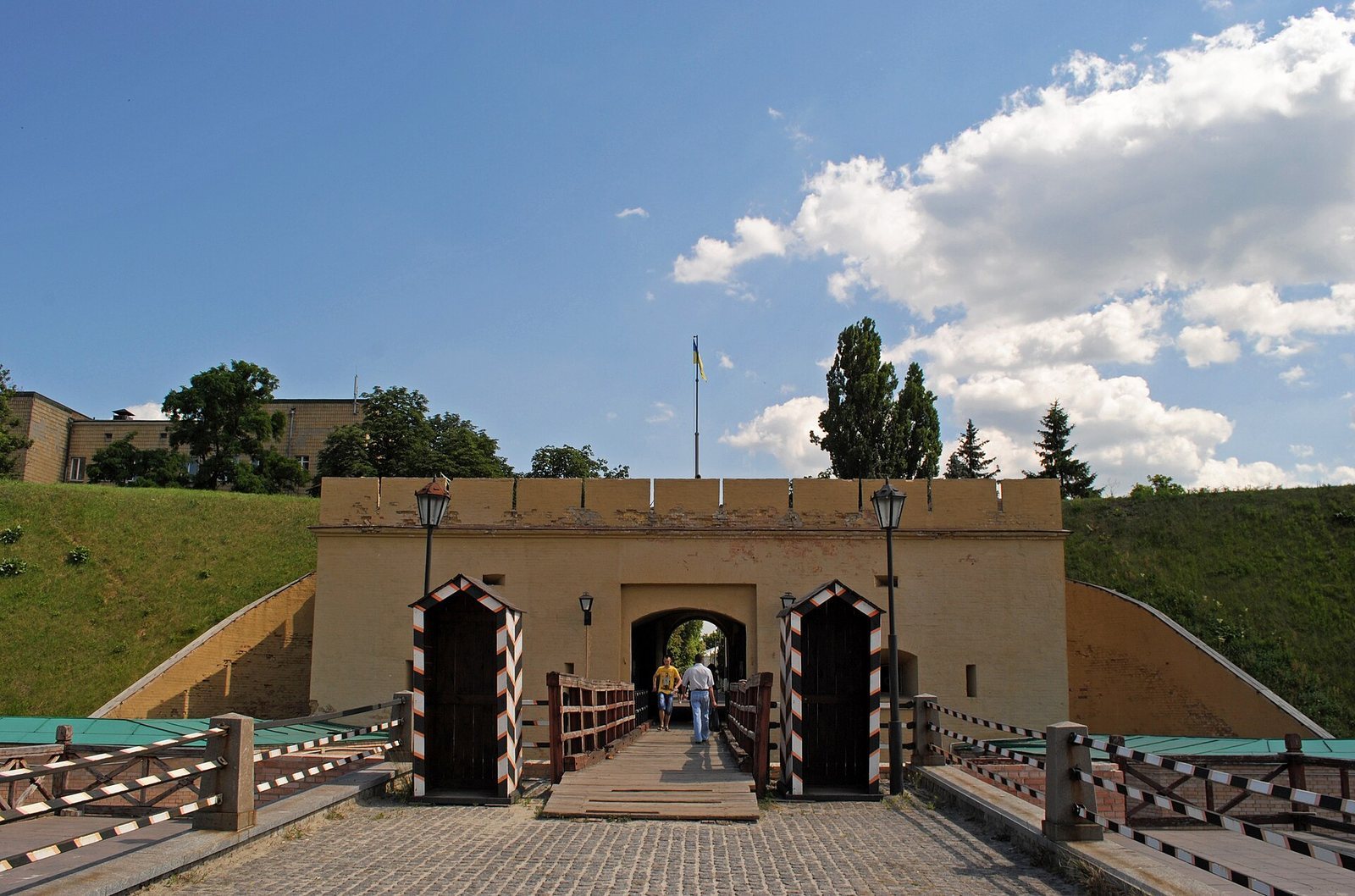
A Kyiv Fortress museum opened in 1927 as a branch of the Museum of Kyiv History. A separate museum for Kosyi Caponier opened in the former prison during the 1930s. In 1991, that museum became the Kyiv Fortress historical and architectural museum, which received national status in 2007. Conservation and restoration have included work on the Hospital fortification’s earthworks, the entrance tower, Central Caponier, bridge, Hospital Square, and Kosyi Caponier; Caponier II was converted into museum space, and the Spassky Bastion was revitalized in 2019. Kyiv Fortress is a national-level heritage site.
A memorial to the five leaders executed after the January Uprising was added to the escarp wall in 1971. During Polish president Lech Wałęsa’s visit in 1993, a plaque in Polish was installed, followed by a black granite cross in 1997. Plaques bearing the names of 811 insurgents were later placed in a caponier passage.
Remains
The surviving fortress is a collection of separate defensive works spread across the hills on Kyiv’s high right bank of the Dnieper. The Klov ravine bounds the complex to the north, while the slopes of the Lybid River valley define its southern and western edges. The Hospital and Vasylkiv works occupy the western part, the Arsenal and related government buildings lie to the north, and the Pechersk Citadel and Lavra are to the south, with the Zvirynets works farther south. A brick factory once stood on Trukhaniv Island across the river.
Medieval defenses
Upper City ramparts
The Upper City defenses covered about 80 hectares and followed a rampart line approximately 3.5 kilometres long. The rampart core consisted of oak-log cells filled with earth dug from the ditch. At the base it was 31 metres wide and rose 12 metres; wooden parapet defenses brought its total height to 16 metres. Towers, galleries, and service cells formed part of the wooden defenses. The ramparts survived into the nineteenth century before being levelled.
Gates and fortified suburbs
Lviv, Lyad, and Golden gates provided entry to the fortified city. The Golden Gate, Kyiv’s principal ceremonial entrance, survives in ruins. The Kopyriv End and Podil also had ramparts, ditches, and walls, but on a smaller scale than the Upper City works. Earlier defenses on the central hill included high earthworks and wooden towers, with fortified suburbs beyond.
Pechersk and the citadel
Pechersk Fortress and Mazepa Walls
The Pechersk Fortress had a semicircular plan, earth ramparts about six metres high, and eight fortified sections. Of its three original main gates, the Vasylkiv and Moscow gates survive. Its inner defenses include the Mazepa Walls and their towers, described as the complex’s oldest surviving monument of medieval-type construction.
Pechersk Citadel
The citadel retains parts of its bastions, a lunette, an outwork formed by projecting faces and flanks, and a brick defensive wall that closes the citadel on the Dnieper side. The surviving lunette is No. 4. The Spassky Bastion is among the works that have been revitalized.
Western fortifications
Vasylkiv fortification
The Vasylkiv works retain all three of their towers, open chambers on the left flank that defended the ditch, part of the rear wall, and Postern No. 4, a small passage through a fortification. The towers are No. 1, a redoubt or small enclosed defensive work; circular Tower No. 2; and Tower No. 3, also known as Prozorivska Tower. Navodnytska Tower No. 4 and Towers Nos. 5 and 6 are also identified as parts of the fortress.
Hospital fortification
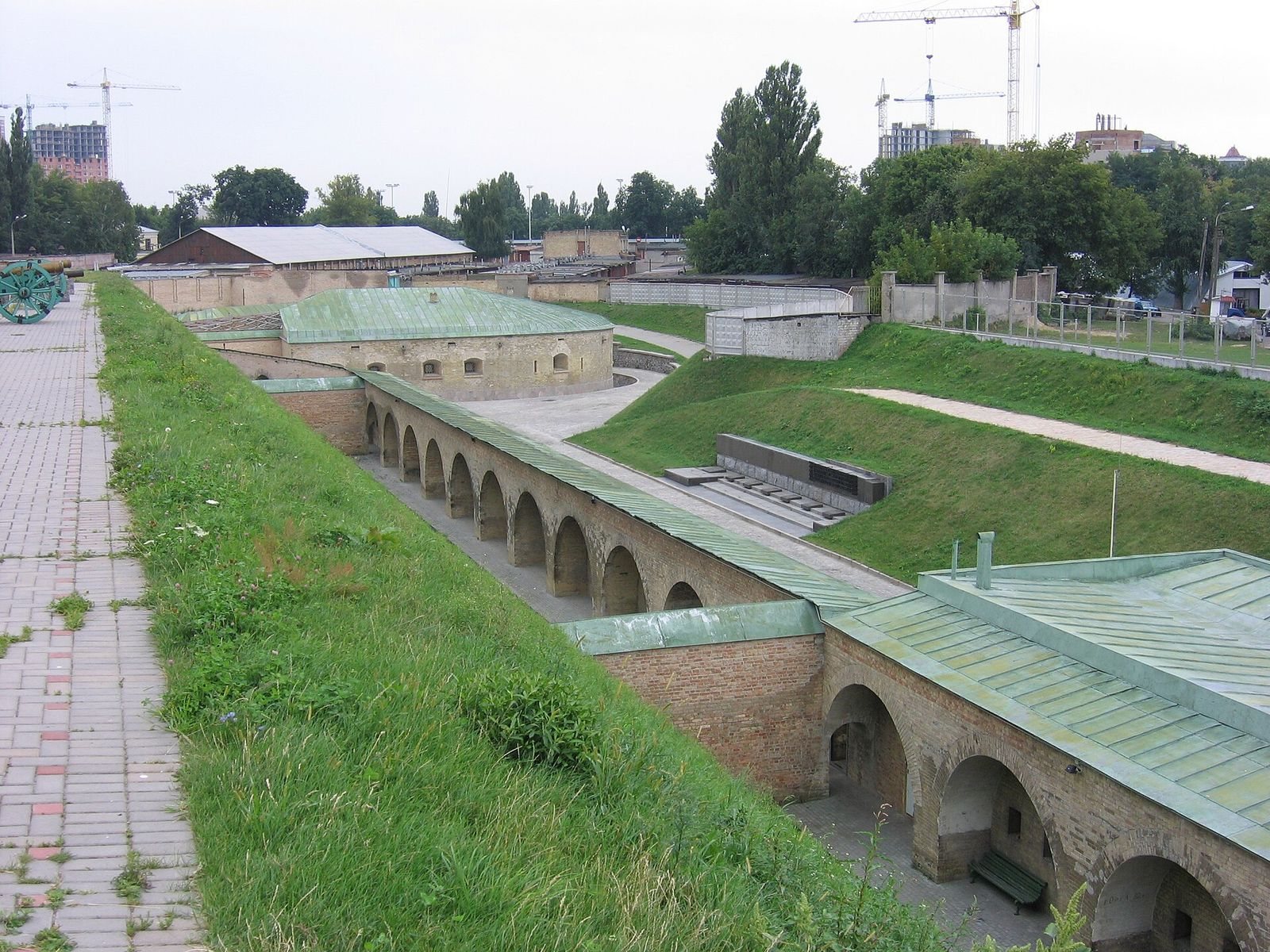
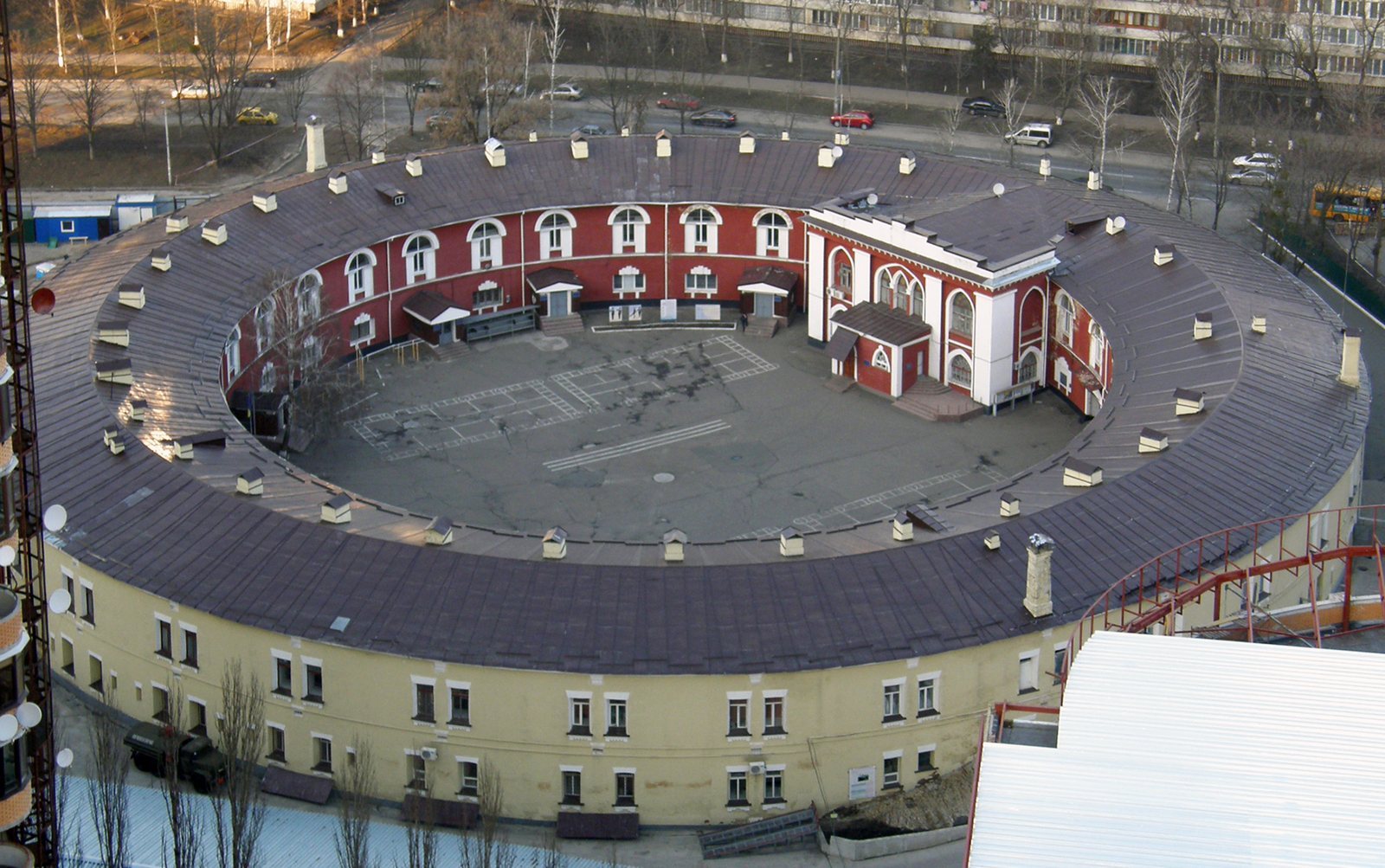
The Hospital fortification includes the Main Military Clinical Hospital and the Kyiv Fortress museum. Its surviving structures include a protected hospital building with casemates, enclosed chambers within a fortification, five caponiers, three posterns, the North Half-Tower, the North Gate, and part of the escarp wall, the defensive wall on the inner side of a ditch. The Main Gate, entrance tower, bridge, Hospital Square, and Central Caponier are also part of the complex. Two caponiers have been adapted for museum use.
Southern works
Zvirynets earthworks
Fragments of the Zvirynets earthworks survive within the National Botanical Garden named for M. M. Gryshko, preserving part of the southern defensive system.
Lysa Hora Fort
Lysa Hora retains a group of defensive works, including Half-Bastion No. 1, Bastion No. 2, polygonal Bastion No. 3, a flèche, a small V-shaped fieldwork, a zigzag defensive fence, a lunette, and eight brick posterns. The fort is a nationally significant architectural monument within the 137.1-hectare Lysa Hora Regional Landscape Park.
Museum and commemorative features
Kosyi Caponier and museum displays
Kosyi, or Skew, Caponier No. 5 was built in 1844 as a defensive work within the Hospital fortification. Its nineteenth-century building, formerly a wing of the fortress, contains semi-underground exhibition space on the history of the fortress buildings’ uses. Caponier II of the polygon contains an exhibition on the history of fortification in Ukraine. An outdoor display includes ramparts, ditches, and the escarp wall.
January Uprising memorial
The memorial comprises the plaques on the escarp wall, the black granite cross between them, and plaques listing 811 insurgents’ names in a caponier passage.
Oleksandr Matsievskyi memorial
A memorial to Ukrainian serviceman Oleksandr Matsievskyi was unveiled on the museum grounds on 6 December 2023. Oleg Tsos and Albina Safonova created the sculpture.