Sankt Lars Church in Linköping: A Parish Church with Medieval Origins
Site at a Glance
- Country
- Sweden
- Primary era
- Modern
- Eras represented
- Medieval, Early Modern, Modern
- Civilizations
- Swedish
- Site type
- Religious
- Remains
- Church
On this page15 sections
History
Medieval origins and parish setting
Sankt Lars Church stands in central Linköping, Sweden, and belongs to the Church of Sweden’s Sankt Lars parish and Linköping Diocese. Its Romanesque stone predecessor was probably built in the first quarter of the 12th century. The name Romanesque refers to a medieval architectural style associated with massive masonry and rounded arches.
A timber church came before the stone building. This earlier type, known as a stave church, used upright posts to support its structure. Decorated Eskilstuna stone coffins indicate that Christians were buried in the area from the 11th century. Tradition places the stone church’s consecration during Bishop Kol’s tenure, from 1171 to 1195. It was probably a renewed consecration after the tower was built, and the church was dedicated to Saint Laurentius, also known as Saint Lawrence, an early Christian deacon and martyr.
Although the church stood within Linköping, Sankt Lars parish historically covered the countryside outside the city. The parish boundary changed in 1961 and now follows Klostergatan, one block west of the church. People commonly called the building Landskyrkan, meaning “the Country Church.” The name S:te Lars-kiörkan appears on a 1696 plot map.
Fire, repairs, and eighteenth-century changes
A fire on the night of 29–30 January 1700 badly damaged the church’s exterior. Repairs lasted six years and included a new tower. Metal recovered after the fire was used to cast a bell, which was recast in 1715, 1735, 1744, and 1767. A six-stop organ, in which each stop controls a set of pipes, was also built in 1700 by Johan Agerwall of Söderköping. It was probably the church’s first organ.
Olof Hedlund repaired and improved the organ in 1732, and Jonas Wistenius altered one of its stops in 1741. The instrument went to Vinnerstad Church in 1767. After repairs there in 1845, it was sold at auction in 1870. Per August Wassrin bought it and gave it to Folkström chapel, where Anders Peter Kullbom probably installed it. Two stops were probably changed during the 19th century, and the Moberg brothers returned the organ to working order in 1953.
The church acquired an altarpiece in 1722 and was enlarged in 1736 with a bigger chancel and a new sacristy, a room used for church service preparations. A pulpit formerly used in the cathedral, where it had been since 1606, came to Sankt Lars in 1745. It was sold in 1802. Wistenius built another organ in 1767, with nine and a half stops, for a new gallery at the church’s west end. It was sold to Madesjö Church in 1799 because Sankt Lars was due for demolition; it was discarded there in 1885.
Rebuilding at the turn of the nineteenth century
Diocesan master builder Caspar Seurling designed the present nave, which was constructed from 1798 to 1801. The chancel and sacristy were built in 1801, and the tower gained an additional storey. The rebuilt church was dedicated on 1 January 1802. Pehr Schörlin had built a 23-stop organ in 1801. Its stops were inspected that November, and some on its first hand keyboard were linked to the foot-operated pedal. Schörlin made a small repair in 1810, followed by work from Carl Hanner in 1832.
King Gustav IV Adolf and Queen Fredrika visited in early May 1802. On 11 May the church received the name Fredrika Dorotea Wilhelmina, which fell out of use in the 1880s. Two large paintings by Swedish artist Pehr Hörberg, donated in 1801 by Charlotte von Friesendorff, were placed in the chancel during a restoration in 1906–1907. The same work moved the pulpit to the left side of the church and installed a plaster figure of Christ based on a sculpture by Bertel Thorvaldsen, flanked by Hörberg’s paintings.
Restoration and changing use in the twentieth century
The 1906–1907 restoration, designed by architect Agi Lindegren, also raised the tower by 1.5 metres and gave it a new upper structure. A large bell was cast in 1907. The following year, Åkerman and Lund built a 23-stop organ behind the retained façade of Schörlin’s 1801 instrument. The new organ had two hand keyboards, a pedal, mechanical action assisted by a pneumatic machine, and a separate console. An electric blower was added in 1915. Revisions in 1939 and 1943 followed Neo-Baroque principles, a revival of Baroque musical and organ-building practices, and changed stops across the keyboards and pedal.
From 1956 to 1957, architect Erik Lundberg led a restoration that strengthened the foundations and included archaeological investigations directed by regional archaeologist Bengt Cnattingius. The work added a marble wall in the chancel and ceiling lights designed by Lundberg. Hörberg’s paintings were moved to the nave walls in the 1980s and later placed on the organ-gallery wall. A room for small gatherings and refreshments was created at the back of the nave in the 1990s. A mechanical choir organ built in 1963 was sold to Ärentuna Church during that decade.
Organs and parish life since the 1960s
Marcussen & Søn built the present main organ in 1964, following the Neo-Baroque approach of the period. Knut Kaliff added stop controls in the early 2000s. In 2016, Åkerman & Lund moved the gallery and organ forward and installed a computer-controlled system for storing combinations of stops. A movable, separate console was placed in the chancel in 2020, when a new pedal stop was also made.
A chest organ was acquired in the 1990s for continuo music. A separate organ, built by I. Starup & Søn in 1958 and donated by the Sankt Lars parish association that year, first stood in the Sankt Larsgården building. After that building was sold in 2006, the organ moved to the church choir room and later to Tannefors parish hall.
During the 2000s, parish activities created a need for permanent facilities. After a proposal for a new building behind the chancel was rejected by Linköping’s building-permit office, the congregation chose to remodel the interior while making little change to the exterior. Architect Per Rydberg led the work. The church is also often used for concerts, a practice associated with its noted acoustics.
Remains
Building and archaeological fabric
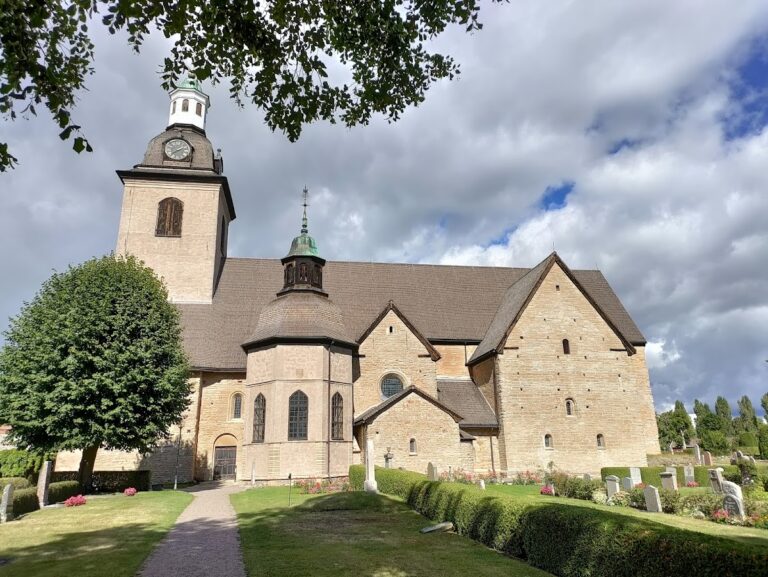
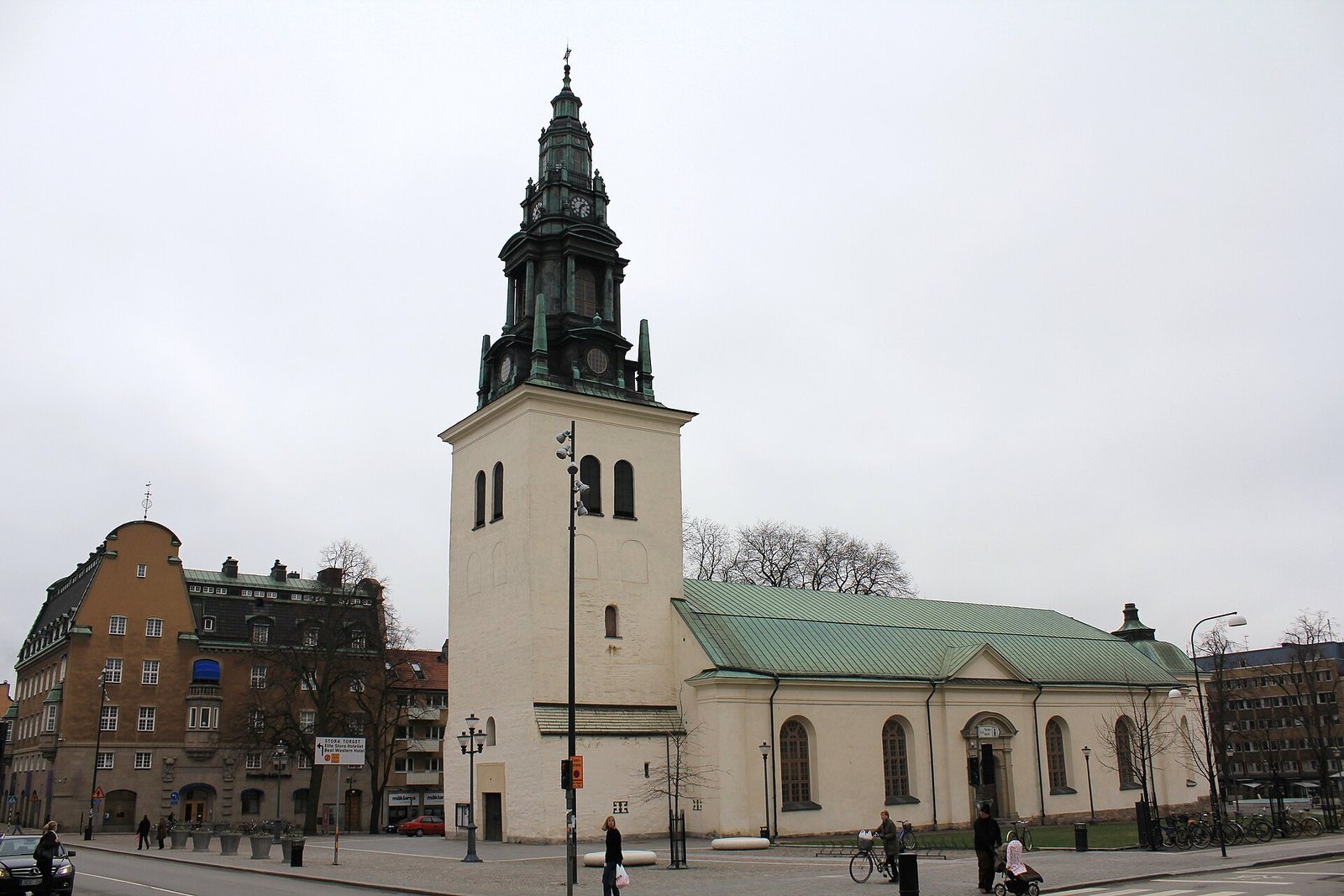
The white-plastered stone church occupies a central position between Stora torget and the Stångån river. Sankt Larsgatan runs in front, Storgatan borders its south side, and Sankt Larsparken surrounds it. The present nave, chancel, and sacristy form a building with an interior 45 metres long, 12.7 metres wide, and 7 metres high at the cornice.
Medieval remains
A crypt, a chamber beneath the church, contains remains of the earlier stone church. The lowest surviving wall remains can be seen in a cellar below the church floor. Excavations also identified the timber church that preceded the stone building and recovered decorated Eskilstuna stone coffins, an early medieval type of burial container.
Tower
The tower’s four lowest storeys are medieval limestone construction. A new tower followed the 1700 fire; a further storey was added as the present church was built, and the tower was raised and given a new upper structure in 1906–1907. The tower, like that of Linköping Cathedral, is a prominent part of the cityscape.
Interior, furnishings, and music
Entrances and parish spaces
The southern portal is the main entrance. The western doorway through the tower remains an entrance, while the north portal has been closed and replaced by Staffan Löwstedt’s photographic work, “The Baptism Window.” The organ gallery has been moved forward and the rear pews removed. The resulting interior includes parish rooms, a children’s corner, a kitchen, a room for diaconal work, and offices and activity areas beneath the gallery. The gallery also holds a choir room and sacristy. A small extension projects from the north side.
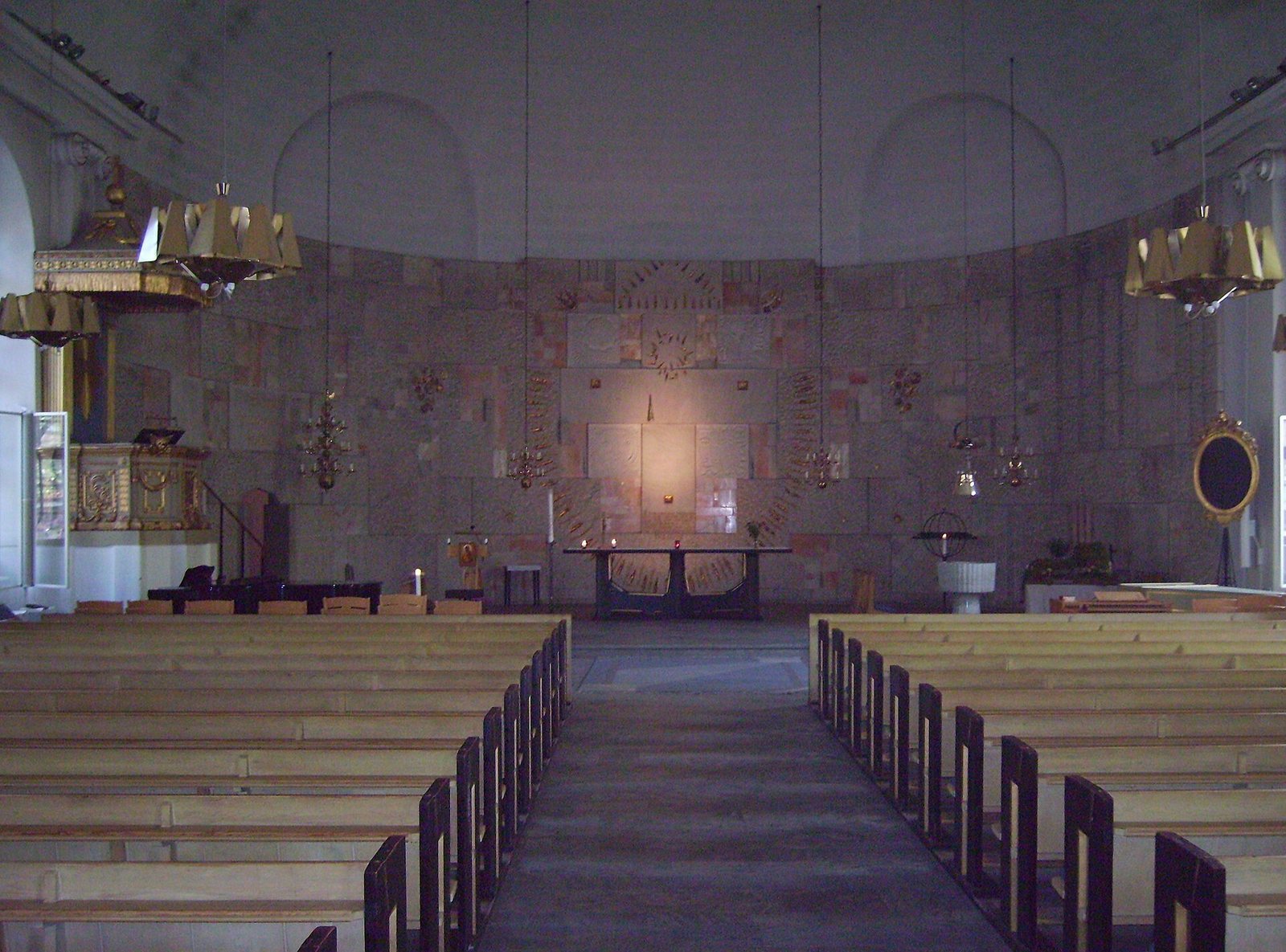
A room for small gatherings and refreshments occupies the rear of the nave. The church also contains a baptismal font, an altar, and a pulpit. Lundberg’s ceiling lights remain in the nave and chancel, and the chancel has a marble wall installed during the 1956–1957 restoration.
Art and textiles
Hörberg’s two wall-height paintings, donated in 1801 by Charlotte von Friesendorff, are now on the organ-gallery wall. Sven-Bertil Svensson’s three-panel work “Mary, Jesus and Saint Lars” is on the south wall. A work by Per Rydberg, “Ichtys – The Fish,” is set in the piscina, a basin or recess used for washing sacred vessels.
The church’s woven damask chasubles, sleeveless garments worn by priests during some services, have a pattern of angels playing music. Damask forms patterns through contrasting weaves. Estate owner and damask weaver Carl Widlund made the garments at Tranjerdstorp outside Karlstad, using a design of his own.
Organs and other keyboard instruments
The main organ has about 2,700 pipes and retains the façade of the 1801 organ. Its largest pipe is wooden and about five metres long; its smallest is metal and only a few millimetres long. The instrument has two hand keyboards, called manuals, and a foot-operated pedal. The pedal has two freely selectable combinations and electro-pneumatic action, while the manuals use mechanical and pneumatic actions. In 2020, a new 10 2/3-foot Quint stop, a rank of pipes sounding a fifth, was made for the pedal by Bergenblad & Jonsson Orgelbyggeri and Åkerman & Lund.
The church’s chest organ was made by Klop Early Keyboard Instruments in the Netherlands. Its pedal can be removed, its stops are divided between two points on the keyboard, and shifting the keyboard allows it to sound a semitone lower. The lid bears the maker’s name, “G. C. Klop, Garderen.” The church also has a two-manual harpsichord built by Matts Arvidsson in 1986 and a Yamaha C7 grand piano.
Bells and carillon
Three bells hang behind the tower’s black shutters, each suspended on a straight axle. The smallest, cast by Magnus Hultman of Norrköping in 1726, weighs about 500 kilograms and measures 91 centimetres across. The middle bell, cast in 1732 and later recast by Bergholtz bell foundry, weighs about 990 kilograms and measures 110 centimetres across. It strikes the hours and half-hours. The largest bell was cast in 1907 and donated by Captain Henric Westman of Valla. It weighs about 1,900 kilograms and measures 138 centimetres across.
Above the tower clock is a carillon, a set of tuned bells arranged to play melodies, installed in 1972. Its 36 bells, cast by Bergholtz of Sigtuna, span three octaves. It can be played from within the tower or set to play automatically.