Markim Church: A Medieval Lutheran Church in Vallentuna, Sweden
Site at a Glance
- Country
- Sweden
- Primary era
- Medieval
- Eras represented
- Medieval, Early Modern, Modern
- Civilizations
- Swedish
- Site type
- Religious
- Remains
- Church
On this page13 sections
History
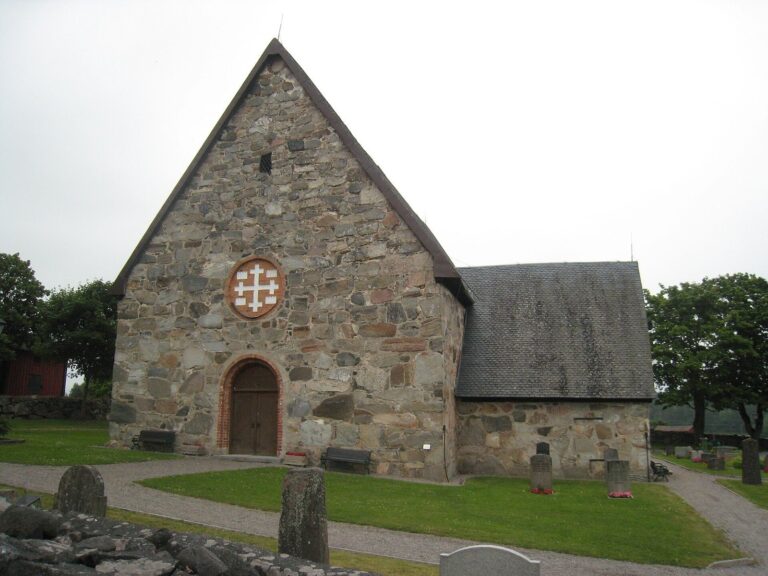
Markim Church is a medieval Lutheran church in Vallentuna, Sweden. Built around 1200, it follows the Romanesque style, a medieval tradition associated with rounded arches and substantial masonry. The church was consecrated during the 13th century.
Medieval origins and worship
Dendrochronological evidence dates the laying of the church roof to around 1213. The building is first mentioned in a testament from 1287, while place-name history and archaeological findings point to an older cultural landscape in the surrounding area. The name Markim may mean “the farmstead toward the outlying lands,” perhaps referring to wooded areas to the north. A sacrificial well on the church hill was probably used before Christianity. Offerings were also made at the site to St Lawrence, an early Christian martyr venerated as a saint and probably the church’s patron.
Alterations from the fifteenth to nineteenth centuries
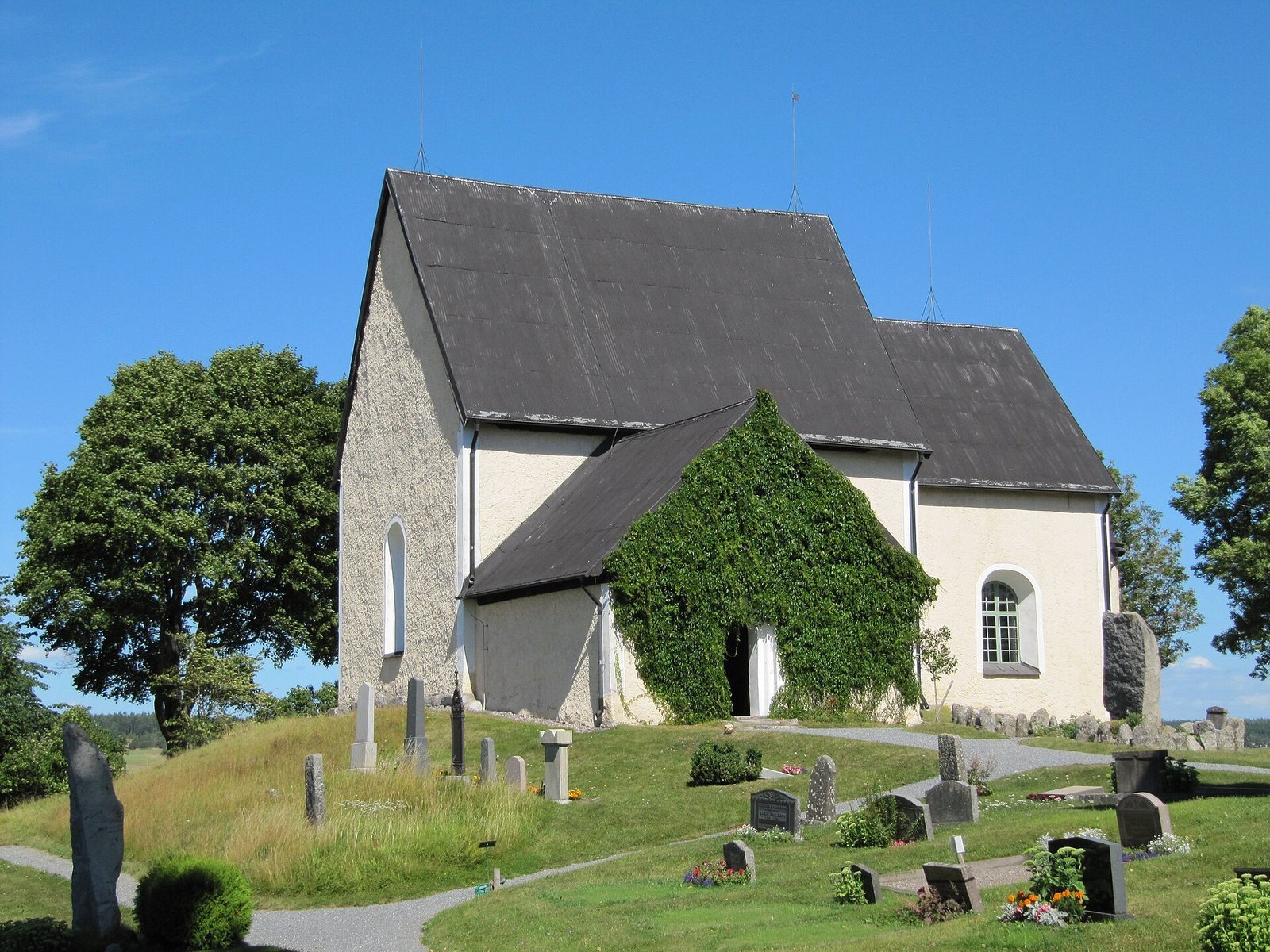
A porch and sacristy were added in the mid-15th century. Around the same time, brick cross vaulting replaced the nave’s original wooden roof. In the 18th and 19th centuries, the windows were altered in several stages: a western window was added to the nave in 1748, an opening was made in the north wall in 1791, all the windows were enlarged in 1812, and a round window was added to the apse in 1850. In 1887, shingles on the roof were replaced with galvanized metal roofing.
The present external belfry replaced an older open timber structure in 1727 and was enclosed with boards in 1742. A 1751 inventory described a medieval altarpiece topped by a small crucifix; the altarpiece was later lost. The medieval baptismal font was discarded in 1751, and the altar-and-pulpit assembly now in the church was made in 1758–1759. The church bought an organ from Danviken Hospital Church in 1758. That instrument was sold to Järfälla Church in 1828, when a replacement was built. A further organ was installed in 1953.
Restoration and parish history
Architect Evert Milles led a restoration in 1950, during which wall paintings were uncovered in the porch. The present organ was built in 1985. Markim Church belongs to the Diocese of Stockholm, an administrative church district overseen by a bishop. It was formerly part of Markim parish, which merged into Vallentuna parish in 2006. The church is a listed building and stands within an area designated as being of national cultural interest.
Remains
Setting, plan, and construction
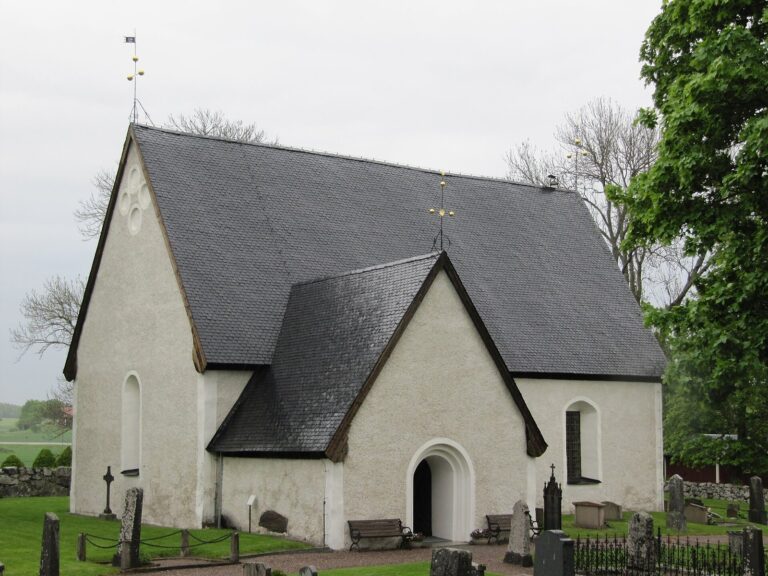
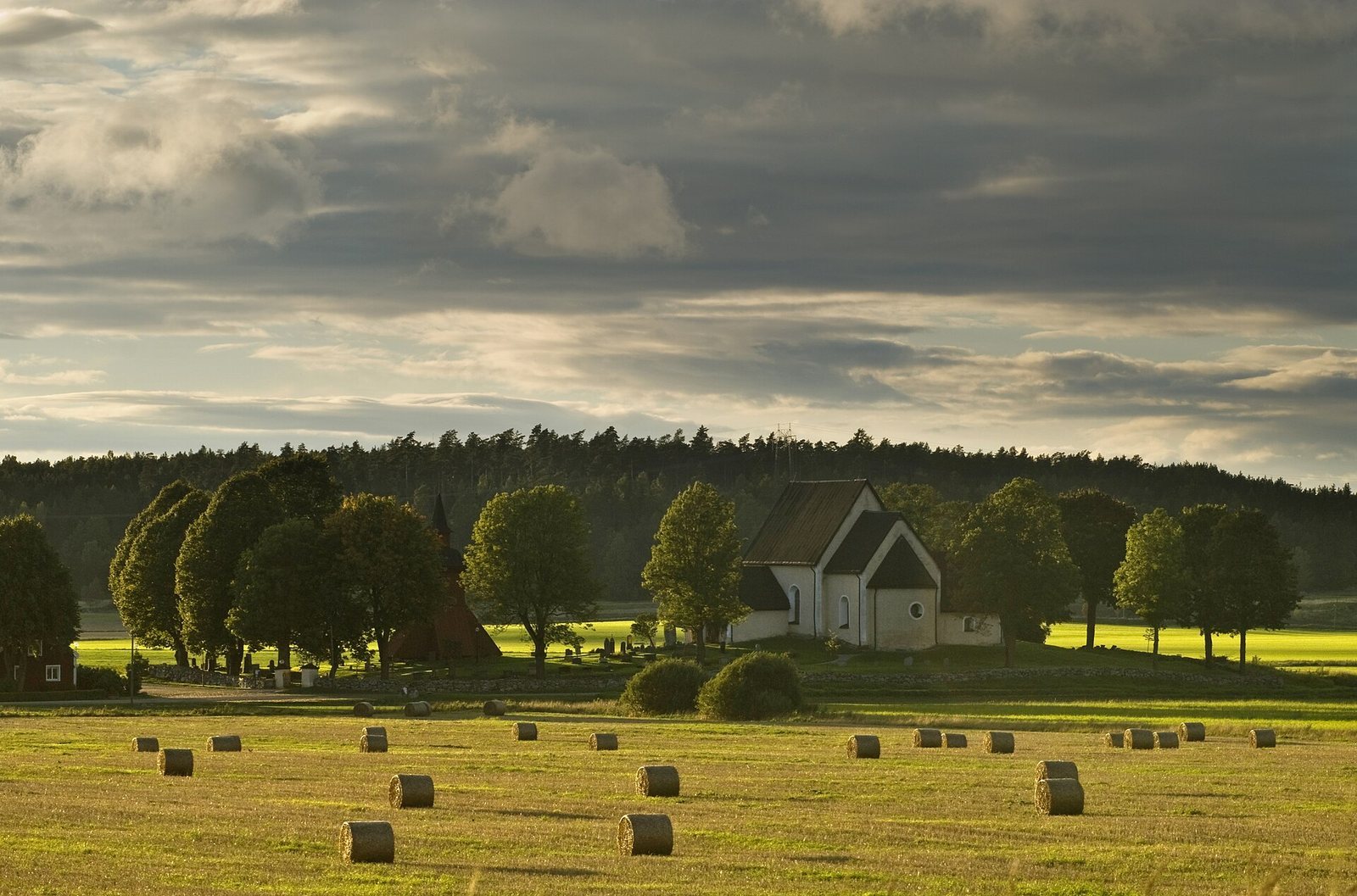
The church stands on a small hill in fertile agricultural country, within a landscape rich in runestones. One runestone is on the north side of the churchyard. Markim retains its original Romanesque plan, described as unusual among early medieval churches in Uppland. The rectangular nave, the main body of the church, leads east to a narrower choir and an apse, a rounded end to the church space. A porch adjoins the southwest side, while a sacristy, a room for storing church vessels and vestments, is attached to the northeast.
The walls are built of roughly hewn stone, with brick used in the vaulting. They are now plastered and painted yellow; originally, the stonework was exposed. Round-arched windows pierce the walls. The main roofs are steeply pitched, while the apse has a semi-conical roof; all are covered in galvanized metal. Inside, the choir has an original barrel vault, a continuous arched ceiling, and the apse has an original dome-shaped vault. Brick cross vaults cover the nave. Its broad, low triumphal arch, which separates the nave from the choir, was once much narrower.
Interior features and furnishings
Porch and entrance door
Fragments of medieval wall paintings are displayed in the porch, whose ceiling paintings have never been overpainted. An oak door between the porch and nave dates broadly to around 1200. Metalwork reinforces the door, which carries a prominent Viking-ship design.
Choir and medieval cross
The choir floor is made up of gravestones, the oldest dating to the 17th century. Above the arch leading into the choir hangs an oak triumphal cross from the second half of the 13th century. It is the only surviving medieval furnishing in the church and has a ring joining its cross arms. This type of cross is more commonly found on Gotland than in Uppland.
Altar and baptismal font
The altar-and-pulpit assembly, made in 1758–1759, is in Rococo style, an ornate decorative style. Its pulpit is set above the altar, and gilded details include a relief of Christ on the cross with John and Mary. Two female figures frame the assembly: Faith stands on the right and Hope on the left. The present baptismal font is a modern-style work made in 1972 by sculptor Axel Wallenberg.
Organ gallery and instrument
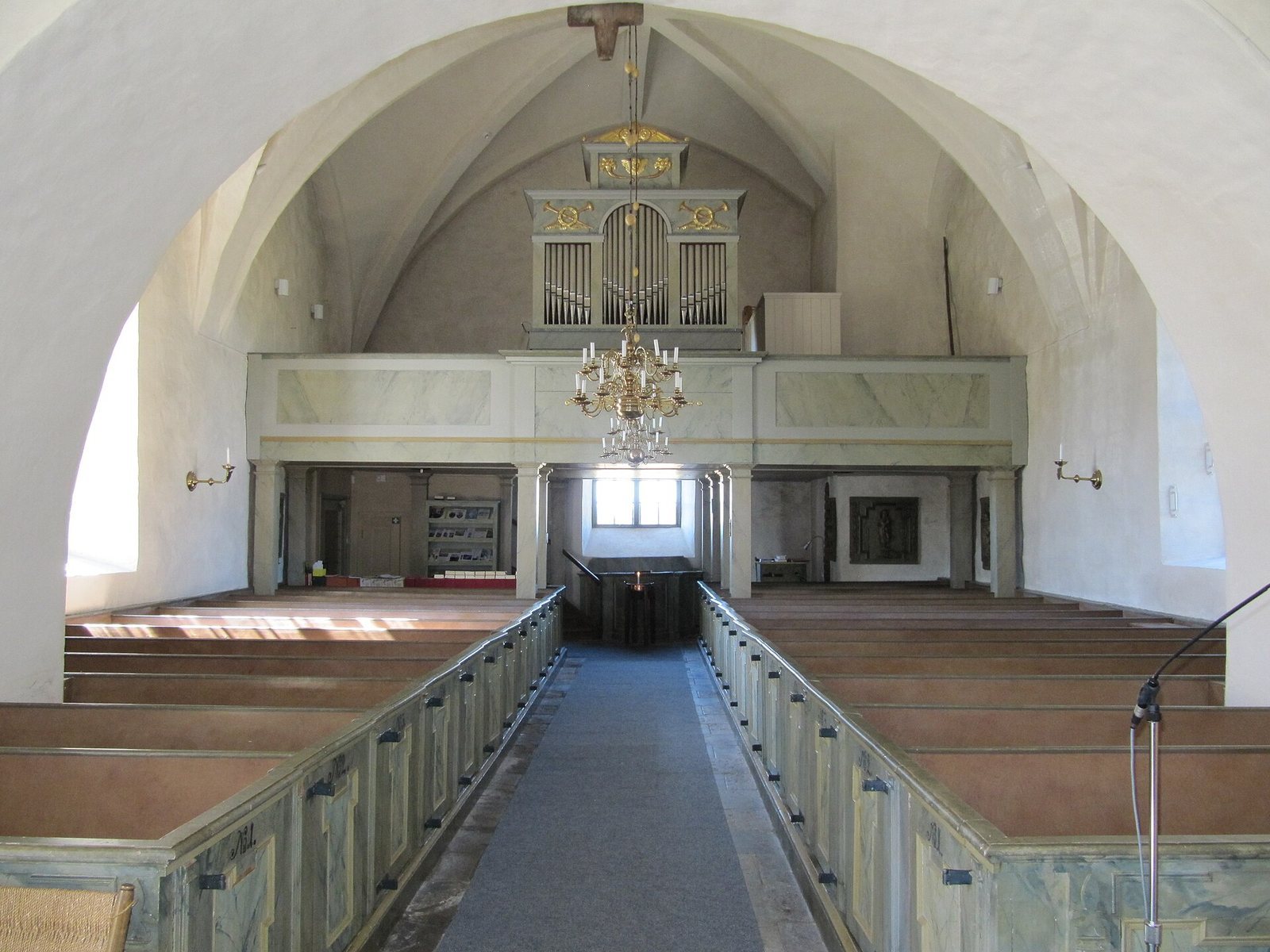
The gallery balustrade and organ façade are in provincial Empire style, an early 19th-century neoclassical style. Both date to the 1820s, and the façade came from the 1828 organ. The earlier balustrade is preserved on the walls below the present gallery. The current mechanical organ has eleven stops, each controlling a set of pipes.
Brass chandeliers
One brass chandelier has sixteen arms and a shaft topped by a draped female figure; its inscription records its donation in 1678. A second, with twelve arms and a double eagle on its shaft, was donated in 1684. The six-arm chandelier in the choir was purchased by the parish in 1761.
Separate belfry
The church has no attached tower. Its separate wooden belfry stands south of the church in the churchyard. The boards are coated with red tar, and a curved roof and lantern with a hood are covered in black-painted metal. A weather vane bears the year 1900. Two bells hang inside: a medieval great bell and a smaller bell dating to 1727.